South Australia’s renewable energy success, as its electricity prices fall
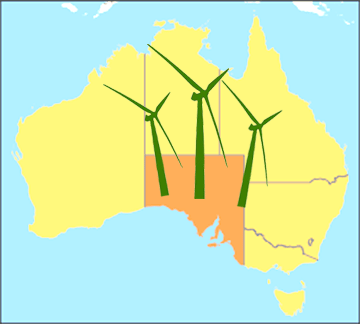

The Australian Energy Market Operator has predicted that the amount of rooftop solar could triple by 2020. Depending on how much wind energy is built between now and 2020 – and that will depend on whether the new government retains the current renewable energy target – the state’s renewable energy capacity is expected to soar well above 50 per cent by then.
South Australia’s perfect energy mix: Cleaner, greener, cheaper REneweconomy, By Giles Parkinson on 18 September 2013 Not only has South Australia achieved the highest level of wind energy and rooftop solar in the country, and has cut its emissions by a third in the last few years, its consumers have also had a windfall in generation costs: they are paying generators much less for their electricity than they did before the boom in wind farm and household solar began in 2009.
A study by energy analyst firm Pitt & Sherry finds that in 2012/13, the average South Australian paid generators $88 a year less for the electricity he or she consumed than they did in 2009-10.
And that is even after the introduction of a carbon price. If the impact of the carbon price is taken out, the average price paid per capita to generators in South Australia has fallen by $188 over the last four years – during which time the wind industry has grown from virtually nothing to more than 1,200MW, and rooftop solar has done the same (it is now 400MW).
That’s due to a bunch of reasons. The impact of wind energy – which supplied 27 per cent of the state’s generation in 2012/13, has forced down the price of wholesale electricity. Rooftop solar has had the same impact because it subtracts from demand from the grid, as have more efficient appliances and other energy efficiency measures.
Unfortunately for South Australians, their electricity bills, like those everywhere else in the country, have risen because of the massive investment in grid upgrades and expansions, and because retail margins have also risen. Much of the investment in the grid is now being questioned, particularly as new forecasts show that electricity demand may fall over the coming decade rather than increase as had been assumed previously.
Indeed, in its latest regulatory filings, the SA grid operator has already cancelled virtually all its planned extensions, for savings of around $167 million, according to data provided by the Australian Energy Regulator.
A graph prepared by Pitt & Sherry (see below) shows that because of South Australia’s high renewable share the impact of the carbon price has been relatively low – just $98 on wholesale costs – compared to $179 in the state with the dirtiest electricity production, Victoria.
South Australia now sources 31 per cent of its electricity generation through wind and solar, which has lowered its emissions by one third over the last four years. The coal-fired generators have either been mothballed completely or closed for half the year. Which just goes to show that an ambitious renewables target and a carbon price can deliver cleaner, greener, and cheaper energy.
The Australian Energy Market Operator has predicted that the amount of rooftop solar could triple by 2020. Depending on how much wind energy is built between now and 2020 – and that will depend on whether the new government retains the current renewable energy target – the state’s renewable energy capacity is expected to soar well above 50 per cent by then. http://reneweconomy.com.au/2013/south-australias-perfect-energy-mix-cleaner-greener-cheaper-34979
No comments yet.
1 This month

of the week – Australians for War Powers Reform (AWPR)
To see nuclear-related stories in greater depth and intensity
 Antinuclear
Leave a comment