ERA flounders with uranium losses, cost-cutting and the prospect of financial collapse
 ERA’s cost-cutting continues while uranium prices flounder The Motley Fool By Darryl Daté-Shappard – September 23, 2013 “…..The company, which is 68% owned by Rio Tinto (ASX: RIO), just recently reported a $53.55 million loss for its half-year result, with its expenses approximately the same as its $144.3 million revenue. A larger than average $129 million depreciation charge added to the net loss, its third in three years since 2010.
Its Ranger 3 Deeps mine project was discussed, and the company said that the pre-feasibility study was on schedule and on budget. Assuming all necessary approvals are granted, the commencement of production should take place in late 2015. This underground project is adjacent to its open pit mine site, located in the Kakadu National Park. The open pit mine is nearing its end, and so are mining approvals for it, so the underground project is of great importance to continue the company’s activities in this area.
This month the newly installed Brine Concentrator began operation to clean up water used in production. It will be able to process up to 1.8 billion litres per year, rehabilitating the site’s water to be safe near the heritage-listed national park. The water facilities cost $20 million annually to operate.
A total cumulative $102 million out of $150 million in projected savings has been achieved since 2011. However, will this lead to a profit in the near-term if the company in the end is producing less than before, and uranium prices are still around $30-$40/lb?
The overseas uranium market still has not recovered since the Japanese nuclear disaster in Fukushima, and downward price pressure is coming from the development of cheap natural gas within the US, seen as an alternative power generation fuel with less pollutants than coal, and no need for specialised containment and storage that nuclear energy requires……..http://www.fool.com.au/2013/09/23/eras-cost-cutting-continues-while-uranium-prices-flounder/
Trans Pacific Partnership could override Australian law, but will Abbott resist this?
The progressive think tank, the Australia Institute, put out a statement within hours of the release of the Coalition Trade policy, attacking the Coalition’s “hidden agenda” which would see “health and the environment sacrificed for free trade”.
It highlights the threat that ISDS provisions pose to pharmaceutical, tobacco and environmental legislation in particular.
“The Howard Government successfully resisted pressure from the US Government but now the Coalition has signalled its intention to sell out Australian sovereignty.”
 provisions of the Trans-Pacific partnership are increasingly encountering resistance within other negotiating nations, which are concerned that the American agenda is more about protecting the interests, particularly the intellectual-property interests, of its big corporations than it is about free trade
Abbott: Open For Business — And Multinational Lawsuits The Global Mail By Mike Seccombe September 20, 2013 ………You’re probably familiar with the fact that a group of tobacco companies including Philip Morris brought a case to the Australian High Court, on the basis that the government had effectively stolen its intellectual property by enforcing plain packaging. It got lots of media coverage.
Less publicised is the fact that having failed in the High Court, the company now is pursuing the matter via a bilateral trade agreement signed between Australia and Hong Kong in the early 1990s, which includes ISDS provisions.
The contempt such an action shows for Australian legal process and sovereignty, says Patricia Ranald, is plain. “They’re saying: ‘We’re going to ignore the High Court, when it says we’re not entitled to compensation; we’re going to go off and find an obscure trade agreement to sue you under’.” Continue reading
Australia’s Climate Commission is dead. Long live Australia’s Climate Council!
 The decision to axe the commission has delighted climate sceptic opponents of Flannery but has horrified several academics, who have raised concerns that the government isn’t interested in providing the public with independent, credible information on climate change.
Axed Climate Commission to be resurrected as Climate Council Tim Flannery says new body will be privately funded thanks to ‘overwhelming’ support of Australian public Oliver Milman theguardian.com, Tuesday 24 September 2013 The Climate Commission has been resurrected just days after its highly controversial axing by the Coalition government as a new, privately funded body called the Climate Council, after being “overwhelmed” by support from the Australian public.
Tim Flannery, outgoing head of the commission, told Guardian Australiathat he and the other commissioners – who include the climate scientist Will Steffen and the former BP executive Gerry Hueston – had been “deluged” by emails and calls from people pledging financial support. Continue reading
Forbes, New South Wales, – concentrated solar power project goes ahead
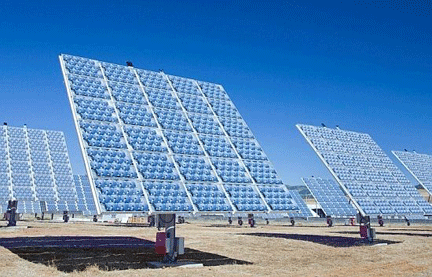 Australian Concentrating Solar Thermal Trial To Proceed http://www.energymatters.com.au/index.php?main_page=news_article&article_id=3954 24 Sept 13 The first Australian trial of concentrating solar thermal (CST) technology has been given the green light by Forbes Shire Council. ABC News states Vast Solar aim to have the demonstration 1.2MWth solar array with high temperature receivers and integrated thermal storage operating by March next year.
“This project will provide Vast Solar with data on system performance that will support the continued development and commercialisation of CST technology that can break the $100/MWh barrier,” says James Fisher, Principal Investigator and Chief Technology Officer of Vast Solar. Continue reading
Indian government faces big rural opposition to its nuclear power plans
 “We have not forgotten the criminal record of ‘Union Carbide’s now Dow Chemical’ in theBhopal gas tragedy and the shameless episode of Indian politicians letting the culprits goes Scott-free: both physically and in terms of adequate liability for the horrendous disaster,” the activists stated.
Communities near the existing nuclear facilities in Tarapur, Rawatbhata, Kalpakkam, Kaiga, Kakrapar and Hyderabad have also been raising voices against radiation leaks and their harmful effects. Existing and proposed new uranium mines in Jharkhand, Andhra Pradesh and Meghalaya have also met with massive protests.
Mith Virdi Nuclear Power Project faces opposition from villagers http://economictimes.indiatimes.com/news/news-by-industry/energy/power/mith-virdi-nuclear-power-project-faces-opposition-from-villagers/articleshow/22929250.cms By Mitul Thakkar, ET Bureau | 23 Sep, 2013 NEW DELHI: Activists against proposed nuclear power project at Mith Virdi in Bhavnagar district of Gujarat are planning a 40 km rally with participation from over 50 villages to mark their protest. Bhavnagar Jilla Gram Bachao Samiti, Gujarat Anu-urja Mukti Andolan and Paryavaran Suraksha Samiti are taking the lead in the protests against 6,000 mw nuclear fired power project. They decided to register their opposition through rally after they learnt that the government of India is moving to further dilute the Nuclear Liability Act to seal the nuclear deal with the US government during Prime Minister’s visit to Washington soon.
Farmers unite in opposing India’s proposed Mithivirdi nuclear plant
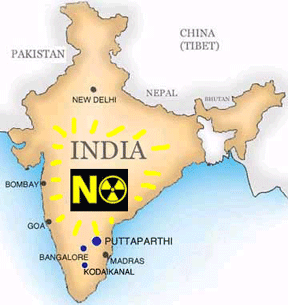 Farmers protest against Mithivirdi nuclear plant http://timesofindia.indiatimes.com/city/rajkot/Farmers-protest-against-Mithivirdi-nuclear-plant/articleshow/22951094.cms TNN | Sep 23, 2013, RAJKOT: Farmers from 30 villages located around the proposed site of 6,000 MW nuclear power plant in Mithivirdi, about 40 km from Bhavnagar, took out the protest rally fromJaspara village to Bhavnagar against the move to set up the power plant.
Throughout their 40km yatra, farmers shouted slogans like ‘Amne pani apo, anu-vijali nahi’ (we want water, not nuclear power) and ‘Jan daisu, zamin nahi’ (we will give our lives, but not land).
Among those who participated in the rally were former BJP MLA from Mahuva Dr Kanubhai Kalsaria and former minister of state for home Gordhan Zadaphia.
“If you want to give us anything, give us irrigation water and we will be happy practicing agriculture,” an agitating farmer from Jaspara village Sonal Gohil said.The farmers have been claiming that the major chunk of 777.8 hectares of land that is proposed to be acquired for the nuclear plant is fertile.
Activists, including veteran Gandhian Chunibhai Vaidya, Dr Kalsaria, former finance ministerSanat Mehta and Rohit Prajapati have been leading the agitation against the project since 2010. They have been raising concerns on threat of radiation.
Over 290 farmers submitted their affidavits saying they don’t want a power plant at the cost of their fertile land to district collector Pravin Solanki.
The plant is proposed to be built by acquiring land in Jaspara, Mandva, Khadpar and Mithivirdi villages. The project is to be implemented in three phases.
So is Tony Abbott going to sign us up to the (rotten) Trans Pacific Partnership deal?
And then there’s the big one, the US-driven Trans-Pacific Partnership Agreement (TPP), now being negotiated
“The Government has not and will not accept provisions that limit its capacity to put health warnings or plain packaging requirements on tobacco products or its ability to continue the Pharmaceutical Benefits Scheme’ – [Gillard Labor Government]
Abbott: Open For Business — And Multinational Lawsuits The Global Mail By Mike SeccombeSeptember 20, 2013 Labor rejected it outright. Even the Howard government issued America with a rare “no” over the legislation, declaring it contrary to national interests. But now the Abbott Coalition is flirting with a trade agreement that would allow companies, acting increasingly in secret, to sue Australia if they don’t like its regulations…….. the Howard government was at first almost pathetically keen to do a deal with the United States.
In the end, however, Australians’ growing hostility to the trade agreement forced Howard, for once, to say “no” to George Bush.
It wasn’t a blanket refusal of an Australia-United States Free Trade Agreement (AUSFTA); a deal was eventually stitched up and began operating in 2005. The “no” was to one of America’s key demands: a provision called Investor-State Dispute Settlement, or ISDS.
What this arcane phrase refers to is the right of foreign companies to sue national governments of the signatory countries, not in domestic courts, but in opaque international forums, if they think some element of that government’s policy is harming their interests.
If a mining company, for example, is unhappy with environmental safeguards which inhibit its operations, if a pharmaceutical company is unhappy with the prices it gets for its drugs, if a chemical company is upset with the banning of an agricultural pesticide, if a tobacco company does not like laws restricting cigarette sales, ISDS provisions in trade agreements give them the means to challenge government policy and to seek compensation. Continue reading
Strong support for carbon emissions scheme, from leading Australian businesses
 Renewable Energy not Swayed by the New Government, Australian Solar Quotes, September 20, 2013 Analysis commissioned by the Climate Institute has revealed that the Abbott Government is planning to cut $4 billion in private funding for the renewable energy industry.
According to reports on Fairfax media, the coalition’s climate change plan will fall $4 billion short of meeting its proposed five per cent cut in greenhouse gas emissions by 2020.
Instead the Climate Institute’s think tank expects a nine per cent increase in emissions by 2020, ……..A survey of 180 leading companies by AECOM found that 65 per cent of respondents supported an Emissions Trading Scheme, 29 per cent supported a carbon price and a mere seven per cent of businesses supported the coalition’s direct action policy.
According to Andrew Petersen, a spokesperson for Business for a Clean Economy, a group established to endorse carbon pricing, many businesses are still transitioning to a clean energy economy, despite investment in carbon pricing being delayed.http://www.australiansolarquotes.com.au/renewable-energy-swayed-government/
Yeah – let’s Australia become the world’s radioactive trash toilet!
Call to store nuclear waste to sustain uranium industry http://www.afr.com/p/business/sunday/call_to_store_nuclear_waste_to_sustain_bQJnppe7viMuI9dlCLPbmJ CLAIRE STEWART, 22 Sept 13 Australia will need to start enriching uranium and storing the nuclear waste if it is going to sustain a competitive uranium industry in the future, says senior finance and resources figure Mark Johnson.
Mr Johnson, a former deputy chair of Macquarie Bank and former chairman of AGL, said Australia had a “great opportunity” to become a participant in a “free world nuclear fuel cycle”, if it produces uranium. “But the consequence of that is we would also have to store spent uranium,” he told Financial Review Sunday.

Federal government laws explicitly prohibit the building of nuclear fabrication, enrichment or power plants and the return of nuclear waste to Australia for storage. “Nobody wants spent nuclear fuel in their backyard, even if it would be right in the centre of the outback of Australia, [with] very stable geological conditions,” Mr Johnson said.
The price of uranium has halved since governments around the world promised to cut their reliance on nuclear power following the Fukushima nuclear disaster. Energy Resources Australia chief executive Rob Atkinson said the market will turn, particularly given expected demand from China.
For other democracies, nuclear power is “off the table for generations”, Mr Johnson said, prompting suggestions that enrichment and storage of waste will be a key part of expanding the industry. Australia currently processes uranium to the “yellow cake” stage, which is then exported for further processing and concentration, and in some cases turned into fuel rods.
Uranium as a fuel source can only be used for about three years before it becomes too unstable, said Australian Conservation Foundation nuclear campaigner Dave Sweeny. He said making Australia part of the global fuel cycle was about opening the country up for return of that spent material. “Industry returns are meagre and the risks are significant and continuing,” he said. “Storage is the Achilles heel . . . it highlights the political, social and technical difficulty of doing this.”
Trans Pacific Partnership a political minefield for the Abbott government
Opening Australian governments to lawsuits over resource extraction, foreign land purchases, pharmaceutical benefits and health measures is a potential minefield for the new government.
Trade treaty stance the same, despite promise, http://www.theage.com.au/business/trade-treaty-stance-the-same-despite-promise-20130922-2u7wm.html#ixzz2fkoj8kHt The Age September 23, 2013 Peter Martin
Foreign corporations wanting to sue Australian governments will have to cool their heels. New trade minister Andrew Robb says Australia’s negotiating position on the Trans Pacific Partnership Agreement remains the same despite an election commitment to overturn the blanket prohibition on ”investor-state dispute settlement” provisions.
The previous government declared point-blank that Australia would never again sign an agreement that included the provisions. One of the few trade agreements Australia has signed with such a clause allowed a Hong Kong-based subsidiary of tobacco giant Philip Morris to take Australia to an international tribunal over its plain-packaging laws, despite having lost its case in the High Court. Continue reading
Reposted – There is a lot wrong with the secretive Trans Pacific Partnership
 The Trans-Pacific Partnership and Its Critics: An introduction and a petition The Asia-Pacific Journal, Vol. 11, Issue 36, No. 3.
Sachie Mizohata and the Association of University Faculties See the petition in English and Japanese. – See more at: http://japanfocus.org/-Sachie-MIZOHATA/3996#sthash.Q1auk4dC.dpuf
- domestic court decisions and international legal standards (e.g., overriding domestic laws on both trade and nontrade matters, foreign investors’ right to sue governments in international tribunals that would overrule the national sovereignty)
- environmental regulations (e.g., nuclear energy, pollution, sustainability)
- financial deregulation (e.g., more power and privileges to the bankers and financiers)
- food safety (e.g., lowering food self-sufficiency, prohibition of mandatory labeling of genetically modified products, or bovine spongiform encephalopathy (BSE) or mad cow disease)
- Government procurement (e.g., no more buy locally produced/grown)
- Internet freedom (e.g., monitoring and policing user activity)
- labor (e.g., welfare regulation, workplace safety, relocating domestic jobs abroad)
- patent protection, copyrights (e.g., decrease access to affordable medicine)
- public access to essential services may be restricted due to investment rules (e.g., water, electricity, and gas)
Although the TPP negotiations have been held in the name of the people, the draft texts have been shrouded in secrecy from the public, thereby precluding public scrutiny and public input. Reportedly, the countries have signed up not to reveal the contents of the agreement for four years after the signing of the agreement. 6 All public information comes from leaked texts.
Bizarrely, the TPP makes a special exception to “a group of some 600 trade ‘advisers,’ dominated by representatives of big businesses.”7 The TPP is a Trojan horse, branded as a “free trade” agreement, but having nothing to do with “fair and equitable treatment. In reality, it is precisely “a wish list of the 1% ―a worldwide corporate power.”8 “Only 5 of its 29 chapters cover traditional trade matters, like tariffs or quotas.”9 “The other chapters enshrine new rights and privileges for major corporations while weakening the power of nation states to oppose them.”1 – See more at: http://japanfocus.org/-Sachie-MIZOHATA/3996#sthash.Q1auk4dC.dpuf
Big increase in health problems among Fukushima nuclear workers
TV: Gov’t reports large spike in health problems for Fukushima nuclear workers — 400% of levels seen previously — Unhealthy white blood cell counts (VIDEO) http://enenews.com/tv-govt-reports-large-spike-in-health-problems-for-fukushima-nuclear-workers-400-of-levels-seen-previously-unhealthy-white-blood-cell-counts-video
NHK World,, Sept. 20, 2013: More Fukushima plant workers show health problems […] The health ministry says the percentage of workers who have health issues in their physical exams has increased at the crippled Fukushima Daiichi nuclear plant and nearby locations. The ministry for the first time analyzed the results of physicals reported to a labor standards inspection office which has jurisdiction over 2 nuclear plants in Fukushima. […] 4.21% of the employees in the area, showed unhealthy medical readings, such as higher white blood cell counts. […] it plans to conduct an epidemiological survey to learn more about the impact of the radiation.
NHK, Sept. 20, 2013 (transcript excerpts): […] They’ve seen an increase in health problems […] More than 4% of those workers had health problems such as high white
Abbott government tight-lipped about Australia’s presence at Global Climate Fund in Paris.
Coalition no comment on UN climate meeting, The Age, September 23, 2013 Peter Hannam Carbon economy editor
Australia’s international commitment to tackling climate change is in doubt with the Abbott government refusing to say if a senior bureaucrat will lead a key meeting of a giant new United Nations fund for developing nations.
Ewen McDonald, acting director-general of Australia’s main aid arm AusAID, is scheduled to co-chair the board meeting of next month’s Global Climate Fund in Paris. The fund is intended to become a conduit for state and private funds of up to $US100 billion ($106 billion) a year by 2020 to help poorer nations shift to low-carbon energy. ”The [fund’s] Interim Secretariat expects that Mr McDonald will attend and co-chair the meeting,” said a spokeswoman for the fund.
AusAID’s executive, though, would not say whether Mr McDonald will take his leadership role in France. The Department of Foreign Affairs, which Prime Minister Tony Abbott directed to absorb AusAID, also refused to comment. Greg Hunt, the new environment minister, referring to Australia’s support for the fund refused to say if Mr McDonald would go to the Paris meeting. Continue reading
France’s transition from nuclear to renewables using carbon tax and nuclear tax

 France to Tax EDF Nuclear Output for Energy Shift to Renewables Bloomberg, By Tara Patel – Sep 21, France will introduce a levy on nuclear energy as well as a tax on carbon emissions from fossil fuels to raise billions needed to boost renewable power and improve energy efficiency.
“All change is expensive in the short term even if it’s beneficial in the long term,” French Prime Minister Jean-Marc Ayrault said today in a speech about the environment in Paris.
The nuclear levy will be applied to Electricite de France SA’s existing atomic reactors, he said. The carbon tax will be introduced “progressively” on fossil fuels in order to earn 4 billion euros ($5.4 billion) in 2016…….
France’s Green party, which had said it would withdraw support for the Socialist government over the slow pace of policy initiatives, applauded the carbon tax announcement and new incentives towards home renovations for improved energy use.
Ayrault didn’t give details of how much EDF, which is 84 percent owned by the government, will have to pay. The utility is compensated for the higher cost of electricity produced by wind turbines and solar panels it buys through a tax on power bills called the CSPE…….
Carbon Tax
The planned carbon tax, to be called a “climate energy contribution,” will be “neutral” next year and generate 2.5 billion euros in 2015 and 4 billion euros in 2016, Ayrault said. It will be applied to gasoline, diesel, coal, natural gas as well as heavy and heating fuels…….
Hollande said yesterday the an energy law would be passed by the end of next year capping nuclear-power capacity and granting the state the legal means to shut down reactors.The president hasn’t said whether more nuclear plants will close, beyond the planned shuttering of Fessenheim in eastern France by the end of 2016.
France will also seek to cut energy use in half by 2050 and fossil fuel use 30 percent by 2030, Hollande announced yesterday. It will implement incentives to spur energy-saving measures in homes and use of electric cars by adding recharging stations.http://www.bloomberg.com/news/2013-09-21/france-to-tax-edf-nuclear-output-for-energy-shift-to-renewables.html
Locating Fukushima nuclear plant over river course was inviting disaster
TV: Warnings the worst is yet to come at Fukushima — Deep underneath nuclear plant a massive pool of contamination is believed to be heading toward Pacific Ocean (VIDEO) Title: Fukushima leak questions handling of nuclear plant crisis
Source: ABC News (Australia)
Date: Sept. 19, 2013 MARK WILLACY, REPORTER: Atsunao Marui is one of Japan’s top groundwater scientists and a member of a panel set up by TEPCO and the Government to try to find ways of managing Fukushima’s growing reservoir of radioactive water. He says putting the nuclear plant on this stretch of coast in the first place was inviting disaster
ATSUNAO MARUI, GROUNDWATER SCIENTIST(voiceover translation): A river used to flow right where the turbine and reactor buildings are now standing, so the groundwater is flowing very fast through there and it’s spreading the contamination. The company should have known this could happen.
WILLACY: But there are warnings the worst is yet to come because it’s believed that deep beneath the nuclear plant is a massive underground pool of contaminated water which is slowly making its way towards the sea…….
1 This month

of the week – Australians for War Powers Reform (AWPR)
To see nuclear-related stories in greater depth and intensity
 Antinuclear