Trans Pacific Partnership could override Australian law, but will Abbott resist this?
The progressive think tank, the Australia Institute, put out a statement within hours of the release of the Coalition Trade policy, attacking the Coalition’s “hidden agenda” which would see “health and the environment sacrificed for free trade”.
It highlights the threat that ISDS provisions pose to pharmaceutical, tobacco and environmental legislation in particular.
“The Howard Government successfully resisted pressure from the US Government but now the Coalition has signalled its intention to sell out Australian sovereignty.”
 provisions of the Trans-Pacific partnership are increasingly encountering resistance within other negotiating nations, which are concerned that the American agenda is more about protecting the interests, particularly the intellectual-property interests, of its big corporations than it is about free trade
Abbott: Open For Business — And Multinational Lawsuits The Global Mail By Mike Seccombe September 20, 2013 ………You’re probably familiar with the fact that a group of tobacco companies including Philip Morris brought a case to the Australian High Court, on the basis that the government had effectively stolen its intellectual property by enforcing plain packaging. It got lots of media coverage.
Less publicised is the fact that having failed in the High Court, the company now is pursuing the matter via a bilateral trade agreement signed between Australia and Hong Kong in the early 1990s, which includes ISDS provisions.
The contempt such an action shows for Australian legal process and sovereignty, says Patricia Ranald, is plain. “They’re saying: ‘We’re going to ignore the High Court, when it says we’re not entitled to compensation; we’re going to go off and find an obscure trade agreement to sue you under’.”
But that’s not the half of it. The tribunals which decide these cases, Ranald says, are not like courts as we usually understand them. “The arbitrators can be advocates one week and arbitrators the next. Generally they favour the investor because they look at it in a business framework and not at the public purpose of the legislation.”
Ranald is far from alone in making this criticism. The UN Conference on Trade and Development (UNCTAD), which oversees such disputes (to the extent that anyone does), itself acknowledges huge flaws in the system of dispute resolution.
In a 2013 report, UNCTAD conceded an urgent need for reform, noting:
“Concerns with the current ISDS system relate, among others things, to a perceived deficit of legitimacy and transparency; contradictions between arbitral awards; difficulties in correcting erroneous arbitral decisions; questions about the independence and impartiality of arbitrators, and concerns relating to the costs and time of arbitral procedures.”
Matters of transparency, or the lack thereof are of particular concern.
Even UNCTAD, in its comprehensive survey of ISDS cases brought in 2012, said: “For five cases, the applicable arbitration rules/venues are unknown.”
Some of the actions pursued are so confidential that often even the existence of a claim is kept secret from the people of the country being sued.
In short, just about every aspect of the system was declared deficient by UNCTAD. Itsreport canvassing the problems and possible reform measures makes for troubling reading.
Among other things, it notes: “In many cases foreign investors have used ISDS claims to challenge measures adopted by States in the public interest (for example, policies to promote social equity, foster environmental protection or protect public health).”
Little wonder then that groups concerned for the future of measures safeguarding such policies in Australia are unhappy.
The progressive think tank, the Australia Institute, put out a statement within hours of the release of the Coalition Trade policy, attacking the Coalition’s “hidden agenda” which would see “health and the environment sacrificed for free trade”.
It highlights the threat that ISDS provisions pose to pharmaceutical, tobacco and environmental legislation in particular.
“A very topical example at the moment is coal seam gas,” the Institute says. “As new information is collected and disseminated governments may want to act to control that activity. Governments would be loath to act if they were liable for massive payouts to foreign companies.
“The Howard Government successfully resisted pressure from the US Government but now the Coalition has signalled its intention to sell out Australian sovereignty.”
The Institute notes, as the Productivity Commission and the previous government had noted before it, that ISDS clauses effectively give “foreign companies much stronger rights than Australian companies”.
“Australia has a very high share of foreign ownership in mining and manufacturing so the issues involved with investor-state dispute settlement mechanisms are likely to severely impact Australia.”
Ranald and AFTINET followed up a few days later with a release noting that closed meetings between representatives of the nations involved in the Trans-Pacific partnership agreement were continuing in Washington.
She expressed concern that the new Abbott government could “cave” almost before it had been sworn in.
“The US is exerting huge pressure on the Australian Government to agree to investors’ right to sue governments as they push to finish the deal this year,” Ranald said.
Ranald called on the new government to “support the right of Commonwealth and State governments to legislate for health and environmental purposes, and to reject proposals for foreign investors to be able to sue them for hundreds of millions of dollars.
“We also call for the release of the full text of the TPPA for public and Parliamentary debate before it is signed by Cabinet,” said Ranald.
We might add that provisions of the Trans-Pacific partnership are increasingly encountering resistance within other negotiating nations, which are concerned that the American agenda is more about protecting the interests, particularly the intellectual-property interests, of its big corporations than it is about free trade……http://www.theglobalmail.org/feature/abbott-open-for-business-and-multinational-lawsuits/700/
No comments yet.
1 This month
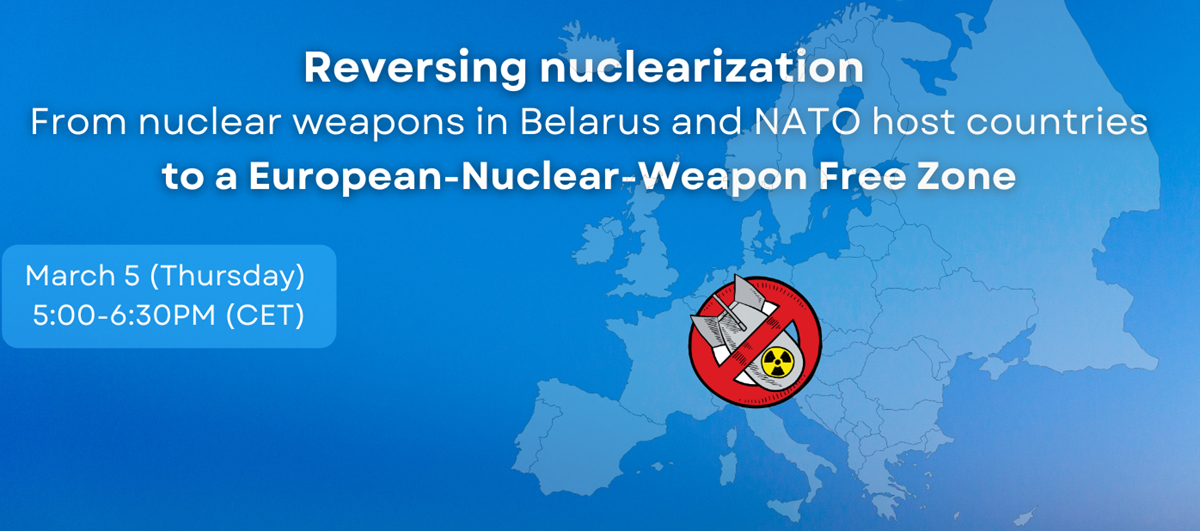
6 March -Online – Reversing nuclearization:
From nuclear weapons in Belarus and NATO host countries to a European-Nuclear-Weapon Free Zone
Mar 6, 2026 03:00 AM in Canberra, Melbourne, Sydney

of the week – Australians for War Powers Reform (AWPR)
To see nuclear-related stories in greater depth and intensity
 Antinuclear
Leave a comment