Don’t let the Australian government lose oversight of the NATIONALLY important (and financially failing) uranium industry
 Uranium mining and export not a piece of yellow cake http://www.couriermail.com.au/news/opinion/opinion-uranium-mining-and-export-not-a-piece-of-yellow-cake/story-fnihsr9v-1226729513911 DAVE SWEENEY THE COURIER-MAIL SEPTEMBER 30, 2013
THIS week the Australian Uranium Association and other nuclear industry hopefuls will head to western Queensland for the Mining the Isa conference. Mt Isa is no stranger to mining but the region – and Queensland – would be well advised to treat the claims of the uranium sector with caution.
Globally the nuclear industry is under intense political, regulatory and community pressure since the Fukushima meltdown, a continuing nuclear crisis directly linked to Australia’s contested and contaminating uranium industry.
Recently the Newman Government released an “action plan” that seeks to open the door to uranium mining in Queensland but the LNP’s uranium road map is deeply flawed and in conflict with federal policy, global markets and community expectations. A key plank of the LNP’s plan is to have “all uranium mining proposals in Queensland assessed and approved by the state government”. Currently uranium mining and wider nuclear issues remain the clear responsibility of the federal government and this is as it should be.
Uranium mining is an issue of national interest and importance with extensive risks and long term impacts and is rightly a matter for the active consideration of the national government.
State governments, mining companies and the Australian Uranium Association, have long dreamt of the power to tick off on a new uranium mine being transferred to state governments in the hope that this would removing key checks and balances and speed up approvals. Continue reading
The impact of climate change on Australia
Australia has ‘much to lose’ from climate change SMH, September 28, 2013 Nick Miller and Nicole Hasham Australia has much to lose if climate change continues unabated, the head of a new review of climate science has warned.
Dr Qin Dahe, a glaciologist and respected Chinese academician, was co-chair of the working group that wrote the fifth major assessment of climate science for the UN’s Intergovernmental Panel on Climate Change, released on Friday. In an exclusive interview with Fairfax, he urged Australia not to think of itself as a small, unimportant player in climate change.
The Chinese government is very aware of the risks of a more extreme monsoon climate on its food supply, the economy and society.“Even if the climate changes slightly that would lead to very catastrophic consequences to China,” he said. “That is why the Chinese government attaches great importance to climate change, including its physical science basis.”
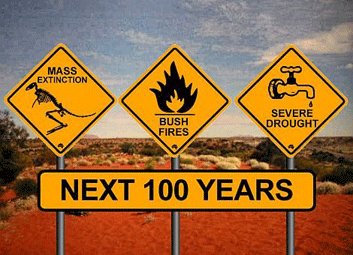
Australia, though smaller in population, has a land mass comparable to China and its population is concentrated along coastlines – “sea level rises pose a hazardous impact to cities such as Melbourne, Sydney and Brisbane,” he said. Climate change could disrupt farming. And the frequency of bushfires is indirectly linked to climate change…… http://www.smh.com.au/environment/climate-change/australia-has-much-to-lose-from-climate-change-20130928-2ukez.html#ixzz2gPQPMyYk
Many symptoms in Fukushima residents – mother’s plea to United Nations
Fukushima Mother’s Plea to U.N.: Children and adults are suffering tremendously — Sharp increase in bloody urine, bone pain, more — Doctor says many have similar symptoms with unknown causes — Family’s health deteriorated all at once, recovered soon after moving http://enenews.com/fukushima-mothers-letter-to-u-n-children-and-adults-suffering-tremendously-sharp-increase-in-bloody-urine-bone-pain-low-blood-pressure-more-familys-health-deteriorated-all-at-once-reco
Fukushima City mother’s letter to the United Nations Scientific Committee on the Effects of Atomic Radiation (UNSCEAR), translated by journalist Mari Takenouchi and published by Save Kids Japan on Sept. 24, 2013: […] 2 years after the accident, members of my family had deteriorated health all at once. We continued to have stuffed throat with phelm, could not stop dry coughing […] the doctor couldn’t tell the cause of our symptoms [… he] said that there are many patients who show the same symptom with unknown causes. My child began to complain pain in his foot bones and I heard many people including children and adults have the same […] I myself had bone pains […] After that, my son and I had continued naucea [sic] and headaches. My son had lowered blood pressure and bloody urine, too.
My family moved out of Fukushima in July. One month afterwards, we all became better […] there is a sharp increase of people who show the same symptoms. There is a much increase of children who has prolonged nose bleeding […] people who died of acute myocardial infarction is increasing. […] Both children and adults have been suffering tremendously. […]
Read more at Save Kids Japan here and follow journalist Mari Takenouchi on Twitter here
USA bans food and fish from 14 irradiated areas in Japan

 FDA Import Alert: U.S. bans agricultural and fishery products from 14 prefectures in Japan due to Fukushima radionuclides — Top Newspaper: Concern over contamination is spreading to most countries around Pacific http://enenews.com/fda-import-alert-u-s-bans-japans-agricultural-and-fishery-products-from-14-prefectures-due-to-fukushima-radionuclides-concern-over-contamination-is-spreading-to-most-countries-around-pacific
Dong-A Ilbo, Sept. 28, 2013 (Korea’s top newspaper): […] Concerns over Japan’s radioactive contamination and its seafood is spreading to most countries in the Pacific basin. The United States has recently banned agricultural and fishery imports from 14 prefectures in Japan, up from eight. South Korea puts a similar ban on fishery imports from eight prefectures, while China and Taiwan does so for 10 and five prefectures, respectively. [… The IAEA’s] upcoming probe needs to shed light on the cause and situation of soil and sea water contamination. […] It would be much better if experts from South Korea, the United States and China participate in the investigation. It is natural for a global organization to intervene in an international issue. […]
FDA Import Alert 99-33 Sept. 9, 2013: Detention Without Physical Examination of Products from Japan Due to Radionuclide Contamination […] NOTE: Revision to this Import Alert dated September 9, 2013 adds multiple products to the list of products restricted by the Government of Japan […] Previous revisions to this Import Alert dated March 23, April 12, April 14, April 20, April 21, May 9, June 13, July 6, October 21, 2011, February 1, 2012 and July 25, 2012 provided updates to the products and/or prefectures subject to detention without physical examination. […] The Fukushima Daiichi nuclear plant houses several nuclear reactors that have posed signs of a potential threat of radiological contamination to the surrounding areas. Due to the public health concerns that are associated with radiation and nuclear contamination, FDA has increased surveillance of regulated products from Japan. […] Guidance: Districts may detain, without physical examination, the specified products from firms in the ***Fukushima, Aomori, Chiba, Gumna, Ibaraki, Iwate, Miyagi, Nagano, Niigata, Saitama Shizuoka, Tochigig, Yamagata and Yamanashi prefectures.*** […] FDA will continue monitoring the public health risks due to radionuclide contamination, and when appropriate will remove the Import Alert and resume routine coverage of entries. […]
Radiation from Fukushima covered large areas of Pacific as well as of Japan and Korea
Textbook: Fukushima disaster contaminated the territory of Japan, Sea of Japan, Korea — Up to 8 orders of magnitude above global fallout background off prefecture’s coast http://enenews.com/book-fukushima-contaminated-japan-sea-of-japan-korean-peninsula-cesium-137-up-to-8-orders-of-magnitude-above-global-fallout-background-in-coastal-seawater
September 28th, 2013_
Title: Fukushima Accident: Radioactivity Impact on the Environment
Source: Elsevier
Authors: Pavel P. Povinec, Katsumi Hirose, Michio Aoyama
Date: July 9, 2013
Emphasis Added
Apart from the contamination of the Japanese territory (Hirose, 2012; Kanai, 2012; Tanaka et al., 2012), the Japan Sea (Inoue et al., 20I2a), and the Korean Peninsula (Hernandez-Ceballos et al., 2012; Lee et al., 2012), due to prevailing western winds, the radionuclides emitted to the atmosphere were mainly transported from Fukushima over the Pacific Ocean (Kamenik et al., 2013) […]
[…] large quantities of radioactive materials released to the atmosphere and coastal waters following a nuclear accident at the Fukushirna Dai-ichi NPP increased considerably the Cs-137 concentrations in coastal seawater off Fukushima up to eight orders of magnitude above the global fallout background (TEPCO, 2012; MEXT, 2012).
Portions of the book available here
International Monetary Fund calls for fossil fuel subsidies to be wound back
 IMF: The Murky Cobweb Of Energy Subsidies http://www.energymatters.com.au/index.php?main_page=news_article&article_id=3961 29 Sept 13 Solar power subsidies are a drop in the bucket compared to the gravy train the fossil fuel sector still rides. The International Monetary Fund has pledged to “shine a light on the murky cobweb of energy subsidies”.
In an address to the UN High-Level Forum on Sustainable Development; IMF Managing Director Christine Lagarde spoke of a triple challenge facing the planet – economic instability, environmental damage and insufficient equity. “We cannot view these in isolation. Each feeds on and magnifies the other,” she said.
 Ms. Largarde stated energy subsidies, including tax subsidies, came to almost $2 trillion in 2011; “a whopping 2½ percent of global GDP that could have been used more wisely.”
Even US President Barack Obama has recognised enough is enough. Earlier this year, he proposed billions more be invested in renewable energy and the elimination of $4 billion in fossil fuel subsidies in his 2014 budget proposal.
In recent years the International Energy Agency (IEA) has also repeatedly called for a winding back of fossil fuel subsidies, which are at times obscured from public view. “Governments need to stop hiding their handouts to oil, gas and coal and come clean,” says the IEA.
Renewable energy subsidies are the relatively new kid on the block, as is the industry itself – and it’s not unusual for fledgling sectors to require a helping hand. However, the fossil fuel sector has been around for well over a century, has been hugely profitable for much of the time; yet has had its snout firmly planted in the public trough for decades – and still does today.
While renewables such as solar power have still flourished on an uneven playing field; with fossil fuel subsidisation wound back and the support diverted to renewable energy, a cheap yet clean energy future will arrive even faster.
Visy group seeks funding grant for waste to energy plan, but will proceed anyway
Visy Group backs waste plan as funding flees http://www.theaustralian.com.au/business/companies/visy-group-backs-waste-plan-as-funding-flees/story-fn91v9q3-1226724734376 DAMON KITNEY SEPTEMBER 23, 2013
THE Pratt family’s Visy Group will not rule out proceeding with a revolutionary $300 million project to turn household garbage into energy that would generate 3000 jobs across the economy, despite federal government moves to slash funding for clean energy projects.
The government last week scrapped the Climate Commission and has previously indicated it wants to wind up the $10 billion Clean Energy Finance Corporation created by Labor to fund renewable energy projects that would otherwise struggle to get commercial backing.
Visy is seeking $100m in government funding for the $200m waste-to-energy plant from the Australian Renewable Energy Agency, or ARENA, the independent statutory body established to provide financing assistance for projects that strengthen renewable energy and energy efficiency technologies. Continue reading
Coverup of the brutal history of the taking of Aboriginal land
Frontier atrocities against Australian Indigenous people were appalling. Frontier conflict is not pleasant at the best of times, but what happened in Australia has been covered up for too long. I leave you with the words of Henry Reynolds (2006) when summing up attitudes towards frontier conflict – and conflict it was – real, bloodthirsty, brutal – a battlefield and a war, waged almost silently, and with little record of it.
It can be found in almost every type of document – official reports both public and confidential, newspapers, letters, reminiscences. Settlers often counted black bodies either in anger or in anguish; members of punitive expeditions confessed to their participation in a spirit of bravado or contrition. Later observers came across bones and skulls; burnt, buried or hidden and occasionally collected and put proudly on display (Reynolds 2006: 127).
Battlefield Australia : Frontier Conflict in Early Australian Settlement by Sue Carter : HeritageDaily , September 28, 2013 It has been estimated that the first people arrived in Australia possibly around 45,000 years ago and from that time, until the settlement of Europeans on the eastern coast, the Australian Aborigines had been turning space into place for much of that time.
It is equally quite easily demonstrated that Indigenous
people were frequently massacred indiscriminately
and with impunity in Colonial Queensland and
that their remains were treated with disrespect,
if not outright contempt (Ørsted-Jensen 2011: 169)
They viewed their lives as being part of an overall design where everything had a right to live, they carved their position nestled in the landscape, and viewed their lives within it as part of a design in which Country was seen as place. Everything within the Indigenous cultural paradigm was multidimensional and people were attached emotionally, psychologically and metaphysically to the land they inhabited (Bird 1996). They sang songs regarding the history and birth of their part of Country, painted and recited stories which were passed down through generation after generation. ……..
The settlement of the continent included invisible boundaries that were known by the various tribes. Each had their own district where they belonged through spiritual and ancestral bonds and there was interaction between neighbouring tribes where their boundaries overlapped in many complex ways, through spirituality, kinship ties and interaction. A major aspect of the inter-tribal and family relationships was that of sharing; no one owned anything – it belonged to all within the group (Reynolds 2006). They lived with and on the land – protecting, nurturing and preserving – for thousands of years. Continue reading
Australia’s anthropologists under fire, because of their support for Aboriginal Land Rights
Throughout the two centuries of colonisation, Aboriginal people, though vastly outnumbered, have done their best to resist European dominance: they fought to defend their land and, even under the enforced control of settlers, missionaries and the state, continued to lead subversive ‘double lives’ in which they tried to maintain their own cultural practices. They have struggled for greater social, economic and political equality, and they have tried desperately to reclaim their land.
Australia is one part of the world in which anthropologists have been able to make themselves genuinely useful to indigenous groups. For many decades now, they have been instrumental in assisting Aboriginal people in recording cultural knowledge and using this to support their claims to land and resources and their efforts to regain self-determination.
The latest development in Australia is for those opposed to land claims to spend very large sums of money suing anthropologists for millions of dollars,
Snippet #40: AUSTRALIA’S ABORIGINAL MINORITY – DISPOSSESSION AND LAND RIGHTS http://snippetysnippet.wordpress.com/2013/09/26/aboriginal-minority-snippet/ 26 Sept 13, “The Aboriginal minority in Australia represents about 2 per cent of the population as a whole. Colonisation of the country by Europeans has taken place over 200 years, with the major dispossession of the indigenous people occurring primarily in the first century of colonisation, but with some areas not fully ‘settled’ until early in the twentieth century. In some regions well into that century, the colonisation of land was accompanied by considerable violence and sometimes by outright genocide. Continue reading
With art showing across Australia, Telstra acknowledges Aboriginal Land Rights
Telstra acknowledges Land Rights across Australia Aboriginal Art News by Jeremy Eccles | 17.09.13
In recognition of its commitment to reconciliation with Aboriginal and Torres Strait Islander peoples, Telstra has rolled out a commissioned Indigenous artwork across its 365 national retail stores and 88 business centres…… http://news.aboriginalartdirectory.com/2013/09/telstra-acknowledges-land-rights-across-australia.php
“Bottom falling out” of economics of New York nuclear power plants
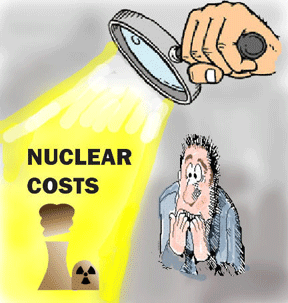 Central New York nuclear plants struggle to avoid financial meltdown Syracuse.com, By Tim Knauss | tknauss@syracuse.com on September 29, 2013 SCRIBA, N.Y. – As recently as four years ago, nuclear power companies were planning to spend billions of dollars to build a new reactor in Oswego County, alongside three existing nuclear plants…..
Then the bottom fell out. Natural gas-burning power plants that benefit from a glut of cheap gas produced by hydrofracking cut wholesale electricity prices in half. Now the outlook for nuclear power plants is so bleak that Wall Street analysts say one or more Upstate nuclear plants could go out of business if conditions don’t change……http://www.syracuse.com/news/index.ssf/2013/09/oswego_county_nuclear_plants_struggle_to_avoid_financial_meltdown.html
See slides: US Nuclear plants – 14 look like being closed soon
 14 U.S. Nuclear Plants Closing or at Risk—in Photographs and Text http://insideclimatenews.org/slideshow/14-us-nuclear-plants-closing-or-risk%E2%80%94-photographs-and-text Four companies announced nuclear plant closures in 2013—representing the first shutdowns in 15 years, and an unprecedented single-year retrenchment for the U.S. nuclear industry. “Renaissance in Reverse,” a July 2013 report by Mark Cooper, highlighted at least ten nuclear plants that could be forced to close earlier than planned. Cooper, a senior fellow at the Vermont Law School’s Institute for Energy and the Environment, drew his conclusions in part from reports by Wall Street analysts. Cooper stopped short of predicting specific plant closures, but he noted that about ten are at greater risk for closure because of low power prices, rising costs and other woes.
(Read: First U.S. Nuclear Power Closures in 15 Years Signal Wider Problems for Industry)
Image: San Onofre Nuclear Generating Station, Units 2 and 3/Credit: Southern California Edison
1 This month
7 April – WEBINAR – Australia and the Doomsday Clock – Preventing nuclear war through NoFirstUse and other policies
Online | Tuesday April 7, 4:00-5:30pm, Australian Eastern Time / 8:00-9:30am Central Europe Time
– Access the registration link
15 April – Zoom –Nuclear Power is Not the Solution
Apr 15, 2026 01:00 AM in Canberra, Melbourne, Sydney

Join the International Physicians for the Prevention of Nuclear War (IPPNW) on Tuesday, April 14th for a timely webinar exploring the risks associated with nuclear power and challenging the myth that it offers a simple, safe, carbon-free solution to the climate crisis

21 April Webinar: No Nuclear Weapons in Australia
Start: 2026-04-21 18:00:00 UTC Canberra, Melbourne, Sydney (GMT+10:00)
End: 2026-04-21 19:30:00 UTC Canberra, Melbourne, Sydney (GMT+10:00)
Event Type: Virtual
A virtual link will be communicated before the event.
Host Contact Info: australia@icanw.org

of the week – Australians for War Powers Reform (AWPR)
To see nuclear-related stories in greater depth and intensity
 Antinuclear