Investors warned about the fading glow of the uranium market (The Australian!)
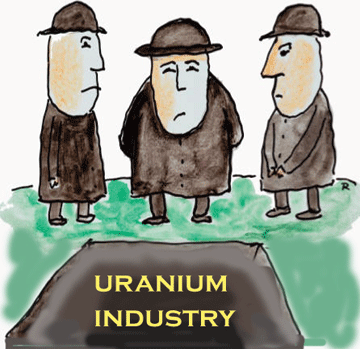 The price fall that started six years ago could continue, especially with major new reserves being readily discovered in Australia and Africa. And it seems nuclear incidents are never too far away.
Those holding shares in uranium companies, or considering them, should handle them with great care.
Uranium best handled with care TONY KAYE THE AUSTRALIAN OCTOBER 05 IT isn’t all about Japan, Iran, the “China syndrome”, or even the swarm of moon jellyfish that forced a shutdown this week of all three reactors at Sweden’s Oskarshamn nuclear plant.
But the cold reality of the meltdown afflicting the uranium sector globally was best demonstrated on Wednesday when Australian group Paladin Energy announced it was slashing its operating costs across the board in the face of a further weakening in the spot price of the nuclear fuel it mines in southern Africa.
Paladin, based in Perth, has watched its share price dive more than 90 per cent since 2007 at the hands of a uranium price that has plunged about 75 per cent over the same period. Compelled to address the issue, the company has taken the knife to its cost structure, cutting head-office jobs, exploration expenses, executive pay by 10 per cent, and cash costs by $23 million.
Paladin is also attempting to sell its stake in its flagship Namibian mine to pay down $US750m ($794m) in debt. “Optimisation strategies have now become even more pertinent with the further incremental weakening of the uranium spot price,” the company said.
So what are the factors behind uranium’s fading glow? The answer is not rocket science. Global supply continues to exceed demand, and there are no signs of that changing dramatically anytime soon…….
global demand for uranium is not increasing. And disasters, such as that still unfolding at Japan’s tsunami-hit Fukushima plant, have not helped the accident-prone nuclear power generation industry.
Think Three Mile Island in 1979, Chernobyl in 1986 and scores of separate incidents that have occurred before and after.
Adding to the uranium squeeze has been the broad reduction in nuclear arms over several decades, primarily driven by the end of Cold War hostilities between the US and the former Soviet Union (primarily Russia).
France and Germany are determinedly pushing ahead into a nuclear-free future, which will probably see more of their fleet mothballed despite enormous pressure building in the European energy sector.
The demand pull just isn’t there for uranium at this point, and one also shouldn’t underestimate the changing tide for energy resources as a whole…..
There has also been a significant push to reduce energy emissions through the use of alternative power sources, including wind and solar.
Uranium, still a hot potato in terms of energy sources given its hazardous nature, has effectively been given the cold shoulder…….
the spot price of uranium will have to double for the industry to get back on its feet and reach a point where new supply can be commercially developed.
But very few commodity watchers, if any, expect the price of uranium to recover quickly, let alone double……. The price fall that started six years ago could continue, especially with major new reserves being readily discovered in Australia and Africa. And it seems nuclear incidents are never too far away.
Those holding shares in uranium companies, or considering them, should handle them with great care.
– See more at: http://www.theaustralian.com.au/business/wealth/uranium-best-handled-with-care/story-e6frgac6-1226733177659#sthash.AUOARFvn.dpuf
No comments yet.
1 This month
7 April – WEBINAR – Australia and the Doomsday Clock – Preventing nuclear war through NoFirstUse and other policies
Online | Tuesday April 7, 4:00-5:30pm, Australian Eastern Time / 8:00-9:30am Central Europe Time
– Access the registration link
15 April – Zoom –Nuclear Power is Not the Solution
Apr 15, 2026 01:00 AM in Canberra, Melbourne, Sydney

Join the International Physicians for the Prevention of Nuclear War (IPPNW) on Tuesday, April 14th for a timely webinar exploring the risks associated with nuclear power and challenging the myth that it offers a simple, safe, carbon-free solution to the climate crisis

21 April Webinar: No Nuclear Weapons in Australia
Start: 2026-04-21 18:00:00 UTC Canberra, Melbourne, Sydney (GMT+10:00)
End: 2026-04-21 19:30:00 UTC Canberra, Melbourne, Sydney (GMT+10:00)
Event Type: Virtual
A virtual link will be communicated before the event.
Host Contact Info: australia@icanw.org

of the week – Australians for War Powers Reform (AWPR)
To see nuclear-related stories in greater depth and intensity
 Antinuclear
Leave a comment