Australia, especially indigenous Australia, vulnerable to climate change extremes
Australia shouldn’t be waiting for more evidence of climate change impacts,such as floods, fires and cyclones.
She says while adaptions can be made by future governments, there should be recognition now of the magnitude of the challenge and of the need to act.
 AUDIO: New climate change warnings for Australia http://www.sbs.com.au/news/article/2013/10/15/new-climate-change-warnings-australia A leaked draft report by the IPCC outlines a sobering set of climate change challenges faced by Australia. By Ildi Amon (Transcript from World News Australia Radio)
In a report last month, the Intergovernmental Panel on Climate Change concluded it was more certain than ever that humans were responsible for global warming.That report focused mainly on the science of climate change, rather than on what to do about it.
Now, the Panel is working on a report on climate change impacts, vulnerabilities and adaptation, due for release in March.
And, as Ildi Amon reports, a leaked draft of that report by the Panel outlines a sobering set of challenges faced by Australia.According to the leaked draft report, climate change will present Australia with significant heat stress, extreme weather events, and a higher rate of disease in the coming decades.
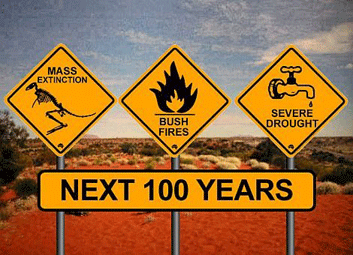
It says there is high agreement among scientists that Indigenous Australians will face disproportionate harm from climate change. Continue reading
Typhoon in Japan -‘ emergency’ release of Fukushima radioactive water
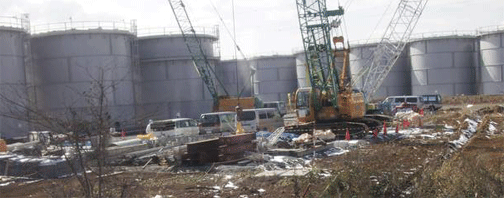 ‘Emergency measures’ used at Fukushima site during typhoon — Contaminated water dumped in ocean — 9 barriers were on verge of overflowing, then released into environment with NO radiation test — CNN: Workers were “on vigil” (VIDEO) http://enenews.com/emergency-measures-taken-at-fukushima-plant-during-typhoon-tv-contaminated-water-dumped-in-ocean-many-barriers-were-on-verge-of-overflowing-then-were-drained-into-environment-with-no-radia
October 16th, 2013
Asahi, Oct. 16, 2013: Heavy rain from Typhoon No. 26 forced [TEPCO] to discharge rainwater Oct. 16 that was threatening to swamp the barriers that surround the radioactive water storage tanks […] According to the utility, workers drained about 40 tons of water from within barriers in areas called C-West and C-East at around 5:40 a.m. The water was transferred to a temporary storage tank to check its radiation levels before it was released, TEPCO officials said. But water levels continued to rise inside the barriers, threatening to spill over. Plant workers were eventually forced to open drainage valves on a total of nine storage areas starting around 7 a.m. to allow the water to escape, according to officials. Earlier, TEPCO had said it would discharge water that accumulated behind the barriers only after transferring it to a temporary storage tank where it would confirm it complied with safety standards. TEPCO officials said circumstances forced it to take “emergency measures” because the water rose at a faster rate than it could transfer to the holding tank.
NHK WORLD, Oct. 16, 2013: [TEPCO] has released rainwater that had accumulated in the compound from typhoon Wipha. The water has reportedly cleared tests for radioactivity. […] It began releasing the water from 9 locations on Wednesday morning. […] The level of tritium, which takes longer to measure, is also likely to be safe. In a separate move, TEPCO made an emergency transfer of highly radioactive water that had pooled at 2 other locations. The water was transferred to an adjacent underground storage pool. TEPCO had not stored water underground since a leak in April […] because rainwater from the typhoon was rising fast, the utility decided to store the radioactive water temporarily in an underground pool […] TEPCO has built additional storage tanks and increased personnel and patrols to control contaminated water after a storm earlier this month. Radioactive water flowed over barriers at that time, and seeped out of an overfilled tank. […] The authority asked TEPCO to tighten monitoring for possible leaks.
CNN,, Oct. 16, 2013: Typhoon Wipha hits Tokyo area, killing at least 17 […] TEPCO, which has been struggling to deal with a series of leaks at its Fukushima Daiichi nuclear plant, said workers at the plant were “on vigil” and accumulated rainwater had been released from storage tanks.
NHK Newsline, , Oct. 16, 2013: The water accumulated around the compound. Some of it became contaminated with radioactive substances. Managers at Fukushima Daiichi instructed workers to release it into the ocean after tetsts showed the radiation levels met safety standards. […] Workers made an ‘emergency transfer’ of rain water at two other locations because they suspected it was highly radioactive.
Watch the NHK broadcast here
Abbott Government puts renewable energy projects in jeopardy
 Abbott risking renewables ‘hiatus‘Business Spectator, 16 Oct, By a staff reporterAcciona Energy chief Andrew Thomson says investment in large-scale renewable energy targets could be put on hold if the Abbott government delayed confirming the Renewable Energy Target, The Australian Financial Review reports.The government is planning to review the RET next year but Mr Thomson said certainty was required to meet the existing 20 per cent, or 41 terawatt hours, target, the newspaper reports….
..Mr Thomson said Acciona’s Spanish parents would redirect capital from Australia as uncertainty reigned.
“There’s no advantage for a country or a market to keep changing the goalposts.”http://www.businessspectator.com.au/news/2013/10/16/renewable-energy/abbott-risking-renewables-hiatus
Huge anti nuclear protest in Tokyo
 ‘Don’t pollute our sea:’ Mass demo in Tokyo to ban nuclear energy (PHOTOS) Rt.com 13 Oct 13 Some 9,000 activists took to the streets of Tokyo on Sunday to protest nuclear power. The march comes as Japanese authorities are considering restarting the country’s nuclear reactors, which were shut down in the wake of the 2011 Fukushima disaster.
The demonstration ended with a rally in front of the headquarters of Tokyo Electric Power Company (Tepco), the operator of the crippled Fukushima power plant.
Activists chanted “Stop the atom” and “Don’t pollute our sea,” referring to the continued leaking of radioactive water, which Tepco uses to control the temperature of the melted reactor cores at Fukushima.
The protesters also called on Japanese media to report more often on the situation at the power plant, which was damaged by the 2011 quake and tsunami.
Anti-nuclear sentiment has grown massively in Japan since the Fukushima disaster, one of the world’s worst nuclear power incidents. Rallies similar to Sunday’s are held regularly and attract thousands of people. According to opinion polls, some 70 percent of Japanese believe that the country’s nuclear power industry should be closed down. ….http://rt.com/news/japan-nuclear-rally-fukushima-135/
Poor forecast for uranium miners ERA and Paladin
 Little optimism in uranium market http://finance.ninemsn.com.au/newscolumnists/greg/8739108/little-optimism-in-uranium-market 15 Oct 13 Olympic Dam is Australia’s largest uranium source but outside of the diversified resource conglomerate that is owner BHP Billiton, Australia’s two “big” pure-play uranium producers are Energy Resources of Australia, operating in the Northern Territory and Paladin Energy operating in Namibia. Continue reading
World Health Organisation accused of cover-up of Iraq birth defects
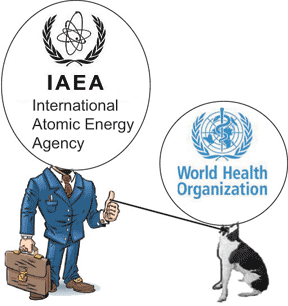 The publication of this ‘summary document’ on the World Health Organisation’s website has raised questions from independent experts and former United Nations and WHO officials, who question the validity of its findings and its anonymous authorship.
“There is definitive evidence of an alarming rise in birth defects, leukaemia, cancer and other carcinogenic diseases in Iraq after the war. Looking at the stark difference between previous descriptions of the WHO study’s findings and this new report, it seems that someone, somewhere clumsily decided that they would not release these damning findings, but instead obscure them.”
How the World Health Organisation covered up Iraq’s nuclear nightmare http://www.theguardian.com/environment/earth-insight/2013/oct/13/world-health-organisation-iraq-war-depleted-uranium by Nafeez Ahmed Ex-UN, WHO officials reveal political interference to suppress scientific evidence of postwar environmental health catastrophe
Last month, the World Health Organisation (WHO) published a long awaited document summarising the findings of an in-depth investigation into the prevalence of congenital birth defects (CBD) in Iraq, which many experts believe is linked to the use of depleted uranium (DU) munitions by Allied forces. According to the ‘summary report’:
“The rates for spontaneous abortion, stillbirths and congenital birth defects found in the study are consistent with or even lower than international estimates. The study provides no clear evidence to suggest an unusually high rate of congenital birth defects in Iraq.”
Jaffar Hussain, WHO’s Head of Mission in Iraq, said that the report is based on survey techniques that are “renowned worldwide” and that the study was peer reviewed “extensively” by international experts.
Backtrack
But the conclusions contrasted dramatically from previous statements about the research findings from Iraqi Ministry of Health (MOH) officials involved in the study. Earlier this year, BBC Newsspoke to MOH researchers who confirmed the joint report would furnish “damning evidence” that rates of birth defects are higher in areas experiencing heavy fighting in the 2003 war. In an earlypress release, WHO similarly acknowledged “existing MOH statistics showing high number of CBD cases” in the “high risk” areas selected for study. Continue reading
Jim Green outlines the uncontrolled state of affairs at Fukushima
Fukushima Is Not ‘Under Control ‘Jim Green, New Matilda, 14 Oct 2013https://newmatilda.com/2013/10/13/fukushima-not-under-control
Few believe Japanese PM Shinzo Abe’s assurances that all is well at Fukushima. Meanwhile, those speaking out against contaminated water from the plant are ignored, writes Jim Green
Japan’s Prime Minister Shinzo Abe assured the International Olympic Committee on 7 September that the Fukushima situation was “under control”. In particular the leakage and spills of contaminated water from holding tanks and the constant flow of contaminated groundwater.
Every day, around 400 tonnes of water are used to cool the stricken reactors. Storing this contaminated water has become increasingly difficult. Groundwater from surrounding highlands also flows under the Fukushima plant, where it in turn also becomes contaminated, before flowing out to the ocean.
Now a month later, Abe is calling for more foreign assistance with water management and other problems. “We are wide open to receive the most advanced knowledge from overseas to contain the problem,” he said on 6 October. Continue reading
1 This month

of the week – Australians for War Powers Reform (AWPR)
To see nuclear-related stories in greater depth and intensity
 Antinuclear