Damian Carrington on Britain’s delusional nuclear power dream
 With its long and lousy track record, it is little wonder that even the sober thinkers at the Economist concluded that “nuclear is the dream that failed”.
Nuclear power’s broken promises means EDF deal is a delusional dream http://www.theguardian.com/environment/damian-carrington-blog/2013/oct/21/nuclear-power-energy-edf-deal The cost of nuclear energy has tripled in just five years, while the cost of renewable energy is falling fast, making the UK government’s deal a truly terrible one Energy efficiency is cheapest and the cost of renewable energy is falling. In contrast, gas prices have risen by 50% in five years and the cost of nuclear energy has trebled since 2008. Yet the UK government today staked a large part of the nation’s energy future on the latter, by agreeing a deal with EDF which might lead to them building a new nuclear power station. Ministers have not backed the favourite, or even a speedy but erratic outsider: they have backed a horse running in reverse.
The 60-year history of the nuclear industry is one unblemished by promises kept. From “too cheap to meter” to safe as houses, every pledge has been broken. When the UK government once again fell for the renewed vows of the nuclear industry in 2008, they were promised reactors would cost £2.8bn to build. Today’s deal shows the cost is now £8bn. They were promised electricity for £31-42 per megawatt-hour: today’s price is £92.50/MWh.
The trashed guarantees stack up as steadily as the toxic waste pile that already costs billions a year to store. In 2007, David Cameron said: “The problems of nuclear waste have to be dealt with to make any new investment possible.” In January 2013, Cumbria, the only place in the running for a permanent disposal site rejected the idea.
The government pledge that the private sector would build the new reactors has collapsed too: EDF is owned by the French state and can only move ahead itself with about 40% of the money stumped up by China.
The final crushed commitment comes from the 2010 coalition agreement: New nuclear power stations “will receive no public subsidy”. If forcing energy consumers to pay roughly £38bn above the current cost of electricity is not a subsidy, what is? If a government package of insurance against accidents and loan guarantees is not a subsidy, what is?
This farrago of fictions matters. EDF and the government say the deal protects the public against the near-certainty of broken promises on costs. But read the small print: “The strike price could be adjusted, upwards or downwards, in relation to operational and certain other costs.” Perhaps the government could bail out of the deal if the costs soared? No: “Hinkley Point C would be protected from being curtailed without appropriate compensation.” If new risks came to light increasing the cost of insurance, could we get out then? No: “Protection would be provided for any increases in nuclear insurance costs as a result of withdrawal of government cover.” No wonder opponents are terrified by the lack of any independent scrutiny to date of the deal struck by the government.
The nuclear industry has captured the government as comprehensively as the big six energy companies have captured the domestic energy market. Don’t forget that just 48 hours after the Fukushima catastrophe, government officials were working with the industry to play down the terrible events – before they had even unfolded.
The alternative to nuclear, made to appear unthinkable by the industry’s lobbying, is in fact far from inconceivable. A huge effort to improve the UK’s woeful energy efficiency is the first step. The UK government currently expects electricity demand to rise by 33-66% by 2050. Why? Germany predicts a 25% cut. That’s how to seriously cut energy bills and the carbon emissions driving climate change: by not having to generate power in the first place. It also happens to create thousands of jobs in every part of the UK, unlike the government’s failing green deal energy efficiency programme, which is actually killing jobs.
The second step is a genuine commitment to renewable energy, youthful technologies ripe for further cost reductions in stark contrast to nuclear. Even today, once you account for the much longer time for which nuclear is promised subsidies, offshore wind costs the same and it will fall.
Yet the ambition for 40GW of offshore wind by 2020, which can be built five times faster than nuclear, is being shredded. The subsidies on offer to up to eight nuclear power stations could build that 40GW twice over, though the money has to be spent up front. Gas would also play an important transitional role, in the absence of nuclear power.
Cameron today said the Hinkley nuclear deal was an example of “our new industrial policy that looks to the future”. It is the precise reverse. With its long and lousy track record, it is little wonder that even the sober thinkers at the Economist concluded that “nuclear is the dream that failed”.
Government and electricity utilities caught unawares by solar energy developments
Energy ministers in NSW, Queensland and Western Australia admit to being taken by surprise by the take—up of solar, even after the ending of most subsidies. Queensland generators and network operators such as Stanwell Corp, Energex andErgon Energy have also noted the profound impact of solar, although they vary about whether this is a blight, a blessing, or an opportunity to the future.
 Origin says solar and storage coming quicker than thought REneweconomy, By Giles Parkinson on 22 October 2013 Origin Energy, Australia’s largest electricity utility, says the energy industry has underestimated the onset of disruptive technologies such as solar PV and battery storage.
In comments made to a conference hosted by GE, the largest  supplier of energy equipment in the world, Origin Energy’s head of energy markets, Frank Calabria, said the uptake of distributed generation such as solar and storage had taken – and would likely continue to take – the industry by surprise.
“Technology will disrupt,” Calabria told a “GE at Work” session on Powering Australia. “I think we have underestimated the rate of onset –not just of solar PV, but PV with the combination of storage as a greater disruption potential. That is not too far away.”
The comments by Calabria shouldn’t be a surprise, given that Australia now has a total of nearly 3GW of rooftop solar PV, and one of the highest levels of rooftop solar penetration in the world. That, in turn, has led to falling demand from the grid, reduced wholesale electricity prices, and the mothballing of nearly a similar amount of coal-fired generation as a consequence.
There is now a growing recognition of the disruptive influences of solar within the Australian electricity industry – something they did not want to admit even just 12 months ago.
Energy ministers in NSW, Queensland and Western Australia admit to being taken by surprise by the take—up of solar, even after the ending of most subsidies. Queensland generators and network operators such as Stanwell Corp, Energex andErgon Energy have also noted the profound impact of solar, although they vary about whether this is a blight, a blessing, or an opportunity to the future.
Later, Calabria told RenewEconomy: “No-one anticipated the level of solar to have penetrated the market as much as it has today …. So industries like ours have to face the prospect of underestimating what they can do in the future.
“If we don’t watch that – combined with what is happening in storage – we could underestimate its development going forward. It would continue to promote a trend of more generation in people’s homes.”…..
The Coalition has said that it will deliver electricity price cuts of 10 per cent by repealing the carbon price. Calabria and others on the panel said the challenge was making this price reduction clear to consumers, as it was likely to be overshadowed by other factors – such as rising network costs (Energex has flagged a 10 per cent interest in those costs next year)……
As RenewEconomy has reported, the renewables industry is seeking to find a compromise position to try to avoid a lengthy review of the RET – promised by the new government – which would translate into another lengthy hiatus in investment. It is understood that the Clean Energy Council is hosting a strategy meeting with key stakeholders today (Tuesday)……http://reneweconomy.com.au/2013/origin-says-solar-and-storage-coming-quicker-than-thought-76354
Renewable energy cheap, in comparison with fossil fuel subsidies
Renewable energy would pay off Stuff,co,nz, ERIC PYLE, 22 Oct 13 “……Even as one of the most heavily industrialised countries in the world, Germany is currently on track to get to 35 per cent renewable sources of electricity by 2030 and 80 per cent by 2050, with CO emissions falling to 30 per cent and 80 per cent below 1990 levels.
A similar story can be told about Australia, where falling electricity generation emissions have more than offset growth in carbon pollution from the transport sector for the past four years.
Research from the Australian Energy Market Operator found Australia could shift towards 100 per cent renewable energy for a similar cost to using fossil fuels.
In addition, analysis by the University of NSW compared the likely costs of pursuing 100 per cent renewable power by 2030 with a range of coal and gas options and found a shift to commercially available clean energy would be cost-effective and relatively low-risk……
The International Monetary Fund is calling for a move away from all fossil fuel subsidies, which it says totalled nearly US$2 trillion (NZ$2.36t) in 2011, or 2.5 per cent of the world’s gross domestic product. This estimate includes direct subsidies and indirect subsidies, such as the environmental costs of using fossil fuels……
The cost of renewable energy policies pale in comparison to the subsidies paid to the fossil fuel industry. In the US it is estimated that the fossil fuel industry has received US$447 billion versus the renewable subsidy of US$6b over the past hundred or so years.
The International Energy Agency estimates that fossil fuel subsidies equate to US$110/tonne of CO pollution.
Globally, fossil fuel subsidies are, at the very lowest estimate, six times those for renewable energy……http://www.stuff.co.nz/dominion-post/comment/9309059/Renewable-energy-would-pay-off
Australia’s exceptionally strong solar radiation – a hazard,but also a blessing?
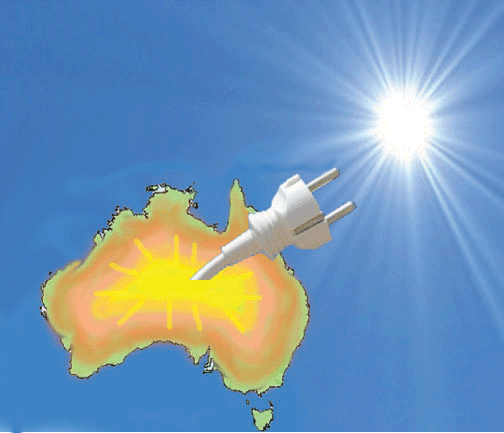 Australia – where the Sun hits the hardest The Starlight Walker, Mathieu Isidro October 8, 2013 “…….Such strong solar radiation also means high ultraviolet radiation (UV is part of the electromagnetic spectrum, like visible light and infrared), which is really bad for your health. In fact, Australia has the highest level of skin cancer in the world.Some 2 out of 3 Australians will be diagnosed with skin cancer before the age of 70, and Australians are 4 times more likely to develop skin cancer than any other form of cancer. So, if you’re coming from abroad, cover up, wear sunglasses and hats and leave your 15+ sunscreen at home, as the minimum recommended here is 30+.
. Finally, the main point I’d like to raise is strong solar radiation also means extreme weather, and it’s getting worse (Read this page to better understand the complex links between solar radiation and greenhouse effect). Australia had a record drought for the better part of the last decade and regularly experiences terrible bushfires. A couple of years ago, Australia also experienced its worst summer. It was so bad that it became known as the Angry Summer. The Climate Council, at the time, produced this scary map summarising it:……..
Australia experiences what might be the world’s strongest solar radiation (and worsening), and it’s a terrible challenge for the country, putting it with other places, particularly in the Pacific and arctic regions, on the frontline of climate change. It has terrible consequences for our environment, for our health and so for our economy.
But it could also be a blessing. Australia could seize this opportunity and invest in a green revolution to harness the Sun’s power in our country, which would in the long term ensure energy independence, sustainability and cheap, permanent energy for the entire country. Surely that is worth thinking about. And like this document will show – published by the Climate Commission in August just before being axed -, there is hope. http://thestarlightwalker.wordpress.com/2013/10/08/australia-where-the-sun-hits-the-hardest/
Scientists say climate change link to bushfires demands action ABC News Mon 21 Oct 2013,With claims that current climate policies would lead to more bushfires, Deputy Greens Leader Adam Bandt was accused of politicising the a natural disaster, but scientists say the link between global warming and fires is established and demands action.
JOHN CONNOR, CEO, THE CLIMATE INSTITUTE: Carbon pollution is a heat-trapping greenhouse gas that is like putting the weather on steroids. It drives the greater extremes. It’s not just warmer weather, it’s wilder weather.
ADAM BANDT, GREENS DEPUTY LEADER: It’s October and we’re having a tragic bushfire, and meanwhile, Tony Abbott and his ministers have been out every day this week saying that they’re going to take Australia backwards when it comes to combatting global warming……
TRACY BOWDEN: Federal Environment Minister Greg Hunt has been reluctant to discuss any link between climate change and the current bushfires.
GREG HUNT, ENVIRONMENT MINISTER: There are 2,000-odd firefighters in the field as we speak. There have been over 200 homes lost and of course a terrible tragedy on the Central Coast. No-one, no-one should be politicising these bushfires and I would say that respectfully to the gentleman in question.
DON HENRY, AUSTRALIAN CONSERVATION FOUNDATION: Well I actually don’t think it should be political that we have to get on with the job of cutting our pollution that’s driving climate extremes.
TRACY BOWDEN: The recent report by the Intergovernmental Panel on Climate Change warned of exactly the kind of conditions which struck last week: more extreme heat in Australia and more bushfires.
ANDY PITMAN, CENTRE FOR EXCELLENCE FOR CLIMATE SYSTEM SCIENCE: We have had fires historically this early before, but I think the difference this time is that we’ve just gone through a winter that is unprecedentedly warm.
TRACY BOWDEN: Climate scientist Andy Pitman says the science is becoming clearer.
ANDY PITMAN: It’s not about the day or the day before the bushfire. It’s about the three or four months of winter that were enormously warm in part due to global warming leading to an environment particularly conducive to fire.
TRACY BOWDEN: Does that mean this is a sign of things to come?
ANDY PITMAN: If we continue to emit nine or 9.5 billion tonnes of CO2 as a species into the atmosphere each year, it is inevitable that temperature extremes will continue to rise and mean temperatures will continue to rise.
DON HENRY: We should be asking our Parliament and all parliamentarians to have strong laws in place to cut pollution.
TRACY BOWDEN: Despite the science, there have been cutbacks at national and state levels in resources to research and prepare for the impact of climate change……http://www.abc.net.au/news/2013-10-21/scientists-say-climate-change-link-to-bushfires/5036554
Labor must keep Bill Shorten firm on carbon pricing
 Bill Shorten puts majority of Labor policies up for review SID MAHER AND JOE KELLY THE AUSTRALIAN OCTOBER 22, 2013
BILL Shorten has put Labor’s carbon pricing policy up for review in a move that gives him maximum flexibility to manoeuvre ahead of the introduction of Tony Abbott’s carbon tax repeal bills next month.
The Opposition Leader called the review of most Labor policies as the government revealed it might not have to rely on the Senate to implement the centrepiece of its direct action plan: the $1.5 billion emissions reduction fund.
Mr Shorten, at the first meeting of shadow cabinet yesterday, put every Labor policy except the Better Schools and disability insurance up for review.
This includes carbon pricing. The frontbench had an “initial discussion” regarding the government’s climate change policy and “reaffirmed” Labor’s commitment to reducing carbon pollution.
The shadow cabinet has scheduled further meetings in the weeks before parliament sits.
Last week, Mr Shorten said he remained opposed to allowing the Prime Minister to abolish the carbon price, but declined to say whether Labor would campaign to ……: http://www.theaustralian.com.au/national-affairs/policy/bill-shorten-puts-majority-of-labor-policies-up-for-review/story-e6frg6xf-1226744103753#sthash.KrDx232s.dpuf
1 This month

of the week – Australians for War Powers Reform (AWPR)
To see nuclear-related stories in greater depth and intensity
 Antinuclear