Hastings branch of Climate Change pushes government to keep carbon pricing
 Climate Change Hastings urges Abbott government to keep carbon tax http://www.abc.net.au/news/2013-10-24/climate-change-hastings-urges-abbott-government-to-keep-carbon-/5043312 24 Oct 2013, The Hastings branch of Climate Change Australia is strongly urging the Abbott government not to repeal the carbon tax. President Harry Creamer said there is no good reason to drop the tax.
He said the tax has had little impact on the economy but a big impact on Australian emissions, lowering them by almost 8 percent.Mr Creamer said a price signal on carbon is the only way to achieve an emissions reduction target of more than 5 percent.
“It is now clear that we need a higher target and the direct action plan cannot achieve anything higher,” he said.’We can make five percent at little or not cost. “What we need to do is to raise our ambition and that’s what the current legislation does across the whole of the economy by sending a price signal on carbon.”
Mr Creamer said Australia will lose international credibility if it scraps the tax without showing how it will continue to cut emissions. He said the tax has lowered Australia’s emissions and reduced coal-fired electricity generation. Mr Creamer said the current bushfires cannot be directly attributed to climate change but they’re a timely reminder. “The current bushfires serve to remind us of the link between mega fires and climate change,’ he said.
“Human induced climate change is making these extreme weather events including bushfires worse. “Quite simply now is not the time to be repealing effective legislation that is working to reduce Australia’s greenhouse emissions.”
How Origin Energy is strangling renewables
Energy giant ‘actively blocking renewables‘ http://www.businessspectator.com.au/news/2013/10/23/renewable-energy/energy-giant-actively-blocking-renewables Origin Energy is actively blocking renewable energy, a report has found.Co-produced by Greenpeace Australia Pacific and 100% Renewable, a community campaign for clean energy, the report – titled Strangling Renewables: Origin Energy’s campaign against renewable energy – accuses the energy giant of strangling renewables as part of a strategy to prolong the dominance of gas and fossil fuels.
“As this report shows, Origin is strangling renewable energy in a number of ways, including running a smear campaign against the renewable energy target, which sets Australia’s goal for the amount of our energy produced by renewables, and using misleading public statements to manipulate the general public and politicians alike,” said Lindsay Soutar, the national director of 100% Renewable.
“Origin’s Managing Director, Grant King, has repeatedly said the renewable energy target is a primary driver of increased energy costs. But, that is inaccurate, with the main cause of price rises – at over 70 per cent – due to over investment in poles and wires.”
Greenpeace Australia head of program Ben Pearson said Origin has used its market power to sideline clean energy sources by underinvesting in its own renewables portfolio. “Origin has also underinvested in its own renewable energy portfolio and is blocking other clean energy developers projects from going forward – using its market power to keep renewables on sidelines,” Ben Pearson, Head of Program at Greenpeace Australia, says.
The report shows that Origin has invested heavily in gas projects, including developing new LNG projects and gas generating plants, and also generates 75 per cent of its profit through its retail arm – but increasingly these are threatened by the emergence of cheaper, cleaner wind and solar.“In truth, renewables are working. As this report shows, renewables are reducing energy bills and producing clean energy in an efficient way. Not only that, but wind power is lowering wholesale power prices. And other countries are surpassing us with more ambitious renewable energy goals,” Ms Soutar says.
A review of Australia’s Renewable Energy Target, which is 20 per cent renewables by 2020, is scheduled to occur early next year. Origin boss Grant King has said he would prefer a higher RET target later – such as 30 per cent by 2030.
The success of decentralised renewable energy in Germany
Not only does local ownership flip the notion of energy costs as consumers become producers, it also flips the notion of political ownership. Three-quarters of Germans want to maintain a focus on “citizen-managed, decentralized renewable energy.”
Three reasons Germans are killing it on renewable energy http://reneweconomy.com.au/2013/three-reasons-germans-are-killing-it-on-renewable-energy-56628 By John Farrell on 24 October 2013 CleanTechnica
Germany is racing past 20% renewable energy on its electricity grid, but news stories stridently warn that this new wind and solar power is costing “billions.” But often left out (or buried far from the lede) is the overwhelming popularity of the country’s relentless focus on energy change (energiewende).
How can a supposedly expensive effort to clean up the energy supply be so popular?
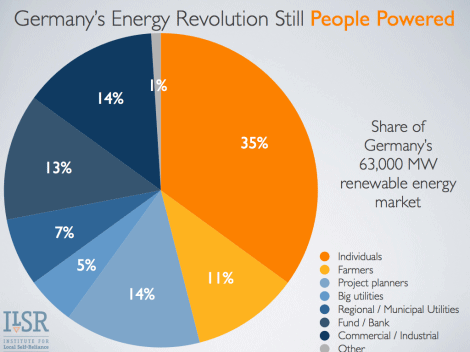
1. It’s about the cost, not the price
Most news stories focus on the cost of electricity in Germany, which has some of the highest rates per kilowatt-hour in the world. But they don’t note that the average German electricity bill – about $100 a month – is the same as for most Americans. Germans are much more efficient users of energy than most, so they can afford higher rates without having higher bills. (Note to self: check out options for energy efficiency).
2. It’s about vision Continue reading
Tricks and strong passions in the corporate drive against renewable energy

The trick for these people is to ignore the benefits of renewables – increased investment, more jobs, lowering emissions, delivering a faster transition to low carbon economy, solar delivering cheaper alternative to homes and businesses – and instead paint a doomsday scenario.
As Wilson (rightly) pointed out, there is a vast reserve of anti-renewables passion in the rump of the National Party and the Liberal party backbench open to such rhetoric– which insiders say is being whipped up by new Liberal MP Angus Taylor.
Wilson insisted that renewables “are producing a product that no one wants to buy.” This ignores the fact that Australian households and businesses are still spending more than $1 billion a year installing their own rooftop solar systems – even with most subsidies removed. (
The dark forces lined up against renewables in Australia http://reneweconomy.com.au/2013/the-dark-forces-lined-up-against-renewables-in-australia-20629 By Giles Parkinson on 24 October 2013 The Australian renewables industry is under no illusion about the extent of the forces lined up against it following the election of a highly conservative Coalition government in Canberra.
The antipathy to renewables in large sections of the Coalition is deep set, as it is among some of the highly influential and ultra-conservative think tanks such as the Institute of Public Affairs, and various industry lobby groups.
But even battle-weary supporters of solar and wind energy – and those firmly in the middle of the road – were taken aback by an extraordinary tirade against renewable energy delivered in Sydney on Wednesday by Burchell Wilson, a senior economist at the Australian Chamber of Commerce and Industry.
ACCI is one of the most visible and influential lobby groups in Canberra, and its opposition to climate policy, carbon pricing, and renewables incentives, is well known. Still, no-one was quite ready for the “venomous rant” – as one observor described it – against the renewable energy target that Wilson delivered to the Eastern Australian Energy Outlook Conference.
Wilson’s approach was not atypical of the sort of rhetoric we have come used to hearing from conservative energy ministers – be they state of federal – and the incumbent utilities, who are threatened by the rise of renewables, and their cheerleaders in the conservative think tanks. Continue reading
Japan’s anti radiation swimwear and undies
Japan Gets Anti-Radiation Swimwear And Underwear http://www.kotaku.com.au/2013/10/japan-gets-anti-radiation-swimwear-and-underwear/ BRIAN ASHCRAFT18 OCTOBER 2013 Radiation is serious — especially in Japan. With the country still dealing with a nuclear disaster, people need to protect themselves. Osaka-based swimwear company Yamamoto Corporation unveiled anti-radiation work wear in the form of a wetsuit made from rubberised kneaded carbon. It can stop nearly 100 per cent of harmful beta rays.
Beta particles can change the structure of molecules, leading to cancer and death. Obviously, this wetsuit is designed with Fukushima clean-up crews in mind.
Weighing only three kilograms, the wetsuit stretches, but has stitching that is completely fused so contaminated water cannot seep through. According to 47News, the wetsuit will be released in late November.
Yamamoto Corporation is also developing lead-based underwear to stop harmful gamma rays. It weighs 3.4 kilograms.
The wetsuit is priced at ¥105,000 ($1070) and the underwear is ¥80,850 ($825).
放射線を遮る作業服開発 山本化学工業、下着も [47News]
Australia’s timely action to prevent skin cancer from tanning beds
Australia’s Tanning Bed Ban Could Save Thousands Of Lives Taken Each Year By Skin Cancer http://www.medicaldaily.com/australias-tanning-bed-ban-could-save-thousands-lives-taken-each-year-skin-cancer-260693 By Justin Caba | Oct 23, 2013 In light of various studies that link UV exposure produced by indoor tanning beds to skin cancer, Australia is close to implementing a nationwide ban on tanning beds. Australia will join Brazil as the only countries to outlaw sun beds on a federal level once the state of Western Australia passes the ban.
“There’s not lots of them, there’s no big downside for them to stop because most of them have other businesses,” Health Minister Kim Hames told ABC Online.“And, I think given every other state and territory has done it, it’s probably right we follow suit.”
The Australian government successfully outlawed the use of indoor tanning beds by people under the age of 18 back in 2008, theWall Street Journal reports. California, Illinois, Nevada, Oregon, Texas, Vermont, the United Kingdom, Germany, Scotland, France, and some Canadian provinces have also banned minors from using tanning beds. Continue reading
Australian utilities’ determined fight to stop solar energy development
 The solar industry in response is feeling outraged because of the way in which the sector has been singled out when the greatest cross subsidy in the industry is given to users of air-conditioners. This is something that the Australian government itself concedes in a white paper revealing that each $1,500 air con system imposes five times that amount in network costs on other users.
Australian utilities are therefore deciding to fight back, rather than adapting their business model to the new renewable economy. They hope to rely on regulatory protection in order to knock back the take-up in solar PV installation.
Australian utilities raise the barricades against solar http://www.renewableenergymagazine.com/article/australian-utilities-raise-the-barricades-against-solar-20131023 Robin WhitlockTuesday, 22 October 2013 Utilities in Australia are now pushing for higher network charges, refusing connections, removing discounts, forcing tariff changes on solar consumers and downsizing rooftop proposals in their bid to resist the growth of solar PV
Hostility to renewable energy in Australia has been notched up a little again as the country’s major utilities prepare to brake or even halt the rapid uptake of solar PV in the country. They are currently pushing for higher network charges, refusing connections, removing discounts, forcing tariff changes on solar consumers and downsizing rooftop proposals. This activity comes even after most of the subsidies for solar have been removed and represents a tacit admission among major generators, network operators and electricity retailers that renewable energy, particular solar PV, is hurting their business model.
The latest move has come from the Australian Energy Market Commission (AEMC) which has released a “strategic priorities” document that as described the growth in solar PV as one of the most pressing issues for the electricity industry, suggesting that network tariffs do not reflect the reductions in the use of the grid caused by solar installation. Continue reading
News reports on the toxicity of the Pacific Ocean fail to mention Fukushima’s radiation
Yet, the original Newcastle Herald article specifically mentions radioactive pollution from Fukushima and includes events that deserve closer scrutiny:
Sailor’s horrific Pacific journey goes viral, smashes record — Picked up by The Guardian, USA Today, many more… All fail to mention ongoing crisis at Fukushima, by far world’s largest release of radioactivity into ocean http://enenews.com/sailors-shocking-pacific-journey-goes-viral-smashes-record-picked-up-by-the-guardian-usa-today-many-more-all-fail-to-mention-ongoing-crisis-at-fukushima-by-far-worlds-largest-release-of October 23rd, 2013
The Newcastle Herald reported yesterday: : “Ocean’s horror tale gets global audience […] The story smashed Fairfax Regional Media records, registering 620,000 unique readers on the Herald site by Tuesday afternoon. It appeared on the front page of Reddit on Monday, was trending in Melbourne early Monday afternoon, and was re-tweeted by, among others, Jack Dorsey, the founder and chief executive of Twitter […]”
Here’s a small selection of the news outlets that published reports based on the Herald’s October 18th article ‘The ocean is broken‘:
- The Guardian: Yachtsman describes horror at ‘dead’, rubbish strewn Pacific Ocean
- USA Today: Sailor’s discovery: ‘The ocean is dead’
- Telegraph: Maritime waste: Our oceans are threatened by a toxic tide
- Salon: “It felt as if the ocean itself was dead”: One sailor’s heartbreaking voyage
None mention the ongoing nuclear crisis at Fukushima Daiichi, which is “by far the largest discharge of radioactivity into the ocean ever seen.The Salon article even incorrectly attributes events that occurred after they left Japan for Hawaii to their trip from Australia to Japan:
[…] “all he’d had to do to catch a fish from the ocean between Brisbane and Japan was throw out a baited line.” On his most recent trip, said Macfadyen, there were no fish to be found: “We hardly saw any living things. We saw one whale, sort of rolling helplessly on the surface with what looked like a big tumour on its head. It was pretty sickening. I’ve done a lot of miles on the ocean in my life and I’m used to seeing turtles, dolphins, sharks and big flurries of feeding birds. But this time, for 3000 nautical miles there was nothing alive to be seen.” More horrifying, even, was what he did see, en route from Japan to California: [tsunami debris] […]
Yet, the original Newcastle Herald article specifically mentions radioactive pollution from Fukushima and includes events that deserve closer scrutiny:
Macfadyen signed up to this scheme while he was in the US, responding to an approach by US academics who asked yachties to fill in daily survey forms and collect samples forradiation testing – a significant concern in the wake of the tsunami and consequent nuclear power station failure in Japan.
The boat’s vivid yellow paint job, never faded by sun or sea in years gone past, reacted with something in the water off Japan, losing its sheen in a strange and unprecedented way. [Not likely to be tsunami-related, which would have been transported far from Japan’s coast by now]
“After we left Japan, it felt as if the ocean itself was dead.”
“We hardly saw any living things.”
“We saw one whale, sort of rolling helplessly on the surface with what looked like a big tumour on its head.”
“I’ve done a lot of miles on the ocean in my life and I’m used to seeing turtles, dolphins, sharks and big flurries of feeding birds. But this time, for 3000 nautical miles there was nothing alive to be seen.”
1 This month

of the week – Australians for War Powers Reform (AWPR)
To see nuclear-related stories in greater depth and intensity
 Antinuclear