The Eastern world, nuclear power and Australia – theme for November 2013
The future for Australia’s uranium industry is murky indeed. The Australian uranium lobby loves to tell us, ad nauseum, what a great future they have in uranium sales to China. What they don’t tell us is that China is determined to become self sufficient in nuclear fuels. Also China has become apprehensive about nuclear power, since the Fukushima disaster. There are serious safety concerns. China has a developing anti nuclear movement China’s renewable energy program is growing faster than its nuclear program . China has suspended inland nuclear projects and slowed its nuclear program. It is almost certainly abandoning its 3 largest nuclear projects.
And of course – with the current world glut of uranium, uranium prices are going to be low for a long time yet (perhaps forever)
The World Nuclear Association is busily touting the future of nuclear technology in Asia and Middle East – (more about that next week on this page) . This may not be all that relevant to Australia. The great leap forward in nuclear power in Asia and Middle East is not happening nearly as fast as the Australian Uranium Association would have us believe. Which means that the future of uranium sales is not looking good.
This is one big reason why the nuclear lobby is turning its attention to Australia becoming in fact like a Third World country – that is – being not so much an exporter of uranium fuel , but a customer for the nuclear materials that USA, France, Russia Japan, (and even China and South Korea) are desperate to sell off.

There’s another side to Australia’s nuclear relationship with Asia. This is the curious contradiction between Australia’s drive to develop trade with Asian countries, and especially with China – and the danger of Australia as a nuclear target. More about this on the sidebar at right.
No sign of hope for uranium mining in Queensland
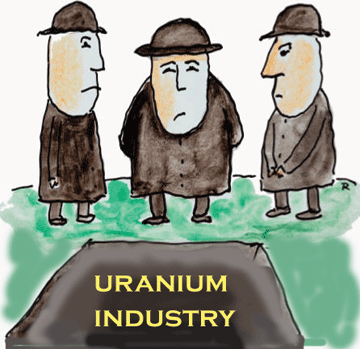 Uranium mining start faces hurdles, ABC News 2 Oct 2013, The Australian Uranium Association says it will be some time before uranium mining begins in Queensland……Mr Angwin says low uranium prices are a big deterrent.
“We’ve got low-cost competitors around the world who are doing much better than Australia is at the moment and we’ve got a relatively cumbersome assessment and approval process for environmental issues,” he said.
“So if you put those three issues together and particularly the low price of uranium then it’ll be some time before companies decide the time is right to mine uranium.” http://www.abc.net.au/news/2013-10-02/uranium-mining-start-faces-hurdles/4993738
Nuclear power is, and will be more and more, – an economic disaster
Because of costs, the de facto “solution” is firstly to extend reactor operating lifetimes, then partly decommission and dismantle reactors when they are taken out of service, delaying the decontamination of nuclear sites, and pushing all costs into the future. Unfortunately and until the reactors are made safe, they by definition pose almost open-ended risks. These extend from “simple” accidents and technical malfunction, to operator errors, and to the risk of them becoming giant Dirty Bomb targets in civil war, international war, or terror attacks. Even the most extreme non-nuclear industrial risks, notably at “Seveso or Bhopal type” chemical facilities, are pale by comparison.
Nuclear Power Dirty Bomb The Market Oracle, Oct 28, 2013 By: Andrew_McKillop THE 100-YEAR CURSE Within the next 15 – 20 years as many as 100 industry standard Westinghouse-type 900 MW PWR pressurized water reactors, concentrated in the “old nuclear’ countries will have to be decommissioned, dismantled and their sites made safe – unless political deciders maintain the sinister farce of rubber stamping reactor operating lifetime extensions. The decontamination process could take as long as 100 years. In several countries, especially Germany, Switzerland and probably Japan the dangerous game of politically-decided reactor life extensions – to push back the date of final decommissioning – has already ended or is ending.
But when it does end, nuclear debt will go into overdrive from its already extreme high setting. Nuclear power is capital intensive, lives on subsidies, thrives on false hopes and dies in debt.

Putting a figure on how much the nuclear “decomm” story will cost and how long it will take is in fact impossible – and is signalled by the tell-tale anticipative action of nuclear friendly governments. One stark example is the UK, which now sets decomm as an activity that will only need to start at a generous, or foolhardy 30 or 40 years after the reactor was powered down and removed from the national power grid. Until then, the reactor can sit on the horizon as a contribution to national culture or something “in perfect safety of course”. Decomm periods could or might therefore be 100 years.
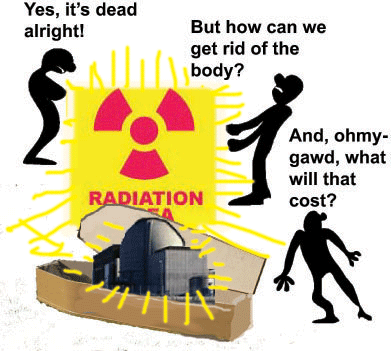 DECOMMISSIONING SAGAS As already noted above, there are no rules, standards and best practice in decommissioning, dismantling and “making safe” or “securing” the former sites of reactors. So there is no standard cost for getting rid of reactors. It is a case-by-case process. This alone prods the highly political decision to set a “delay” between reactor shut down, and decommissioning which as noted above, in the extreme UK case is now set at 30-40 years.
Before the final shut down, of course, reactor operating life extensions can squeeze some more power out of the reactor – and further delay the moment when it has to be decommissioned. Only idiots can pretend this does not expose the reactor to increased risks of accidents. Ask yourselves if you prefer to fly in a 40-year-old airplane, or a new one.
Real-life decomm sagas, as distinct from emergency dismantling following a serious or catastrophic accident as in the case of Three Mile Island, Chernobyl and Fukushima are always – always – a tale of vastly underestimated initial costs and timelines for decomm, followed by massive cost overruns and time overruns. Plenty of examples concern the now-quarter-century old projects, and longer, where initial cost estimates have been exceeded by actual spending by 5 or 10 times, and the decomm project’s time for completion multiplied by 3. And today the projects are not yet fully completed!…….. Continue reading
Climate Action Canberra reports that Bill Shorten will stick by the carbon tax!
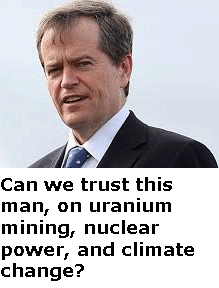
Climate-Action Canberra 30 Oct 13, Belinda from Bill Shortens office just said he will not backflip and will stick by the carbon tax !
Keep the carbon tax – urges Labor’s national secretary, George Wright
 Labor should stick with carbon pricing, national secretary tells party colleagues theguardian.com, Tuesday 29 October 2013 Katharine Murphy deputy political editor ‘We are on the right side of history on this argument,’ says George Wright in frank election postmortem at press club Labor’s national secretary, George Wright, has urged his parliamentary colleagues to persist with carbon pricing, declaring that the policy positions the party on the right side of history, climate science and economics…….http://www.theguardian.com/environment/2013/oct/29/stick-with-carbon-pricing-labor
Labor supports dumping the carbon tax, and opposing Abbott’s “Direct Action” policy
 ALP supports dumping tax not direct action HERALD SUN AAP OCTOBER 29, 2013 SHADOW assistant treasurer Andrew Leigh says Labor will support scrapping the carbon tax but insists it needs to be replaced with an emissions trading scheme. “We said we would scrap the carbon tax, the fixed price period, and move straight to a floating emissions trading scheme,” Dr Leigh told Sky News on Tuesday.
“That’s something that we will be happy to vote for on the floor of parliament.” This is consistent with the policy Kevin Rudd took to last month’s election, he said.
But he clarified there would still have to be discussions in shadow cabinet and caucus about the party’s final position on the government legislation…….
Dr Leigh said the lesson Labor had learned was from 2010.
“We were seen to walk away from carbon pricing,” he said. “I think it would be a mistake for us to do that again.” He says he doesn’t believe the coalition’s direct action policy will work to halt climate change.
Reported plans to attach direct action to the budget bills was “a classic Tea Party trick” used in the US Congress, to force Labor to vote for the “whacky” plan or make the whole budget fall. http://www.heraldsun.com.au/news/breaking-news/alp-supports-dumping-tax-not-direct-action/story-fni0xqi4-1226748787512
Slowly unfolding environmental misery – Fukushima nuclear radiation
”There is no precedent for what is happening, so we are on untrodden ground.”
 The Fukushima plant’s tainted water continues to contaminate the sea, Canberra Times, Martin Fackler and Hiroko Tabuchi, 28 Oct 13, FOR MONTHS now, it has been hard to escape the continuing deluge of bad news from the devastated Fukushima nuclear power plant.
Even after the company that operates the plant admitted this summer that tonnes of contaminated groundwater were leaking into the Pacific Ocean every day, new accidents have added to the uncontrolled releases of radioactive materials. Last month, newly tainted rainwater overflowed dykes. Two weeks before that, workers mistakenly disconnected a pipe, dumping 10 more tons of contaminated water onto the ground and dousing themselves in the process.
Those accidents have raised questions about whether the continuing leaks are putting the environment, and by extension the Japanese people, in new danger more than 2½ years after the original disaster – and long after many had hoped natural radioactive decay would have allowed healing to begin.
Interviews with scientists suggest they are struggling to determine which effects – including newly discovered hot spots on a wide swath of the ocean floor near Fukushima – are from recent leaks and which are leftovers from the original disaster. But evidence collected by them and the plant’s operator, the Tokyo Electric Power Co, or TEPCO, shows worrying trends.
The latest releases appear to be carrying much more contaminated water than before into the Pacific. And that flow may not slow until at least 2015, when an ice wall around the damaged reactors is supposed to be completed. Beyond that, although many Japanese believed that the plant had stopped spewing radioactive materials long ago, they have continued to seep into the air.
”This has become a slowly unfolding environmental misery,” said Atsunao Marui, a geochemist at the Geological Survey of Japan who has studied contaminated groundwater flowing from the plant. ”If we don’t put a stop to the releases, we risk creating a new man-made disaster.”…… Continue reading
AUDIO: climate change causes dangerous jellyfish to move South, threatening Australia’s tourism industry
 AUDIO Researchers say Irukandji jellyfish migrating further south along Qld coast http://www.abc.net.au/news/2013-10-29/irukandji-jellyfish-migrating-further-south-along-qld-coast/5051580 AM By Nance Haxton and staff 29 Oct 2013,
Marine researchers say climate change could be altering the migration patterns of the dangerous Irukandji jellyfish along Queensland’s east coast.
The Irukandji is one of the deadliest marine animals, so venomous it inflicts excruciating pain that sometimes leads to death.
It has been on a relentless march southwards down the Queensland coast.
If the Irukandji becomes established off Queensland’s south-east coast, it would be devastating for the region’s tourism industry……
1 This month

of the week – Australians for War Powers Reform (AWPR)
To see nuclear-related stories in greater depth and intensity
 Antinuclear