Top Secret Trans Pacific Partnership – some of its secrets unravelled
Full Show: The Top Secret Trade Deal You Need to Know About Moyers and Company November 1, 2013
BILL MOYERS: This week on Moyers & Company… TPP: the big story you haven’t heard about.
YVES SMITH: There’d be no reason to keep it so secret if it was in the interest of the public.
DEAN BAKER: This really is a deal that’s being negotiated by corporations for corporations and any benefit it provides to the bulk of the population of this country will be purely incidental.
“A Corporate Trojan Horse”: Obama Pushes Secretive TPP
A cornerstone of President Obama’s plan to create more American jobs is a new agreement called the Trans-Pacific Partnership (TPP), referred to by some as “NAFTA on steroids.” While negotiations are being carried out in secret and very little about the terms has been leaked, enough is known to worry about its possible effect on trade unions and our copyright and patent laws, not to mention environmental, health and safety regulation
This week on Moyers & Company, Bill discusses the TPP with two perceptive observers of the global economy. Yves Smith is an expert on investment banking who runs the Naked Capitalism blog, a go-to site for information and insight on the business and ethics of finance. Dean Baker is co-director of the progressive Center for Economic and Policy Research in Washington, DC.
Also on this week’s broadcast, a preview of Robert Greenwald’s new documentary, Unmanned: America’s Drone Wars. It’s release coincided with a first: victims of deadly drone attacks testified at a special briefing for members of Congress. In this week’s show we feature clips from the film, which shares testimony, stories and alarming news on the fatal impact of our drone strategy…..http://billmoyers.com/episode/full-show-the-top-secret-trade-deal-you-need-to-know-about/
Mainstream media in Australia has brought about a public fog of ignorance about climate change
 If you believe that the main obligation of journalists is to the public right to know, the results of this study are truly alarming. Journalism is about reporting contemporary events as accurately as possible. There could be no better example of the importance of this than the reporting of climate science.
News Corp’s coverage seems to be more about production of ignorance than informing people so they can participate in debates about solutions. If people are confused or ignorant about potential threats, they cannot be expected to support action to confront them.
 Big Australian media reject climate science The Conversation, Wendy Bacon,1 November 2013, Australia has the most concentrated press ownership in the world. What does that mean for significant issues such as climate change?
In 2011 and 2012 we at the Australian Centre for Independent Journalism at University of Technology, Sydney collected data on climate science coverage in ten Australian newspapers. We published the results yesterday in a report: Sceptical Climate: Part 2.
We found that Australia’s concentrated newspaper ownership has a significant effect on how climate science is covered. One third of articles in Australia’s major newspapers do not accept the consensus position of climate science: that human beings are contributing to climate change.
That’s a very high level of scepticism when you consider that these stories are rejecting findings that over 97% of the world’s climate scientists support. Recently the International Panel on Climate Change found there was 95% certainty that people were contributing to climate change.
How did we decide what was sceptical? Continue reading
The nuclear industry’s fairy tale of “renaissance’ continues
As always in the face of failure, the industry puts forth new designs as a basis for new promises, now touting small modular reactors with the same fervour with which it touted large, partially modular reactors a decade ago. Congress finds a few hundred million to preserve these dreams even as its cutbacks shatter so many others.
In the astonishing persistence of the global appetite for false nuclear promises lies the critical importance of the World Nuclear Industry Status Report,
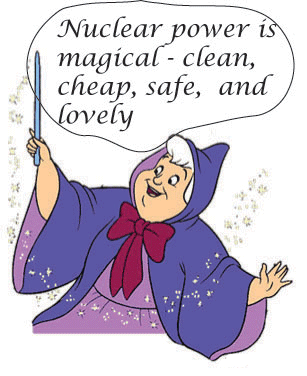
Nuclear Renaissance Was Just a Fairy Tale http://ourworld.unu.edu/en/nuclear-renaissance-was-just-a-fairy-tale 2013•07•12 Peter Bradford Vermont Law School Nuclear power requires obedience, not transparency. The gap between nuclear rhetoric and nuclear reality has been a fundamental impediment to wise energy policy decisions for half a century now.
For various reasons, in many nations the nuclear industry cannot tell the truth about its progress, its promise or its perils. Its backers in government and in academia do no better.
Rhetorical excess from opponents of nuclear power contributes to the fog, but proponents have by far the heavier artillery. In the US, during the rise and fall of the bubble formerly known as “the nuclear renaissance”, many of the proponents’ tools have been on full display. Continue reading
VIDEO: Discussion on the implications of the Trans Pacific Partnership
The first language in both these deals goes something along the lines with, “All signatories are required to make their laws and regulations conform to the standards of this agreement.” They are literally required to make their nation-based laws subordinate to the terms of these agreements.
Quebec has an anti-fracking prohibition to protect the Saint Lawrence River Valley. There’s a US company that’s suing $250 million. And if they win that case before the special panel, the Quebec government will have to pay that amount. Under the TPP, you’ll see an enormous expansion of that kind of power.
One of the aspects of the Trans-Pacific Partnership is it’s an everyone-but-China deal. One of the intentions of the deal is to isolate China. So if you think isolating China is a good thing, then that would be a reason to support the deal.
 VIDEO: Yves Smith and Dean Baker on Secrets in Trade http://billmoyers.com/segment/yves-smith-and-dean-baker-on-secrets-in-trade/ TRANSCRIPT of VIDEO November 1, 2013 Let’s turn now to another big story most of us know even less about than drones. TPP — the Trans-Pacific Partnership. It’s a trade agreement the United States is negotiating with Australia, Canada, Japan and
  eight other countries in the Pacific region. If you don’t know about the TPP, and few do, it’s because the powerful people behind it — including President Obama — don’t want you to know.
The negotiations are shrouded in secrecy, and once they are completed, Obama wants to rush the agreement through Congress — fast-tracking, they call it — with our elected representatives given the choice only of voting it up or down. Last year, over 130 members of Congress asked the White House for more transparency about what’s being negotiated, and were essentially told to go fly a kite. You can be sure of this, however: a select group of corporate partners — companies like General Electric, Goldman Sachs, and Pfizer, the pharmaceutical giant — are not likely to be in the dark. Players like these stand to be the real beneficiaries of the agreement, because like other so-called “free trade” agreements, TPP actually will reward those at the top, even as it creates rules to override domestic laws on the environment, workplace safety, and investment. Corporate lobbyists already are lining up in Washington to ram the agreement through once the White House hurries it out of the delivery room. How do we know this? Because some vigilant independent watchdogs are tracking the negotiations, with sources they trust, and two are with me now. Continue reading
Fukushima workers describe conditions, and involvement of yakuzas (crime gangs)

 Workers include people sent here by yakuzas for their debts and down and out yakuzas themselves. The site is full of yakuzas and rank amateurs…
Anonymous Fukushima Workers: We dumped untested water last typhoon, could be criminal — ‘Landmines’ of extremely high radiation at many locations — Very worrying that I’m getting sick more now — “Site full of yakuza & rank amateurs” http://enenews.com/anonymous-fukushima-workers-dumped-untested-water-during-last-typhoon-could-be-criminal-landmines-extremely-high-radiation-many-locations-very-worrying-im-getting-sick-site-full-yakuza-rank October 31st, 2013
Excerpts from an Oct. 22, 2013 report in Shukan Gendai with translation by EX-SKF:
Worker A, man in his 30s from Kanagawa Prefecture, volunteered to work at Fukushima I NPP right after the accident
The skilled workers […] work closer to the reactors, and they exceed the limit in one to two weeks.
Worker B, man in his 40s from Osaka Prefecture, commutes to the plant from his dorm in Iwaki City
I’m working with […] a former worker at a pub in Shinjuku, a life guard at a swimming pool, a cram school teacher, a truck driver. In other words, rank amateurs. There is no skilled worker. […]
Continue reading
USA Veterans call for ending subsidies for nuclear power
 End Taxpayer Subsidies for Nuclear Power Veterans Today, By Dr Stuart Jeanne Bramhall, 31 Oct 13 One week we learn the stricken Fukushima nuclear plant has contaminated the entire North Pacific with via the daily discharge of 300 tons of radioactive water into the ocean. The following week we learn that Britain has approved the first new, “totally safe” nuclear power plant in 35 years, at Hinkley Point in Somerset. The snow job being perpetrated on the British and American public is that nuclear energy creates electricity without emitting carbon dioxide and that it’s cheaper than renewable energy. Neither is true.
A Little Problem of Nuclear Waste Nuclear energy only looks cheap and carbon neutral if you take plant construction and nuclear waste disposal out of the equation. The US, British, French, Chinese and other governments driving the current nuclear renaissance don’t want you to think about nuclear waste disposal. This is because the technology required to safely neutralize and store spent plutonium that remains radioactive for 10,000 years has yet to be invented.

Finland has come the closest, with the launch of a $3 billion excavation of an underground depository at Onkalo. Since the US site at Yucca Mountain was defunded in 2010, most countries have been leaving their spent fuel rods lying around in containment pools. At Fukushima, the spent rods were on the roof of the stricken reactors – before they melted down and spewed immeasurable amounts of radiation into the air and groundwater. In Britain, most nuclear “decommissioning” happens at a former nuclear weapons site called Sellafield. Despite a government allocation of more than ₤67 billion to the facility, the spent rods are still lying around in open pools. No one can figure out what to do with them.
Nuclear Affordability Depends on Massive Subsidies
Aside from the unsolvable nuclear waste dilemma, nuclear power plants are also incredibly expensive to build, owing to extensive safety/containment requirements. None have been built anywhere without major government subsidies. Prime Minister David Cameron boasts that Hinkley Point will be the very first to be constructed without government support. Instead of committing taxpayer funds to its construction, Cameron is guaranteeing that British consumers will pay a price for Hinkley Point power that is double what they currently pay.
At present the British public pay an average of ₤0.05 (7 ½ US cents) per kilowatt hour (kwh) for electricity produced by existing coal and gas powered plants. In sealing the deal with the French-Chinese consortium building Hinkley Point, Cameron has locked British consumers into paying twice that – ₤0.092 or 14 cents per kwh – when Hinkley Point comes on line in 2023.
Deceptive Claims About Renewable Energy………
As usual, Obama is less concerned about taxpayers than his friends in the nuclear industry who helped finance his political career. http://www.veteranstoday.com/2013/10/31/end-taxpayer-subsidies-for-nuclear-power/
Energy storage batteries could soon make solar households independent of the grid
 Solar has power to cut grid reliance http://au.news.yahoo.com/thewest/a/-/wa/19635839/solar-has-power-to-cut-grid-reliance/ Thousands of WA households with solar panels could begin disconnecting from the electricity grid once batteries became “affordable and reliable”, Australia’s peak renewable energy lobby has claimed.
Warning about the huge financial implications for traditional energy businesses unless governments got policy settings right, the Clean Energy Council said residential solar customers could soon become independent of the network. Continue reading
Anti wind farm group’s ‘sprawling and inarticulate’ tactics to try to delay King Island wind project

 Judge labels King Island wind farm legal challenge ‘sprawling and inarticulate’ http://www.abc.net.au/news/2013-11-01/king-island-wind-farm-legal-challenge-too-27sprawling27/5063722 1 Nov 2013 A legal challenge against Hydro Tasmania’s King Island wind farm proposal has been described as “sprawling” and liable to create additional costs.
The No TasWind Farm group has appeared in the Federal Court in a bid to stop Hydro proceeding with its $2 billion project. Lawyers representing the group say Hydro did not have broad community support for the wind farm and it should not proceed.
Justice Duncan Kerr described the application as massively sprawling, inarticulate and likely to result in significant costs to Hydro Tasmania, without concluding anything. He has ordered the two parties to meet and narrow down the claim before returning to court later this month. Hydro wants to build 200-turbines on the island, creating the largest wind farm in the Southern Hemisphere.
It said the project would not proceed to the feasibility study without the backing of most of the residents. The survey in June found just under 59 per cent support, which Hydro described as sufficient. The close vote prompted the opponents to launch a legal challenge to stop the project. In a statement,
Hydro says a decision on the project’s future will only be made after a feasibility study. Several studies are underway looking at whether the TasWind project is commercially and technically feasible. Hydro says the court challenge will not affect the timing of this phase.
USA plans to promote nuclear industry in Japan, while helping to clean up Fukushima
 He [Former nuclear executive, now Energy Secretary, Ernest Moniz] said a U.S.-Japan commission to strengthen co-operation in civil nuclear research and development, as well as Fukushima cleanup, emergency response, and regulatory issues, will meet in Washington next week.
Fukushima nuclear plant operator to work with U.S. in cleanup effort Mari Yamaguchi, The Associated Press CTV News, November 1, 2013 TOKYO — The utility operating Japan’s crippled nuclear power plant said Friday that it will work with the U.S. Department of Energy in decommissioning the site and in dealing with radioactive water problems.
Tokyo Electric Power Co. President Naomi Hirose said he agreed to accept U.S. help in discussions with U.S. Energy Secretary Ernest Moniz as they visited the Fukushima Dai-ichi nuclear plant on Friday to inspect preparations to remove fuel rods from a storage pool……..Following criticism of its perceived reluctance to accept foreign help, Japan has recently begun to show more willingness to do so.
Operators of the plant are currently making final preparations to remove fuel rods from an uncovered cooling pool at Unit 4 — one of four reactor buildings damaged in the crisis, and the one considered at highest risk. Continue reading
Despite the Australian government, the Clean Energy Finance Corporation continues to lend money
Clean Energy Finance Corporation defies Government call to stop lending ABC News, By Anna Henderson and Jane Norman 1 Nov 2013, The investment fund set up under Labor to encourage low emission technology and renewable energy projects has rejected a request from the Treasurer Joe Hockey to stop making new investments.
The announcement comes ahead of a key shadow cabinet meeting today at which Labor MPs will discuss their next move on the future of the carbon tax. The Coalition’s carbon price repeal policy includes provisions to dismantle the Clean Energy Finance Corporation (CEFC).Mr Hockey is expected to introduce the legislation later this year and has asked the CEFC to stop lending in the interim.
However, the board and executive of the fund have decided to continue making investment decisions.
In a statement the CEFC says:
“Until legislation is passed, the CEFC is required by law to fulfil its responsibilities under the legislative framework in which it operates. This includes performing our investment function and therefore we are continuing to progress investment proposals.”
The CEFC has already invested more than half a billion dollars in low emissions projects…… http://www.abc.net.au/news/2013-11-01/labor-negative-political-climate-carbon-policy/5063658
1 This month

of the week – Australians for War Powers Reform (AWPR)
To see nuclear-related stories in greater depth and intensity
 Antinuclear