Nuclear free movement ramps up in Jordan
Jordanians fret over ‘dangerous’ nuclear plan Phys Org, 6 Nov 13, by Kamal Taha Jordan’s plan to build its first nuclear plant with Russian help has stirred fresh fears and suspicions as experts called for the “dangerous” and “illogical” project to be abandoned. The government announced late last month that two Russian firms will build and operate a $10-billion (7-billion-euro) nuclear plant, including two 1,000-megawatt reactors.
The plant, to be completed in 2023, will be built in Amra, a desert area north of the capital, the government said.
Energy-poor Jordan says it wants to develop nuclear power to meet its growing needs and to fire desalination plants to overcome its crippling water shortage.
But activists and environmentalists warn that the project is too risky. Continue reading
Film “Utopia” to be shown in Australia on 26 January
..You have been documenting this struggle for decades. What change would you most like to see next?
One word: treaty. That’s the beginning.
John Pilger, Utopia 5 November, 2013 | By Andreas Wiseman Veteran journalist and BAFTA-winning filmmaker John Pilger returns to the screen with new documentary Utopia, about the plight of indigenous Australians. Pilger, who has reported discrimination against Australia’s first people since the 1970s, describes his new film as “a journey into a secret country” describing “not only the uniqueness of the first Australians, but their trail of tears and betrayal and resistance – from one utopia to another.”
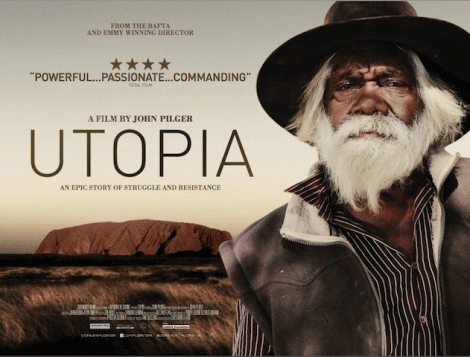
Interviewees include Aboriginal leaders, human-rights campaigners, academics and politicians, among them former prime minister John Howard.
Never one to shy away from controversy, the film will be released in Australia on Australia Day (or ‘invasion day’, as Pilger also calls it) and will play at indigenous festivals including Sydney’s Yabun Festival. Continue reading
How quickly Australia could transition to renewable energy
 Australia’s rapid renewables transition – all it needs is policy (good tables, graphics) REneweconomy, By Giles Parkinson on 5 November 2013 Australia has the opportunity to make an incredibly rapid transition to a mostly renewable energy-based grid within two decades with a strong carbon price and other incentives, but will most likely maintain the status quo and increase emissions from its grid if the carbon price is removed.
That is the broad conclusion of the Climate Change Authority’s draft investigation into the emissions reduction potential for the electricity report, included in a 245-page appendix to the 176 page overview released last week.
The scenarios unveiled by the CCA would make even the most optimist Green policy seem modest in comparison. By 2030, it says, renewables could make up 69 per cent of Australia’s generation (that includes a large slab of geothermal) and by 2050 the grid could be almost emissions free.
That is almost a complete reversal of the current make-up of Australia’s electricity grid, which is dominated by coal and is one of the most energy intensive in the developed world. This table below outlines the scenarios envisaged under the modelling.
The prognosis is not really that outlandish. Renewables already compete with new build fossil fuel generation, Continue reading
John Pilger talks about his new film “Utopia” about Australia
John Pilger’s film Utopia, about Australia, is to be released in British cinemas on 15 November and in Australia in January
 In the lucky country of Australia apartheid is alive and kicking John Pilger The Guardian, Wednesday 6 November 2013 “…….The parliament stands in Barton, a suburb of Canberra named after the first prime minister of Australia, Edmund Barton, who drew up the White Australia Policy in 1901. “The doctrine of the equality of man,” said Barton, “was never intended to apply” to those not British and white-skinned.
Barton’s concern was the Chinese, known as the yellow peril; he made no mention of the oldest, most enduring human presence on Earth: the first Australians. They did not exist. Their sophisticated care of a harsh land was of no interest. Their epic resistance did not happen. Of those who fought the British invaders of Australia, the Sydney Monitor reported in 1838: “It was resolved to exterminate the whole race of blacks in that quarter.” Today, the survivors are a shaming national secret…….
According to the Credit Suisse Global Wealth report, Australia is the richest place on Earth.
Politicians in Canberra are among the wealthiest citizens. Their self-endowment is legendary. …… Continue reading
1 This month

of the week – Australians for War Powers Reform (AWPR)
To see nuclear-related stories in greater depth and intensity
 Antinuclear