This week in nuclear news
 Well, it’s amazing what terrific access the pro nuclear lobby has to Australia’s mainstream media. We hear little about the precarious situation at Fukushima nuclear plant, or about the deplorable economics of nuclear power as evidenced right now in the UK, or the European Union wanting mandatory disaster insurance for nuclear power plants. … But I digress.
What Australians do hear about is the call by Tom Wigley, of Adelaide University, for nuclear power as the solution to climate change. Wigley is a member of the pro nuclear lobby group – Breakthrough Institute. (They’re the people who brought you that glossy nuclear advertising film “Pandora’s Promise”) Wigley thinks that climate change is a severe problem (which puts him at odds with the prevailing public position of the Liberal Party) And NSW Liberal MP Jonathon O’Dea came out with the same pro nuclear argument.
I’d say that Wigley and O’Dea got in just a bit too soon. They really needed to wait until the Abbott government had demolished all effective action to combat climate change. Then, we will all be allowed to believe in climate change again, even the Liberals, as they need a reason to promote nuclear power.
But now – there’s John Howard, arising from the political dead, to: (a) pour scorn on the “alarmist” scientific consensus on global warming in a speech to a gathering of British climate sceptics, comparing those calling for action on climate change to religious zealots. And (b) promote nuclear power. – “as it becomes more economic to have nuclear power, we should entertain it.” (Howard thinks that nuclear will get cheaper!)
Media. The ABC did show Mark Willacy’s low key, but very touching video on people of Fukushima. Much more radical will be John Pilger’s new film “Utopia” – on Australia’s Aboriginal people – to be shown on Invasion Day – sorry, I mean Australia Day 26 January.
Other news – Paladin Energy in trouble, as usual – losses, never any dividends. Trans Pacific Partnership under secret negotiations with Abbott government. Anti wind farm group trying every strategy to delay feasibility study on wind farm for King Island.
Environmentalists rally to dispute claims that nuclear power can fix climate change
 Greens dispute climate scientists on nuclear power http://thehill.com/blogs/e2-wire/189258-greens-dispute-climate-scientists-on-nuclear-power By Ben Geman, 7 Nov 13 Environmentalists are pushing back against four prominent climate scientists who say the green movement should embrace nuclear power plant construction to help fight climate change.
E2-Wire wrote about the open letter from the four scientists to environmentalists on Sunday.
Several anti-nuclear environmental groups said Tuesday that it didn’t change their minds. Greenpeace wasn’t swayed by the letter from scientists James Hansen, Ken Caldeira, Tom Wigley and Kerry Emanuel.
“While we respect Dr. Hansen and his advocacy to raise the alarm about catastrophic climate change, we thoroughly disagree that nuclear power has any role to play in addressing the threat posed by global warming. If we are to abate the worst impacts of climate change we need solutions that are fast, affordable, and safe. Nuclear is none of these,” said Jim Riccio, nuclear power analyst with Greenpeace USA. Continue reading
Dangers of the radioactive uranium mining industry will be obscured
Uranium mining IS different from other mining industries.
True, all mining has problems, and in fact, all mining does release some radioactive particles into the environment.
However, that pales into insignificance compared with the health and environmental problems of uranium mining. The only other mining of exceptionally serious health danger – is asbestos mining, and that is now long banned in Australia. Uranium mining should be banned, too.
Uranium mining leaves a legacy of radioactive tailings, of radioactively polluted waterways – problems that last long long after the mining company has disappeared from the scene, and from the responsibility.
Uranium mining is also completely involved in teh dangerous nuclear industry, and in catastrophes such as the Fukushima nuclear accident. It is also an essential part of the nuclear weapons industry.
It is a backward step for Australians to accept the idea that uranium mining is a “normal” industry, to be merged and hidden within the general mining scene.
! AUSTRALIAN URANIUM ASSOCIATION TO BE INTEGRATED INTO MINERALS COUNCIL OF AUSTRALIA (FED)
7 Nov 13, National mining industry advocacy is to be further strengthened through the integration of the Australian Uranium Association (AUA) and the Minerals Council of Australia (MCA). The decision to integrate the two organisations has been taken by member companies of both organisations. The move will enhance the uranium sector’s advocacy, reinforce its position in the mining industry.
Fukushima: the perilous process of removing nuclear fuel rods is soon to begin
Unit 4 presented particular dangers because its entire stock of fuel rods was in the pool at the time of the accident.
If the operation goes as planned, attention will then focus on the massive challenges posed by Units 1, 2 and 3.
Tepco will not confirm the precise timing of the fuel rod operation but after so much public outrage at the company’s handling of the crisis so far, scrutiny of this latest episode will be intense.
Fukushima nuclear plant set for risky operation http://www.bbc.co.uk/news/science-environment-24843657 7 Nov 13 David Shukman A task of extraordinary delicacy and danger is about to begin at Japan’s Fukushima nuclear power station.
Engineers are preparing to extract the first of more than 1,000 nuclear fuel rods from one of the wrecked reactor buildings. This is seen as an essential but risky step on the long road towards stabilising the site.
The fuel rods are currently in a precarious state in a storage pool in Unit 4. This building was badly damaged by an explosion in March 2011 following the Great Tohoku earthquake and tsunami. Moving the rods to safety is a high priority but has only become possible after months of repair work and planning.
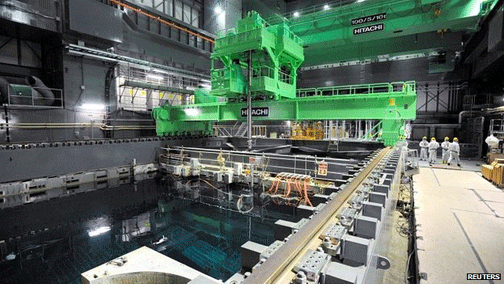
One senior official told me: “It’s going to be very difficult but it has to happen.” Continue reading
1 This month

of the week – Australians for War Powers Reform (AWPR)
To see nuclear-related stories in greater depth and intensity
 Antinuclear