Doubts raised on the safety of Ranger uranium mine
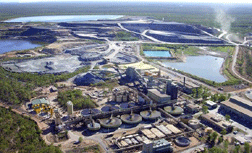 ACF questions Ranger uranium mine safety http://news.ninemsn.com.au/national/2013/11/08/16/49/acf-questions-ranger-uranium-mine-safety 8 Nov 13 It would be a case of good luck rather than good management, if it turns out there is no radiation contamination due to an an unauthorised vehicle leaving the Ranger uranium site in Kakadu, an environment group says. At about midnight on Sunday, a controlled vehicle used in the most contaminated parts of the Rio Tinto-owned Ranger mine left the site without permission. Continue reading
VIDEO: Dr Helen Caldicott on the legacy of Fukushima
The Future of Fukushima: Escape of Radiation is Virtually Unstoppable http://www.globalresearch.ca/the-future-of-fukushima-escape-of-radiation-is-virtually-unstoppable/5357229?utm_source=rss&utm_medium=rss&utm_campaign=the-future-of-fukushima-escape-of-radiation-is-virtually-unstoppable 7 Nov 13, Google Hangout with one of the most articulate and passionate advocates of citizen action to remedy the nuclear and environmental crises: Dr Helen Caldicott. ot any questions about our planet’s nuclear future, chances of Fukushima issue being tackled and pros and cons of the nuclear energy?Come and ask Helen Caldicott, who the Smithsonian calls one of the most influential women of the 20th century, at a Google+ Hangout.
Fukushima’s Legacy: “Shut Down All Nuclear Power Plants!”
In one of her recent articles on RT.com, Helen Caldicott wrote:
“As I contemplate the future at Fukushima, it seems that the escape of radiation is virtually unstoppable. The levels of radiation in buildings 1, 2 and 3 are now so high that no human can enter or get close to the molten cores. It will therefore be impossible to remove these cores for hundreds of years if ever.”
She believes that one of the steps Japanese government should take to prevent worst case consequences is to cancel the 2020 Olympics in Tokyo.
Hotter weather could turn people against Abbott’s climate change policies
The polling suggest that from a carbon tax-inspired nadir last year, concern about climate change is creeping up……..two separate studies of polling show that people are more likely to be concerned about climate change if they have directly experienced hot, dry weather.
 Abbott’s climate change Achilles heel: the weather November 9, 2013 The Age, Tom Allard National Affairs Editor Hotter days could bring with them a potent political wildcard.”……….Neither Foreign Affairs Minister Julie Bishop nor Environment Minister Greg Hunt will now be attending global talks in Warsaw on how to reduce global greenhouse emissions. Not even a parliamentary secretary will represent.
Japan’s food problems – Trans Pacific Partnership, as well as radiation worries
Experts here say farmers may have blown the whistle on the substitution scandal as they are outraged at being asked to accept tariff cuts as Japan moves to join the US-backed Trans-Pacific Partnership while cost-conscious catering bosses use inferior foreign products falsely labelled.
 Honour on the line as culinary racket rocks Japan RICK WALLACE, TOKYO CORRESPONDENT THE AUSTRALIAN NOVEMBER 09, 2013 CATERING and hotel managers in Japan are falling on their swords – or kitchen knives – as a food-substitution scandal grips this gastronomically obsessed country.Japan takes extravagant pride in its reputation as a culinary power and is on the cusp of beginning an export drive for its cuisine and ingredients.
But its hard-won reputation is being marred by ongoing distrust in some countries about radiation in food after Fukushima, and the erupting menu-fraud scandal.
One of the first casualties was the head of Hankyu hotel chain, who was forced to step down this week for using Brazilian chicken in a dish labelled as containing Japanese ingredients. Continue reading
Debunking the spin about Intergral fast Nuclear Reactors (IFRs)
Other Department of Energy studies showed that pyroprocessing, by generating large quantities of low-level nuclear waste and contaminated uranium, greatly increases the volume of nuclear waste requiring disposal, contradicting “Pandora’s Promise’s” claim it would reduce the amount of waste.
 Scientist: Film hypes the promise of advanced nuclear technology By Edwin Lyman, CNN November 7, 2013 In his zeal to promote nuclear power, filmmaker Robert Stone inserted numerous half-truths and less-than-half-truths in his new documentary “Pandora’s Promise,” One of Stone’s more misleading allegations was that scientists at a U.S. research facility, the Argonne National Laboratory, were on the verge of developing a breakthrough technology that could solve nuclear power’s numerous problems when the Clinton administration and its allies in Congress shut the program in 1994 for purely political reasons.
Like the story of Pandora itself, the tale of the integral fast reactor (IFR) — or at least the version presented in the movie — is more myth than reality. In the final assessment, the concept’s drawbacks greatly outweighed its advantages. The government had sound reasons to stanch the flow of taxpayer dollars to a costly, flawed project that also was undermining U.S. efforts to reduce the risks of nuclear terrorism and proliferation around the world…….
What did “Pandora’s Promise” leave out? First, it does not clearly explain what a “fast reactor” is and how it differs from the water-cooled reactors in use today. Most operating reactors use a type of fuel called “low-enriched” uranium, which cannot be used directly to make a nuclear weapon and poses a low security risk. The spent fuel from these water-cooled reactors contains weapon-usable plutonium as a byproduct, but it is very hard to make into a bomb because it is mixed with uranium and highly radioactive fission products.
Fast reactors, on the other hand, are far more dangerous because they typically require fuels made from plutonium or “highly enriched” uranium that can be used to make nuclear weapons.
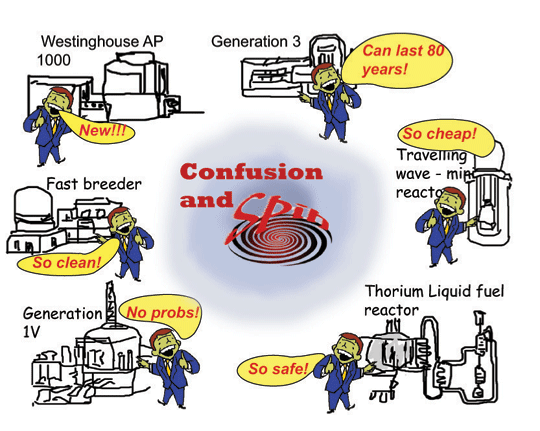
In fact, fast reactors can be operated as “breeders” that produce more plutonium than they consume. To produce the large quantities of plutonium needed to fuel fast reactors, spent fuel from conventional reactors has to be reprocessed — chemically processed to separate plutonium from the other constituents. Facilities that produce plutonium fuel must have strong protections against diversion and theft. All too often, however, security at such facilities is inadequate.
In the IFR concept, which was never actually realized in practice, reactor-spent fuel would be reprocessed using a technology called pyroprocessing, and the extracted plutonium would be fabricated into new fuel. IFR advocates have long asserted that pyroprocessing is not a proliferation risk because the plutonium it separates is not completely purified.
But a 2008 U.S. Department of Energy review — which confirmed many previous studies — concluded that pyroprocessing and similar technologies would “greatly reduce barriers to theft, misuse or further processing, even without separation of pure plutonium.”
See the Department of Energy review here (PDF) Continue reading
Off grid solar energy an economic benefit to mining companies
Of the 400 operating mine sites in Australia, 170 are either off-grid or connected to a smaller distribution network and needing to supply their own electricity. Natural gas and diesel dominate as fuel supplies for electricity generation and other energy uses. Rising prices of both of these fuels are leading mining companies to consider alternatives.
In South Africa, reliability of electricity supply has been a major issue for the mining sector, with electricity shortages in 2008 severely impacting operations and financial performance at a number of mine sites. The South African Government is addressing electricity supply issues through a renewable energy procurement programme….
Renewable energy, and in particular solar photovoltaic (PV), can offer significant benefits to mining companies. The unit cost of energy from solar PV is now below $US200/MWh in many locations compared to typical diesel generation costs of around $US300/MWh. This provides an opportunity for mining companies to reduce energy costs by reducing diesel consumption and maintenance costs with solar generation, particularly at sites with high day-time loads. The diesel engines are retained for night-time generation and as backup to the solar panels. Their operating life is also extended through lower annual operating hours.
Mining operations are strongly influenced by international commodity prices and operational focus can change rapidly in response to market signals. Diesel generators support this flexibility through their modularity and ability to be relocated to other sites if required. Solar modules also offer a degree of flexibility. With simple foundation systems and electrical reticulation, solar installations can theoretically be redeployed to other sites if mining operations need to close down. Recent trends in lease financing of solar modules provide further alignment with mining operations.
As panel prices continue to decrease and panel efficiency continues to increase, expect to see greater focus on renewable energy as a strategic consideration for mining operations. http://sourceable.net/grid-renewables-mining-energy-price-certainty/
Hunter Valley needs to get going on renewable energy
Hunter urged to look at renewable energy options http://www.abc.net.au/news/2013-11-08/hunter-urged-to-look-at-renewable-energy-options/5078014 Fri 8 Nov 2013,A Newcastle University professor says it is vital the region looks at renewable sources of energy in a bid to reduce the Hunter’s reliance on coal-fired power stations.
Professor Garry Wilgoose, who is the director of the University’s Centre for Climate Impact Management, will speak at a public meeting in Muswellbrook next week that is examining concerns with the region’s air and water quality.
Other speakers include public health physician Craig Dalton and Dr Gary Ellen from the University’s Tom Farrell Institute for the Environment.Professor Wilgoose says it is important alternative sources of energy are introduced sooner rather than later.
“We need them, mainly because we need to broaden the base of energy resources,” he said. “Looking into the future at carbon dioxide and methane and greenhouse, whether you believe it or not, and the evidence is pretty strong that it is happening, we need to get some runs on the ground in terms of serious installations that can go some way to offsetting the existing power stations.”
Western Australia’s biggest national park faces uranium threat
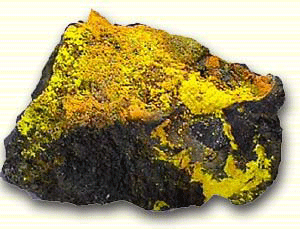 WA’s biggest national park faces uranium threat National and state environment groups have vowed to fight plans for a uranium mine that would directly threaten Western Australia’s largest national park. The Australian Conservation Foundation and the Conservation Council of WA will join groups across the nation to challenge plans by the Canadian multinational Cameco, which today lodged an Environmental Review Management Plan for the Kintyre uranium mine at Karlamilyi National Park (Rudall River) with the WA Environment Protection Agency.
“Kintyre is in one of the most unique and diverse ecosystems in the country and is directly connected to WA’s largest national park,” said ACF campaigner Dave Sweeney. “The proposal to mine at Kintyre has been actively contested since the 1980s and will continue to be a priority issue for the environment movement given the high conservation values of the area and the unique risks of uranium mining.
“Many things have changed since the first proposal to mine Kintyre, including a severe and sustained slump in the uranium price and increased pressure on nuclear power from the growth in renewable energy and concerns fuelled by the continuing Fukushima crisis.“This is not the time – and certainly not the place – to give a green light to yellowcake.”
The Kintyre uranium deposit is nestled between two branches of Yanadagodge Creek which feeds springs and lake systems throughout the Karlamilyi National Park and the communities of Punmu and Parngurr. Radioactive contamination of water sources is already an issue in the area with elevated uranium levels found in Parngurr’s (Cotton Creek) drinking water.
“We will use every available avenue to challenge this dangerous proposal,” said CCWA campaigner Mia Pepper. “Cameco’s plan for a 1km wide, 1.5km long open pit only 500 metres from the Yanadagodge Creek could have devastating impacts on this fragile desert ecosystem.”
“Uranium poses unacceptable and unnecessary risks to the environment and public health. Cameco’s plan is a long way from being economically viable or environmentally approved.”
Cameco’s plan will be open for public comment for fourteen weeks.
Contact: Dave Sweeney 0408 317 812 or Mia Pepper 0415 380 808
Safety slip up at ERA’s Ranger uranium mine disturbs Aboriginal landowners
Uranium contamination fears: police investigate Rio Tinto Ranger mine SMH, November 8, 2013 Peter Ker Resources reporter Rio Tinto’s relationship with an indigenous group in Kakadu National Park has taken ”two steps backward” after a safety breach at the Ranger uranium mine.
The Rio subsidiary that operates Ranger, Energy Resources of Australia, has confirmed that a vehicle used within the mine was taken out of controlled areas, sparking contamination fears among the nearby Mirrar people. Police are investigating the incident, which took place without the consent of ERA management in the early hours of Sunday morning, and which some believe may be a breach of the company’s authorisation to mine.
Like all uranium mines, Ranger operates under strict conditions to ensure dangerous levels of uranium do not contaminate the nearby area. ERA said the car – which was supposed to remain inside the mine at all times – had been checked and was ”free of contamination”.
But Justin O’Brien, who represents the Mirrar people, said it had caused great concern among the local community.
”We think it is very serious that you could take potentially contaminated material from an operational mine site, avoid all scrutiny, leave the mine site with it and then be found down the highway,” he said. ”There needs to be a broader inquiry into how on earth this could happen in the first place.”
ERA’s relationship with the Mirrar people is crucial to its survival, given the company has agreed not to restart mining at Ranger without approval from the group. Ranger ceased operating as an open-cut mine last year, and its only future lies in winning approval to become an underground mine in coming years.
The nearby Jabiluka uranium deposit will also not be mined until the Mirrar people give their full support, something that appears unlikely any time soon………Australian Conservation Foundation spokesman Dave Sweeney said it was not the first breach at Ranger, and it was time for Rio Tinto to ”reconsider the project”. http://www.smh.com.au/business/uranium-contamination-fears-police-investigate-rio-tinto-ranger-mine-20131107-2x46w.html#ixzz2k5tWwFN7
RADIO 3CR: Saturday Nov 9 Australian Nuclear Free Alliance
 *Saturday morning November 9 at 10-10:30 am on 3CR*
 The Australian Nuclear Free Alliance
Strong and deadly in 2013
ANFA is an alliance of Aboriginal people, activists, doctors, unionists and NGOs from all across the country to connect the dots and battle the uranium industry together. This unique gathering meets once a year and this week’s Radioactive Show introduces twenty-eight individuals at this years meeting held in the Adelaide hills in October, woven between the gorgeous music of June Mills. Be inspired and energised for the year ahead, we’re in good company.
Australian government snubs international climate talks
Australian Youth Climate Coalition 8 November 13 Greg Hunt MP just announced that our Government will not send an Australian Minister to the UN climate talks in Warsaw next week.
Instead they will repeal our only climate change policy.
If they won’t lead we will. November 17th we will show our Government what climate leadership looks like.
6,375 nuclear fuel rods in Fukushima common storage pool MUST be continually cooled
 Nuclear Expert: Fuel rods are “in a jumble” at Fukushima Unit 4 pool; Unclear if they are cracked — US pressing Japan on removal, fears terrorist activity at plant (VIDEO) http://enenews.com/nuclear-expert-fuel-rods-are-in-a-jumble-at-fukushima-unit-4-pool-unclear-if-they-are-cracked-us-pressing-japan-on-removal-fears-terrorist-activity-at-plant-video
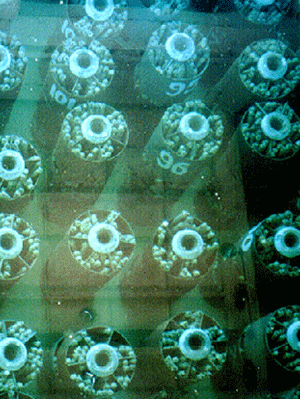
Telegraph,, Nov. 6, 2013: “Did you ever play pick up sticks?” asked a foreign nuclear expert who has been monitoring Tepco’s efforts to regain control of the plant. “You had 50 sticks, you heaved them into the air and than had to take one off the pile at a time. “If the pile collapsed when you were picking up a stick, you lost,” he said. “There are 1,534 pick-up sticks in a jumble in [sic] top of an unsteady reactor 4. What do you think can happen? I do not know anyone who is confident that this can be done since it has never been tried.” Even now, it is not clear whether any of the rods, containing transuranic and transplutonic elements, are cracked, he said. […]
Others have issued even more dire warnings, with Charles Perrow, a professor emeritus at Yale University, warning: “The radiation emitted from all these rods, if they are not continually cool and kept separate, would require the evacuation of surrounding areas, including Tokyo. Because of the radiation at the site, the 6,375 rods in the common storage pool could not be continuously cooled; they would fission and all of humanity will be threatened, for thousands of years.”
Dangerous Operation at Fukushima’s Reactor No 4 Could Ignite “A chain reaction”
Nikkei, Nov. 7, 2013: [Tepco] will begin removing spent nuclear fuel from the storage pool at the Fukushima Daiichi plant’s No. 4 reactor this month, a company official said at a press corps gathering at the site Wednesday. […] The U.S. and other countries have been pressing Japan to securely store the spent fuel, fearing another earthquake or terrorist activity. […] the upper part of the No. 4 reactor building was severely damaged, causing a large amount of rubble to fall into the pool. Concerns have arisen that the fuel may be damaged, making it even less certain whether the work will proceed smoothly.
Watch Bloomberg’s report on Unit 4 here
“Impolite” for Japanese lawyer to draw Emperor’s attention to Fukushima nuclear crisis
 Anti-nuclear letter handed to Japan’s Emperor Akihito causes uproar, news.com.au, NOVEMBER 07, 2013 A NOVICE Japanese lawmaker who wanted to draw attention to the Fukushima nuclear crisis has caused an uproar by doing something taboo: handing a letter to the emperor.
The ruckus began at an annual autumn Imperial Palace garden party last week. As Emperor Akihito and his wife, Michiko, greeted a line of guests, outspoken actor-turned-lawmaker Taro Yamamoto gave the emperor the letter – a gesture considered both impolite and inappropriate…….. Yamamoto’s action drew criticism from both ends of the ideological spectrum and left many Japanese baffled by what they consider to be a major breach of protocol: reaching out to the emperor in an unscripted act………Many conservatives still consider the emperor and his family divine (“the people above the clouds”) and believe a commoner shouldn’t even talk to him…….The Imperial Household Agency vice chief said that Yamamoto’s action was “inappropriate,” and that the incident could affect operation of future palace public events. He said the agency has the letter, and Akihito hasn’t read it.
Yamamoto’s anti-nuclear stance makes him a target for conservatives in the ruling Liberal Democratic Party, which is pushing for a return to nuclear power. Education Minister Hakubun Shimomura called for Yamamoto’s resignation……
Nakano [ Koichi Nakano, a political scientist at Sophia University in Tokyo] said Yamamoto has at least drawn some public attention to the potential health risks faced by children from the Fukushima area and plant workers. “After all, he might have achieved part of his goals, ” Nakano said. http://www.news.com.au/world/anti-nuclear-letter-handed-to-japans-emperor-akihito-causes-uproar/story-fndir2ev-1226755434400
VIDEO: Call to stop public subsidy to anti wind group Waubra Foundation
 VIDEO Greens target anti-wind farm lobby group Waubra Foundation over oil industry links http://www.abc.net.au/news/2013-11-07/greens-bid-muzzle-anti-wind-farm-lobby-waubra-foundation/5075190?section=vic By environment reporter Jake Sturmer and Sam Clark in Waubra The Greens have launched a bid to muzzle one of Australia’s most prominent anti-wind farm lobbies.
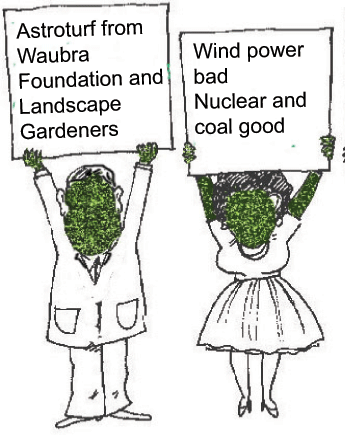 The Waubra Foundation is named after the tiny north-western Victorian town of Waubra, which is home to more than 120 wind turbines and about 500 residents. Chief executive officer Sarah Laurie travels around the country, highlighting the alleged health problems wind turbines cause.
But the National Health and Medical Research Council has said there is insufficient scientific evidence linking wind turbines with health problems.
And the Greens say there is no credible scientific or medical body that supports the existence of wind turbine syndrome.
[The organisation] being granted status as a health charity means that they are the beneficiary of enormous public subsidies. Those public subsidies are being used to spread misinformation about wind energy and its health impacts.
“[The organisation] being granted status as a health charity means that they are the beneficiary of enormous public subsidies.
“Those public subsidies are being used to spread misinformation about wind energy and its health impacts.”Senator di Natale has made a complaint to the Australian Taxation Office (ATO) and the Australian Charities and Not-For-Profits Commissioner (ACNC), calling for an urgent review.
Surge in cancers in Southern Italy due to dumped radioactive nuclear trash
‘To clean it up it would cost the entire Italian budget for a year I think.’
The lower house in the Italian Parliament had elected to make the documents public in the interests of transparency.
Toxic nuclear waste dumped illegally by the Mafia is blamed for surge in cancers in southern Italy He added: ‘We disposed of 70 or 80 trucks from the north, millions and millions of tonnes. Read more: http://www.dailymail.co.uk/news/article-2483484/Toxic-nuclear-waste-dumped-illegally-Mafia-blamed-surge-cancers-southern-Italy.html#ixzz2k64qz8UL
- Italian Senate investigating link between pollutants and 50 per cent rise
- Classified documents from 1997 reveal poison would kill everyone
- Nuclear sludge, brought from Germany, was dumped in landfills
By HANNAH ROBERTS IN ROME 1 November 2013 Toxic nuclear and industrial waste, dumped illegally by the Neapolitan mafia, is responsible for a surge in cancers in southern Italy, it is feared.
The Italian Senate is investigating a link between buried pollutants and a rise of almost 50 per cent in tumours found in the inhabitants of several towns around Naples.
In classified documents from 1997, only now released to the public, a mafia kingpin warned authorities that the poison in the ground would kill everyone ‘within two decades’. Camorra chief Francesco Schiavone, once the world’s number one mafia fugitive, said: ‘The inhabitants are all at risk of dying from cancer within twenty years.
‘In towns like Casapesenna, Casal di Principe, Castel Volturno, and so on, they have, perhaps, twenty years to live. In fact I don’t think anyone will survive.’
Doctors first noticed that cancers in towns around Naples were on the rise in the 1990s. But since that time they have increased by 40 per cent in women and 47 per cent in men.
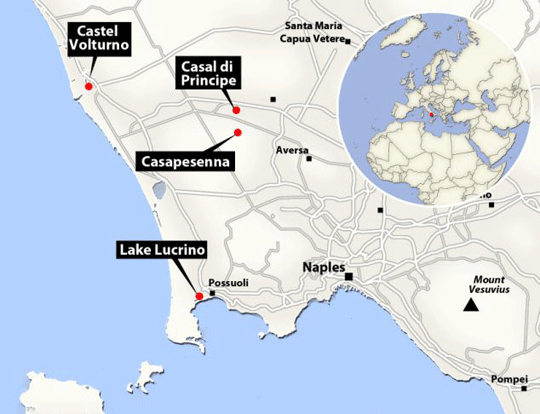
In secret out-of-court testimony he told lawyers how the Casalesi clan ran ‘a military style operation’ dumping millions of tonnes of waste on farmland, in caves, in quarries and even on the edge of towns. The mafia family also disposed of contaminated waste in Lake Lucrino and all along the coast.
Operatives were equipped with real police and carabinieri uniforms, as well as firearms, and the clans raked in huge profits of up to 600 million of the old lire (£200,000) a month. The industry became an officially clan-sanctioned ‘business’ in 1990 but had been going on long before. Nuclear sludge, brought in on trucks from plants in Germany, was dumped in landfills, Schiavone said. The trucks would unload waste at night before earth was thrown over with a JCB.
He said: ‘I know that some is on land where buffalo live today, and on which no grass grows’
The cost of a clean up would run into billions, he said, describing several sites in the suburbs of Naples.
Schiavone revealed: ‘We buried 520 drums of toxic waste in a specially dug quarry near the town of Pure Villaricca. But we also did it in very populated places, outside towns- at Casal di Principe behind the sports field at the edge of the motorway.’He added: ‘We disposed of 70 or 80 trucks from the north, millions and millions of tonnes.
‘To clean it up it would cost the entire Italian budget for a year I think.’ The lower house in the Italian Parliament had elected to make the documents public in the interests of transparency.
1 This month

of the week – Australians for War Powers Reform (AWPR)
To see nuclear-related stories in greater depth and intensity
 Antinuclear