Notes on Australian nuclear, climate news this week
 Senate motion; the indefatigable Senator Ludlam brings a motion (14 November) in Parliament to call on the government to assess the situation (removal of nuclear fuel rods from Unit 4) at Fukushima, and evaluate, advise the Senate on the risks and radioactive pollution of the Pacific Ocean.
Radioactive trash. Warning to Western Australia on chance of it being selected, if Muckaty nuclear waste dump plan falls through. WA is the only state with a dedicated low-level nuclear waste storage facility. The trash is not medical, as the government would have us believe, but wastes from the Lucas Heights nuclear reactor. (and perhaps the precursor to importing other countries’ radioactive trash)
Uranium. As USA’s nuclear power plants shut down, falling like ninepins, Australia’s uranium mines look like following the trend. The Ranger mine in the Northern territory is closed. Now the Honeymoon mine in South Australia is closing. Uranium explorers are getting nervous. Thundelarra sells its Hayes Creek uranium asset
Climate change: the Australian government snubbed the United Nations climate change talks in Warsaw, by for the first time in 16 years, not sending a Minister there. Meanwhile Tony Abbott talked with Alan Jones on radio, repeating misconceptions about wind energy, and renewable energy in general. Abbott begins the new Parliament with a determination to remove carbon pricing.
Australia refuses to join new UN Green Climate Fund that is set up to help poor countries deal with climate change. World Meteorological Association declares 2013 to be becoming the seventh hottest year on record, and singles out Australia as a country most affected.
14 November – Motion before the Senate on Fukushima and Pacific Ocean radiation pollution
 NOTICE OF MOTION
SENATOR LUDLAM
I give notice that on 14 November 2013 I shall move:
That the Senate notes:
1. The nuclear crisis at the Fukushima Daiichi reactor site is progressively deteriorating;
2. Australian uranium was in each of the reactors at Fukushima on 11 March 2011, and;
3. Nuclear utility TEPCO is embarking on the risky removal of more than 1500 highly irradiated fuel rods from Unit 4 of the reactor complex.
Calls on the government to
1. Provide the Senate with an assessment of the likelihood of success, and consequence of failure of fuel recovery operations;
2. Inform the Senate of whether or not it has evaluated the contamination risks to Pacific Ocean ecosystems, fisheries and communities in the event of a fire or other accident during fuel recovery operations;
3. Regularly advise the Senate of progress toward the removal of fuel from Fukushima Daiichi Unit 4 and subsequent progress toward reducing the flow of radioactive water into the Pacific Ocean.
Government may target Western Australia for radioactive trash dump
 Mr Sweeney said substantial nuclear waste was created at Australia’s nuclear reactor Lucas Heights, 31 kilometres from the Sydney CBD, and not medical waste from cancer treatments and scientific research as the government has previously stated.
“Nuclear medicine is not the driver,” Mr Sweeney said.
“It’s deeply misrepresentative. The government has been asked not to use this language.”
 Western Australia in nation’s nuclear waste dump sights SMH, Leanne Nicholson, 12 Nov 13 Australia’s nuclear waste could be dumped in Western Australia if a Federal Court challenge by traditional owners against a Northern Territory site selected by the federal government is successful.
WA, the only state with a dedicated low-level nuclear waste storage facility, has been identified by leading environmental group Australian Conservation Foundation as a legitimate option for a national nuclear waste dump if a challenge by Muckaty Station traditional owners is upheld.
Traditional owners will contest plans for the proposed low-level and intermediate level nuclear waste dump, selected by the then-Gillard government in 2010, on the Aboriginal freehold landholding, also known as Warlmanpa. The challenge states the nomination of Muckaty is invalid and the Northern Land Council did not correctly identify the traditional owners, did not consult adequately and did not get proper consent before recommending the site.
ACF’s nuclear free campaign director Dave Sweeney told Fairfax Media that if the challenge was successful, WA – previously named as a possible site for nuclear waste storage – would be considered a feasible location. “Clearly if Muckaty falls over,” Mr Sweeney said, “everywhere is going to come back into the frame and WA wasn’t ticked off but it was in the frame. Continue reading
The Honeymoon is over: post Fukushima reality check for Australia’s uranium industry

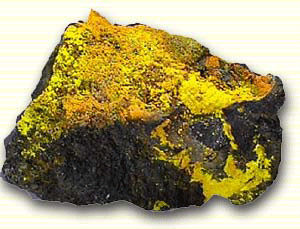 13 Nov 13 ACF has described reports of the imminent closure of the Honeymoon uranium mine in South Australia as further proof of the marginal and embattled nature of the uranium sector that highlights the need for an evidence based assessment of Australia’s uranium trade.
The Honeymoon mine in north east South Australia is set to close following a write down in the mine’s value of over seventy million dollars due to a combination of high costs, technical difficulties and a collapsing uranium price as the market fallout from the Fukushima nuclear crisis in Japan continues.
The Honeymoon closure is the latest in a run of bad news for Australia’s uranium industry that includes:
- Sustained losses and operational failures at Energy Resources of Australia’s Ranger mine in Kakadu
- The scrapping of plans for a massive expansion of BHP Billiton’s Olympic Dam mine in SA because of the ‘uncertain’ uranium market
- A fall of around fifty per cent in the uranium commodity price and larger falls in the share value of uranium mining companies since the Fukushima crisis began
- Attempts by Queensland uranium promoters to receive ‘royalty relief’ and public concessions even before making any formal applications to mine
- Projects stalled, scrapped or deferred across WA, SA and the NT and uranium hopefuls like Toro Energy effectively stranded without the necessary approvals or financing
- Increased shareholder anger over the poor performance of uranium companies like the Perth based Paladin Energy
- Sustained global scepticism over the role of nuclear energy following Fukushima – a continuing crisis directly fuelled by Australian uranium Continue reading
Fortunately the Philippines’ Bataan nuclear power plant was never activated, never fueled

 Luckily, the Bataan Nuclear Power Plant was never fully activated. The Bataan Nuclear Power Plant is 45 miles west of Manila atop volcanic activity It is located on a 3.57 square kilometre government reservation at Napot Point in Morong, Bataan. It was the Philippines’ only attempt at building a nuclear power plant.
Philippines Minister calls for action on climate change, links global warming to typhoons
 “It’s time to stop this madness” – Philippines plea at UN climate talks RTCC 11 November 2013, Yeb Sano tells UN summit in Warsaw “colossal devastation” from Typhoon Haiyan should serve as warning to planet Philippines lead negotiator Yeb Sano has just addressed the opening session of the UN climate summit in Warsaw – calling for urgent action to prevent a repeat of the devastating storm that hit parts of his country at the weekend. A full transcript of his speech is below………
The science has given us a picture that has become much more in focus. The IPCC report on climate change and extreme events underscored the risks associated with changes in the patterns as well as frequency of extreme weather events. Science tells us that simply, climate change will mean more intense tropical storms. As the Earth warms up, that would include the oceans. The energy that is stored in the waters off the Philippines will increase the intensity of typhoons and the trend we now see is that more destructive storms will be the new norm.
This will have profound implications on many of our communities, especially who struggle against the twin challenges of the development crisis and the climate change crisis. Typhoons such as Yolanda (Haiyan) and its impacts represent a sobering reminder to the international community that we cannot afford to procrastinate on climate action. Warsaw must deliver on enhancing ambition and should muster the political will to address climate change…..
What my country is going through as a result of this extreme climate event is madness. The climate crisis is madness. ………. :http://www.rtcc.org/2013/11/11/its-time-to-stop-this-madness-philippines-plea-at-un-climate-talks/#sthash.XNwbM2xW.OYYJsoyC.dpuf
Adam Bandt addresses media on global warming
VIDEO: Sydney could have 100% renewable energy by 2030
Allan Jones: Sydney’s Master Plan for 100% Renewable Energy by 2030
Fukushima children: 26 confirmed thyroid cancers, 32 suspicious biopsy results
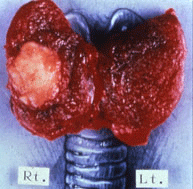 26 Thyroid Cancer Cases Confirmed in Fukushima Children: Preliminary Results of FY2011-2013 Thyroid Ultrasound Examination http://fukushimavoice-eng2.blogspot.co.uk/2013/11/26-thyroid-cancer-cases-confirmed-in.htmlThirteenth Prefectural Oversight Committee convened on November 12, 2013, releasing the results of the latest thyroid examination as part of the prefectural health management survey.
Total number of children examined as of September 30, 2013: 289,960
Total number of children whose initial examination results are confirmed: 225,537
(up to the August 23rd, 2013 examination)
Assessment A1 121,525 (no nodules or cysts found)
Assessment A2 102,453 (nodules 5.0 mm or smaller or cysts 20.0 mm or smaller)
Assessment B 1,558 (nodules 5.1 mm or larger or cysts 20.1 mm or larger)
Assessment C 1 (requiring immediate secondary examination)
Secondary examination includes more detailed thyroid ultrasound, blood and urine tests, and fine-needle aspiration biopsy if warranted.
1,559 are eligible for secondary examination
1,148 have actually undergone secondary examination
897 finished the secondary examination
During the committee meeting, Shinichi Suzuki, the head of the thyroid examination, mentioned that one of the 26 confirmed cancer cases was not papillary thyroid cancer: This case is undergoing cytological reevaluation to determine the subtype of thyroid cancer.
During the press conference following the committee meeting, no information was given, as to the details of individual cancer cases, such as the presence of lymph node metastasis or the type of surgery done.
Shinichi Suzuki maintains that this thyroid examination was originally initiated to assess the baseline thyroid condition of Fukushima children, as there is no such epidemiological data available in Japan, with an understanding that it was not possible to obtain pre-exposure data. It is being conducted on an assumption that the effect of radiation exposure would not be obvious for at least four years after exposure, as was seen after the Chernobyl accident.
If these cancer cases were indeed screening effects, similar malignancy would have to be expected in other parts of Japan. As for the thyroid survey conducted by the Ministry of Environment in Aomori, Yamanashi and Nagasaki Prefectures, widely recognized as a comparison study, no cancer data is available from the cases of thyroid ultrasound abnormalities detected. Also it is not age- and gender-matched, and there is a question about the possibly uneven quality of ultrasound examination itself between the two studies. The MOE spokesperson indicated that abnormal cases are undergoing further examination, and more data might become available for comparison.
Stuxnet computer worm from USA and Israel – infected Russian nuclear plant
 US-Israeli computer super-worm hit Russian nuclear plant – Kaspersky Rt.com : November 12, 2013 The CEO of one of the world’s foremost computer security firms says the Stuxnet worm that targeted Iranian nuclear facilities may have also infiltrated similar critical systems in Russia.
If accurate, allegations that Stuxnet snuck its way into Russia could implicate the United States and Israel in an even broader act of cyberwar than previously reported.
Since Stuxnet was discovered in 2010, the media has all but confirmed that the US and Israel collaborated on the computer worm to try and cripple machinery inside Iran’s nuclear power plants. Senior White House officials speaking to the New York Times have previously lent credence to that accusation, National Security Agency whistleblower Edward Snowden confirmed in a Der Spiegel interview earlier this year and the origin of the worm is nowadays hardly contested. Speaking in Australia last week, however, the head of the international IT firm, Kaspersky Lab, raised new questions regarding the actual scope of the secretive program.
Eugene Kaspersky was making a presentation at the National Press Club of Australia on the topic of cybersecurity when he warned of the serious ramifications that could be caused by unleashing viruses. ……
Eugene Kaspersky Press Club 2013
After Kaspersky’s remarks began to circulate like wildfire on the Web, his company issued a press release reiterating the size and scope of Stuxnet, based on what scientists have already managed to learn. “According to data from the Kaspersky Security Network, by the end of September 2010, more than 100,000 computer systems in approximately 30,000 organizations around the world were infected by Stuxnet,” the company confirmed.
As Kaspersky told the crowd in Australia, though, these computer worms — estimated to cost tens of millions of dollars to manufacture — are indeed quite capable of coming back and infecting entities it never intended to impact. “Everything you do is a boomerang. It will get back to you,” he said.
According to Kaspersky, companies need to take necessary steps to protect themselves from hackers, whom he estimates to be behind millions of attacks every day. And even if attacks against critical infrastructure components are limited, he cautioned that no target is was too large to be subject to a cyber-attack…… http://rt.com/usa/kaspersky-russia-nuclear-plants-612/
Japan report: Fukushima residents may never go home
 Fukushima residents may never go home, say Japanese officials Admission deals blow to government assurances that radiation near the Daiichi nuclear plant can be brought down to safe levels Justin McCurry in Tokyo theguardian.com, Wednesday 13 November 2013 Japanese officials have admitted for the first time that thousands of people evacuated from areas near the Fukushima Daiichi nuclear powerplant may never be able to return home.
A report by members of the governing Liberal Democratic party [LDP] and its junior coalition partner urges the government to abandon its promise to all 160,000 evacuees that their irradiated homes will be fit to live in again. The plan instead calls for financial support for displaced residents to move to new homes elsewhere, and for more state funding for the storage of huge quantities of radioactive waste being removed from the 12-mile evacuation zone around the plant.
The parties’ admission that some areas closest to the wrecked facility will remain too contaminated for people to make a permanent return is a blow to official assurances that radiation can be brought down to safe levels.
The government has come under pressure to abandon those promises amid evidence that attempts to reduce radiation to its target of 1 millisievert a year are failing. Decontamination is woefully behind schedule in seven of the 11 selected towns and villages, forcing authorities to concede recently that they will not complete the work by the March 2014 deadline…….
“At some point in time, someone will have to say that this region is uninhabitable, but we will make up for it,” the LDP’s secretary general, Shigeru Ishiba, said recently. It now appears that officials will abandon efforts to clean up highly irradiated areas closest to the plant and focus on areas where there is a more realistic chance of success……. The last category includes the small town of Okuma, where evacuated residents told the Guardian over two years ago that they had given up all hope of ever returning…… http://www.theguardian.com/environment/2013/nov/12/fukushima-daiichu-residents-radiation-japan-nuclear-power
High time for a Treaty with Australia’s indigenous people
Unlike nations such as New Zealand, Canada and the US, agreements such as treaties have not been reached that recognise a measure of indigenous sovereignty. Instead, in Australia, decisions have often been imposed on Aboriginal people by parliaments and governments lacking even a single indigenous member.
A treaty could give rise to stronger, and more capable, institutions of Aboriginal governance…..
 Treaty with Australia’s indigenous people long overdue SMH, November 12, 2013 George Williams Professor of Law at the University of NSW Treaties and other forms of agreements are accepted around the world as the means of reaching a settlement between indigenous peoples and those who have settled their lands.
Treaties can be found in countries such as the US, Canada and New Zealand. Indeed, in nations such as Canada, new treaties are still being made.
Australia is the exception. We are now the only Commonwealth nation that does not have a treaty with its indigenous peoples. We have never entered into negotiations with them about the taking of their lands or their place in this nation. Rather than building our country on the idea of a partnership with Aboriginal people, our laws have sought to exclude and discriminate against them.
This is reflected in the text of our constitution, which in 1901 created the Australian nation. Continue reading
Australian government must stop picking on vulnerable postcodes for a nuclear waste dump
 Western Australia in nation’s nuclear waste dump sights SMH, Leanne Nicholson, 12 Nov 13 “…….About 10,000 44-gallon drums of nuclear waste are stored at Woomera, South Australia. In 2002 Woomera was selected by the Howard government as the proposed site for the national nuclear waste repository.
However, the announcement received fierce opposition from the South Australian government of the day and during a legal challenge, WA was named as a potential site if the Howard government failed to secure Woomera. After a Federal Court challenge by SA, the Howard government dropped the plan in 2004.
Mr Sweeney said there was no question Australia needed a storage facility but a change in approach by government to site selection was needed and more community consultation was required to secure a location. “This has been going on for 20 years and communities have been bombarded,” Mr Sweeney said.”There has always been this urgent need for politics and post codes, there’s got to be a mature way to handle this, a fair dinkum discussion, is needed.
“They need to move this obsession with selecting vulnerable postcodes. “No community should bear the brunt of this.
“Work with the community … It’s not A plus B equals waste dump.”
“Radioactive waste is a very difficult area but it’s not the only difficult areas the government has had to work out and you don’t solve them by making top-down hard decisions.”It’s a national issue, it’s a national responsibility, it’s a legacy for all Australians, so let’s get it right.
Fairfax Media has contacted the Australian Department of Resources Energy and Tourism and the WA Department of Finance for comment http://www.smh.com.au/federal-politics/western-australia-in-nations-nuclear-waste-dump-sights-20131112-2xdzn.html#ixzz2kYINbTw1
Cogeneration sugar mill plants give renewable energy a new lease of life
Sugar mill renewable energy plants kick started by overseas sale. ABC Rural News, 12 Nov 13 Swiss-based company Capital Dynamic has taken over two of the country’s major renewable energy assets for an undisclosed sum.The cogeneration plants at the Broadwater and Condong Sugar Mills, in northern NSW, recommenced operations last Friday processing sugar cane trash from the current harvest.
They cost the NSW Sugar Milling Co-operative $220 million to build but have been shut down while receivers looked for a buyer.David Scaysbrook, managing director of Clean Energy Infrastructure at Capital says they have had their eye on the plants for a year.
“We have a history of taking over broken assets..we’ve done similar things in the UK in gas, coal and methane assets. We are operational experts and we think we can add something to the resuscitation of the business.”…….. Capital Dynamics refers to its purchase of the two cogeneration plants as a “compelling investment”.
The company’s David Scaysbrook, managing director the Clean Energy and Infrastructure team, says their investment breathes new life into the power plant operation and the future prospects for the local community in which they operate.
He says “especially to the local sugar cane growers who are so critical to the region’s economy.”
Capital Dynamics plans to “operate the assets over the very long term, to improve them and to deliver to their investors strong financial returns from multiple revenue sources”.
Mr Scaysbrook says it is a genuine, long-term partnership model.
The company’s chief executive officer, Stefan Ammann, says their team has decades of experience in successfully investing and operating thermal plants as well as other renewables such as wind and solar.
Capital Dynamics now owns and manages more than 230 mega watt of clean energy capacity in North America, Europe and Australia, with 68 MW of those now in northern NSW. http://www.abc.net.au/news/2013-11-11/cogen-plants-sold-to-foreign-investor/5083058
1 This month

of the week – Australians for War Powers Reform (AWPR)
To see nuclear-related stories in greater depth and intensity
 Antinuclear