Japanese nuclear expert gives Queensland a warning on uranium exporting, and nuclear waste
Top Japan nuke expert warns Qld on uranium http://au.news.yahoo.com/a/19813899/top-japan-nuke-expert-warns-qld-on-uranium/ 7 News, MARTY SILK -November 13, 2013 Mining uranium is far more dangerous to human health than nuclear power, a top Japanese expert warns. Japan Atomic Energy Commission vice chairman Dr Tatsujiro Suzuki says Queensland’s government must be extremely careful if it allows mining to go ahead.
The state wants to begin assessing uranium mining applications from next year after lifting a longstanding ban.
But Dr Suzuki warns that countries must plan every aspect of uranium mining meticulously. “Mining actually poses larger risks than reactors, even when there are not accidents,” he told AAP at the Australia-Japan Dialogue in Brisbane on Wednesday.
“Uranium miners are regularly exposed, there’s high exposure in areas around mines and the potential for atmospheric contamination.
“You have to be very, very careful.”
 Dr Suzuki says the key issue is how to safely store more than 1300 spent nuclear fuel rods. Japan is set to run out of nuclear waste storage capacity within six years and is looking to sign deals with uranium suppliers who are prepared to help it dispose of radioactive waste.
He added that an independent regulator should also ensure that Queensland uranium exports were only used for peaceful purposes.
Australia signed a deal to export uranium to India last year and Dr Suzuki said it couldn’t be certain that the uranium was only being used for civilian purposes.
India hasn’t signed the nuclear non-proliferation treaty and access to Australian uranium could help free up its domestic reserves for use in nuclear weapons.
Australia’s forgotten nuclear veterans
 LEST WE FORGET NUCLEAR VETERANS HTTP://GREENS.ORG.AU/NEWS/LEST-WE-FORGET-NUCLEAR-VETERANS Between 1952 and 1963, approximately 16,000 Australian civilians and serviceman were exposed to nuclear fallout when British nuclear weapons were tested at the Montebello Islands in Western Australia, Maralinga and Emu fields in South Australia, and over the Christmas and Malden Islands.
“Today Australians mark the sacrifice, suffering and deaths of our servicemen and women in all wars, but unfortunately some of our veterans have been forgotten,” said Australian Greens spokesperson on nuclear policy, Senator Scott Ludlam.
“We are running out of time to exercise our duty of care to the 1892 Australian nuclear veterans that are denied Gold Card health care costed by the Parliamentary Budget Office at less than $30m per year. Continue reading
A warning about Japan’s “Nuclear Village”
if Hirose and others like him outside of the ‘‘nuclear village’’ are right in their warnings, then we in other countries will need more information, not less, as Japan debates putting its reactors back online
GREG RAY: Beware nuclear village Newcastle Herald, By Greg Ray Nov. 14, 2013 “I’M a Japanese woman from Kyoto,” last night’s surprise email began…..
….I bought a copy of Japan-based Australian journalist Mark Willacy’s book, Fukushima, hoping it would help me cut through some of the myths and lies about the nuclear accident. It did that, and more, alerting me to much wider issues in Japan’s nuclear industry.
Willacy criticised Japan’s “nuclear village”, a club of politicians, scientists, journalists and business people who tightly control information about the atomic energy industry in Japan. Journalists and others who dare to disagree with the village-approved line risk being ostracised and ridiculed, Willacy wrote.
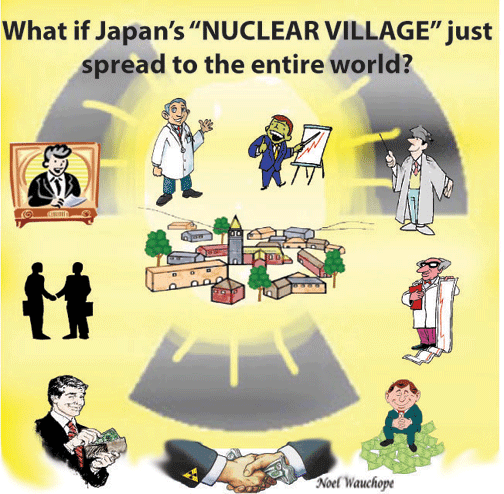
 So I sought books by Japanese writers from outside “the village”, and found Fukushima Meltdown, by Takashi Hirose.
Even allowing for the possibility of a certain amount of overstatement – Hirose’s book is rather emotional behind its facts and figures – the descriptions of Japan’s 50-plus nuclear power plants make scary reading. Hirose itemises their locations relative to geological faults and volcanoes, their various levels of preparation for predictable disasters and their histories of accidents and problems.
In addition to the “normal” nuclear power plants (off-line since the Fukushima melt-downs), Japan also has a fast-breeder reactor with a terrible accident history, some reactors that use deadly plutonium as well as uranium for fuel and the Rokkasho Village nuclear fuel reprocessing facility. Continue reading
Abbot government backs USA corporations against Australia’s public interest
Australia backs the US at every turn against its own consumers The Age, November 14, 2013 Peter Martin Economics correspondent In public the Australian government is on the side of consumers. Yet behind closed doors it is siding with the US government to block them at every turn.
The extraordinarily detailed information on negotiating positions released by WikiLeaks shows Australia repeatedly backing the interests of the US against the objections of countries including Canada, New Zealand, Japan, Singapore and Vietnam on questions involving intellectual property. Australia is often the only one of the 12 parties to the Trans Pacific Partnership negotiations to do so……..

In 2005 the High Court ruled that it was legal for Australians to use so-called ”mod chips” to bypass the copy-protection measures in Sony Playstations. In June this year a committee made up of both sides of Parliament unanimously recommended Australia amend its copyright law to put beyond doubt ”consumers’ rights to circumvent technological protection measures that control geographic market segmentation”. In other words, Australians would be completely free to modify their DVD machines to play discs made for use anywhere in the world. And to defeat the technologies that allow US giants such as Amazon and Apple to geographically segment their markets and charge Australians more than almost anyone else.
Yet in closed-door negotiations so secret the media was excluded from Australian briefings on their progress, Canberra has backed the US in trying to criminalise such measures. An amendment proposed by Canada and Singapore to the effect that it is legal to sell and import devices whose sole purpose is to defeat region coding, does not list Australia among its backers.
Canada and seven other countries want to make it clear that internet providers such as Australia’s iiNet cannot be held legally responsible for copyright infringement on their networks. In 2012 iiNet went to the High Court to enforce that right. But Australia and the US are listed in the negotiating document as opposing it…….
The WikiLeaks release comes as developments in the US put the Trans Pacific Partnership under a cloud. More than 20 Republican Congressmen have written to President Barack Obama threatening to withdrawing the ”fast track” negotiating authority that allows him to close a deal. An influential group of Democrats is about to do the same.
http://www.smh.com.au/federal-politics/political-news/australia-backs-the-us-at-every-turn-against-its-own-consumers-20131113-2xh0p.html#ixzz2kgk1SlcQ
Anti Wind group exposed – poses as a “charitable foundation” – Senator Di Natale
Pollie Watch: Senator for Victoria holds anti-wind farm lobby to account Yes 2 renewables November 14, 2013 by Leigh Ewbank Senator for Victoria Richard DiNatale (Australian Greens) has used his first speech since the 2013 election to hold the anti-wind farm lobby to account for spreading health fears, being subsidised by Australian taxpayers, and having links to fossil fuel investors.
Rather than distracting policy makers with spurious claims of a wind farm noise disease and wasting taxpayers money, Senator DiNatale suggests the anti-wind farm groups could campaign on the health impacts of poor air quality.
“We are seeing more people dying from poor air quality than we’re seeing die from the road toll. The mining and combustion and transport of coal is one of the reasons why that’s happening. But no, this group campaigns against a clean renewable form of energy, despite the fact that if we able to make the transition to cleaner renewable energy we mitigate against some of the most important health impacts…”
DiNatale takes aim at the Waubra Foundation and their status as a ‘health promotion charity,’
“The issue here is not that the Waubra Foundation should continue to spread the misinformation that it does. The issue here is that the Australian taxpayer should be subsidising that activity. [Australian taxpayers] are subsidising the work of the Waubra Foundation–that is, every person in this country makes a donation to the anti-wind activities of the Waubra Foundation.”
In his speech, DiNatale shines a light on the background of the founder and current chairman of the Waubra Foundation, Peter Mitchell. According to DiNatale, Mr Mitchell is a “current and former director of a number of coal, gas, and uranium related companies” as well as a background campaigning against wind farms:
“[Mitchell] is a director of Lowel Resources, who are basically the ultimate holding company of a resources fund, which are companies engaged entirely in mining and energy investment including oil, gas and uranium. He’s also the former director of the Australian Petroleum Institute Limited and Molopo Limited, a company entirely invested in oil and gas ……http://yes2renewables.org/2013/11/14/pollie-watch-senator-for-victoria-holds-anti-wind-farm-lobby-to-account/
Trans Pacific Partnership helps USA corporations overcome rights of Australian citizens
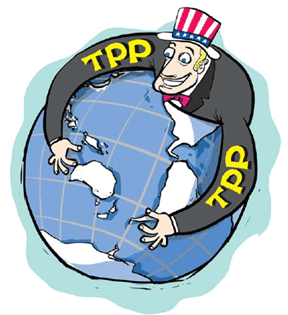 the draft was ”very prescriptive” and strongly reflected US trade objectives and multinational corporate interests ”with little focus on the rights and interests of consumers, let alone broader community interests”. ”One could see the TPP as a Christmas wish list for major corporations
The full transcript of the leaked negotiating text can by found at www.wikileaks.org.
Australians may pay the price in Trans-Pacific Partnership free trade agreement The Age, November 14, 2013 Philip Dorling A leaked draft of the Trans-Pacific Partnership deal looks to have worrying intentions.Australians could pay more for drugs and medicines, movies, computer games and software, and be placed under surveillance as part of a US-led crackdown on internet piracy, according to details of secret trade negotiations exposed by WikiLeaks.
A leaked draft of a controversial chapter of the Trans-Pacific Partnership free trade agreement reveals the negotiating positions of 12 countries including Australia on copyright, patents and other intellectual property issues, with a heavy focus on enforcement measures against internet piracy.
Intellectual property experts are critical of the draft treaty, which they say would help the multinational movie and music industries, software companies and pharmaceutical manufacturers to maintain and increase prices Continue reading
Abbott government to gut Renewable Energy Agency, to prevent new renewable energy industry development
 Australian Renewable Energy Agency To Be Gutted http://www.energymatters.com.au/index.php?main_page=news_article&article_id=4023 Proposed changes to ARENA’s funding would mean support for new projects would essentially disappear. 100% Renewable’s accusation prior to the election that the Coalition was no friend of renewable energyis unfortunately proving to be an accurate charge.
Continuing its slash and burn approach to years of hard work in trying to make Australia a global renewable energy leader, the Government has announced it intends cutting funding to the Agency by $435 million. While this would not impact current projects; the Agency would be left with little to drive the further development of renewable energy.
The Clean Energy Council has expressed disappointment with the news. “The government gave repeated commitments on its support for ARENA prior to the election and it is disappointing that the agency is now facing a significant budget reduction,” said the CEC’s Deputy Chief Executive Kane Thornton.
“Successive governments have now reduced and altered the level of ARENA’s funding during the short period since it was established. This unstable policy environment has had a clear impact on major technology innovators, developers and financiers, who will understandably be questioning their future in Australia.”
The Australian Solar Council has called on Parliament to block any attempt to gut the Australian Renewable Energy Agency.
“The solar industry takes the government at its word when it says it is committed to tackling climate change and supporting the renewable energy industry in Australia, but so far we have only seen one half of the equation – the cuts,” said the Council’s Chief Executive, John Grimes. “Where are the government’s positive policies for direct action on climate change?”
“The work that ARENA does is an excellent example of Direct Action. This independent agency, with its annual funding prescribed in legislation, backs practical programs. This is about real action in the real world.” The anti-renewable energy crusade may not be over yet – yesterday we reported it appears Prime Minister Abbott has the Renewable Energy Target in his sights next.
USA and France prevented diplomatic deal with Iran, by last minute demands
 Western Backtrack on Uranium Enrichment Killed Iran Deal http://news.antiwar.com/2013/11/11/western-backtrack-on-uranium-enrichment-killed-iran-deal/ US, France Sought to Change Deal at Last Minute by Jason Ditz, November 11, 2013 More details continue to emerge on the disagreements that prevented an expected weekend pact between the P5+1 and Iran, with a last minute side conversation between Secretary of State John Kerry and his French counterpart Laurent Fabius apparently keeping it from continuing. Fabius demanded last second changes to the draft agreement, including removing a clause guaranteeing Iran’s right to civilian uranium enrichment. Kerry reportedly endorsed that demand.
Iran has, under its safeguards agreement, every right to enrich uranium for civilian purposes, and has insisted they are willing to limit that enrichment, but not abandon the right outright.
That already put the talks on shaky ground, and Fabius followed it up with a demand that Iran abandon the under construction Arak reactor, which runs on unenriched uranium. Between the two demands this amounted to a de facto demand to surrender their entire civilian nuclear program, but the US and France continued to insist on only minor sanction relief. At that point though, the deal was dead and everyone just decided to meet again later this month.
Importance of the Pacific ocean and its tiny islands, in climate change
Tiny islands with big climate change problems http://www.enn.com/wildlife/article/46672 1 Tiny island states that speck the vast swathe of the Pacific Ocean have a far greater importance in understanding global climate change than their tiny populations would suggest. This was the message given to delegates during a side event of the UN Framework Convention on Climate Change’s 19th annual meeting in Warsaw today
The delegates from Fiji and Samoa believe their nations do not get the support they need to conduct vital climate observations in the region.”In terms of climate change, up to 90 per cent of heat is absorbed by oceans, so understanding how the oceans behave is critical to understanding how the atmosphere will change,” says Neville Koop, a climatology advisor with the Samoan delegation.
Considering the huge marine areas that Pacific nations cover — Kiribati consists of 800 square kilometres of coral atolls spread over an area half the size of Europe — the poor observational capacity of island states creates a large gap in the global climate data set, he says.
Better oceanic and high altitude measurements, as well as more rudimentary metrics such as rainfall and atmospheric pressure are vital for producing more accurate climate models, Koop adds.
Furthermore, as the birthplace of the El Niño Southern Oscillation weather system that periodically warms the waters of the Pacific Ocean, this patch of ocean influences climates across Asia, Africa and the Americas, and so accurate observations are necessary to predict future changes, he says.
But with populations often in the tens of thousands, these states’ meteorological agencies can never hope to fulfill this vital task alone, Koop says. Some governments, such as the United Kingdom’s, are already working to increase the observational capacity in the Pacific, but a concerted international effort is needed to fully plug the data gaps, he says.
Important information for Australians about UV rdaiation
 Sunscreen application and skin cancer: an interview with Dr Michelle Hunt, Inner Sydney Dermatology, News Medical, November 13, 2013
How many people does skin cancer affect and is it on the rise?
Unfortunately the incidence of skin cancer has risen in Australia over the past decades. From 1982 to 2007, melanoma diagnosis increased by around 50%, and in 2011, 1544 people died due to melanoma.
Over 434,000 people are treated for one or more non-melanoma skin cancers (NMSC) in Australia each year, and two in three Australians will be diagnosed with skin cancer by the time they are 70.
More than 2000 Australians died from skin cancer in 2011.
How effective is sunscreen at protecting the skin against sun damage? Continue reading
Interview with John Pilger about his new film “Utopia”
 Utopia – a powerful film about the subjugation of Aboriginal First Australians 09/11/2013 An interview with the maker of Utopia, John Pilger John Pilger, the renowned investigative journalist and award winning film maker, has recently completed a new film, Utopia, which deals with the subjugation of the Aboriginal First Australians. Niall Mulholland interviews John about the film’s themes, followed with a review of Utopia. Socialistworld.net
Your new film, Utopia, is a powerful and harrowing look at the legacy of colonial genocide and successive government policies on Australia’s indigenous people. What made you return to this theme?…….. Continue reading
Tony Abbott to cut funding for Australian Renewable Energy Agency (ARENA)
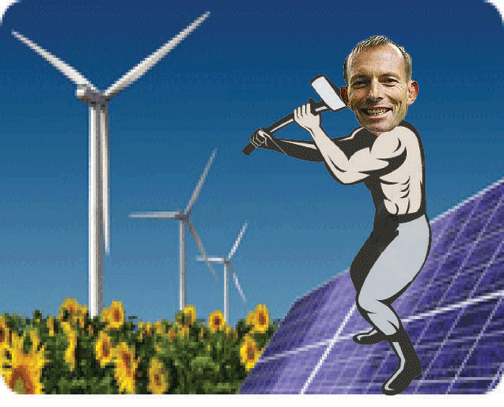 Abbott government to cut $435m from renewable energy agency, SMH, Tom Arup. November 13, 2013 The Abbott government will cut funding to Australia’s $3 billion renewable energy agency by $435 million, details of its carbon tax repeal legislation reveals.
The Coalition had flagged a cut to the Australian Renewable Energy Agency (ARENA) when it released its pre-election costings, but at the time refused to detail how big it would be…….. Continue reading
1 This month

of the week – Australians for War Powers Reform (AWPR)
To see nuclear-related stories in greater depth and intensity
 Antinuclear