Wind energy in Australia – a good investment
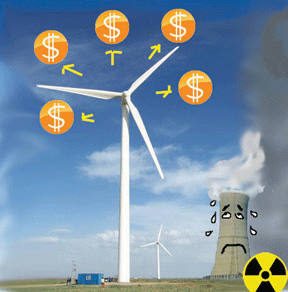 Investing in Australian wind energy http://ecogeneration.com.au/news/investing_in_australian_wind_energy/084291/, 15 November 2013 In this exclusive excerpt from the December 2013 edition of EcoGeneration, newly appointed Managing Director of OneWind Australia Michael Toke discusses the company’s investment strategy for Australian wind energy.
In May 2013, Denham Capital announced a planned investment of $US75 million ($A78.8 million) equity in a 1 gigawatt portfolio of Australian wind energy projects currently under development.As part of the deal, Denham partnered with Enersis Australia, National Power and Kato Capital to create a new entity called OneWind Australia.
OneWind Australia will initially focus on the late-stage development and financing of several Australian projects, including:
- Glen Innes, a 100 megawatt (MW) project in New South Wales
- Lincoln Gap, a 250 MW project in South Australia
- Cattle Hill, a 240 MW project in Tasmania
.
Denham said that its investment is aimed at accelerating development of these projects, with a goal of achieving financial close on several phases in the first half of 2014.
Why does OneWind Australia see Australia as a good market for investment in wind farms?
Firstly, there are great natural resources available in Australia in terms of the quality of wind and the availability of sites. This is compared to markets such as Europe and the United States for example, where it is much harder to find adequate available space to build a utility scale wind project.
In Australia, while a lot of best locations have already been taken, recent advancements in technology have opened up new sites which previously might have been passed over because of lower wind speeds. As a result of new technology, these new sites can yield better results than the best sites with older technology.
Australia also has macro-level stability and steady economic and legal systems. Even with the turmoil created by the recent elections, Australia’s political system compares very favourably to other markets. All this means is that there is an ease of doing business here.
You also have a financial system that considers renewable energy to be quite bankable. Australian banks and investors are very open to renewables and wind energy in particular.
Finally, while grid-parity hasn’t been reached yet, Australia is moving closer towards it and wind is becoming more and more cost-competitive with other sources of generation.
All of the projects OneWind has slated for investment are in the later stages of development. Why has OneWind selected these projects to invest in, as opposed to projects that are in the very early planning stages?
OneWind acquired a portfolio of late-stage projects because these offer the potential for quick realisation. That said, we are looking to augment our portfolio with earlier stage projects.
What was the selection process for choosing these particular wind farm projects? There are lots of wind farms in Australia in the latter stages of development, was there a strategy around selecting these ones in particular?
There certainly was. These projects were part of a portfolio that was developed by our original sponsors National Power, Enersis Australia and Kato Capital. Taken as a whole, it offered a very attractive opportunity. As mentioned, the projects are all in the later stages of development and overall the portfolio offered an opportunity that was better than others.
The full version of this article is available in the December 2013 edition ofEcoGeneration.
No comments yet.
1 This month

of the week – Australians for War Powers Reform (AWPR)
To see nuclear-related stories in greater depth and intensity
 Antinuclear
Leave a comment