Australia’s 99 year leases – a blatant Government campaign to end Aboriginal land rights.
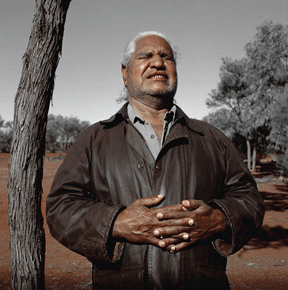 Don’t take our lands – Yami Lester The Stringer, by Gerry Georgatos November 16th, 2013 There is a wave of fear spreading across remote Aboriginal communities where people had believed that in the least they had achieved the return of Country through various forms of land rights and agreements. Elders around the country are joining Northern Territory Elders in speaking out against the blitzkrieg campaign being conducted by the Federal Government for communities to effectively sign away their Country for 99-year-leases – what many Elders believe a blatant Government campaign to end Aboriginal land rights.
South Australia’s Anangu Pitjantjatjara Yankunytjatjara (APY) Elders are concerned that the Minister Nigel Scullion-led-campaign in the Northern Territory remote communities to sign away their townships over to 99-year-leases is on its way across the border to South Australia’s APY lands. APY Maralinga Tjarutja Pitjantjatjara Elder Yami Lester said it is self-evident that this is what is occurring.
Mr Lester lost his sight as a young child in 1956 after the atomic bomb tests at Maralinga. “I may be blind but I can see what is happening, and so can many others of our people in this Country. Across the border in Country shared, everyone, there and here, is worried by what is happening.”
“The leases are about ending our land rights. Of what worth were the land rights deals we signed if they can be cheated out of us like this? There is a great fear among all our peoples that the Government is coming. (Minister Nigel) Scullion is pushing communities to sign these leases in the Territory and this is not going to be limited to the Territory but is a nationwide plan.”
“They are using poverty and welfare arguments to trick everyone that this is best for us, but land rights, ownership of our Country has nothing to do with welfare and poverty, these are other issues altogether,” said Mr Lester.
“If we sign these leases then we are finished forever as people on Country, our rights will disappear into the forgetfulness of time. We will not recover what the land rights struggles and some of the achievements promised our long suffering people.”
Chair of South Australia’s Narrunga peoples, Tauto Sansbury supported Mr Lester. “Yami is right, this is exactly what the Government will attempt to do, it’s not just on the cards, it’s knocking at the door. They want our Country for any number of reasons, but it will be the death knell of land rights, we will be finished. They want to demoralise us, for us to go out into assimilation with just a whimper while they benefit from the fruits of Country like resources or other developments. What their hearts and souls are cold to is what it will do to many of us. The demoralisation will end in many more suicides, the crisis of our identity will be at the heart of much grief. The worst is yet to come.”
“Despite what many of those who say they are looking out for us say, whether those who look out for us are Warren Mundine, Noel Pearson and like company, and whether they are the Prime Minister and his Office of Aboriginal Affairs, despite their big opinions, even if it is well meaning, despite all that, is that we do want our Country, and we do not want all the things that they may want for us. What we are entitled to in terms of high expectations and materialism have nothing to do with taking our Country or denying us the fruits from that Country.”
“Where is that quiet giant, the National Congress? Where are they on speaking out against the 99-year-leases?”
“We want to live in happy and healthy ways, not necessarily in all the expectations others have for us, who forever want to dictate to us.”
“None of us support these 99-year-leases, none of us support some money for our Country. We should have our Country and we should properly benefit from our Country while also being entitled to everything any Australian is entitled to,” said Mr Sansbury.
“Self-esteem, respect of self and of others, confidence are tied up in our Country. By removing from us our tie to Country they will kill many of us. Governments have always been in a battle to extinguish our rights, we fight tooth and nail in the Courts for even the most basic right, they give us next to nothing without us having to fight for it.”………
Mr Lester said that his peoples are “the trustees of our Country, and our Elders only concern themselves with the protection of our lands for the generations of our peoples to come.”
“We take better care of Country than does the white fella, who drops atomic bombs on them, who kills Country and people, who makes toxic the land, who pollutes endlessly, who makes both Country and peoples sick. This has never been our history or our way.”
Mr Lester pointed to Governments mining resources to excess, developing uranium mines on Arabunna and Kakadu Country, and he pointed to the uranium waste intended for Muckaty.
Dr Djiniyini Gondarra recently criticised the speed and the manner in which Minister Scullion’s representatives had secured Memorandums of Understandings from the Arnhem’s Yirrkala and Gunbalanya communities. He said that after the leases were done and money spent, less than $1 million for the community per annum, that his peoples would have been removed, assimilated, that cultural genocide would have been achieved. He said that the Government that was selling the 99-year-leases to communities was the same Government that launched “the terror of the Northern Territory Intervention, which had left such trauma that had not been felt since the 1950s and prior.”
Australia did not experience land rights litigation until the 1970s, when in 1971 the Northern Territory High Court rejected the concept in the Gove Land Rights case. Thanks to Prime Minister Gough Whitlam in 1973 the Aboriginal Lands Rights Commission was established in the wake of the High Court debacle. In 1979 Aboriginal lawyer Paul Coe took on the Commonwealth with a class action on behalf of all Aboriginal peoples in reference to land rights. He was unsuccessful. In 1976, the Aboriginal Land Rights Act established a statutory procedure that would return approximately 40 per cent of the Northern Territory to Aboriginal ownership. In 1981, the Anangu Pitjantjatjara Yankunytjatjara Land Rights Act had a similar effect for South Australia. Then in 1992, following the 1989 Wik decision, the High Court of Australia using the Racial Discrimination Act 1975 overturned the Northern Territory’s 1971 High Court decision and upheld Mabo verse Queensland in rejecting ‘terra nullius.’ This paved the way for Native Title.
Mr Lester is concerned that Native Title and Land Rights Acts are now on their way out.
“If I can see one thing, it is this, we cannot allow this to happen. The Government and the media have been portraying Yirrkala and Gunbalanya as hopeless messes of drunk people and truant children and that the leases will allow the community to begin fixing the communities while the Government sticks more of its nose in. They have been saying many same things about our (APY) Country and they have had the media writing these bad stories, so that everyone will believe that signing our Country away is for our good – when it is not.”
“It will be the end of our people in the ways we choose to be, alongside all our other rights. This is what Governments want, to get rid of us as a problem, get rid of the Aboriginal people from Country and make them like everyone else in the cities. it will be the death of our people, and the death of true Country too.”
Senator Scullion said the Yirrkala agreement with Traditional Owners had the support of the Northern Land Council. However Mr Sansbury said that these leases are “dispossession, theft, and racism.”
“Why is it always the Aboriginal person is treated differently and always finishes up with less?” http://thestringer.com.au/dont-take-our-lands-yami-lester/#.Uo5eU9Jwo7o
No comments yet.
1 This month

of the week – Australians for War Powers Reform (AWPR)
To see nuclear-related stories in greater depth and intensity
 Antinuclear
Leave a comment