Busting the uranium industry’s propaganda that “all is well’ with that industry
 Time to spill truth on uranium sector, Townsville Bulletin, DAVE SWEENEY, 23 Nov 13, THERE is an old saying that no trader calls out ‘‘bad fish’’. So it comes as no surprise that a former uranium company executive now paid to do public relations for the uranium sector will say all is well in the industry (Uranium: safety first, TB, 18/11). The reality is the industry is in very poor shape, financially and operationally – as can be seen by the recent mothballing of the Honeymoon mine in South Australia, because the numbers didn’t add up, and the backroom push by the Queensland Resources Council to get ‘‘royalty relief for Queensland uranium mines that have not even filed an application to develop yet.
The most recent independent assessment of the Australian uranium industry – an inquiry by the Australian Senate in October 2003 – found the sector characterised by underperformance and noncompliance, an absence of reliable data to measure contamination or its impact and an operational culture focused on the short-term.
Uranium mining is a high-risk, low-return sector that poses unique unresolved and long-lived threats and does not enjoy secure social license. Australian uranium fuelled Fukushima. Every Australian uranium mining operation has a history of leaks and spills. The need to manage radioactive materials over extremely long periods, along with security and
proliferation concerns, make uranium mining fundamentally different from other mining. In the shadow of Fukushima, and given the call by the UN Secretary General in September 2011 that Australia conduct an indepth assessment of the net cost impact of the impacts of uranium mining on communities and ecosystems, it is time the industry and state and federal governments supported a comprehensive and independent assessment of the costs and consequences.
The continued failure to do so highlights the industry’s preference for public relations over public scrutiny– and the fact that uranium is a very smelly fish.
Bikini nuclear tests as cause of 1954 Adelaide earthquake?
The electromagnetic pulse and ionization of the atmosphere resulting from the high-yield nuclear bomb Bravo was clearly associated with Adelaide earthquake.
 The Castle Bravo nuclear explosion of 1954. Part 1: Bobby 1’s Blog 21 Nov 13 In the Adelaide, Australia earthquake in the early morning of March 1, 1954, residents of Adelaide, Australia were awakened to a violent shaking in their beds. When they went outside, they saw a brilliant glow in the east. The United States had just set off the Castle Bravo nuclear bomb on Bikini Island, 3,600 miles away.On March 1, 1954, the detonation of an estimated 15 megaton thermonuclear weapon, known as “Bravo” took place – as part of the “Castle” test series. According to the U.S. Radiochemistry Society, “the Bravo test created the worst radiological disaster in US history ….the yield of Bravo dramatically exceeded predictions, being about 2.5 times higher than the best guess and almost double the estimated maximum possible yield (6 Mt predicted, estimated yield range 4-8 Mt).” The bomb was over 1000 times more powerful than those exploded over Hiroshima and Nagasaki in 1945. The Bravo crater in the atoll reef had a diameter of 6,510 ft, with a depth of 250 ft. The cloud top rose and peaked at 130,000 feet (almost 40 km) after only six minutes. Eight minutes after the test the cloud had reached its full dimensions with a diameter of 100 km, a stem 7 km thick, and a cloud bottom rising above 55,000 feet (16.5 km), and after 10 minutes had a diameter of more than 60 miles.
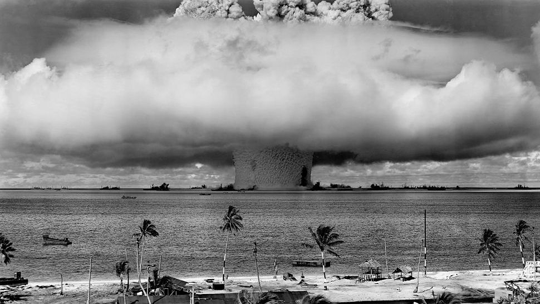
The radioactive fallout from Bravo covered the planet, including the Southern Hemisphere. It was a fission-fusion-fission bomb, designed to release high levels of radioactivity. Its yield was 15 megatons, but it released almost seven times as much radiation than the Russian Tsar Bomba, which had a yield of 50 megatons. Continue reading
Protest against Australian company Lynas’ rare earths operation in Malaysia
 Malaysians to Occupy Lynas HQ in Sydney: Protest shareholder meeting, divest from Lynas, 29 November.
SYDNEY | Eight representatives from Himpunan Hijau, one of the largest environmental movements in Malaysia, will be travelling to Australia to protest against Australian rare earth mining company, Lynas Corporation. Lynas has started exporting its toxic and radioactive rare-earth pollution to it’s controversial refinery, the Lynas  Advanced Materials Plant (LAMP) in Kuantan, Malaysia.
Himpunan Hijau will be joined by Friends of the Earth Australia, Beyond Nuclear Initiative, AidWatch and The Greens.
Safety problems, conflict of interest in Lynas rare earths factory
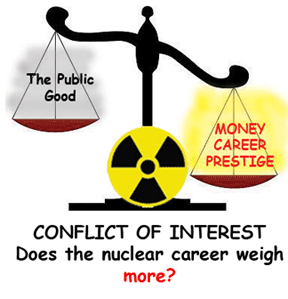 “Section 11 of the law allows the minister to direct regulators toward certain policies and so there’s massive
  conflict of interest,” said Dr Peter Karamoskos, an Australian nuclear radiologist.
Problems at Lynas factory can cause radioactive leaks, say experts The Malaysian Insider, 24 Nov 13, Prevailing problems in waste management, storage, disposal facility and waste cleaning at the Lynas factory can lead to radioactive leakages if the Australian firm fails to address the issues, said experts t at a seminar in Kuala Lumpur today.
The mining company’s refinery near Kuantan, Pahang, has several problems, which experts said in the event of an accident or carelessness, could harm to residents near the factory. Continue reading
UK government is up for massive costs for new nuclear energy
 Reality check on renewable energy could unblock climate talks REneweconomy, By Giles Parkinson on 24 November 2013 “………The conclusions reached by IRENA are also interesting because most conventional forecasts, would have you believe that carbon capture and storage and nuclear will play a greater combined role than renewables in the abatement of greenhouse gases.
Gielen said that the abatement potential of renewables is twice that estimated by most people – at around 6GT a year – and this was borne out in a different session hosted earlier in the week by the Global Carbon Capture Institute, where the economist Lord Stern said that while energy efficiency could, renewables might only account for 20 per cent, with carbon capture and nuclear making up the rest.
The problem with these two latter technologies is the massive cost. In CCS, it is also a question of whether it will work. Even CCS proponents privately concede – that because of the cost – it will have little application in the electricity sector, although it could be  valuable (or even an essential) option in the industrial sector, where there is no other available option.
The huge price struck by the UK government for the proposed construction of the Hinkley nuclear reactor has brought clarity to the massive costs of nuclear energy. Few governments would, or could, stand behind a nuclear plant with loan guarantee, production guarantees and insurance guarantees in the way the UK government has had to do.
Which is why the new developments in renewables is so important. Nuclear proponents spend most of their time muddying the field for renewables, saying they are expensive and unreliable. But the subsidy agreed for the Hinkley plant alone is nearly as big as the subsidies paid for the entire global renewables industry in 2012, and most national grid operators have concluded that having 100 per cent, or close to it, renewable penetration is not difficult. Getting to 40 per cent in major economies is really no problem at all………… http://reneweconomy.com.au/2013/reality-check-on-renewable-energy-could-unblock-climate-talks-65554
Japan cracks down on critics of nuclear policies

 Censorship and Dispossession in Japan http://majiasblog.blogspot.jp/2013/11/censorship-and-dispossession-in-japan.html Developments in Japan are concerning: First, according to The Asahi Shimbun, Japan’s Nuclear Regulatory Authority (NRA) is trying to accelerate returning people to Fukushima prefecture by measuring citizen exposure levels using individual dosimeters instead of official air sampling. The Asahi notes dosimeters have much lower readings than official air sampling and that the NRA’s draft policy has no discussion of health impacts.
The proposed exposure level for returning evacuees is 20 millisieverts based on dosimeter readings alone (no inclusion of estimates of exposure from contaminated food, water, and bio-accumulation).
Second, anti-nuclear groups in Japan have been subject to denial of service attacks since September. I had heard rumors this was occurring. I’m grateful The Asahi Shimbun reported it.
I am reminded that Japan is trying to pass new whistle-blower laws that criminally prosecute any whistle-blower who reveals corporate or government secrets (seehttp://rt.com/news/japan-state-secrets-law-712/)
The new whistleblower law and the concerted attacks against anti-nuclear groups together indicate pretty clearly that elements of the Japanese state/industry are reacting fascistically to deteriorating conditions at Daiichi.
You should be worried because your nation could be next.
After many years of effort – some sort of nuclear agreement reached between Iran and the West

 Iran nuclear program deal reached with world powers during diplomatic talks in Geneva ABC News 25 Nov 13Iran has reached a deal with six world powers to curb its nuclear activities in return for the easing of sanctions imposed by Western countries.
EU foreign policy chief Catherine Ashton, who coordinated the talks in Geneva, said they had agreed a “first step” towards a comprehensive solution. United States president Barack Obama hailed the deal saying: “While today’s announcement is just a first step, it achieves a great deal.
“For the first time in nearly a decade, we have halted the progress of the Iranian nuclear program, and key parts of the program will be rolled back…….
Under the agreement Iran has promised not to enrich more uranium above a level of five per cent for six months. It has also agreed to halt construction of the Arak research reactor, which is feared capable of yielding potential bomb material. In return the six powers will remove the embargo on trade with Iran in precious metals while refraining from imposing new sanctions for six months.
China’s foreign minister Wang Yi says the deal will help normalise relations with Iran, and “will help provide a better life for the Iranian people.”…..http://www.abc.net.au/news/2013-11-24/iran-reaches-deal-with-world-powers-on-nuclear-program/5113460
Iran and uranium enrichment
Uranium enrichment at heart of Iran nuclear deal WP 24 Nov 13, Iran’s ability to enrich uranium — at what levels and what speed — is a cornerstone of the deal reached Sunday between Tehran and world powers. Here are answers to some important questions about uranium enrichment, the central process in turning concentrated uranium into nuclear fuel.
Q: WHAT IS URANIUM ENRICHMENT?…….
Q: SO WHY THE WORRY ABOUT NUCLEAR WEAPONS?…….
Q: WHY WON’T IRAN GIVE UP ENRICHMENT?
A: This is what Iran has frequently called its “red line.” Iran’s leaders say they will never relinquish control over the entire nuclear cycle as a matter of national pride. Iran portrays itself as an emerging technological giant of the Islamic world. The nuclear energy program is a pillar of Iran’s self-image as a center of scientific advances independent of the West. Iran has made some other important strides, including claims of sophisticated drone development, a homegrown auto industry and an aerospace program..
Q: WHERE ARE IRAN’S ENRICHMENT SITES?
A: Iran has two main uranium enrichment facilities. The oldest and largest — in Natanz, about 260 kilometers (160 miles) southeast of Tehran — is largely built underground and is surrounded by anti-aircraft batteries. Uranium enrichment began in 2006. Another site is known as Fordo, which is built into a mountainside south of Tehran. Its construction was kept secret by Iran until it was disclosed in September 2009 in a pre-emptive move before its existence was revealed by Western intelligence agencies. The area is heavily protected by the Revolutionary Guard. U.N. nuclear inspectors have visited both sites and have installed round-the-clock monitoring systems. The new accord allows for the possibility of daily U.N. inspection visits.
Q: HOW MANY OTHER COUNTRIES ENRICH URANIUM?
A: More than a dozen countries have enrichment programs, but several of those do not have nuclear weapons. http://www.washingtonpost.com/national/uranium-enrichment-at-heart-of-iran-nuclear-deal/2013/11/24/fce9a86e-54cd-11e3-9ee6-2580086d8254_story.html
Australia a fossil fool at the international climate talks
Australia left exposed on the climate front The Age, November 25, 2013 EDITORIAL So intense has been the focus on axing the ”carbon tax”, for which a repeal bill has passed the lower house, that this seems to have become an end in itself, divorced from the policy goal of averting dangerous climate change. The politics of the issue will dominate for some time, should the Senate block the legislation. Yet once Prime Minister Tony Abbott gets the result he promised – which depends on the new senators who take their seats in July – the policy question of how best to cut greenhouse gas emissions is likely to become ever more pressing. Experts doubt the Coalition’s ”direct action” policy can achieve even the minimum target of a 5 per cent cut from 2000 levels by 2020, especially as Mr Abbott insists funding will not increase to ensure it is reached. Where does that leave Australia if the required target increases?

The difficulty of answering that question may have prompted the government’s decision not to have ministerial representation at the latest UN climate conference in Warsaw. The minister would have faced embarrassment at being so out of step with other nations. This would also have drawn Australians’ attention to the actions economic giants such as the US, China and the European Union are taking to make deeper, earlier cuts to emissions………
Negotiators in Warsaw were dismayed that Australia, which once led the way, ”obstructs the process at every turn”, as one said. Coming from the world’s worst greenhouse gas emitter per person (and 15th in total emissions), this is seen as an act of bad faith. Australia won multiple ”fossil of the day” awards from environment groups at the Warsaw talks…….
http://www.theage.com.au/comment/the-age-editorial/australia-left-exposed-on-the-climate-front-20131124-2y43b.html#ixzz2lhO3sf2N
Strong financial case for home solar energy, despite government disincentives
 Home Solar in Australia : Study http://www.energymatters.com.au/index.php?main_page=news_article&article_id=4043 25 Nov 13 13 per cent of homes in Australia now have a solar panel system and 3 million Australians live in a solar household – and the RET is costing far less than some would have us believe.
A report by Green Energy Markets for the REC Agents Association (RAA) shows Australians installed more than 1 gigawatt of solar panels last year, but during the last 12 months, installations have dropped 22% as a result of winding down of rebates and incentives.
The report also reveals a very important point about the costs of that support.
While the Federal Government appears to have Australia’s Renewable Energy Target in its sights, when taking into consideration the impact solar has had onreducing wholesale power costs, the real cost of the SRES to all households will be just $1.90 per quarter by 2016 – or just 0.38% of a typical household quarterly bill. Continue reading
Sydney Nov 29: Malaysians will reveal true state of Lynas rare earths factory
Problems at Lynas factory can cause radioactive leaks, say experts The Malaysian Insider, 24 Nov 13, Save Malaysia Stop Lynas (SMSL), co-organiser of the seminar, announced that representatives of the group will head to Lynas’ headquarters in Sydney, Australia, tomorrow to attend the firm’s annual shareholders meeting on November 29.
“We will reveal to the shareholders the true conditions of the plant in Pahang,” said Tan Boon Teet, spokesperson of SMSL.
Meanwhile, Himpunan Hijau’s activist Wong Tack said that the lack of response from the government and Lynas is “frustrating” and that the NGOs involved with campaigning against the plant would give the company six months to cease operations.
“Six months from Lynas’s AGM, we will have a shutdown campaign and hold a protest to close Lynas’s operations,” he said, affirming that a major street protest would be held on June 29, next year. – November 24, 2013.http://www.themalaysianinsider.com/malaysia/article/problems-at-lynas-factory-can-cause-radioactive-leakages-if-no-action-is-ta
Wrong perceptions about costs of renewable energy compared to costs of fossil fuels
one of the main barriers is that the fossil fuel industries is simply resisting change. The incumbent generators fight against energy efficiency and renewables, because of the damage it is doing to their traditional business models. Fossil fuel companies are still invested $675 billion a year in R&D on finding new fossil fuels.
“The perception is that renewables are expensive,” says Elisabeth Press, the executive secretary of IRENA. “The narrative around renewables has to change.”
Reality check on renewable energy could unblock climate talks REneweconomy, By Giles Parkinson on 24 November 2013 The biggest frustrations of the UN sponsored climate change talks are the endless blockages that are seemingly caused because the potential solutions to rising greenhouse gases appear insurmountable: Yet the solutions are staring the negotiators in the face.
Energy efficiency could provide half the abatement required to meet the “emissions gap” between where the world is heading and what it needs to do to meet the global target to cap emissions at 450 parts per million, or a better than even chance at capping global warming at 2C. It can do this at little or no extra cost. And a new study to be released in the new year will say that renewable energy alone could provide the other half of the abatement needed from now to 2030, again for little or no extra cost.
 The findings by the International Renewable Energy Agency – to be included in a document called ReMap 2030 and released in January – suggests that this can be done by doubling the penetration of renewables in the global electricity market to 36 per cent by 2030.
Much of this will be taken up by “modern renewables” such as wind and solar, and biomass. The level of “traditional” biomass, which some question is renewable at all, will fall sharply in this scenario.
This, the study will say, could be done at no additional cost to business as usual, which is probably taking the world to around 21 per cent renewables by 2030. Continue reading
On Country: Connect, Work, Celebrate is now showing at the National Museum of Australia.
 ■ On Country: Connect, Work, Celebrate is now showing at the National Museum of Australia.
Aboriginal art: On Country exhibition hopes to provide the big country picture Canberra Times, November 25, 2013 Sally Pryor Looking after a country is a serious business, and land management is hard. But, as a new exhibition at the National Museum shows, it is also life-affirming and gives hope for the future when it comes to adjusting to climate change and dealing with the challenges of an evolving planet.
With about 90 photographs taken around Australia, On Country celebrates how indigenous people use generations of knowledge to manage Australia’s land, rivers and oceans.
The photographs show how these communities are using traditional and modern land management techniques to manage cultural sites and heritage values, as well as fire regimes, feral animals, pollution and the impacts of climate change. Curator Barbara Paulson said she hoped people would come away from the exhibition understanding more about how hard indigenous people worked to maintain their connection to the land………….
Ms Paulson said while the museum had never shied away from telling difficult stories, this one had a positive message – that indigenous people never took their connection to country for granted.
”There is a real understanding that you borrow the country for the future,” she said. ”You don’t inherit it from your ancestors, you borrow it for future generations, for your grandchildren, and you look after it to make sure that it stays intact so that they can continue to live.” http://www.canberratimes.com.au/act-news/aboriginal-art-on-country-exhibition-hopes-to-provide-the-big-country-picture-20131124-2y47d.html#ixzz2lghOVCVs
Rio Tinto boss among heads of Abbott’s ‘Indigenous Advisory Council’
 Corporate big hitters Gail Kelly and David Peever recruited to Prime Minister’s Indigenous Advisory Council, Yahoo News, November 23, 2013,Prominent business figures have been recruited to Tony Abbott’s Indigenous Advisory Council as part of the Prime Minister’s aim of creating a “new engagement” with Aboriginal people.
Westpac’s chief executive Gail Kelly and Rio Tinto boss David Peever are among the 12-member group, dubbed “the Indigenous dozen”, who will address a lack of opportunity in Indigenous communities.
The head of the council, Warren Mundine, a former president of the ALP, says the inclusion of senior business people will help drive economic development. Mr Mundine says getting corporate Australia on board is critical to solving Indigenous disadvantage……. Other members of the panel include successful Indigenous businessman Daniel Tucker, the managing director of Carey Mining – an entirely Indigenous-owned mining and civil contractor.
Ngaire Brown, one the first group of Aboriginal medical students in Australia, is also included. Andrew Penfold, the chief executive of the Australian Indigenous Education Council, and Peter Shergold, chancellor of the University of Western Sydney are also among the 12.
The council will meet three times a year with the Prime Minister and other senior ministers to inform the policy implementation of the Government. http://au.news.yahoo.com/a/19982010/corporate-big-hitters-gail-kelly-and-david-peever-recruited-to-prime-ministers-indigenous-advisory-council/
1 This month

of the week – Australians for War Powers Reform (AWPR)
To see nuclear-related stories in greater depth and intensity
 Antinuclear