A new warning for Australia – on UV radiation and skin cancer
Christina Macpherson 27 Nov 13, Today’s item from the Courier Mail should concern people, especially Queenslanders –
“…..You can still get burnt on windy, cloudy and cool days. UV radiation can penetrate overcast conditions and may even be more intense due reflection off the bottom of clouds, says Cancer Council CEO, Professor Ian Olver.
“Australia experiences extremely high UV levels in summer around the country, so it’s important to slip on clothing, slop on sunscreen, slap on a hat, slide on sunglasses and seek shade,” he warned. http://www.couriermail.com.au/lifestyle/health/ways-to-prepare-for-a-wet-summer/story-fnivsueq-1226768585528
Australia tops the world for getting UV radiation of both types UVA and UVB. The “hole in the ozone layer” seems to be out of fashion as a news topic in Australia. The Antarctic ozone hole is a dramatic thinning of ozone in the stratosphere over Antarctica each spring. This means that Australians are getting much more UV radiation than ever before. We are vulnerable to all types of skin cancer, and now – the most dangerous type is on the increase. They thought that the rare Merkel cell skin cancer was caused by a virus. Now they’re finding that UV radiation may be the cause.

Warning on new killer skin cancer: Merkel cell carcinoma http://www.cqnews.com.au/news/warning-on-new-killer-skin-cancer-merkel-cell-carc/2093729/#comments 24th Nov 2013
THE world’s deadliest skin cancer has taken a grip on Queensland, yet many people have never heard of it. Merkel cell carcinoma is a highly aggressive form of skin cancer, with 60% of patients dying within five years of diagnosis.
That compares to just 7% of melanoma patients. Queensland has at least double the world rate of the rare cancer.
New research from Cancer Council Queensland, the University of Queensland and the Western Australia Institute of Medical Research suggests ultra-violet radiation plays an important role in the development of Merkel cell carcinoma, contributing to Queensland’s record rates. The findings have been presented at The Global Controversies and Advances in Skin Cancer Conference, hosted by Cancer Council Queensland, in Brisbane.
Cancer Council Queensland spokesperson Katie Clift said the five-year relative survival rate for Merkel cell carcinoma was just 41%, compared to 93% for melanoma. “A total of 340 cases of Merkel cell carcinoma were diagnosed in Queensland from 2006 to 2010,” Ms Clift said.
“As with most cancers, the best chance of survival is early diagnosis. “This is particularly important for Merkel cell carcinoma as these tumours tend to grow rapidly.”
It was essential health experts developed public health campaigns to educate people about the cancer, she said. “Merkel cell carcinomas can be difficult to identify, and are sometimes confused with benign skin cancers,” she said.
“It is therefore imperative that Queenslanders get to know their own skin. “If they notice a new spot or lesion, or a spot or lesion change in shape, colour or size, they should visit their GP immediately.”
Uranium loses its glow at SA mining conference
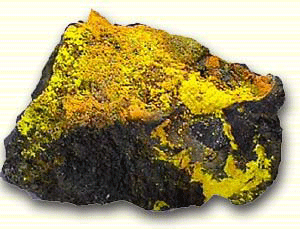 AUSTRALIAN CONSERVATION FOUNDATION, 26 Nov 13, Uranium hopefuls will be hard pressed to find a positive story about the embattled sector at a mining industry conference this week in South Australia. The last two weeks have seen further evidence of the continuing market fallout from Fukushima on SA’s embattled uranium sector with the closure of the Honeymoon operation and the decision by Marathon Resources to exit the uranium trade, declaring the sector’s ‘risks outweigh the rewards’.
 The news comes as a set of uranium junior companies join with the Beverley project’s Heathgate Resources to talk up the sector at the 2013 Mining South Australia conference, which starts today in Whyalla.
Australia’s uranium industry is suffering from:
- · The scrapping of plans for a massive expansion of BHP Billiton’s Olympic Dam mine in SA because of the ‘uncertain’ uranium market
- · A fall in the uranium commodity price of around 50 per cent and larger falls in the share value of uranium mining companies since Fukushima – a continuing crisis directly fuelled by Australian uranium
- · Sustained losses and operational failures at ERA’s Ranger mine in Kakadu
- · Attempts by Queensland uranium promoters to receive ‘royalty relief’ and public concessions even before making any formal applications to mine
- · Projects stalled, scrapped or deferred in WA, SA and the NT
“The uranium industry has long caused trouble, now it is increasingly in trouble,” said Australian Conservation Foundation nuclear free campaigner Dave Sweeney. “Uranium mining is a high-risk, low-return sector that poses unique, unresolved and long-lived threats and does not enjoy secure social license.
“It is time for politicians to stop accepting industry promises and start genuinely examining industry performance. “ACF urges state and federal governments to give effect to the UN Secretary General’s call that Australia conduct ‘an in-depth assessment of the net cost impact of the impacts of mining fissionable material (uranium) on local communities and ecosystems’.
“Instead of misplaced industry enthusiasm it is time for a comprehensive and independent assessment of the costs and consequences of the uranium sector.”
Tasmania on track for 100% renewable energy
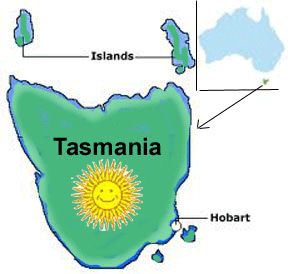 Tasmania aims for 100 pc renewable energy use in seven years http://au.news.yahoo.com/a/20024300/tasmania-aims-for-100-pc-renewable-energy-use-in-seven-years/ BY LUCY SHANNON -November 26, 2013 The Tasmanian Government has released a climate change strategy aimed at 100 percent renewable power usage by 2020.
The Climate Smart Tasmania plan includes energy reduction targets across government, land use, infrastructure, transport and waste systems. The Climate Change Minister, Cassy O’Connor, says its the most comprehensive plan by any Australian Government to reduce carbon emissions as well as adapt to a changing climate.
The strategy sets a new interim 2020 target to reduce carbon emissions to 35 percent below 1990 levels. Ms O’Connor says its about showing leadership on climate change. “We now have in Australia a climate denialist Government that is taking us backwards on climate change” she said.
“Tasmania here has extraordinary advantages with our Hydro power, with the carbon in our forests and we do need to show leadership; it’s also the economically sensible thing to do.”
The first step for Fukushima is to end the media blackout
The Global Threat of Fukushima, counterpunch A Global Response is Needed WEEKEND EDITION OCTOBER 25-27, 2013 by KEVIN ZEESE AND MARGARET FLOWERS “………… The Solutions The three major problems at Fukushima are all unprecedented, each unique in their own way and each has the potential for major damage to humans and the environment. There are no clear solutions but there are steps that need to be taken urgently to get the Fukushima clean-up and de-commissioning on track and minimize the risks.
The first thing that is needed is to end the media blackout. The global public needs to be informed about the issues the world faces from Fukushima. The impacts of Fukushima could affect almost everyone on the planet, so we all have a stake in the outcome. If the public is informed about this problem, the political will to resolve it will rapidly develop.

The nuclear industry, which wants to continue to expand, fears Fukushima being widely discussed because it undermines their already weak economic potential. But, the profits of the nuclear industry are of minor concern compared to the risks of the triple Fukushima challenges.
The second thing that must be faced is the incompetence of TEPCO. They are not capable of handling this triple complex crisis. TEPCO “is already Japan’s most distrusted firm” and has been exposed as “dangerously incompetent.” A poll foundthat 91 percent of the Japanese public wants the government to intervene at Fukushima.
Tepco’s management of the stricken power plant has been described as a comedy of errors. The constant stream of mistakes has been made worse by constant false denials and efforts to minimize major problems. Indeed the entire Fukushima catastrophe could have been avoided:
“Tepco at first blamed the accident on ‘an unforeseen massive tsunami’ triggered by the Great East Japan Earthquake on March 11, 2011. Then it admitted it had in fact foreseen just such a scenario but hadn’t done anything about it.”
The reality is Fukushima was plagued by human error from the outset. An official Japanese government investigation concluded that the Fukushima accident was a “man-made” disaster, caused by “collusion” between government and Tepco and bad reactor design. On this point, TEPCO is not alone, this is an industry-wide problem. Many US nuclear plants have serious problems, are being operated beyond their life span, have the same design problems and are near earthquake faults. Regulatory officials in both the US and Japan are too corruptly tied to the industry.
Then, the meltdown itself was denied for months, with TEPCO claiming it had not been confirmed. Japan Times reports that “in December 2011, the government announced that the plant had reached ‘a state of cold shutdown.’ Normally, that means radiation releases are under control and the temperature of its nuclear fuel is consistently below boiling point.” Unfortunately, the statement was false – the reactors continue to need water to keep them cool, the fuel rods need to be kept cool – there has been no cold shutdown. http://www.counterpunch.org/2013/10/25/the-global-threat-of-fukushima/
Kevin Zeese JD and Margaret Flowers MD co-host ClearingtheFOGRadio.org on We Act Radio 1480 AM Washington, DC and onEconomic Democracy Media, co-direct It’s Our Economy and are organizers of the Occupation of Washington, DC. Their twitters are @KBZeese and @MFlowers8.
Fukushima reactor No 4 contains new nuclear fuel rods – highly dangerous MOX fuel
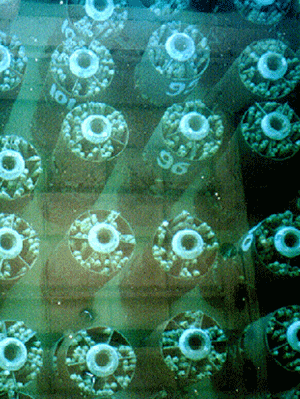 The un-irradiated rods inside the Unit 4 spent-fuel pool are, in all probability, made of a new type of MOX fuel containing highly enriched plutonium.
Why TEPCO is Risking the Removal of Fukushima Fuel Rods. The Dangers of Uncontrolled Global Nuclear Radiation, Global Research, 24 Nov 13 By Yoichi Shimatsu
“…….Mystery of MOX super-fuel A Mainichi Shimbun editorial mentions in passing that the Reactor 4 pool contains 202 fresh fuel assemblies.(3) The presence of new fuel rods was confirmed in the TEPCO press release, which  described the first assembly lifted into the transfer cask as an “un-irradiated fuel rod.” Why were new rods being stored inside a spent-fuel pool, which is designed to hold expended rods? What threat of criticality do these fresh rods pose if the steel frame collapses or if crane operators drop one by accident onto other assemblies, as opposed to a spent rod?
Against the official silence and disinformation, a few whistleblowers have come forward with clues to answer these questions. Former GE nuclear worker Kei Sugaoka disclosed in a video interview that a joint team from Hitachi and General Electric was inside Reactor 4 at the time of the March 11, 2011 earthquake. By that fateful afternoon, the GE contractors were finishing the job of installing a new shroud, the heat-resistant metal shield lining the reactor interior.(4)
TEPCO inadvertently admitted to the presence of foreign contractors at Fukushima No.1 up until March 12, 2012, Continue reading
Solomon Islanders look to becoming climate refugees, as sea level rises
 Climate-threatened Solomon Islanders prepare for evacuation, trust.org, Source: Thomson Reuters Foundation – Mon, 25 Nov 2013 Catherine Wilson AUKI, MALAITA PROVINCE, Solomon Islands – In the Solomon Islands, where the sea level rise of 8 millimetres per year is almost three times the global average, survival of communities on the low-lying atoll of Ontong Java is already threatened.
But identifying a new home for those who are eventually displaced will be difficult, even in this sprawling nation of more than 900 islands located northwest of Fiji, in the southwest Pacific region. “The number one obstacle will be access to land,” said Hudson Kauhiona, deputy director of the government’s climate change division, in the capital, Honiara. “It is going to be a very big challenge when moving people.”…….
Resettlement is the last option for atoll communities impacted by climate change. But the situation is becoming critical as the encroaching sea erodes Ontong Java, which is an average of 2-3 metres (6-10 feet) above sea level and has just 12 square kilometres (4.6 square miles) of land area.
Adaptation activities, including an atoll agriculture project and installation of rainwater tanks to provide salt-free drinking water, are currently being implemented by the Anglican Church of Melanesia’s mission programme………
The Solomon Islands is not only on the frontline of climate change, but also a pioneer in developing new strategies to deal with climate-related displacement. The European Union is currently assisting the Solomon Islands government in developing its first climate change relocation policy, which is expected to be finalised by the end of 2014.
“According to scientific projections, the climate change situation is not going to get better,” Kauhiona said. “Cases such as Ontong Java, where people have to move to other islands, will only increase. So we might as well put ourselves in a better position now, rather than in 30 or 50 years time when things are happening and we aren’t prepared.” According to the Pacific Climate Change Science Program, ocean acidification, extreme rainfall and temperatures will steadily increase in the Solomon Islands, while the sea could rise by up to 15 centimetres (6 inches) by 2030. Looking ahead is vital given that an estimated 1.7 million people in the Pacific Islands could be displaced due to climate change by mid-century, programme officials say.Catherine Wilson is a journalist based in Sydney, Australia. http://www.trust.org/item/20131125112530-1wkla
Australian Industry Group not happy with the government’s climate plan
 AUDIO: Ai Group urges changes to climate plan (AM)
Ai Group warns of flaws in Coalition climate change plan as Warsaw talks wrap up ABC Radio News AM By Lexi Metherell 25 Nov 2013, The Federal Government now has a deadline of early 2015 to set a target for reducing carbon emissions after nearly 200 countries reached a deal at the end of international climate talks in Warsaw.
But a peak industry body says a central part of the Government’s climate change policy will not always work.The Warsaw meeting ended with an agreement on a timetable for nations to name their emissions cuts before another meeting in Paris in December 2015. The Paris meeting aims to produce an international agreement to replace the Kyoto Protocol that will come into place in 2020. The Government is proposing to pay polluters to reduce emissions under its $1.5 billion Emissions Reduction Fund, which it wants up and running in July.
In its submission on the scheme, industry lobby group Australian Industry Group says companies are not always going to be able to deliver as planned. While the Government wants the fund to target domestic emissions, Ai Group is urging it also to include international carbon emissions. Chief executive Innes Willox says the Government should spend a portion of the allocated budget on the reserve of international carbon credits. “We need to get our emission reductions done at least cost,” he said…….
Australia’s current target is to reduce emissions by 5 per cent by 2020 and the Climate Change Authority is recommending that it be at least 15 per cent.Ai Group says its proposal is a “prudent fallback” in case that target cannot be reached or if the Government wants to go further than 5 per cent.”…..
Federal Environment Minister Greg Hunt was unavailable for interview. http://www.abc.net.au/news/2013-11-25/business-group-warns-on-climate-policy-as-warsaw-talks-wrap-up/5114192
As uranium prices languish indefinitely, Goldman Sachs gets out of uranium investing
 Goldman Sachs to sell uranium unit BUSINESS DAY, BY SCOTT DISAVINO AND DAVID SHEPPARD, NOVEMBER 25 2013 NEW YORK — US BANK GOLDMAN SACHS GROUP HAS PUT ITS URANIUM TRADING BUSINESS UP FOR SALE, A SOURCE FAMILIAR WITH THE MATTER SAID ON FRIDAY, THE LATEST SIGN THAT WALL STREET’S MOST STORIED COMMODITY TRADER IS PARING BACK PARTS OF THE BUSINESS.
The move comes as other US banks, including JPMorgan Chase and Morgan Stanley, look to exit physical commodity trading in the wake of increased government scrutiny, squeezed trading margins and forecasts for tepid demand in certain markets……
The move to sell also comes as uranium prices languish at their lowest since 2005. Spot prices of U3O8 (triuranium octoxide), a material that is converted to uranium hexafluoride for the purpose of uranium enrichment, have ranged from $34-$35 a pound since September, less than half the price prior to the Fukushima disaster in Japan in 2011……
Financial firms started to get into the uranium business in the mid-2000s when prices were rising on expectations demand would grow with the nuclear renaissance. Reuters http://www.bdlive.co.za/world/americas/2013/11/25/goldman-sachs-to-sell-uranium-unit
1 This month

of the week – Australians for War Powers Reform (AWPR)
To see nuclear-related stories in greater depth and intensity
 Antinuclear