Australian Greens call for permanent closure of accident-prone Ranger uranium mine
 Greens call for end of Ranger uranium mine operations after slurry spill ABC News 8 Dec 13 The Greens are calling for a permanent end to operations at the Ranger uranium mine in the Northern Territory after a radioactive spill at the site yesterday morning.
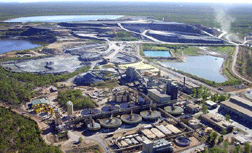 A tank containing up to a million litres of uranium ore and acid split, damaging the crane that was trying to repair it and surrounding infrastructure at the mine near Kakadu National Park…..
West Australian Greens Senator Scott Ludlam says the mine should now be shut down for good.
“The company thinks that the way to save operations at Ranger is to go underground through the 3 Deeps projects,” he said.
“As far as the Greens are concerned the company should be as good as its word and close that facility when its lease runs out.
“I think this latest disaster doesn’t improve anyone’s confidence that the mine is capable of running for another 10 or 15 years.”
Senator Ludlam says there are a number of lessons to be learned from the incident, and has called for the Federal Government to reconsider giving more approval power over uranium mines to state and territory governments.
“I think some short-term lessons include the company disclosing how many other of these leach tanks there are, and whether they’re in the same condition as the one that burst,” he said.
“But in the longer term, this is a very strong sign for Environment Minister Greg Hunt that under no circumstances should he let regulation of the uranium sector go back to the states and territories.”….http://www.abc.net.au/news/2013-12-08/greens-call-for-end-of-ranger-uranium-mine-operations/5142734
Call for no uranium exported through Queensland port: Protect Barrier Reef!
 Anti-nuclear campaigner seeks port uranium assurances http://www.abc.net.au/news/2013-12-05/anti-nuclear-campaigner-seeks-abbot-point-uranium/5137248 An anti-nuclear campaigner is calling on the Queensland Government to rule out that uranium will be exported through the Port of Mackay.
Last year, the Newman Government reversed a long-standing ban on uranium mining in Queensland.
The port’s operator, North Queensland Bulk Ports (NQBP), said it could be used to transport associated mining equipment.
Mark Bailey from Keep Queensland Nuclear Free says he has serious concerns about the possibility of the resource being shipped through the reef.”I don’t think any of us want uranium on the Great Barrier Reef and we certainly don’t want our tourism industry affected by an incident like a grounding on the reef in bad weather with a uranium ship,” he said.
“This has happened before, you know Cameco had a ship that hit bad weather in the Pacific. If that happens on the reef, the publicity will be very bad.”
He says he wants assurances Abbot Point will not be used.
A spokesman for NQBP says there are no plans to export the commodity through the Port of Mackay at this stage.
The real Fukushima nightmare is the 3 molten cores of nuclear reactors Nos 1,2 and 3
 BBC: Work at Fukushima Unit 4 a “distraction”; The “real nightmare” is coming from 3 molten cores — NYTimes: Melted fuel is “all over the place… First goal is simply to stop uncontrolled releases of radioactive material” (AUDIO)
BBC Tokyo correspondent Rupert Wingfield-Hayes, Dec. 6, 2013 (at 2:30 in): They’re doing this work because that’s the easy bit. Reactor 4 was not badly damaged compared to the other reactors. There was no core meltdown, so that is the one that they can sort of get to grips with […] Reactor buildings 1, 2, and 3 where there were core meltdowns, the radiation levels there are still way too high for anyone to go in those buildings. So I think Reactors 1, 2, and 3, the reactors that had core meltdowns, are the real long-term problem, and a very difficult problem to deal with. Reactor 4 is a bit of a distraction. It’s important to get the fuel out, but it is the easy bit. […] the really big headache [is] to keep those melted reactors cool, which they have to do for many years to come. They have to pump water into the damaged reactor cores […] It’s a real nightmare to manage this ever-growing amount of water.
Full interview with Hayes here
New York Times reporter Matthew Wald* (at 46:30 in): The water, about a thousand tons a day, comes through the site and some of it goes into the basements of these ruined reactors, and these basements now have radioactive material in them. And the basements, the whole building is being cooled to keep the debris cool […] The water when it reaches the ocean just about meets international standards for drinking water, it’s barely polluted […] but it just looks awful that two and a half years after this accident, you have not contained the radioactive debris. […] [The fuel] is not molten anymore. Of course it’s kind of like candle wax that solidified, but it’s all over the place and getting it out is going to be a challenge. […] The vessel was over pressurized, the seals failed, little bits of fuel got out on to the space around the vessel into the basement, etc., etc. It’s dangerous, it’s highly radioactive. On the other hand it’s not really in a public place. […] But probably the first goal is simply to stop uncontrolled releases of radioactive material, and they haven’t quite reached that yet.
* A pro-nuclear blogger discussed Wald earlier this year: Matt Wald of the New York Times recently reviewed a new book on America’s nuclear waste storage saga […] Aside: Sadly, Matt’s post was one of the last posts ever published on Green, which just announced its demise due to budget constraints. It’s a crying shame; Green provided excellent coverage […]
Vote Glencore Xstrata for the world’s most unethical corporation
 PUBLIC EYE AWARD 2014 http://publiceye.ch/en/ Glencore Xstrata is the world’s largest diversified trader in commodities such as coal, oil, copper, zinc, lead, aluminium, metal alloys, grains, or oilseeds. Glencore Xstrata’s mining activities are forcing local communities and indigenous groups from their homes.
 Water and land – their basic necessities for life – are polluted or destroyed; entire communities are separated and authorities corrupted. Moreover, the company has been found to be working with corrupt intermediaries and evading taxes, thereby depriving the commodity-rich countries of a much-needed source of income. Those who dare to voice criticism are prosecuted or physically threatened by security forces or armed groups…..
Causes
Glencore Xstrata is striving to secure their lucrative business at any cost and is violating the social, cultural and political rights of communities and destroying the environment along the way. The company’s greed for profit seems unstoppable even in the face of social movements, legal proceedings and fines, environmental surveys proving the toxic effects of their business, and criticism by civil society.
Around the globe, Glencore Xstrata is manipulating public opinion, claiming to be generating economic value for the local communities. In reality, however, they are submitting the regions surrounding the mines to their own conditions. The company’s aggressive tax evasion combined with corrupt practices is preventing the mining countries from benefitting from their abundance of natural resources.
Glencore Xstrata – the ugliest corporation in the world?
– Who’s the ugliest of them all? Glencore Xstrata is a hot contender for worst corporation award New Internationalist Stephanie Boyd on why she thinks the mega-miner should win Public Eye’s competition 8 Dec 13, “……..in these wired times we can express our disfavour by voting for the world’s top corporate bad guy. Eight companies have been shortlisted for the annual Public Eye awards, given to the worst violators of human rights and the environment.
The awards, which are sponsored by Greenpeace and the Berne Declaration, will be given out at the World Economic Forum at Davos in January to the (un)lucky winners. There’s also a jury award, selected by distinguished experts in business ethics, the environment and human rights, including Vandana Shiva. Competition is tight. Nominees include such infamous corporations as Gap, Syngenta/Bayer/BASF, FIFA and Glencore Xstrata.
The selection is so good, or rather, so terribly bad, I found it hard to pick just one. In the end, personal experience won out. I live not far from a mine owned by Glencore Xstrata (GX) in the mountains of Peru and have witnessed the long-running conflict. – ………
This incident is just one in a slew of accusations against GX operations around the world. Human rights activists have united and formed the Shadow Network: Glencore Xstrata Watchdogs to monitor the company and push for changes. Earlier this year I met with some of the network’s members from Bolivia, Colombia, Argentina, the Philippines, Peru and Switzerland. –
Their stories are frighteningly similar: lack of environmental monitoring and controls, harassment and threats against leaders, police violence against peaceful demonstrations and an unwillingness to negotiate with legitimate community leaders. -………
But that’s just my opinion. Now it’s your turn to vote, according to your own conscience.
No matter who you choose, this simple act will send a message to the world’s economic leaders when they gather next year in Davos: we’re watching you, so shake those nasty ghosts out of your closet because sooner or later, the truth will come out. And next time, it might be you up on the podium, receiving the statue of corporate shame.
Vote on the Public Eye Award. http://publiceye.ch/en/
Senate inquiry into Abbott’s “Direct Action” policy on Climate Change
 Labor, Greens join forces to set up Senate inquiry on Government’s Direct Action policy By political reporter Jane Norman ABC News 7 Dec 2013, Labor and the Greens have moved to establish a Senate inquiry into the Government’s Direct Action policy.
The multi-billion-dollar emissions reduction policy would provide polluters with financial incentives to cut emissions.
The inquiry will examine whether it is the most cost-effective way of cutting greenhouse gases and will report back by late March.
Greens leader Christine Milne says the inquiry will expose the policy as a sham……
Labor and the Greens have already vowed to block the Government’s moves to repeal the carbon tax in the Senate.http://www.abc.net.au/news/2013-12-07/labor-greens-join-forces-on-emissions-inquiry/5141872
New evidence of cancer risk for those living near nuclear reactors
 http://www.dailymail.co.uk/news/article-42066/New-study-links-nuclear-sites-cancer.html Saturday, Dec 07 2013 A Euro MP has called on the Government to release figures after a new study suggested people living near nuclear power stations stood a high risk of developing cancer.
Radiation expert and independent researcher for Green Audit Dr Chris Busby found that children in Chepstow, south Wales, were 11 times more likely to develop myeloid leukaemia than the national average.
Chepstow is just five miles from Oldbury nuclear power station on the banks of the River Severn, which has been found to contain high levels of radioactive particles.
South West MEP Michael Holmes, who commissioned Dr Busby’s report, said: “It is imperative that Health Minister Alan Milburn releases data on all cancer incidence down to ward levels as a matter of grave public concern. Continue reading
Lecture 11 December: White Man’s Law on Aboriginal Land
 Upcoming Event – White Man’s Law on Aboriginal Land: The Conflict of Legal Cultures on the South Australian and Prairie Canadian Frontiers http://blogs.adelaide.edu.au/public-law-rc/2013/12/03/upcoming-event-white-mans-law-on-aboriginal-land-the-conflict-of-legal-cultures-on-the-south-australian-and-prairie-canadian-frontiers/
The Adelaide Law School is proud to host:
White Man’s Law on Aboriginal Land: The Conflict of Legal Cultures on the South Australian and Prairie Canadian Frontiers
Presented by: Professor Louis Knafla
Dr Louis A Knafla is Professor Emeritus of History, University of Calgary, and specializes in early modern English and western Canadian legal history. The editor of “Aboriginal Title and Indigenous Peoples: Canada, Australia and New Zealand” (2010), he is currently completing a co-authored book on “Fragile Settlements: Aboriginal Peoples, Law and Resistance in Australia and Western Canada, 1830-1914” with colleagues at Adelaide and Winnipeg.
Date: Wednesday, 11 December 2013
Time: 5:30-7:00pm
Venue: Moot Court, Ligertwood Building, University of Adelaide
RSVP: By Monday, 9 December 2013 to Dr Matthew Stubbs (matthew.stubbs@adelaide.edu.au)
Solar power is reshaping Australia’s electricity market
 People power: Rooftop solar PV reaches 3GW in Australia REneweconomy,By Giles Parkinson on 4 December 2013 Australia has passed through another significant solar milestone, reaching 3GW of solar PV this month, as Queensland nudged the 1GW mark and states such as South Australia reached household penetration rates of 25 per cent.
“Solar power is reshaping Australia’s electricity market,” says Warwick Johnston, the head of solar research group SunWiz, who compiled the data. “This is a milestone as note-worthy as the one millionth solar power system that was installed in April.”
The growth in solar PV in Australia is quite remarkable, given that Australia’s capacity was barely more than 180MW in 2009. Much of this growth came as a result of generous feed in tariffs, but the growth continues as a new generation of households look to solar to hedge against the rising cost of grid-based electricity, to make a statement about green energy, or to do both.Australia is almost unique in the world in having its solar installations almost exclusively in rooftop solar PV. That, according to Johnston, now totals 3GW on its own, mostly residential but also on a growing number of commercial rooftops, such as wineries.
Australia has only one solar PV array above 1.2MW, the 10MW Greenough River solar farm in Western Australia, although three projects have begun or are about to begin construction in the ACT, and the 102MW Nyngan project will also begin construction in January. Others are in the wings. To put this into comparison, the Japanese market is expected to install 9GW of solar in 2013 alone, much of it at commercial or larger scale…….http://reneweconomy.com.au/2013/people-power-rooftop-solar-pv-reaches-3gw-in-australia-99543
Renewable Energy Target (RET) to bring down electricity prices
The Climate Change Authority carefully considered the costs and benefits of the RET during its review of the scheme last year.
A 130-page modelling report it commissioned from SKM-MMA concludes that the RET scheme’s net impact on retail electricity prices will be to reduce retail electricity prices in 2020, as the cost of the RET scheme will be completely mitigated by its downward pressure on electricity prices.
RET brings downward pressure on electricity prices http://www.theaustralian.com.au/business/opinion/ret-brings-downward-pressure-on-electricity-prices/story-e6frg9if-1226775423434# MILES GEORGE THE AUSTRALIAN DECEMBER 05, 2013
ON November 20, 1997, John Howard announced a proposal to establish a national mandatory renewable energy target.
In a speech titled Safeguarding Australia’s Future: Australia’s Response to Climate Change the prime minister said a mandatory renewable energy target would “accelerate the uptake of renewable energy in grid-based electricity and provide a larger base for the development of commercially competitive renewable energy”.
Three years later Australia’s renewable energy target scheme was passed into law, with bipartisan support.
Over the past 16 years the RET has been expanded and improved, in each case with bipartisan support, and it continues to enjoy bipartisan support as an effective piece of market-based legislation that has consistently achieved its objectives.
During that period the scheme has enabled more than $20 billion of investment in the construction and operation of clean energy facilities, resulting in enough electricity to be generated to power about two million homes — half of which largely represents utility scale wind and solar photovoltaic investments in regional areas, and the other half residential rooftop solar PV facilities.
Perhaps most important, it has been shown the RET creates significant downward pressure on electricity prices. This is because large-scale renewable energy facilities nearly always underbid fossil fuel generation in the wholesale electricity market, thereby reducing wholesale prices.
This fact is acknowledged by the Australian Electricity Market Operator, the Climate Change Authority, Bloomberg New Energy Finance and other experts. Continue reading
1 This month
7 April – WEBINAR – Australia and the Doomsday Clock – Preventing nuclear war through NoFirstUse and other policies
Online | Tuesday April 7, 4:00-5:30pm, Australian Eastern Time / 8:00-9:30am Central Europe Time
– Access the registration link
15 April – Zoom –Nuclear Power is Not the Solution
Apr 15, 2026 01:00 AM in Canberra, Melbourne, Sydney

Join the International Physicians for the Prevention of Nuclear War (IPPNW) on Tuesday, April 14th for a timely webinar exploring the risks associated with nuclear power and challenging the myth that it offers a simple, safe, carbon-free solution to the climate crisis

21 April Webinar: No Nuclear Weapons in Australia
Start: 2026-04-21 18:00:00 UTC Canberra, Melbourne, Sydney (GMT+10:00)
End: 2026-04-21 19:30:00 UTC Canberra, Melbourne, Sydney (GMT+10:00)
Event Type: Virtual
A virtual link will be communicated before the event.
Host Contact Info: australia@icanw.org

of the week – Australians for War Powers Reform (AWPR)
To see nuclear-related stories in greater depth and intensity
 Antinuclear