BHP not keen to waste more money developing uneconomic Olympic Dam
 Where Olympic Dam is concerned, it’s the outlook for the main commodity—uranium—rather than potential investors that it mostly dislikes.
BHP Warms to Partnerships, But Olympic Dam Remains in the Cold WSJ 10 Dec 13, BHP Billiton Ltd. wants to share the love to get its $10 billion Jansen potash project in Canada off the ground. But the world’s biggest mining company is being a determined single when it comes to another costly development: Australia’s Olympic Dam…….
BHP’s reluctance to seek a partner for an expanded Olympic Dam project in South Australia may surprise as it’s stuck on the back burner, squeezed by low commodity prices and high development costs estimated by analysts at around $30 billion. In August last year, BHP said it would look for a less costly design for the Olympic Dam mine, which had been expected to bring in billions in tax dollars and create thousands of jobs. Up to now, it hasn’t announced any new plans for the site.
At first glance, finding a competitor to share development costs and risks with BHP makes sense. If they also bring in new technology then so much the better.
The problem for BHP is that a partner might actually want to get the project moving, even at a much-reduced scale. That would test BHP’s desire to keep annual spending below $15 billion in future, down by a third from last year’s bill totaling $21.7 billion. With uranium prices continuing to hover near eight-year lows, and several countries debating nuclear power in their energy mix, BHP can avoid such tough decisions by keeping full control of the asset.
“We like partnerships,” Mr Mackenzie told U.S. investors. Where Olympic Dam is concerned, it’s the outlook for the main commodity—uranium—rather than potential investors that it mostly dislikes. http://blogs.wsj.com/moneybeat/2013/12/10/bhp-warms-to-partnerships-but-olympic-dam-remains-in-the-cold/
Previous studies underestimated the global consequences of even a “limited” nuclear war
 Nuclear war would ‘end civilization’ with famine: study , NewVision, 11 Dec 13 A nuclear war between India and Pakistan would set off a global famine that could kill two billion people and effectively end human civilization, a study said Tuesday.
Even if limited in scope, a conflict with nuclear weapons would wreak havoc in the atmosphere and devastate crop yields, with the effects multiplied as global food markets went into turmoil, the report said.
The Nobel Peace Prize-winning International Physicians for the Prevention of Nuclear War and Physicians for Social Responsibility released an initial peer-reviewed study in April 2012 that predicted a nuclear famine could kill more than a billion people.
In a second edition, the groups said they widely underestimated the impact in China and calculated that the world’s most populous country would face severe food insecurity.
“A billion people dead in the developing world is obviously a catastrophe unparalleled in human history. But then if you add to that the possibility of another 1.3 billion people in China being at risk, we are entering something that is clearly the end of civilization,” said Ira Helfand, the report’s author.
Helfand said that the study looked at India and Pakistan due to the longstanding tensions between the nuclear-armed states, which have fought three full-fledged wars since independence and partition in 1947.
But Helfand said that the planet would expect a similar apocalyptic impact from any limited nuclear war. Modern nuclear weapons are far more powerful than the US bombs that killed more than 200,000 people in Hiroshima and Nagasaki in 1945.
“With a large war between the United States and Russia, we are talking about the possible — not certain, but possible — extinction of the human race……..
ultimately, the only answer was the abolition of nuclear weapons.
“This is a disaster so massive in scale that really no preparation is possible. We must prevent this,” he said.
President Barack Obama pledged in 2009 to work toward abolition but said that the United States would keep nuclear weapons so long as others exist. Nine countries are believed to possess nuclear weapons, with Russia and the United States holding the vast majority. http://www.newvision.co.ug/news/650353-nuclear-war-would-end-civilization-with-famine-study.html
The few surviving Maralinga nuclear veterans lose yet another case for justice
 Australian veterans affected by nuclear testing lose final bid for case to be heard http://www.abc.net.au/news/2013-12-10/veterans-affected-by-british-nuclear-testing-lose-court-bid/5147678 By Sally Block 10 Dec 2013 Australian veterans of British nuclear testing in the 1950s and 1960s have lost their bid to have their case investigated.
About 300 surviving members of the Australian Defence Force applied to the Australian Human Rights Commission to have their case heard.
The veterans were involved in the nuclear tests by the British at Maralinga, Emu Field and Monte Bello islands. Their lawyers argued the Menzies government at the time exposed them to the harmful effects of radiation in full knowledge of the damage to their health and that is a breach of the Universal Declaration of Human Rights.
The Commission knocked them back, saying it is out of their jurisdiction to inquire into the acts or practises by the Commonwealth that are alleged. Continue reading
At last – a positive diplomatic accord between UN and Israel
 Iran Nuclear Accord Is a Good Deal, BU Today, Critics of agreement miss the lessons of history 12.09.2013 By Robert Loftis Strip away all the rhetoric, and the November 23 agreement with the Islamic Republic of Iran over its nuclear program emerges as an exercise in realism. It recognizes that three decades of enmity and distrust will not be erased overnight, nor can the knowledge of how to make a nuclear weapon be destroyed. This interim agreement represents a first step in verifiably ensuring that Iran’s nuclear program can be strictly limited to peaceful purposes. It is definitely a path worth pursuing.
The outlines of the agreement are simple: in return for a six-month halt to certain construction and enrichment activities, conversion and dilution of an existing 20 percent of enriched uranium stocks, and intrusive inspections by the International Atomic Energy Agency, the United States and other powers will offer limited relief from crippling sanctions on Iran’s economy.
In essence, it deprives Iran of the opportunity to readily further enrich uranium to levels of purity necessary for nuclear weapons. Over the course of this six-month agreement, the sides will explore the possibility of a comprehensive pact that will ensure Iran’s nuclear program is limited to civilian purposes and that treats Iran as any other signatory to the Non-Proliferation Treaty. If, during the next six months, it becomes clear that the Iranians are cheating or trying to hide a military program, then the sanctions can be reimposed immediately and further steps considered. It is worth highlighting that the Iranians made this agreement not just with the United States and its European allies, but also with the Russians and the Chinese. The Iranians would have to weigh the costs of crossing its most sympathetic global powers by failing to live up to the agreement.
Far from being the “historic mistake” that Israeli Prime Minister Benjamin Netanyahu contends, the accord is the first step toward a goal that we all claim to share: an Iran that does not pose a nuclear threat to our friends and allies. …………….http://www.bu.edu/today/2013/pov-iran-nuclear-accord-is-a-good-deal/
Israel pressurising Australia to muck up the UN – Iran nuclear deal

 Israel wants Australia to use its influence in UN Security Council to amend nuclear deal with Iran SMH, December 11, 2013 Peter Hartcher, Israel has urged Australia to use its new found influence to force a much tougher deal on Iran over its nuclear program.
Israel’s Minister for the Economy, Naftali Bennett, told Prime Minister Tony Abbott that Israel ”badly wants a deal” to halt Iran’s nuclear progress, Mr Bennett said.
Israel is deeply unhappy with the terms of the interim deal negotiated by the five permanent members of the United Nations Security Council – the so-called P5 – plus Germany on November 24. ……..Australia can be an important factor in shaping the final deal, due in six months, Mr Bennett said, because it is a member of the UN Security Council next year and also the chairman of the council’s sanctions committee on Iran.
Iran has agreed to freeze parts of its nuclear program and dilute its most highly concentrated uranium in return for a partial easing of the international sanctions that have forced it into recession.
Israel’s essential demand is that Iran be forced to surrender its nuclear fuel-making machinery. Where the P5+1 deal has allowed Iran to keep its centrifuges for concentrating uranium into nuclear fuel, Israel wants them removed. : http://www.smh.com.au/federal-politics/political-news/israel-wants-australia-to-use-its-influence-in-un-security-council-to-amend-nuclear-deal-with-iran-20131210-2z42x.html#ixzz2nBQ2kJxj
Read more: http://www.smh.com.au/federal-politics/political-new
Australia appears to be caving in to USA in the Trans Pacific Partnership
 The commentary also says that Australia has worked with Japan and the US on a revised version of the controversial annex which deals with government regulation of medicine prices, including Australia’s Pharmaceutical Benefits Scheme, while most other countries are opposing it.
Trade Minister Robb said last week that Australia was prepared to agree to give investors the right to sue governments over Australian laws which they claimed harm their investment, which we have experienced in the Philip Morris case.
It is also worrying that the government appears to have agreed with the US refusal to support proposals from the World Intellectual Property Organisation, which assist developing countries to get access to cheaper generic medicines. Most other countries have agreed to support these proposals
TPP talks in Singapore rocked by leaked document By Dr Patricia Ranald (AFTINET Convener) 11 DEc 13,I arrived in Singapore after a week in Bali at the World Trade Organisation talks, at which the US tried but did not succeed in blocking developing countries, led by India, from taking measures to ensure they can make basic food available for the poorest in their countries. A compromise was reached which means that developing countries can continue to do this. AFTINET working group member Peter Murphy was also at the WTO meeting and has done a longer report……
The TPP negotiations here in Singapore are of course still secret, and governments are not making any public statements. The US has set the agenda of bilateral and small group meetings. They are desperate to pressure others to agree to their proposals so they can announce that the agreement is on track to be finalised by the end of the year. Continue reading
Corporations more powerful than governments, in secret Trans Pacific Partnership deal
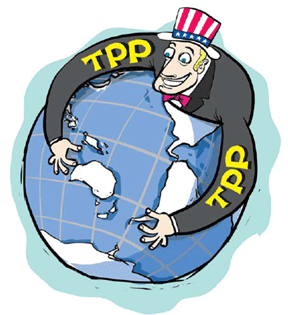 One of the most controversial provisions in the talks includes new corporate empowerment language insisted upon by the U.S. government, which would allow foreign companies to challenge laws or regulations in a privately run international court.
Previously leaked TPP documents have sparked alarm among global health experts, Internet freedom activists, environmentalists and organized labor, but are adamantly supported by American corporations and the U.S. Chamber of Commerce. The Obama administration has deemed negotiations to be classified information — banning members of Congress from discussing the American negotiating position with the press or the public. Congressional staffers have been restricted from viewing the documents
Obama Faces Backlash Over New Corporate Powers In Secret Trade Deal HUFFINGTON POST 12/09/2013 WASHINGTON –– The Obama administration appears to have almost no international support for controversial new trade standards that would grant radical new political powers to corporations, increase the cost of prescription medications and restrict bank regulation, according to two internal memos obtained by The Huffington Post. Continue reading
Film Fallout staggeringly relevant to today’s nuclear weapons situation
Back then we were closer to WWII and the bombs that were dropped on Hiroshima and Nagasaki. We knew the destructive power. Now, time blurs memories and people don’t realize how devastating those weapons are. The kilotons in nuclear bombs today dwarf the power of nuclear bombs when we grew up. ……..
Thanks Kat for bringing awareness in an industry that is more prone to “Hangover III” than hard-hitting documentaries.
When ActivistsMake Movies: The Nuclear Arms Race is Relevant Again With ‘Fallout’ The Wrap, HOLLYBLOGS | By Richard Stellar on December 10, 2013 The documentary details the making of Stanley Kramer’s epic “On the Beach”
Below – Lily Tomlin, Dr Helen Caldicott, Kat Kramer, Karen Kramer

You wouldn’t know that Kat Kramer was an activist. The daughter of director Stanley Kramer (above, second from right) looks as if she’d be more comfortable on the cover of Vogue than she would in a cramped editing room, poring over footage of films that, in her estimation, “change the world.”
One such film that efforts to do just that premiered a few weeks ago at the famed Sunset-Gower Studios lot,…… “Fallout” details the making of Stanley Kramer’s epic “On the Beach” — adapted from the fertile mind of Nevil Shute’s novel of a post-apocalyptic world ……..“Fallout” is about a movie about “the bomb” — and its relevance to today is staggering. Continue reading
Thorium does not resolve nuclear power’s proliferation and waste issues,
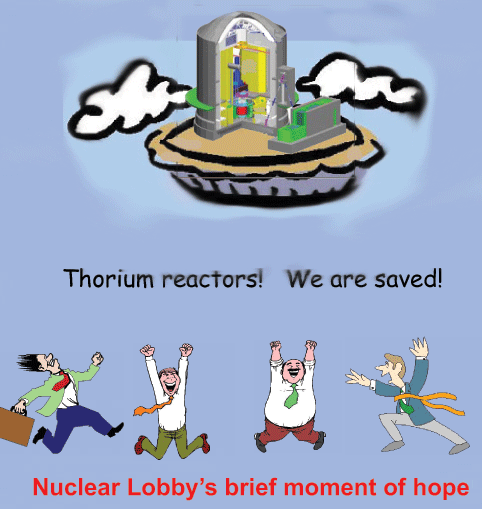 Thorium Reactors: Nuclear Redemption or Nuclear Hazard?, The Energy Collective 10 Dec 13,“….Thorium does not resolve nuclear power’s proliferation and waste issues, Institute for Energy and Environmental Research President Dr. Arjun Makhijani responded to Martin on the NPR program last year. Pure uranium-233 can be derived from the molten salt coming out of thorium reactors “which is easier to make bombs with than plutonium.” And the waste, Makhijani added, contains carcinogenic radioactive materials…….
“My reactor is free. It’s in the sky, 93 million miles away. You can store its energy in molten salt. It is being done today. You can generate electricity for 24 hours a day,”
Even with extensive investment in thorium technology, he said, it would take ten years to build the infrastructure and ten more to put regulation in place. “I did an honest, unbiased look, not thinking we could do renewable energy. And I found out that my hunch was wrong: We can do 100 percent renewable energy.”……
Let them raise venture capital and do it,” said Vermont Law School Institute for Energy and the Environment nuclear economics researcher Mark Cooper. “I have low carbon and no carbon technologies whose costs have been coming down and they can keep the lights on. In 25 years I am likely to have a whole range of cost effective ways to keep the lights on that evolve from the current set of technologies.”…
1 This month
7 April – WEBINAR – Australia and the Doomsday Clock – Preventing nuclear war through NoFirstUse and other policies
Online | Tuesday April 7, 4:00-5:30pm, Australian Eastern Time / 8:00-9:30am Central Europe Time
– Access the registration link
15 April – Zoom –Nuclear Power is Not the Solution
Apr 15, 2026 01:00 AM in Canberra, Melbourne, Sydney

Join the International Physicians for the Prevention of Nuclear War (IPPNW) on Tuesday, April 14th for a timely webinar exploring the risks associated with nuclear power and challenging the myth that it offers a simple, safe, carbon-free solution to the climate crisis

21 April Webinar: No Nuclear Weapons in Australia
Start: 2026-04-21 18:00:00 UTC Canberra, Melbourne, Sydney (GMT+10:00)
End: 2026-04-21 19:30:00 UTC Canberra, Melbourne, Sydney (GMT+10:00)
Event Type: Virtual
A virtual link will be communicated before the event.
Host Contact Info: australia@icanw.org

of the week – Australians for War Powers Reform (AWPR)
To see nuclear-related stories in greater depth and intensity
 Antinuclear