Australian Government now subverting the Human Rights Commission
 Tony Abbott sure is good at destroying progressive agencies. Australians have been caught unawares at the speed and ruthlessness of this destruction. Starting with having no Minister for Science, then destruction of Climate Change Authority, of AusAid, and now the Immigration Health Advisory Group .
However, Tony’s getting a tad more subtle now – why shut down an agency when you can subvert it towards pushing your own agenda?
The first big step in this more subtle tactic was in appointing Warren Mundine (of the Australian Uranium Association) as Aboriginal Advisor.
And now, – Tony’s appointing Tim Wilson to the Human Rights Commission.
And what is Tim Wilson’s idea of “Human Rights”? Why – it’s the right to publish false science about climate. the right of tobacco companies to promote cigarettes to children, the right to say racist things about Aborigines and asylum seekers.
The Australian Human Rights Commission was getting pretty piss-weak anyway – with its latest decision against the rights of nuclear veterans. Tim Wilson should help Abbott to keep the focus off anything of real human value, – while favouring xenophobia and the tobacco companies.
Australian Government opposes efforts to ban nuclear weapons.

The bitter reality is that because of its willingness to support and assist deployment, targeting and potential use of US nuclear weapons, Australia is more part of the problem, holding back disarmament, than it is working for the solution”.
NO-NUKE AUSTRALIA THWARTS NUCLEAR FREE WORLD BY NEENA BHANDARI* | IDN-INDEPTH NEWSANALYSIS SYDNEY (IDN) – 17 Dec 13 Australia has been expressing support for a nuclear weapons-free world, but documents obtained by disarmament advocacy group, the International Campaign to Abolish Nuclear Weapons (ICAN), reveal that the Australian Government sees the increasing international focus on the humanitarian impact of nuclear weapons as “rubbing up against” its reliance on the United States nuclear weapons.
 ICAN has obtained declassified diplomatic cables, ministerial briefings and emails under freedom-of-information laws, which show that the Australian Government plans to oppose efforts to ban nuclear weapons. Continue reading
JAPAN ON WAY TO DE FACTO TOTALITARIAN STATE
 Abe shows totalitarian bent The “old” Liberal Democratic Party that former Prime Minister Junichiro Koizumi is supposed to have destroyed is making a strong resurgence as is the traditional “triangle” of the LDP, the Ministry of Economy, Trade and Industry (METI) and the Japan Business Federation (Keidanren).
When Prime Minister Shinzo Abe goes abroad, he is often accompanied by as many as 100 business leaders as he busies himself with exporting nuclear reactors and other infrastructural items through “top-level sales campaigns.” Furthermore, defying the traditional practice of determining wage levels through labor-management negotiations, Abe has asked Keidanren Chairman Hiromasa Yonekura to raise the wages of workers and this request has been handed down to Keidanren member corporations. His intervention in wage negotiations clearly indicates that Japan is a nation of highly controlled state capitalism, transcending a free market economy. Moreover, should a constitutional revision come to restrict freedom of speech, Japan would become a de facto totalitarian state http://www.japantimes.co.jp/opinion/2013/12/16/commentary/abe-shows-totalitarian-bent/#.UrBsOWRDtD5
AUDIO: Australia’s radiation affected veterans denied justice yet again
 they’ve been treated like second-class citizens.
“This really is disgusting. How is it that these people, subject to the fury of a nuclear blast, aren’t even entitled to a gold card for their medical treatment as other veterans are?”
 AUDIO Aussie nuclear veterans ‘disgusted’ by bid failure http://www.sbs.com.au/news/article/2013/12/17/aussie-nuclear-veterans-disgusted-bid-failure Australian veterans of British nuclear tests say they’re disgusted by the latest setback to their campaign for compensation. (Transcript from World News Australia Radio) Australia’s Human Rights Commission has decided it can’t consider the case of the 300 veterans because the matter is out of its jurisdiction.
The decision has left the veterans’ lawyers saying it’s the end of their campaign.
Murray Silby spoke to some of the veterans, including Avon Hudson “They’ll act with extreme disgust at the government and the Human Rights Commission. I mean we shouldn’t wait on the Human Rights Commission. This should have been addressed by governments of the past, but given the Human Rights heard this I have no time for the Human Rights (Commission) now.”
Avon Hudson says he and his fellow veterans have lost faith in a system that should have protected their rights.”I don’t know anybody that was there when I served there that hasn’t had either cancer or some other illness induced by radiation. Continue reading
With development of battery storage, Australia’s renewable energy will go ahead
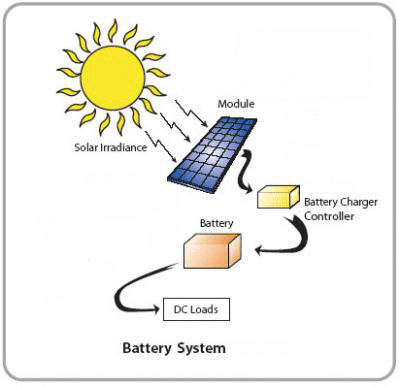 Storing renewable energy starts at home, DW Jonathan Gifford 16 Dec 13 Almost all of Australia’s solar energy comes from the roofs of private homes. There’s no shortage of sunlight, but to develop solar power, a storage solution is needed. Vast solar power plants may be commonplace in Germany, but in Australia the turn to renewable energy has largely taken place on an individual basis. More than one million Australian homes now have solar panels, but how to store that energy for when it’s needed is emerging as the next challenge.
Australia’s recently elected coalition government has wasted no time in taking measures to halt the expansion of renewable energy. It has passed legislation to repeal the previous government’s carbon price mechanism, closed the Climate Change Commission and slashed funding for the Australian Renewable Energy Agency.
Much of Australia’s renewable energy, and almost all of its solar efforts, however, have been deployed in the country’s suburbs on the roofs of private households.
This also brings with it challenges, and electricity grid operators have begun taking measures to limit the amount of solar power that can be added in an area. In Western Australia, the utility Western Power is preventing large installations – bigger than 30 kilowatt peak (kWp) – from feeding any electricity produced back into the grid. The utility that supplies remote or rural parts of the state, Horizon Power, announced in October that if a solar system is installed, it needs to be equipped with some kind of “renewable energy smoothing” technology – essentially some form of battery………
http://www.dw.de/storing-renewable-energy-starts-at-home/a-17266796
French taxpayers to join British taxpayers in funding UK new nuclear power
 Areva may use French fund to help pay for UK nuclear plant – paper http://uk.reuters.com/article/2013/12/16/uk-areva-hinkleypoint-funds-idUKBRE9BF0KS20131216 (Reuters) – Areva is in talks with the French government to release some funds set aside for dismantling its nuclear installations in France to help the company finance a new
  British nuclear reactor, a newspaper reported.
 Britain signed a deal with France’s state-owned utility EDF in October to build a 16-billion pound nuclear power plant at Hinkley Point in southwest Britain, the first new plant in Europe since the Fukushima disaster.d to help pay for UK nuclear plant – paper
PARIS Mon Dec 16, 2013 State-owned Areva is taking a 10 percent stake in the consortium that will build the facility, which also includes EDF’s Chinese partners China General Nuclear Corporation (CGN) and China National Nuclear Corporation (CNNC).
Areva may use French fund to help pay for UK nuclear plant – paper
Right wing climate sceptic appointed to Australian Human Rights Commission
 Thinktank director Tim Wilson appointed human rights commissioner Attorney general says director of right-wing Institute of Public Affairs will ‘restore balance’ to Human Rights Commission Bridie Jabour theguardian.com, Tuesday 17 December 2013 The attorney general has appointed a director from the right-wing thinktank, the Institute of Public Affairs, as Australia’s human rights commissioner.
George Brandis said Tim Wilson, a member of the Liberal party until this month, had been appointed to “restore balance” to the Human Rights Commission.
Wilson, a self-declared classic libertarian, directs climate change policy at the IPA as well as the Intellectual Property and Free Trade Unit.

Wilson said he had stepped down from his position at the IPA as well as resigned from the Liberal party to take up the appointment.The IPA called for the Human Rights Commission to be abolishedearlier this year with Simon Breheny, director of its Legal Rights Project, saying it did not protect human rights.…..http://www.theguardian.com/world/2013/dec/17/thinktank-director-tim-wilson-appointed-human-rights-commissioner
Australia can have defence co-operation without supporting nuclear weapons
NO-NUKE AUSTRALIA THWARTS NUCLEAR FREE WORLD BY NEENA BHANDARI* | IDN-INDEPTH NEWSANALYSIS
SYDNEY (IDN) – 17 Dec 13 “…..Defence cooperation sans nukes possible “To make matters worse, Australia’s increasing military involvement with the US is making particularly the huge and expanding military spy base at Pine Gap near Alice Springs an even higher priority nuclear target in the event of any war the US gets embroiled in with China or any other nuclear armed state,” Ruff, who is also co-president International Physicians for the Prevention of Nuclear War, told IDN.
New Zealand’s healthy and growing defence cooperation with the US makes plain that it is perfectly feasible for countries to have a military relationship with the US which excludes nuclear weapons. “Pursuing such a path would be the best thing Australia could do to actually help in freeing the world from nuclear weapons,” Ruff added.
Advocates for a nuclear free world argue that a global ban on nuclear weapons can be achieved through sustained public pressure and leadership from governments. Former Prime Minister Malcolm Fraser, who was critical of Australia’s decision not to endorse the humanitarian statement, is of the view that the current Australian Government may wish to please the US even more than the previous government. Continue reading
Queensland Government’s unreasonable attack on renewable energy
The large scale renewable energy target is probably the smallest component of the electricity bill. It’s interesting that McArdle chooses to attack this, and not the network costs, which account for around half of consumer bills.
It’s all about self-interest, and McArdle has just underlined the untenable conflict of interest in having governments acting as owner, regulator, price-setter and policy developer.

Queensland energy minister launches wild attack on renewables http://reneweconomy.com.au/2013/queensland-energy-minister-launches-wild-attack-on-renewables-15549 By Giles Parkinson on 16 December 2013 The Queensland government has declared its hand in the upcoming review of the renewable energy target with an extraordinary – and in many places misinformed – attack on the costs of renewable energy.

The Queensland Energy Minister Mark McArdle wrote an opinion piece in The Australian on Monday challenging an assertion by Miles George, the head of Infigen Energy and a director of the Clean Energy Council, that renewable energy has a dampening impact on electricity prices. Continue reading
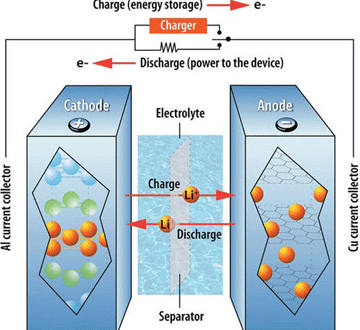
For the moment – limits to traditional battery storage of renewable energy
Falling battery prices coupled with a desire for self-sufficiency and the need for resilience against extreme weather events may mean that families purchasing a house Down Under may soon ask: “does it come with batteries?”
Storing renewable energy starts at home, DW Jonathan Gifford 16 Dec 13 “……At this stage the problem is that batteries are either expensive or inefficient. Even homes with a relatively large solar installation find that they cannot rely on it exclusively – even under the Australian sun. “The main problem for me is the storage of electricity hasn’t improved a great deal in the 41 years I’ve been here,” said Peter Holland, a Western Australian who has been living on a ‘bush’ property outside of the state’s capital, Perth.
“I’ve always had a bank of 12 two-volt batteries, but there’s a huge amount of loss,” Holland said. “The batteries are relatively inefficient and they’re extremely expensive.” Because of this, Holland’s off-grid system still requires a backup generator to cope when the sun isn’t shining or when large household appliances are switched on.
The solar industry has long understood the necessity of electricity storage. Shaun Qu, founder and CEO of Canadian Solar, says that the development of storage technologies will allow for more renewable energy to be installed. Continue reading
1 This month
To see nuclear-related stories in greater depth and intensity
– go to https://nuclearinformation.wordpress.com/


 Antinuclear