For the moment – limits to traditional battery storage of renewable energy
Falling battery prices coupled with a desire for self-sufficiency and the need for resilience against extreme weather events may mean that families purchasing a house Down Under may soon ask: “does it come with batteries?”
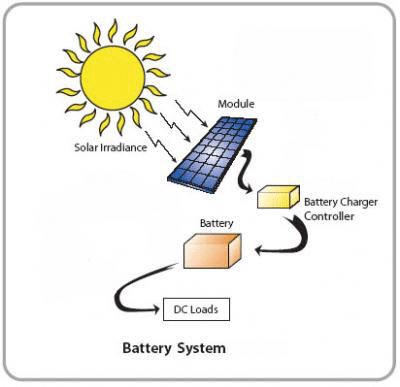 Storing renewable energy starts at home, DW Jonathan Gifford 16 Dec 13 “……At this stage the problem is that batteries are either expensive or inefficient. Even homes with a relatively large solar installation find that they cannot rely on it exclusively – even under the Australian sun. “The main problem for me is the storage of electricity hasn’t improved a great deal in the 41 years I’ve been here,” said Peter Holland, a Western Australian who has been living on a ‘bush’ property outside of the state’s capital, Perth.
“I’ve always had a bank of 12 two-volt batteries, but there’s a huge amount of loss,” Holland said. “The batteries are relatively inefficient and they’re extremely expensive.” Because of this, Holland’s off-grid system still requires a backup generator to cope when the sun isn’t shining or when large household appliances are switched on.
The solar industry has long understood the necessity of electricity storage. Shaun Qu, founder and CEO of Canadian Solar, says that the development of storage technologies will allow for more renewable energy to be installed. Canadian Solar is currently the fifth largest solar photovoltaic (PV) company in the world, according to figures from analysts IMS Research.Shaun Qu recently visited Australia for the first time for a renewable energy industry event, and he observed that as more solar gets added, storage will become increasingly important. “For solar without storage, you can only install it to a certain percentage of your consumption level,” Qu said. “But with storage, you will be able to further increase the ratio of PV within the total energy profile.”
Potential cost reductions
Despite Peter Holland’s complaints, there have been developments on the electricity storage front – particularly among batteries. In fact, academic and energy analyst Ray Wills says that the familiarity with battery technology means that cost reductions can be reached relatively quickly.
“Batteries are pretty exceptional, because we’ve actually been using batteries for a long time and a lot longer than we’ve been deploying solar panels,” said Wills. He said that demand for more batteries, particularly lithium-ion batteries that are found in electronic devices like smartphones and laptops, will drive an increase in battery production.
“We’ve seen a 600% increase in production of solar panels over the last five years and the consequence was that solar panels came down in price more than 80% over the course of several years,” he noted, “and we’ll see that sort of development with batteries as well.”
In an Australian context, with relatively abundant sunshine and high electricity prices, Wills expects residential batteries to become an increasing feature of solar installations. “What we know at the moment is that batteries installed in the home have a payback of around nine to ten years, so when we see batteries drop behind a five-year repayment, we’re going to see a very rapid uptake.” Wills predicts batteries for family homes to reach that point some time in 2015.
Falling battery prices coupled with a desire for self-sufficiency and the need for resilience against extreme weather events may mean that families purchasing a house Down Under may soon ask: “does it come with batteries?”
For Peter Holland, that moment couldn’t come soon enough. “While (my solar array) is a fabulous system in some ways, I’m also disappointed or frustrated that I can’t always achieve the efficiencies that I would like.”http://www.dw.de/storing-renewable-energy-starts-at-home/a-17266796
No comments yet.
1 This month
To see nuclear-related stories in greater depth and intensity
– go to https://nuclearinformation.wordpress.com/


 Antinuclear
Leave a comment