Unsettling truths about Australia’s uranium and nuclear history
a few unsettling home truths about Australia, as a far-flung outpost of what the writer B. Wongar has called the ‘Nuclear Empire’.
the plunder of native land for its enormous reserves of uranium has entrenched the country’s problematic engagement in world nuclearism and undermined its international credentials as a leading proponent of nuclear non-proliferation.
 Anzac, New Mexico: Placing Australia in the Nuclear Empire, Meanjin, Robin Gerster, Dec 13 It is a lament that many Australian readers will recognise: an indigenous narrator is telling the story of colonial dispossession, from the time of white settlement to the rampant mining activity of today, expressing his helplessness in the face of an implacable force that reinscribes the very landscape it has taken over, mapped and mined………….
In August 1945, unable to boast a military role in such a king-hit to its hated enemy Japan, Australia sought another way to take a small slice of the wretched glory. Two days after the Hiroshima bombing, the claim was circulated that ‘Little Boy’ was fuelled by Australian uranium: ‘Uranium from S.A. source’, ran a story on page one of the Sydney Morning Herald. But the text itself says nothing more than the fact that uranium is vital to nuclear fission, that it had been mined at Mt Painter in South Australia, and (portentously) that supplies of the element had been ‘flown out’ from the mine’s newly constructed aerodrome. The Herald soon retracted the story, quoting Prime Minister Ben Chifley to the effect that ‘though Australia attempted to secure uranium for the atomic bomb, the production stage was never undertaken’. This was a minor humiliation in the scheme of things, but a reminder that Australia’s part in these epochal events was essentially peripheral. Undeterred, a Courier-Mail correspondent on 9 August, the day of reckoning for Nagasaki, claimed that Australia ‘gained prestige’ from the advent of the atomic bomb merely by being one of the world’s leading sources of the element.
Plight of homeless men working at Fukushima nuclear radioactive wreck
UN Official ‘Astounded’: Homeless are taken to work in Fukushima, ready to die — Pastor: “At end of month, they’re left with no pay” — Police: They end up in debt to employers after food and housing fees deducted (VIDEO) http://enenews.com/un-official-astounded-homeless-are-taken-to-work-in-fukushima-theyre-ready-to-go-die-pastor-at-end-of-month-theyre-left-with-no-pay-police-they-end-up-in-debt-to-employer
Reuters, Dec. 29, 2013: SPECIAL REPORT- Japan’s homeless recruited for murky Fukushima clean-up […] Some say better homeless than going into debt by working […] Gangsters run Fukushima labour brokers […] Sendai, the biggest city in the disaster zone, has emerged as a hiring hub for homeless men. Many work […] cleaning up radioactive hotspots […] Seiji Sasa, 67 [recruits] homeless men at the Sendai train station to work in the nuclear cleanup. […] homeless men ended up in debt after fees for food and housing were deducted, police say. […] a shelter funded by the city […] sent other homeless men to work for him […] 55-year-old homeless […] worker’s paystub, reviewed by Reuters, showed charges for food, accommodation and laundry were docked from his monthly pay equivalent to about $1,500, leaving him with $10 […] The problem of workers running themselves into debt is widespread.
Kenichi Sayama, general manager at subcontractor Fujisai: “If you don’t get involved (with gangs), you’re not going to get enough workers […] The construction industry is 90 percent run by gangs.”
Yasuhiro Aoki,, Baptist pastor and homeless advocate: “Many homeless people are just put into dormitories, and the fees for lodging and food are automatically docked from their wages […] Then at the end of the month, they’re left with no pay at all.”
Shizuya Nishiyama, , 57 years old: He now sleeps on a cardboard box in Sendai Station […] [For decontamination work, an employer] offered him $90 a day […] he was made to pay as much as $50 a day for food and lodging. He also was not paid on the days he was unable to work [but] would still be charged for room and board. He decided he was better off living on the street than going into debt. “We’re an easy target for recruiters […] if we haven’t eaten, they offer to find us a job.”
Mr. Anand Grover, Esq., United Nations Special Rapporteur, , published Oct. 24, 2013: (at 15:30 in) “These workers told me, ‘Do you know we are actually living in a shanty town?’ I can show you the photographs — literally on the pavement, in the non-used pavement between the railway station there were plastic huts where people were living, in Japan, in Tokyo — not Bombay. It actually astounded me that these things were happening. Then they told me that people come take them, give them ‘X’ amount of money […] They’re ready to go into the fire and die. Other people are not ready to do it.”
Tony Abott’s climate denialist voice – Maurice Newman
“The worst part about Mr Newman’s ignorant comments is that he’s only voicing what we know Tony Abbott thinks about climate change,”
The CSIRO says robust scientific findings include clear evidence for global warming
 Tony Abbott’s top business adviser accuses IPCC of ‘dishonesty and deceit’, The Guardian, 31 Dec 13 ‘The scientific delusion, the religion behind the climate crusade, is crumbling,’ Maurice Newman says Tony Abbott’s top business adviser has accused theIntergovernmental Panel on Climate Change of “dishonesty and deceit” as it focuses on “exploiting the masses and extracting more money” in a climate crusade.
Maurice Newman, chairman of the prime minister’s new Business Advisory Council, used an interview with the Australian newspaperto launch a strongly worded attack on the global body that provides advice to governments on the body of scientific findings about climate change.
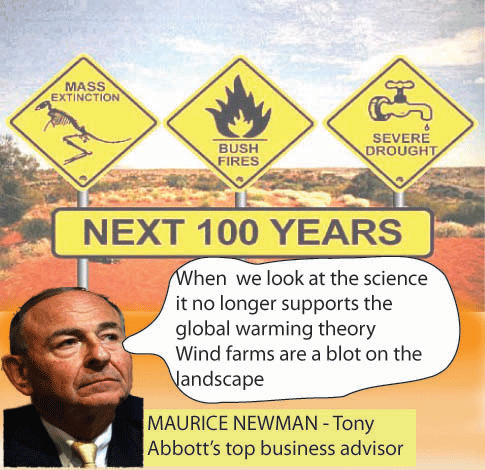
Newman also argued Australia had fallen “hostage to climate change madness” but he believed the “scientific delusion” was crumbling amid suggestions the global temperature could drop to little ice age levels.
The opposition described Newman as an embarrassment to Australia, saying he was not a scientist and therefore not qualified “to make such outrageous claims”. Continue reading
The drive by energy utilities to stop small scale solar power

The goal of utility companies, on the whole, is to work to ensure that a new model of decentralized renewable energy distribution does not emerge.
It’s an issue of the private good versus the public good: profit vs. what benefits the public commons and life on earth
 Monopolistic Utilities Know Renewable Energy Will Cut Their Profits, So They Stall It MARK KARLIN, EDITOR OF BUZZFLASH AT TRUTHOUT, 31 Dec 13 There’s one overwhelming dirigible-size reason for-profit (and often monopolistic) utility companies — that transmit and sell most of America’s energy — generally discourage, if not crush, residen ial solar (and other renewable) energy: fear of large scale loss of profit……..
for-profit utility companies were dragged kicking and screaming into the concept of allowing renewable households and industries to sell their excess energy back via transmission lines (known as hooking up to the grid). Why might you ask would a for-profit utility company be against households or industries becoming so successful in renewable energy that they are generating excess power?
Simply put, for every household or industry that becomes self-sustainable with renewable energy, the for-profit utility loses a customer, which is the same as saying losing profit. For every renewable house or industry that uses net-metering to send excess energy over the transmission grid of the utility, the utility is losing both a customer and weakening its energy monopoly. Continue reading
Australia’s miserable history as part of the global nuclear empire
the outrage committed against the land and communities of Aboriginal Australia.
A small community of Aborigines at a nearby station was poisoned by the fallout, though it was unacknowledged at the time and for years afterwards.
Anzac, New Mexico: Placing Australia in the Nuclear Empire, Meanjin, Robin Gerster, Dec 13 “…………The Fox Report fiasco is indicative of contradictions in Australian political attitudes to the nuclear industry. Australia refuses to contemplate nuclear power plants on its own soil, but it is happy to peddle its uranium to numerous countries in Asia and Europe. The meltdown at Fukushima in Japan in 2011 (in a reactor complex owned and operated by a big buyer of Australian uranium) temporarily rocked the markets and embarrassed advocates of nuclear energy…..
The state governments of mining mainstays such as South and Western Australia have a cheerfully gung-ho attitude to uranium. Distant Fukushima is out of mind as well as well out of sight. In addition to hosting established mega-concerns such as BHP Billiton, operator of the Olympic Dam mine near Roxby Downs, South Australia is rolling out the red carpet for new players…….
At Four Mile in the northern Flinders Ranges, another mine has been given the go-ahead. It is majority-owned by a subsidiary of Heathgate Resources, operator of the existing mine at Beverley in the same region, which is itself an affiliate of the nuclear arms maker General Atomics…. ‘Nuclear-free’ Australia has some alarming business connections. …
After the Second World War, Australia wanted to keep some atomic stuff for itself in addition to supplying the product to the United States and Britain. Continue reading
1 This month
Chernobyl: The Lost Tapes – A good documentary on Chernobyl on SBS available On Demand for the next 3 weeks– https://www.sbs.com.au/ondemand/tv-program/chernobyl-the-lost-tapes/2352741955560
15 April – Zoom –Nuclear Power is Not the Solution
Apr 15, 2026 01:00 AM in Canberra, Melbourne, Sydney

Join the International Physicians for the Prevention of Nuclear War (IPPNW) on Tuesday, April 14th for a timely webinar exploring the risks associated with nuclear power and challenging the myth that it offers a simple, safe, carbon-free solution to the climate crisis

21 April Webinar: No Nuclear Weapons in Australia
Start: 2026-04-21 18:00:00 UTC Canberra, Melbourne, Sydney (GMT+10:00)
End: 2026-04-21 19:30:00 UTC Canberra, Melbourne, Sydney (GMT+10:00)
Event Type: Virtual
A virtual link will be communicated before the event.
Host Contact Info: australia@icanw.org

of the week – Australians for War Powers Reform (AWPR)
To see nuclear-related stories in greater depth and intensity
 Antinuclear