Abbott commissions unnecessary research on wind energy and health
 Abbott’s fear mongering on wind farms is dangerous and reckless: Greens http://richard-di-natale.greensmps.org.au/content/media-releases/abbott%E2%80%99s-fear-mongering-wind-farms-dangerous-and-reckless-greens 08 Jan 2014 | Richard Di Natale
“This is another cynical attack on renewable energy that will create more fear and anxiety in the community” said Senator Di Natale.
“After trying to dismantle the carbon price, axe the Clean Energy Finance Corporation and attacking the Renewable Energy Target, it’s no surprise that the anti-science Abbott Government has latched onto the discredited anti-wind campaign.
“It is the Prime Ministers actions, not the wind industry’s that will put people’s health at risk. His fear mongering is reckless, dangerous and irresponsible. The truth is that there has already been extensive research into this issue and no credible health body or medical journal in the world supports the idea of wind turbine syndrome.
“There is significant research to indicate that misinformation about wind farms can make people sick. Much like a placebo can lead to genuine health benefits, false claims that something is harmful can lead to real harms.
“By commissioning further unnecessary research, the Abbott Government is simply sending a signal that there could be something to worry about. Every dollar the NHMRC spends on politically-motivated research is a dollar not spent on cancer or diabetes research.
“If the Abbott Government is truly concerned with the health impacts of power generation, a Senate Inquiry found earlier this year that the mining, transportation and combustion of coal contributes to poor air quality which has a greater impact than the road toll. It’s time the Prime Minister got on with implementing those recommendations rather than pursuing his reckless and dangerous campaign against clean energy.”
Australia has 2 million small scale renewable energy systems
 Australia reaches nearly two million small scale solar systems http://reneweconomy.com.au/2014/australia-reaches-nearly-two-million-small-scale-solar-systems-66389 By Giles Parkinson on 9 January 2014 Clean Energy Regulator says Australia now has 2 million small scale renewable energy systems – enough to power Perth, Hobart, Darwin and Canberra.
Australia has now installed more than 2 million small scale renewable energy systems – reaching the target just eight months after the country achieved its first one million rooftop solar systems.
The announcement came from the Clean Energy Regulator, which manages Australia’s renewable energy target. The total is made up of 1.83 million small scale solar systems (both rooftop PV and solar hot water, and 173,000 air source heat pumps – see graph below).
The CER said the data underlines the fact that investment in small-scale renewable energy continues to flourish in Australia. Nearly all subsidies have been removed for small scale installations, although rooftop solar and other systems still benefit from renewable energy certificates. Continue reading
Small Modular Nuclear Reactors irrelevant to nuclear power’s decline
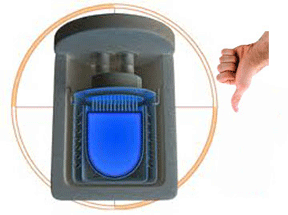 Small reactors just compound the waste problem because you generate more radioactive components (aside from all the nuclear fuel that turns into nuclear waste too) than a large nuclear reactor does per unit of energy generated. And placing them underground, while making them less tempting targets for terrorists, brings up issues of groundwater contamination and greater earthquake vulnerability in affected areas. The fact that you could use ground-source cooling to condense your cooling water a lot easier with these reactors is a benefit, so they aren’t completely a bad idea.
However, it should be made abundantly clear why some in the nuclear industry see these reactors as a way forward. As the article mentions, building large 1GW+ reactors has become an immensely risky undertaking from a financial perspective. Forget all the crap people harp on about Fukushima, the price tags on these reactors are the real killer. The new reactor under construction in Finland (Olkiluoto Unit 3) is coming in at 8.5B euros ($11.55B), or almost 3 TIMES it’s initial cost estimate. In dollar terms, that amounts to over $7.21 per watt!
http://en.wikipedia.org/wiki/Olkiluoto_Nuclear_Power_Plant
New reactors going up in the US are posting similar figures, although the massive web of government supports and insulation from market forces that the nuclear industry benefits from makes true cost figures for these reactors hard to pin down.
This is in the face of wind power getting INSTALLED for $1 – $2 per watt:
In short, the nuclear industry is scrambling for solutions before it becomes clear to everybody how irrelevant they are. Much like typewriters got really fancy and sophisticated in the 1990’s before going the way of the buggy whip and the rotary phone.
USA can’t afford its $1 trillion nuclear missiles plan
 U.S. Nuclear-Weapons Plan Is So Expensive, It Can’t Be Implemented, National Journal by Douglas P. Guarino January 8, 2014 A new study says the strategy to update the U.S. triad of nuclear-armed aircraft, submarines and missiles would cost $1 trillion over the next 30 years, even under conservative assumptions
U.S. plan for modernizing the nation’s nuclear arsenal is so expensive that it cannot be implemented, the authors of a new study contend.
“It’s just not real,” Jeffrey Lewis, one of the report’s co-authors, said in reference to the current U.S. modernization blueprint. “It’s inconceivable to me that we will execute anything like the plan that they say they’re going to do.” The analysis, released on Tuesday by the James Martin Center for Nonproliferation Studies, says the strategy to update the U.S. triad of nuclear-armed bomber aircraft, submarines and ground-based missiles would cost $1 trillion over the next 30 years, even under conservative assumptions.
The estimate relies largely on official government figures, the authors say, and does not include costs associated missile defense, nonproliferation efforts and related intelligence programs Continue reading
Integrity of the Intergovernmental Panel on Climate Change
Representatives of 194 participating governments make up the panel, which sets the scope of the assessments and elects the bureau that oversees the detailed preparation of the reports. These reports are prepared by thousands of scientists who are selected, on the basis of their personal research records, for three working groups……..
Given that the climate panel’s reports are reviewed by thousands of scientists and hundreds of government representatives, we need hard facts before we can demonstrate lack of integrity.
 Don’t shoot the climate change messenger, The Age, January 9, 2014 Mary Voice A long investigation into the effects of greenhouse gases has strived to be objective, responsible, cautious and realistic. Opinions are just that. Opinions. They are not evidence or worthy of our consideration unless backed up by evidence and data. There are many opinions, floating around the blogosphere and newspaper opinion pieces, that the Intergovernmental Panel on Climate Change lacks integrity and accountability. If this was true to any significant degree, it would be very serious for public policy.
At the same time, it is of paramount importance not to shoot the messenger should that messenger be trying to let you know of something really important.
The climate change panel is a messenger of unwelcome news and, given our human natures, is a classic shooting target……. Continue reading
Energy prices fall in Europe as record winds bring cheap power
Record Winds Cause Energy Prices to Fall in Europe
Electricity prices across Europe dropped last month as mild temperatures, strong winds and stormy weather produced wind power records in Germany, France and the UK, according to data released by Platts. The Platts Continental Power Index (CONTI) fell 0.4% in December 2013 to €46.80 per Megawatt hour (/MWh) compared to the November 2013 rate of €47.00/MWh, when calmer winds and colder temperatures suppressed wind power and boosted electricity prices. Year-over-year the index was up 8.8%.
http://www.enn.com/business/article/46873
Wind energy maintained Texas electricity despite the pressure of “polar vortex”
 Thanks To Wind Energy, Texans Didn’t Lose Power During The Polar Vortex, Climate Progress BY KATIE VALENTINE ON JANUARY 8, 2014 On Tuesday, frigid temperatures pushed Texas to a new winter record for power usage. But thanks in part to wind power, Texans were able to avoid major power outages, despite the stress on the grid.
On Monday, cold weather and shut downs of some power plantsforced the Texas grid operator to begin implementing its emergency plan to meet demand. Demand remained high on Tuesday, but increased output from West Texas wind farms enabled the state to avoid an emergency scenario. It wasn’t the first time wind has helped Texas avoid power outages in extreme weather, either — in 2011, high wind outputs during peak demand helped Texas’s grid weather 100-plus temperatures.
Wind energy is helping other states weather the Polar Vortex as well — as AWEA notes, when the temperatures first began dropping in the Upper Midwest, wind generated enough energy to power 6 million average homes. The Mid-Atlantic region, too, saw high wind energy output, which helped bolster the grid after some power plants failed unexpectedly due to the weather…….http://thinkprogress.org/climate/2014/01/08/3134181/polar-vortex-wind-energy/
Fukushima IS an ongoing disaster, but watch out for hoax stories
 Fukushima Radiation Scare Hoaxes Fukushima Radiation Scare Hoaxes refers fictitious reports about dangerous radiation from the 2011 Fukushima Daiichi nuclear disaster.
Fukushima’s cascade of disasters is not over
a constant flow of water is necessary to keep the molten uranium from heating up. TEPCO has built thousands of tanks to store the daily flood of contaminated water, but it is running out of space.
“The tanks have mushroomed all over the power plant,” McNeill said. “Because if they don’t keep it cool, it heats up, radiation escapes and then we’re back to square one.”
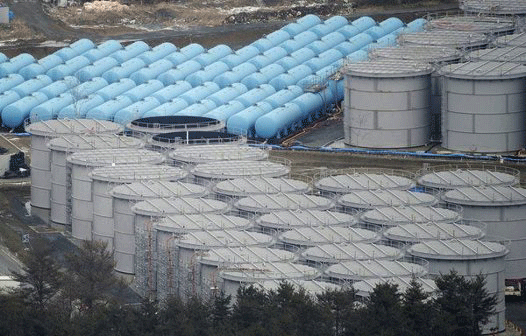
Is Fukushima at risk for another nuclear disaster?, Aljazeera America, 9 Jan 14 by Michael Okwu Nearly three years after the nuclear catastrophe at the Fukushima Daiichi Nuclear Power Plant, there remains concern about whether another disaster is right around the corner. America Tonight
At the Fukushima Daiichi plant, the Tokyo Electric Power Co., or TEPCO, is struggling to contain the ongoing nuclear disaster. Since the catastrophe almost three years ago, there has been disagreement about whether the plant is safe.
The official line from the Japanese government is that the situation is under control.
“The government is moving to the forefront and we will completely resolve the matter,” said Prime Minister Shinzo Abe in September, just before Tokyo was awarded the 2020 Summer Olympics.
But others, such as then–Tokyo Gov. Naoki Inose, have said the situation is “not necessarily under control.”…..
‘An ongoing crisis’ Journalist David McNeill has been covering Japan since 2000. America Tonight
“I think this is an ongoing crisis,” said David McNeill, a journalist who has lived in Japan since 2000 and has been covering the Fukushima disasterfrom the beginning. “What you’ve had is a series of ad hoc strategies designed to deal with the crisis that’s right in front of you.” Continue reading
1 This month

of the week – Australians for War Powers Reform (AWPR)
To see nuclear-related stories in greater depth and intensity
 Antinuclear