Abbott’s attack on renewable energy is bad economic judgment
The most baffling thing about Abbott’s assault on renewable energy is that it also flies in the face of economic good sense.
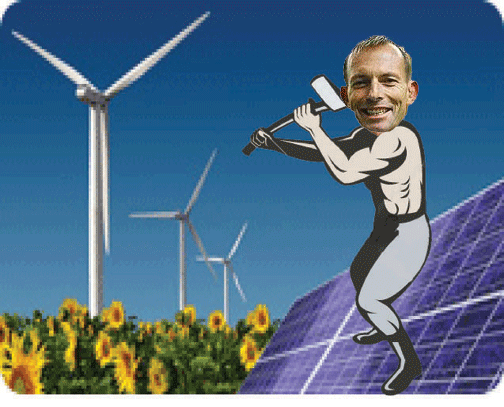 Australian PM Ignores Climate Change, Trades Renewables for Coal , Triple Pundit, ““““Eric Justian | Thursday January 16th, 2014 “……..The Australian government, under Prime Minister Tony Abbott, seems committed to exacerbating its nation’s climate woes. Even as his Environmental Minister approved a vast coal mine that will produce 40 million tons of CO2-emitting coal per year, Abbott is calling Australia’s strong renewable energy sector into question.
He’s cutting funding for renewables, threatening to remove the 20 percent renewable energy standard and even falling back on the old and largely debunked criticism that wind power has negative impacts on human health. Australia’s National Health and Medical Research Council looked into the issue in 2010 and again in 2012. And now Abbott is calling for another review. Because, why not?
And just for good measure, he’s also dismantling Australia’s well-regarded plans for curbing carbon emissions and jettisoning the nation’s goals for carbon reductions………
Australia can power itself entirely through renewable sources like wind and solar power by 2040. They could do it affordably, reliably and cleanly — working towards reducing the climatic impact on the nation. There’s simply no benefit to moving back toward coal, and nothing but risk.At least the U.S. doesn’t hold a monopoly on climate change denialists in public office. http://www.triplepundit.com/2014/01/australian-pm-ignores-climate-change-trades-renewables-coal/
Climate change being ignored by Australia’s leaders. to our cost

Giving financial assistance to the coal industry is irresponsible, to say the least. This is an industry that has profited, unhindered, for at least a century. This is an industry that should be phased out by Australia. This is an industry that will fall into the abyss, at the hands of its own customers, as the rest of the world takes on climate change.
What ever happened to climate change in Australia? http://www.onlineopinion.com.au/view.asp?article=15927&page=2 David Leigh 17 Jan 14 In the lead up to the last election, climate change was part of usual rhetoric that politicians espouse, along with the many other championed causes. It was either about the Clean Energy Fund, fueled by the Carbon Tax and by the Labor camp, or it was about not believing the science from the Liberals. Actually, that is far from liberal open-mindedness, when you think about it.
Either way, the airwaves were full of discussion about the biggest threat to humanity of all time. Now, as we find ourselves 6-months into Abbott’s Australia, there is little or no discussion. First he attempted to silence the reporting body by removing its funding, as though stopping talk would make it all go away. Now, even the Labor opposition remains quite on the subject. Only the Greens appear to understand that it won’t abate, although the Green focus seems to be snagged temporarily on asylum seeker wellbeing. Incidentally, that is another subject that seems to have gone away since the reporting stopped.
Despite having just had the hottest year on record and every monthly Australian record being broken and with the US having an unprecedented cold snap with temperatures below –34c the subject has conveniently gone quiet. This of course suits the big end of town, because climate change is expensive to mitigate. They should also realize it is far more expensive to ignore.
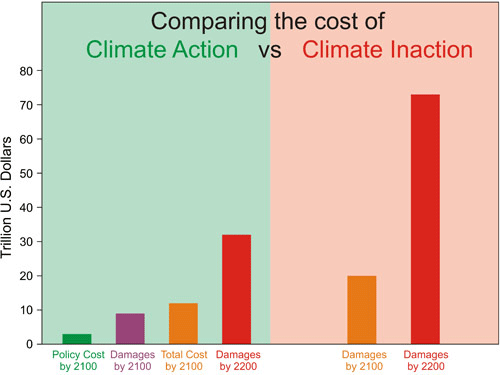
Australia is still locked in the same old political cycle of red team, blue team and the policies of the current blue team – if you can call them policies – seem focused only on the next 3-years. It is a far cry from the time of independents like Tony Windsor and Rob Oakeshott, where governance was about policy not dogma Continue reading
Why nuclear power cannot solve climate change
 Unlike solar power, nuclear power does not work well in warming climates. The summer of 2004’s heat wave across Europe not only killed thousands of people, but because of dwindling river levels caused many reactors to reduce power levels and even shut down entirely.
  levels, and even water temperatures, can greatly affect reactor operations. Reactors in the U.S. have similarly been forced to close during heat waves.
 REDUCTIONS http://www.climatecollective.org/media/uploads/resources/nukesclima.pdf
Countering the Thorium Nuclear Reactor Propaganda
 As expert Jo Abbess states more clearly than anyone, thorium is “quite probably the most well-funded piece of astroturfing propaganda in existence.”
Thorium Nuclear Information Resources http://kevinmeyerson.wordpress.com/2012/04/26/thorium-nuclear-information-resources/ There is a rash of misinformation on the net about the supposed merits of the ‘new’ nuclear energy source on the block, thorium. I am sure that in a perfect world where nobody lies, thorium would be the perfect answer to the world’s energy needs as is claimed. This is unfortunately not the case.
Apparently, every time there is a new nuclear catastrophe, the thorium ‘miracle’ is promoted again as the ‘savior’ for the world. The Fukushima nuclear radiation catastrophe was not unique and the thorium misinformation artists have come out in droves. It’s the nuclear industry’s defense mechanism – create a new ‘safety myth’ that regular people can latch onto.
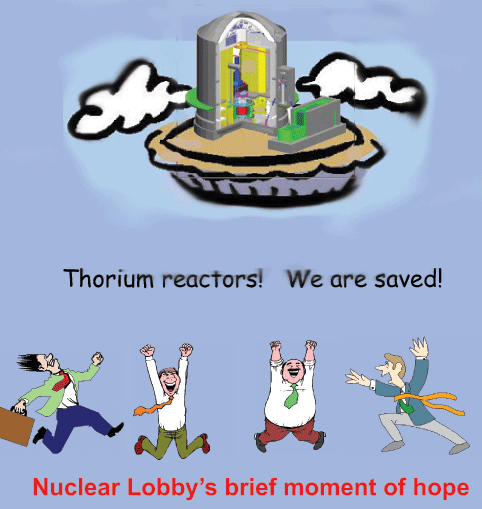
In reality, the thorium nuclear fuel cycle has been under development since the very early days of the nuclear industry. India, for example, has spent decades trying to commercialize it, and has failed. The US, Russia, Germany, and many others tried and failed as well. At best, thorium based nuclear power generation may be commercialized in a few decades.
I doubt it.
Fortunately, there are a number of independent trustworthy and expert sources of information on the internet regarding thorium nuclear. Here they are:………. Continue reading
Solar power combats effects of heat wave in Australia
 Australian Heatwave Solar Power Statistics http://www.energymatters.com.au/index.php?main_page=news_article&article_id=4129 17 Jan 14, The contribution solar energy has made in combating the effects of the current heatwave is significant.
With electricity generation plants and mains supply networks feeling the strain of 40C-plus heat and demand caused by air-conditioning; solar has helped alleviate the pressure.
The Australian Solar Council has found that at their peak on Wednesday,solar panel systems were contributing the following as a percentage of state electricity use:
– 27.54% in South Australia
– 11.77% in Western Australia
– 8.14% in Queensland
– 5.38% in Victoria
– 5.23% in New South Wales
The value of this power was not only in the quantity, but also in its timing; with peak production between 2:30pm-5:00pm – a timeframe when demand is high. This helped to rein in wholesale pricing which has reached staggering levels at times and possibly reduced the number of blackouts and load shedding that may have otherwise occurred.
Load shedding and blackouts are not only inconvenient and can cause significant economic losses; the often sudden nature of these events can also be dangerous.
“As a community we should be congratulating those people who have made a significant personal investment in installing solar PV, which is now paying dividends for the entire community,” said John Grimes, Chief Executive of the Australian Solar Council.
“Because solar PV produces electricity where it is used and does not need vast network infrastructure, the power that is produced is all being used to best effect, which adds up to a big saving for solar.”
“In a country like Australia where 1 in 100 year heat waves are becoming more frequent, solar is the perfect solution” said Mr. Grimes. “We expect more and more Australians to invest in solar PV systems to take control of their own energy future.”
While some states are yet to feel any relief from the heat, it’s reassuring to know that thousands of solar power systems are quietly working away delivering clean energy and helping to keep the lights and cool on indoors for many.
Australian Renewable Energy Agency, (ARENA) funding offshore wind energy
 Ocean Power Technologies forms new offshore wind power funding agreement With Australian Government http://www.renewableenergyfocus.com/view/36498/ocean-power-technologies-forms-new-offshore-wind-power-funding-agreement-with-australian-government/ 16 January 2014
A$66.5 million grant will be used towards the cost of building and deploying a 62.5MW peak-rated wave power station off the coast of Portland, Victoria. The agreement with the Australian Renewable Energy Agency, or “ARENA”, is a Deed of Variation to the original Funding Deed, through which a A$66.5 million grant was previously awarded by the Commonwealth.
Among the important changes included in the new agreement are:
The incorporation of milestones for each of the three stages of the project
Acceleration of reimbursement of eligible expenses for stages one and two
An increase in the number of milestones to better support project cash flow requirements The agreement also recognizes the role of Lockheed Martin as the lead for systems integration of the PowerBuoys and overall program management.
1 This month

of the week – Australians for War Powers Reform (AWPR)
To see nuclear-related stories in greater depth and intensity
 Antinuclear