Australia can’t afford to ignore the various impacts of climate change
heatwaves dubbed the “silent killer” because they led to more deaths than do other natural events
Rising temperatures and possible lower rainfall have the potential to cut future farming output sharply.
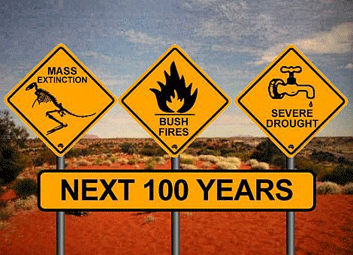 Scorchers: the reality of a sunburnt country January 18, 2014 Peter Hannam Environment Editor, The Sydney Morning Herald “………Wang Xiaoming, a senior principal scientist at CSIRO, said lip-service is often paid to the [planning for climate change] issue but little more.
“If you’re looking at the current building codes, if you’re looking at engineering design standards, actually there’s nothing considering future climate change at the moment,” Wang said.
Building standards and design can make a big difference. According to CSR, a building materials producer, lax standards in the past mean the power system is strained each time an extreme event – hot or cold – arrives.
A prototype home design by CSR in western Sydney shows what can be achieved with products already on the market. When the city was breaking its maximum heat record on January 18 last year the house remained about 15-16 degrees cooler than outside temperatures without the need for any airconditioning, the company says……..
‘Silent killer’
Adjustments in other parts of society may be a lot more painful, with heatwaves dubbed the “silent killer” because they led to more deaths than other natural events such as fires and cyclones but with much less publicity.
Excessive heat during the run-up to Black Saturday probably killed about 500 people in SA and Victoria.
……..Crops and creatures
The impacts of climate change are showing up in other fields. Grain prices globally are two or three times more volatile in the past decade than over the previous 40 years or so, said Steven Crimp, an agricultural crops expert at CSIRO. “We’re starting to get changes in the frequency [of temperature extremes] and that’s playing havoc with established ways farmers have timed their plantings,” he said.
Rising temperatures and possible lower rainfall have the potential to cut future farming output sharply. Average temperature increases of 4 degrees – not beyond the range of some forecasts for this century – and a 10 per cent drop in rain, could cut output by 50-60 per cent, Crimp said.
Livestock also tend to fare worse as temperatures rise. An increase in the so-called “pant rate” – when animals spend more time panting than eating – hurts milk output from cows and does little good for their overall health.
Longer-term planning to cope with an increased frequency of heatwaves won’t come cheap. Ignoring the signs, though, will probably be more difficult as information becomes more refined. http://www.smh.com.au/environment/climate-change/scorchers-the-reality-of-a-sunburnt-country-20140117-3105t.html#ixzz2qmRpYgjS
No comments yet.
1 This month

of the week – Australians for War Powers Reform (AWPR)
To see nuclear-related stories in greater depth and intensity
 Antinuclear
Leave a comment