Nuclear power has no future for reducing Australia’s carbon emissions
even on the most optimistic projections of the world’s leading nuclear agency, nuclear power won’t play any significant role in decarbonising the electricity sector, let alone the economy as a whole.
 A few more observations on nuclear power January 18th, 2014 John QuigginL I thought I should respond to the latest suggestions from Department of Industry and others that nuclear power is an option worth considering for Australia. While I’m at it, I’ll add some updates on global developments.
The most striking feature of recent Australian discussion, beginning with the Australian Energy Technology Assessment from 2011 is the claim that “small modular reactors” represent an appealing option for Australia. AETA listed these as being one of the cheapest options for 2020. with an estimated levelised cost of between $75 and $125/MWh.
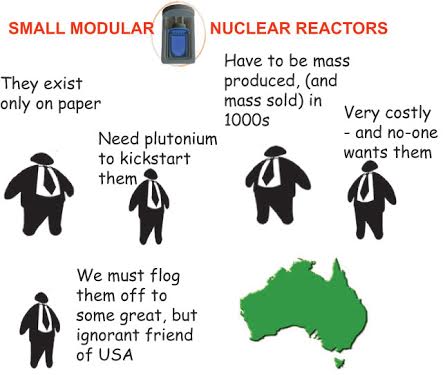
That’s both ambitious and remarkably precise for a technology that does not yet exist, even in prototype form. Continue reading
Democratic Labour Party Senator doesn’t understand renewable energy
Madigan Gets It Wrong On Renewables http://www.energymatters.com.au/index.php?main_page=news_article&article_id=4132 The Democratic Labour Party’s Senator John Madigan last week unleashed a blistering and misinformed attack on renewable energy’s performance during the recent heatwave.
A press release from Senator Madigan’s office stated in part:
“What is the point of relying on an energy source to heat and cool your home if they won’t work once the mercury rises? We need power the most during times of extreme temperature, yet our increasing reliability on renewables lets us down.”
“Clean energy technologies such as solar power and solar hot watermade a big difference in helping the state’s electricity system cope with near-record demand,” said the CEC’s Acting Policy Director Tim Sonnreich.
“This is a case of Australia’s Renewable Energy Target helping households to take pressure off our electricity system as a whole – while also reducing their individual power bills through these technologies.”
Mr Sonnreich pointed out the massive Loy Yang A coal-fired power station in the Latrobe Valley suffered unexpected outages as a result of the heat.
“Wind farms and solar households are made up of thousands of independent generators, so a fault in one makes almost no difference.”
National solar provider Energy Matters is expecting increase in interest in solar power systems as a result of the heatwave as home-owners realise the substantial increase in power bills they will face as a result of power-hungry air conditioners. The company has also just released consumer insights showing solar power to be Australia’s best-performing investment.
Constant flow of water pouring from Fukushima Reactor 3
 Wall St. Journal, Japan TV: ‘Problem on their hands’ at Fukushima, constant flow of water pouring from foot-wide leak at Reactor 3; “They don’t know where water it’s coming from” —WSJ: Radiation level spikes 60-fold in seconds nearby (VIDEO) http://enenews.com/japan-tv-problem-at-fukushima-constant-flow-of-water-pouring-from-foot-wide-hole-at-reactor-3-they-dont-know-where-the-water-is-coming-from-wsj-radiation-level-spikes-60-fold-in-seconds
Wall St. Journal, Jan. 17, 2014: As the bus carrying reporters [taking part in a media tour on Jan. 15] drove past by unit 3 toward units 1 and 2, readings on a dosimeter carried by an employee of plant operator [Tepco] spiked at over 600 microsieverts per hour, compared with a reading of around 10 microsieverts just seconds earlier. Reactors 1-3 are so highly contaminated that no one, even in a protective suit, can enter the buildings. That means almost all the cleanup work at the three units will have to be undertaken by remote-controlled robots.
NHK Newsline (Transcript), Jan. 18, 2014: The people in charge of the Fukushima Daiichi nuclear power plant have another problem on their hands. They say they found water pouring into a drain inside a reactor building. Officials at [Tepco] say they don’t know where the water is coming from and their not sure how much radioactivity it contains.
NHK, Jan. 18, 2014: Water leak found inside Fukushima reactor building […] spotted on the first floor of the reactor building on Saturday by a camera […] the water flow was about 30-centimeters wide [11.8 inches] and constant. TEPCO added that the water is likely flowing toward the building’s basement where a large amount of radioactive water has accumulated. TEPCO says that inside the reactor building there is water for cooling melted fuel and water in the spent fuel storage
pool. It says rain water may have entered the damaged building. TEPCO is trying to find out the source of the leaking water by analyzing footage […] radiation levels are too high for workers to approach the site.
Kyodo News, Jan. 18, 2014: Water leakage found inside No. 3 reactor of Fukushima plant: TEPCO […] Water that could contain radioactive material has been pouring [from a] 30-centimeter wide water leak […] It said the water had not leaked outside the building. TEPCO has been pouring cooling water on the No. 1 to 3 reactors to cool melted fuel, and water has been seen leaking through damaged parts of the No. 3 reactor’s containment vessel. […]
Watch NHK’s broadcast here — Tepco’s video of leak here
|
|
USA’s help to Fukushima as long as no liability for General Electric company
 US Puts Major Strings On Offer To Help With Fukushima Disaster http://www.fukuleaks.org/web/?p=11673 5 Nov 2013, US Energy Secretary Moniz offered “international help” with the Fukushima disaster but it comes with some big strings attached.
Ex-SKF discovered that the US is holding help hostage by demanding Japan sign a nuclear liability treaty in trade for assistance. The treaty appears to allow US companies to not be held liable if their technology or work fails. If the treaty is retroactive on liability waivers or financial aid to victims is not completely clear. Japan would also be the final ratifying country needed to make the treaty work.
Moniz touted US company Kurion as a company that could come to TEPCO’s rescue. Kurion was the company that provided the first cesium absorption machine that was full of failures. It was quickly tossed aside when Toshiba installed the Sarry cesium absorption system. The irony of Moniz touting a failed US nuclear company as the solution for Fukushima Daiichi raises some questions about the sincerity of US officials.
Every time the US comes calling with a nuclear solution for Japan it seems to end with Japan getting the rotten part of the deal.
Renewable Energy Target enabled Musselroe Wind Farm
the jobs and investment in Tasmania would not have been possible without the Renewable Energy Target, which is supporting the development of new clean energy projects right across Australia.
This year sees yet another review of the RET, with initial signals from Prime Minister Abbott being less than encouraging – a situation that is negatively affecting investment in new major renewable energy projects in Australia.
 Tasmania’s Musselroe Wind Farm Opens, Renewable Energy News, 20 Jan 14 Tasmania’s largest wind farm was officially opened on Wednesday by Premier Lara Giddings. The 168-megawatt Musselroe Wind Farm consists of 56 Vestas wind turbines and is joint venture operated by Shenhua Clean Energy and Hydro Tasmania.
According to Hydro Tasmania, the wind farm is generating enough energy to supply the needs of up to 50,000 homes; equivalent to the residential power needs of Burnie and Devonport combined…..Clean Energy Council Chief Executive David Green –
“The $394 million Musselroe Wind Farm has employed Tasmanians in construction jobs since 2011, and the steel towers for the project were manufactured locally in Launceston,” he said. Continue reading
Global co-operation to double renewable energy use by 2030
 Irena details plan to double renewables’ market share by 2030, The National, 20 Jan 14 More than 1,000 delegates from around the world gathered in Abu Dhabi on Saturday for the release of a detailed plan to double renewables’ share of the global energy market by 2030. Heads of state and ministers from more than 150 countries and representatives of 120 organisations took part in the opening of the International Renewable Energy Agency’s fourth annual assembly.
At the St Regis resort on Saadiyat Island, Irena detailed its “REmap 2030” plan for increasing adoption of renewable energies around the world.
The meeting is part of Abu Dhabi Sustainability Week, which incorporates conferences including the World Future Energy Summit and the International Water Summit, and the announcement of the Zayed Future Energy Prize winners.
Irena is the global centre for renewable-energy cooperation for its 123 member states, as well as the European Union.
The assembly announced the first six renewable-energy projects in developing countries to receive loans under Irena’s project partnership with the Abu Dhabi Fund for Development……
Figures from Middle East Economic Digest, Meed, show the total value of renewable-energy projects in the Middle East will be 36 times greater in the next decade……
Projects include Masdar 100-megawatt solar plant in Abu Dhabi, a 1,000MW solar park in Dubai, and ambitious projects planned for Saudi Arabia, Kuwait, Qatar and Oman. http://www.thenational.ae/uae/environment/irena-details-plan-to-double-renewables-market-share-by-2030#ixzz2qxvy478H
Solar panels – literally our best investment
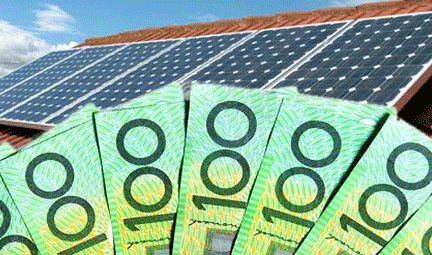 Home Solar: Australia’s Best-Performing Investment http://www.energymatters.com.au/index.php?main_page=news_article&article_id=4131 20 January 2013 – National solar provider Energy Matters has released consumer insights that rank each town for solar viability and also reveal the true investment potential of solar power in comparison to shares, property, gold, global fixed interest or even fine art.
The figures will startle many; with it outperforming all other investment options using current ASX figures and other key organisations that rate investment opportunities.
The consumer insights also revealed Townsville in Queensland was Australia’s top address for solar, giving its residents a healthy return of investment of 21.8% per year. Other mainland capital cities included Brisbane (annual return of investment of 20.2%), Adelaide (19.1%), Sydney (18.9%), Perth 17.8%) and Melbourne (13.2%). Continue reading
Award to Australian university team for cost-cutting solar technology
 Bright sparks scoop top award for cutting cost of solar power, The Age, 20 Jan 14 Peter Hannam ENVIRONMENT EDITOR, THE SYDNEY MORNING HERALD AUSTRALIA’S WORLD-LEADING EFFORTS TO DRIVE DOWN THE COST OF SOLAR ENERGY HAVE BEEN RECOGNISED WITH AN AUSTRALIA-BASED RESEARCHER TAKING OUT THE ENGINEERING EQUIVALENT OF THE OSCARS.
Professor Stuart Wenham and his team at the University of NSW won this year’s A. F. Harvey Engineering Research Prize from the Institution of Engineering and Technology, and plan to plough the $560,000 award – one of the world’s richest – back into their work. “The prizemoney is going to be very valuable for us,” Professor Wenham said. “We’re going to use that to expand one of the research areas that actually contributed to winning us the prize.”
As Fairfax Media reported in May, Professor Wenham’s team discovered methods to control hydrogen atoms to correct deficiencies in silicon, the most costly material in solar photovoltaic (PV) cells.
As a result of the new hydrogenation process, lower-quality low-cost silicon can achieve the same performance as typical commercial cells using the expensive high-purity silicon, which now convert about 17-20 per cent of the sun’s energy into electricity.”
1 This month

of the week – Australians for War Powers Reform (AWPR)
To see nuclear-related stories in greater depth and intensity
 Antinuclear