Nuclear power has no future for reducing Australia’s carbon emissions
even on the most optimistic projections of the world’s leading nuclear agency, nuclear power won’t play any significant role in decarbonising the electricity sector, let alone the economy as a whole.
 A few more observations on nuclear power January 18th, 2014 John QuigginL I thought I should respond to the latest suggestions from Department of Industry and others that nuclear power is an option worth considering for Australia. While I’m at it, I’ll add some updates on global developments.
The most striking feature of recent Australian discussion, beginning with the Australian Energy Technology Assessment from 2011 is the claim that “small modular reactors” represent an appealing option for Australia. AETA listed these as being one of the cheapest options for 2020. with an estimated levelised cost of between $75 and $125/MWh.
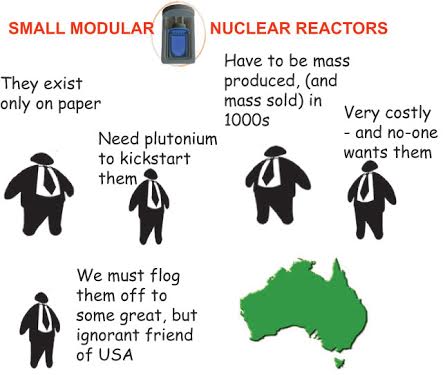
That’s both ambitious and remarkably precise for a technology that does not yet exist, even in prototype form.
Leaving aside niche technologies like the Russian proposal to adapt nuclear sub reactors as floating platforms, the only serious contender in this field is the US, where the Department of Energy has provided grants for the development of two pilot plants. The target date (almost certainly over-optimistic) for these to begin operation is 2022. To get any idea of economic feasibility, it would be necessary both to undertake commercial deployment (in the US, obviously) and to to accumulate some years of operating experience. To get this done by 2030, or even 2035 would be an ambitious goal, to put it mildly. Again assuming everything goes well, Australia might be in a position to undertake deployment of SMRs by, say, 2040. But obviously, if we are going to reduce emissions on anything like the scale we need (80 per cent by 2050), we need to phase out most fossil fuel electricity well before that. Obviously, all these points apply in spades to proposals that exist only as designs, with no active proposals even for prototype development, such as the Integral Fusion Reactor. As I’ve argued before, to the extent that nuclear power makes any contribution to reducing CO2 emissions on a relevant time scale, it will have to be with current technology, most likely the AP1000.
Talking of the AP1000, the builders four plants under construction at two sites in the US have just announced another 6 months delay,pushing the operations date out to 2017 or 2018 (release from FoE, but links to originals)
* Most interesting of all are projections released by the International Atomic Energy Agency last year for the period to 2050. Currently nuclear power accounts for around 11 per cent of global electricity. The IAEA “low’ projection has that falling to 10 per cent by 2030 and 5 per cent by 2050. The “high” projection, which includes steady growth in both North America and Western Europe as well as spectacular growth in Asia, has the share remaining roughly stable. So, even on the most optimistic projections of the world’s leading nuclear agency, nuclear power won’t play any significant role in decarbonising the electricity sector, let alone the economy as a whole…http://johnquiggin.com/2014/01/18/a-few-more-observations-on-nuclear-power/
No comments yet.
1 This month

of the week – Australians for War Powers Reform (AWPR)
To see nuclear-related stories in greater depth and intensity
 Antinuclear
Leave a comment