In respect for Aboriginals, we should change the date for Australia Day
Should we shift our Australia Day?, Queensland Times, Vonnie’s View – Yvonne Gardiner’s take on the world
24th Jan 2014 UNFORTUNATELY Australia Day seems to be as much a time of discord as it is a cause for celebration.
Many of us understand the seething resentment surrounding a day which commemorates the arrival of the First Fleet at Sydney Cove in 1788.Not only were the first inhabitants of our island colonised, they were also overrun by criminals – hardly an auspicious start to the forming of a great nation.
Despicable deeds were done by the “invaders”. Land was stolen, traditional owners were massacred, Aboriginal children were removed from their families, while adults were made to work in menial positions for little pay.
That kind of behaviour was a modus operandi for the colonisers, who had been invaded in their own land countless times. Through these hostilities, they had developed a warlike, domineering way of thinking that had no respect for any indigenous culture they encountered.
We probably should look at shifting Australia Day to another date, so every one of us can feel pride in inhabiting a great country without being reminded of the shackles of our past.http://www.qt.com.au/news/should-we-shift-our-australia-day/2147638/
Secrecy about Fukushima- an issue for Japan, USA, and the world
The Fukushima Secrecy Syndrome – From Japan to America http://www.commondreams.org/view/2014/01/24-8 By Ralph Nader, 24 Jan 14 Last month, the ruling Japanese coalition parties quickly rammed through Parliament a state secrets law. We Americans better take notice.
Under its provisions the government alone decides what are state secrets and any civil servants who divulge any “secrets” can be jailed for up to 10 years. Journalists caught in the web of this vaguely defined law can be jailed for up to 5 years.
Government officials have been upset at the constant disclosures of their laxity by regulatory officials before and after the Fukushima nuclear power disaster in 2011, operated by Tokyo Electric Power Company (TEPCO).
Following this statement, the Japan Scientists’ Association, Japan’s mass media companies, citizens associations, lawyers’ organizations and some regional legislatures opposed the legislation. Polls show the public also opposes this attack on democracy. The present ruling parties remain adamant. They cite as reasons for state secrecy “national security and fighting terrorism.” Sound familiar?
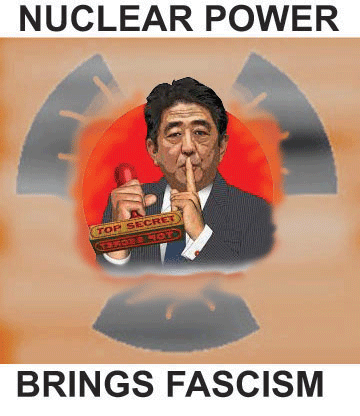 The American people have to be alert to our government’s needless military and political provocations of China, which is worried about encirclement by surrounding U.S.-allied nations and U.S. air and sea power. Washington might better turn immediate attention to U.S. trade policies that have facilitated U.S. companies shipping American jobs and whole industries to China.
The Obama administration must become more alert to authoritarian trends in Japan that its policies have been either encouraging or knowingly ignoring – often behind the curtains of our own chronic secrecy.
Nuclear media censorship as Tokyo election approaches
“Shock & Outrage”: Japan TV host reveals being told he cannot discuss nuclear power until pivotal Tokyo election ends —“Somebody needs to bring these issues into the media” — #2 in trending news http://enenews.com/shock-outrage-japan-tv-host-reveals-being-told-he-cannot-discuss-nuclear-power-until-pivotal-tokyo-election-ends-somebody-needs-to-bring-these-issues-into-the-media
TokyoReporter’s tweet, Jan. 22, 2014: Radio host Peter Barakan says broadcasters told him to avoid nuclear issues till after poll
For Aboriginals, Australia Day is Invasion Day
Australia Day: Why 26 January continues to divide Aussies Most Aussies celebrate 26 January in the sun, but the commemoration of white settlement angers others, The Week, UK, 24 JAN 2014 AUSTRALIA’S national day is celebrated each year on 26 January with the ignition of thousands of barbeques and the downing of millions of cold beers. But Australia Day – which marks the establishment of the first European settlement in 1788 – is regarded as a day of shame by some Australians. Here are five key questions about the event:……….
Why is Australia Day controversial? Some Australians – both indigenous and non-indigenous – refer to 26 January as “Invasion Day”. They argue that the brutal treatment of the Aborigines by white settlers and the legacy of disease and addiction they inflicted on Australia’s first people makes it impossible to celebrate the arrival of Europeans. The issue continues to be a hot-button. This week Captain Cook’s historic home, rebuilt in Melbourne after being shipped from England, was sprayed with graffiti by activists in a protest against Australia Day. Phrases such as “26th Jan Australia’s shame” were daubed on to the two-story stone building, known as Cook’s Cottage, Sky News reports.
Will the day ever unite Australia? That seems unlikely. Despite efforts to reconcile white and indigenous Australians, Australia Day continues to be a reminder of oppression to some. “To many Aboriginal people there is little to celebrate and it  is a commemoration of a deep loss,” says the Creative Spirits website. “Loss of their sovereign rights to their land, loss of family, loss of the right to practice their culture.”http://www.theweek.co.uk/asia-pacific/57035/australia-day-why-26-january-continues-divide-aussies
New South Wales’ biggest wind farm on the way
Foundations poured for NSW biggest renewable energy projecthttp://www.abc.net.au/news/2014-01-24/wind-project/5216572 Fri 24 Jan 2014 Foundations have begun to be laid at the Monaro site in the New South Wales south east of what will become the State’s biggest wind farm project. Continue reading
Solar panels soon stand alone says Australia’s biggest power company
 Power company says solar panels can soon stand alone ANNABEL HEPWORTH THE AUSTRALIAN JANUARY 25, 2014 AUSTRALIA’S largest energy retailer is predicting that solar rooftop electricity panels will be competitive without subsidies in the next few years, adding to pressure on the federal Coalition to scale back the renewable energy target in this year’s review of the scheme.
The Weekend Australian can reveal that ahead of the RET review this year, Origin Energy — which has 4.3 million customers — thinks photovoltaic panels will be able to compete without subsidy in the next few years and wants this conclusion investigated as part of the review…..(subscribers only) http://www.theaustralian.com.au/national-affairs/policy/power-company-says-solar-panels-can-soon-stand-alone/story-e6frg6xf-1226810029021#
1 This month

of the week – Australians for War Powers Reform (AWPR)
To see nuclear-related stories in greater depth and intensity
 Antinuclear