New Nuclear technology not really an option for Australia
The Australian government is under pressure from the USA nuclear lobby, and a bunch of entrepreneurial Australian types, to buy the (as yet only on paper) Small Modular Nuclear Reactors, based on Thorium as fuel.
Sure, let’s debate nuclear power – just don’t call it “low-emission” , The Conversation , Mark Diesendorf, Associate Professor and Deputy Director, Institute of Environmental Studies, UNSW at University of New South Wales 6 Feb 14,
“……..The technology trap Could new types of nuclear power station solve the problem?“Fast breeder reactors” produce more nuclear fuel than they use and so would theoretically have much lower life-cycle CO2emissions than existing “burner” reactors. But in practice breeders are even more complex, dangerous and expensive than burners. As a result they have been stuck at the demonstration stage for decades and even some nuclear proponents admit that breeders are unlikely to be commercialized for at least another two decades, if ever.
The government’s issues paper mentions the possibility of nuclear reactors based on the thorium fuel cycle, but these are also more complex than uranium-based nuclear energy and there are no commercial systems operating as yet.

Advocates of another possible option, nuclear fusion on Earth, recognize that it unlikely to become a commercial reality for at least three decades, if ever.
To sum up, based on existing commercial technology, nuclear energy is not a solution to the global climate crisis, because it will soon become too emissions-intensive. It is also not a short-term solution, because it is a very slow technology to plan and construct. It is dangerous and very expensive.
So why bother? There is already a better alternative to fossil fuels: the efficient use of renewable energy.http://theconversation.com/sure-lets-debate-nuclear-power-just-dont-call-it-low-emission-21566
Japan will be plagued with the radiation problem for generations to come
 The results of the research carried out in Ukraine for 25 years after the Chernobyl disaster prove that living even in slightly contaminated areas for long periods of time is more harmful than receiving a one-time large radiation dose
 Top Radiation Expert: ‘Extremely dangerous’ situation in Japan — 14,000 km² of land contaminated by Fukushima — Mayor: Country will be dealing with this for generations to come — Officials thought hot spots would diminish with distance from plant… Why didn’t they? http://enenews.com/top-radiation-expert-extremely-dangerous-situation-japan-14000-km-land-contaminated-fukushima-thousands-km-away-be-safe-officials-thought-hot-spots-diminish-distance-plant-didnt
Professor Vsevolod Kortov, prominent scientist and leader of the school of solid-state radiation physics, Russian Academy of Natural Sciences, Feb. 5, 2014: “I spoke at a press-conference in Fukushima City and offered explanations and some criticism. 20 millisievert a year is the occupational radiation dose for adults. I mean people employed at nuclear power plants 6 hours a day who afterwards go to a clean environment. And here it was planned to send both youngsters and old people to spend 24 hours in such radioactive zones. Continue reading
Political bias at Australia’s ABC
 Status Update By Don’t blame me I didn’t vote for Tony Abbott POST BY PAGE MEMBER RICHARD O’BRIEN:
Howard government appointments:
Donald McDonald – Liberal Party member and long-time friend of the Howard Family.
Michael Kroger – Liberal party powerbroker and former president of the Victorian Liberal party. Member of the right-wing think tank the Institute of Public Affairs (“Ding!”)
Judith Sloan – Right-wing labour market economist, News Ltd Columnist and outspoken critic of the ABC. Associated with right-wing think tanks the Centre for Independent Studies, the HR Nichols Society and the IPA (“Ding, Ding!”)
Ross McLean – Former Liberal party MP for Perth.
Leith Boully – Member of the Murray-Darling CAC with close ties to the Liberal party. Former member of the NT Young Country Liberal Party.
Maurice Newman – Close friend and confidant of John Howard and founder of the Centre for Independent Studies, a right-wing think tank identical to the IPA (“Ding, Ding, Ding!”)
Janet Albrechtson – Right-wing columnist for News Ltd. Associated with the CIS and IPA (“Ding, Ding, Ding, Ding!”)
Ron Brunton – Former right-wing columnist for News Ltd. Climate change skeptic, critic of the stolen generations report and Director of Indigenous Affairs at the IPA (“Ding, Ding, Ding, Ding, Ding!”)
Steven Skala – Former director of the CIS (“Ding, Ding, Ding, Ding, Ding, Ding!”)
Keith Windschuttle – Right-wing historian. Outspoken critic of the ABC and regular keynote speaker for the CIS and IPA (“Ding, Ding, Ding, Ding, Ding, Ding, Ding!”)
Peter Hurley – President of the SA Hotels Association and major donor to the Liberal party and right-wing think tanks…oh bugger it (“Ding, Ding, Ding, Ding, Ding, Ding, Ding, Ding!”)
Jonathan Shier – Right-wing opponent of all public broadcasting. Was appointed with a mandate to attack the ABC but resigned after 19 months. Guess who called for this guy’s appointment. (“Ding, Ding, Ding, Ding, Ding, Ding, Ding, Ding, Ding!”)
Mark Scott – Former staffer to NSW Liberal minister Terry Metherell.
Rudd/Gillard appointments
James Spigelman – No known political affiliation.
Julianne Schultz – No known political affiliation.
Cheryl Bart – No known political affiliation.
Fiona Stanley – No known political affiliation.
Jane Bennett – No known political affiliation.
Five ABC board appointments fall vacant in the current government’s term.
GOVERNMENT IGNORES UN RECOMMENDATION THAT WE ASSESS FULL COSTS OF URANIUM MINING
“…..…Recommendation For Assessment Of Environmental And Societal Costs Of Uranium Mining Hansard Page: 13 Question Date: 18 November 2013 Senator Ludlam asked:
 Senator LUDLAM: It probably makes more sense to have your answer in front of me, rather than this back-and-forth across the table. What steps have been taken by the Commonwealth, or any agencies, or indeed your agency, to address the UN Secretary-General’s September 2011 recommendation that Australia conduct an in-depth assessment of the net cost impact of mining fissionable materials—that is, uranium—on local communities and ecosystems? It was an SG recommendation of 2011—…..
Mr McAllister: I can look into it, yes.
After 20 expensive years, Japan abandons nuclear reprocessing project
 Japan to drop troubled fast breeder reactor from energyhttp://asia.nikkei.com/Politics-Economy/Policy-Politics/Japan-to-drop-troubled-fast-breeder-reactor-from-energy-plan?n_cid=NARAN012plan TOKYO 6 Feb 14,– Japan will scrap its grand nuclear energy plans centering on the accident-prone Monju fast breeder reactor, a decision that will likely force a reassessment of a fuel cycle program that was supposed to provide an infinite source of energy.
Monju, once touted as a “dream reactor” that generates more fuel than it consumes via nuclear chain reaction, has remained shut down due to a series of troubles. Its enormous upkeep costs, reaching 50 million yen ($490,000) a day, have led to criticism of wasting taxpayer money. Continue reading
Mark Diesendorf points out that nuclear power is just NOT “low emission”
Sure, let’s debate nuclear power – just don’t call it “low-emission” , The Conversation , Mark Diesendorf, Associate Professor and Deputy Director, Institute of Environmental Studies, UNSW at University of New South Wales 6 Feb 14,
With environmental considerations constraining the further development of hydro-electric sources, nuclear technologies continue to present an option for future reliable energy that can be readily dispatched into the market.
This sentence appears in a passage dealing with the “move to low-emissions energy”, and although nuclear is not explicitly described as a low-emission option, it certainly looks as if the government is prepared to consider embracing nuclear power as part of an alleged move away from fossil fuel
Is nuclear energy really low-emission?

Unfortunately, the notion that nuclear energy is a low-emission technology doesn’t really stack up when the whole nuclear fuel life cycle is considered. Continue reading
Nuclear power operators in a panic about market failure of nuclear energy
 “We’re all coming together, racking our brains, saying what’s out there, what can we do, whether it’s market reform or raising awareness of the value of nuclear?” said David Brown, Exelon’s vice president of federal affairs.
Nuclear giants urge market changes to thwart closures Hannah Northey, E&E reporter Greenwire: Thursday, February 6, 2014 The country’s largest nuclear operators yesterday reiterated their calls for market changes to prevent a spate of reactor closures Continue reading
US nuclear operators sulk as nuclear power now uneconomic
Beside the current closures and uprate cancelations, of which there are nine, 38 reactors in 23 states are also at risk of early retirements, with 12 of those facing the greatest risk of being shutdown,
little chance that the cost of new reactors will become competitive with low carbon alternatives
 Nuclear Energy Operators Say Market Stacked Against Them, Forbes, Ken Silverstein, 6 Feb 14 When Entergy ETR +1.87% Corp. made its decision to close its Vermont Yankee nuclear facility, it opened the door to discussions on how to allow all electric generating facilities fair access to the markets. The utility says that the action it has taken could become more widespread unless system operators make corrections….
Australia’s solar energy up against attack from Tony Abbott
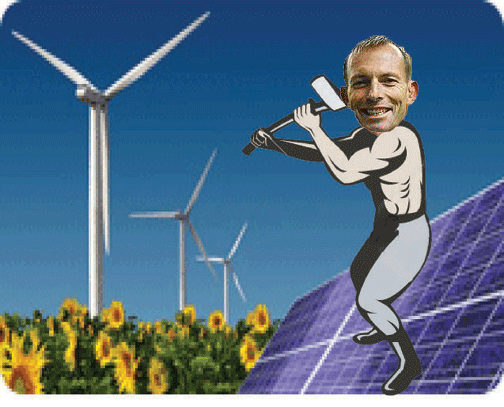 Australia’s solar industry prepares for battle, pvmagazine 06. FEBRUARY 2014 | BY: EDGAR MEZA The government of Prime Minister Tony Abbott looks set to gut the country’s Renewable Energy Target program. Critics accuse Abbott of having misrepresented his stance on renewables. Australia’s renewable energy sector is feeling increasingly threatened by the government of Prime Minister Tony Abbott.
In a report on Thursday in U.K. newspaper The Guardian, opposition Labor Party environment spokesman Mark Butler took Abbott to task. Butler accused the prime minister of having pretended to support the renewables industry before the election but said he was now “launching a full-frontal attack” on the sector…….
The Labor environment spokesman said Abbott had taken control of a scheduled review of the country’s Renewable Energy Target (RET), adding that the current ruling coalition may reassess the program due to increases in power prices.
Butler said Labor would continue to oppose the repeal of the country’s carbon tax when parliament resumes this month and added that the party was also preparing “to ramp up a community campaign in support of renewable energy.” The renewable energy sector has become increasingly alarmed at the possibility of the government drastically reducing or even abolishing the RET.
The Australian solar council has already launched a “save solar” campaign out of fear the government review will immobilize the industry by eliminating the target, which requires 45,000 gigawatt hours of power to be sourced from renewables by 2020 and provides a subsidy to people who install solar systems. http://www.pv-magazine.com/news/details/beitrag/australias-solar-industry-prepares-for-battle_100014143/#ixzz2se7wYtKC
Audio: Tony Abbott’s war on renewable energy
Audio Prime Minister vows to revisit renewable energy target http://www.abc.net.au/worldtoday/content/2013/s3939181.htm Stephanie Smail reported this story on Thursday, February 6, 2014 ELEANOR HALL: The Prime Minister is vowing to look closely at changing Australia’s Renewable Energy Target (RET), as Queensland’s biggest energy generator warns that the target is pushing up costs in the industry…..In its submission to the Federal Government’s Energy White Paper, Stanwell blames energy policies, including the renewable energy target and the carbon tax, for its soaring costs……
Mr Abbott agrees that Australia has become one of the world’s most expensive countries for energy.
He says the carbon tax needs to go and other energy policies might need tweaking…..
STEPHANIE SMAIL: Kane Thornton from the Clean Energy Council says there’s no evidence to support claims the renewable energy target is to blame for soaring power prices.
He says a move to overhaul the target would be a backward step.
KANE THORNTON: We would see a fairly significant impact on the amount of new renewable energy that came into the energy sector in Australia and that would obviously therefore have to increase our exposure to both that old coal-fired power generation but also higher cost gas generation.
That would ultimately mean that we’d be exposed over the longer term to higher retail electricity prices because of that increased cost of gas and also obviously the carbon footprint from our energy sector would clearly trend upwards again…….
STEPHANIE SMAIL: The Federal Government’s Energy White Paper is due to wrap up in September.
1 This month
15 April – Zoom –Nuclear Power is Not the Solution
Apr 15, 2026 01:00 AM in Canberra, Melbourne, Sydney

Join the International Physicians for the Prevention of Nuclear War (IPPNW) on Tuesday, April 14th for a timely webinar exploring the risks associated with nuclear power and challenging the myth that it offers a simple, safe, carbon-free solution to the climate crisis

of the week – Australians for War Powers Reform (AWPR)
To see nuclear-related stories in greater depth and intensity
 Antinuclear