Petitioners battle against Kintyre uranium mine plan
 Petition fights Kintyre uranium mine plan http://www.abc.net.au/news/2014-02-14/peptition-fights-kintyre-uranium-mine-plan/5260832
14 Feb 2014,Four green groups are preparing a petition to the Environmental Protection Authority (EPA), rejecting a proposed uranium mine in the east Pilbara. The EPA is assessing a proposal by Cameco to develop the Kintyre mine, near Karlamilyi National Park.
There are fears the mine could affect drinking water supplies to a nearby Aboriginal community, as well as the park’s natural waterways.
A petition containing 2,500 signatures will be lodged with the authority today.
The conservation council’s Mia Pepper says she would not be surprised if the EPA recommended the mine be approved.
“We’ve lost a lot of faith in their independence and ability to assess,” she said.”Unfortunately with this proposal we’re likely just to see just an approval, hopefully with some really strong conditions about regulating tailings, which is the high-risk part of the project.”
IMF boss urges Australian govt not to abandon climate change action
“Australia was very much at the forefront, Australia was pioneering in this field and I would hope that it continues to be a pioneer,”
 IMF chief Christine Lagarde in veiled criticism of government’s climate role The Age February 15, 2014 Peter Wilson, Jonathan Swan Christine Lagarde, Christine Lagarde, the head of the International Monetary Fund, has urged the Abbott government not to abandon Australia’s role as what she calls “a pioneer” in the debate on climate change.
The former finance minister of France said it would be a mistake to assign climate issues to “the backburner” because action to reduce carbon emissions cou ld strengthen economic growth as well as protect the environment.
Speaking in Paris before her first visit to Australia as IMF chief next week to attend a G20 meeting, Ms Lagarde said previous Australian governments had played an important role in international debates about climate change.
“Australia was very much at the forefront, Australia was pioneering in this field and I would hope that it continues to be a pioneer,” said Ms Lagarde, who as a politician was a conservative. “I do think that climate change issues and progress in that regard are critical and are not just fantasies, they are real issues.”……
Despite being criticised for unwinding the previous government’s hard-won pricing on carbon pollution, Mr Hunt suggested “anyone who supports tackling climate change would support repealing the carbon tax”…….
Labor environment spokesman Mark Butler said he was not surprised that “international communities [were] shocked by the Abbott government’s ignorance” about climate policy.
“Much of the world, including countries such as China, America and Korea, are forging ahead with serious action on climate change while Tony Abbott is intent on sending Australia backwards,” Mr Butler said. “This policy retreat on such a critical issue is embarrassing Australia on the international stage.” http://www.smh.com.au/national/imf-chief-christine-lagarde-in-veiled-criticism-of-governments-climate-role-20140214-32r9u.html#ixzz2tPtJTBMr
Record cesium levels in Fukushima groundwater
 samples of water tested contained radioactive cesium at levels never seen before by the embattled utility.
Radioactive cesium levels “never seen before” at Fukushima — New record as amount in groundwater nearly doubles in 24 hours — Officials admit ‘may be new leak’ — IAEA urges ‘resumption’ of dumping contaminated water in ocean; ‘All options’ need to be on table (VIDEO) http://enenews.com/radioactive-cesium-spikes-over-past-24-hours-to-new-record-high-officials-admit-there-may-be-a-new-leak-iaea-urging-for-resumption-of-dumping-contaminated-water-into-ocean-all-options
AFP, Feb. 13, 2014: Fukushima should eye ‘controlled discharges’ in sea: IAEA — The [IAEA] urged Japan to consider “controlled discharges” into the sea of contaminated water […] “This would require considering all options, including the possible resumption of controlled discharges to the sea.” […] local fishermen, neighbouring countries and environmental groups all oppose the idea. […] radioactive groundwater […] leaking into the ocean [is] an ongoing problem that has stoked fears about dangers posed to marine life and the food chain. […] Continue reading
Nuclear fusion not economically viable, but solar power is,
Would nuclear fusion be economically viable? THE WEEK, 14 Feb 14 Scientists have passed a crucial milestone on the road to nuclear fusion. But the final frontier for fusion isn’t scientific — it’s economic.
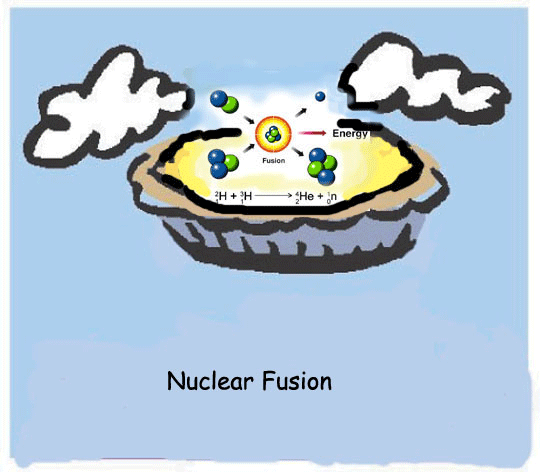
A team of scientists at the Lawrence Livermore National Laboratory in California announced Wednesday that they have reached a key milestone in the development of nuclear fusion. Nuclear fusion is the process of atomic nuclei fusing to form a larger atom, which is how the sun emits heat and light.
Writing in the journal Nature, the scientists declared that for the first time ever they had yielded more energy out of fusion than what was needed to create the reaction. They used 192 lasers to compress a pellet of fuel, generating a reaction in which more energy came out of the fuel core than went into it.
But the goal of “ignition” — which is when more energy is yielded than was consumed in the entireprocess — remains distant……However, even ignition is not enough. The final frontier for nuclear fusion is not scientific, but economic — meaning, when it can compete price-wise with the alternatives. And humans already have lots of energy options for the future……
The twilight of the fossil fuel age is being spent developing renewable forms of energy. Some are inherently small-scale in nature, like wind and hydroelectric power………… the Sun, which each year casts down much greater quantities of energy onto the Earth than the total amount of fossil fuel beneath its surface.
For photovoltaic energy, we have already passed the threshold of “ignition,” with solar panels capturing more energy than it takes to produce them. Furthermore, solar energy’s prices are falling so rapidly that it is becoming competitive with fossil fuels……..or most purposes, it all comes down to efficiency. We still don’t know how efficient nuclear fusion reactors will be in practice. Right now, we do know that solar energy is already viable.John Aziz http://theweek.com/article/index/256500/would-nuclear-fusion-be-economically-viable
Tony Abbott’s advisors: hard core climate denialists and renewable energy haters
The $5bln IPA mistake that derailed Australia’s renewable policy REneweconomy,By Giles Parkinson on 14 February 2014 Ever since it became clear earlier in 2013 that the conservative coalition parties were likely to gain power at the next federal poll – which they did – the renewable energy industry in Australia has pretty much ground to a halt.
The reason for this? The Coalition’s insistence from early last year that it hold another review of the renewable energy target, even though the Climate Change Authority had completed one just months earlier.
The problem was that the CCA did not give the answer the Coalition and its business supporters wanted. Not only was the renewable energy target weakening the revenues, profits and business models of the incumbent generators, the Coalition was being fed the line that RET was much more expensive than being let on.
The new Coalition government has since tried to dissolve the CCA, and the government’s inner core is being advised by climate change hard-liners and renewable-haters who repeat the theme that renewables are expensive. Prime Minister Tony Abbott most certainly thinks so. Continue reading
1 This month
To see nuclear-related stories in greater depth and intensity
– go to https://nuclearinformation.wordpress.com/


 Antinuclear