Another radioactive spill at an Australian owned uranium mine
 Paladin Energy spills radioactive material at African mine, The Age, Peter Ker 17 Feb Another Australian uranium miner has been forced to clean up a spill of radioactive material.
ASX-listed Paladin Energy has reported a spill near one of its African mines, saying a truck carrying a container of uranium oxide from its Kayelekera mine in Malawi overturned while negotiating a curve in the road…….
The incident comes less than three months after ASX-listed Energy Resources of Australia (ERA) suffered a spill at its Ranger precinct in the Northern Territory. That spill is still under federal investigation and processing at the site has not resumed since.
ERA is majority owned by Rio Tinto, and the incident at Ranger occurred in the same week as a similar spill at a Rio Tinto mine in Nambia…..
The incident occurred just three days after Paladin announced it would cease mining at the loss-making Kayelekera until uranium prices improved significantly…..
Australian Conservation Foundation spokesman Dave Sweeney said the Paladin incident highlighted the risks that were inherent in mining uranium.
“We have seen costs rising and corners being cut right across Africa,” he said.
“Paladin have announced they are closing Kayelekera and this is a toxic and tragic way to say goodbye.”http://www.smh.com.au/business/mining-and-resources/paladin-energy-spills-radioactive-material-at-african-mine-20140217-32v7v.html#ixzz2td54yjQ1
Three major untruths of the nuclear lobby’s film “Pandora’s Promise”
3 Myths From Pro-Nuclear Film ‘Pandora’s Promise, Eco News, 16 Feb  14,,’”…….Pandora’s Promise … propagated three common myths about nuclear power: it suggested the environmental movement’s “scare tactics” are what has inhibited nuclear power, claimed nuclear power is cheaper than renewables and downplayed complications from nuclear waste.This led to a generally one-sided story, which has led to criticism from many reviewers.
Here’s how the film Pandora’s Promise propagated nuclear power myths:
1.Claimed Nuclear Energy Is Cheaper Than Renewable Energy…….
2. Blamed Environmentalists For Preventing Nuclear Deployment.……the lack of nuclear expansion in the U.S. comes down to a simple case of economics. …..As the libertarian Cato Institute’s Jerry Taylor explained that there’s “zero evidence” that environmental opposition is preventing new nuclear power plants, a myth that he said has been purported by nuclear advocates who “like to dodge the cost estimates.”
3. Whitewashed The Issue Of Nuclear Waste……..The U.S. has accumulated more than 70,000 metric tons of spent nuclear fuel, and continues to accumulate 2,200 tons per year, yet CNN’s documentary made light of this waste—Lynas claimed that nuclear waste is “not an environmental issue.”….http://ecowatch.com/2013/11/08/3-claims-pro-nuclear-film-pandoras-promise/
Abbott govt to weaken safety regulations on uranium sales to India
There are indications that the Abbott government might be willing to dilute some of Australia’s monitoring safeguards
Australia seeks to draw India into tighter embrace with nuclear deal TNN | Feb 17, 2014, CANBERRA: Australia, which in the past has expressed serious reservations about New Delhi’s nuclear programme, appears extremely keen to close a deal to supply uranium to India. “We see it as a priority and want to move as quickly as possible. The political will certainly exists within this government,” Australia’s foreign minister Julie Bishop told reporters here even as the two countries were in the middle of their fourth round of talks for a civil nuclear cooperation agreement. …..
While she would not elaborate, the South Pacific Nuclear Free Zone Treaty, of which Australia is a member, is said to be one of them. (There’s also a narrower self-interest in finding a new market for Australia’s uranium producers.) …………..
Our National Parks are no place for uranium mines
By Dave Sweeney and Mia Pepper, 17 Feb 14 When we think of National Parks in Australia we generally think of places of renewal and natural beauty where we can take the whole family to recharge and reconnect with nature – places that draw international visitors to our shores looking for a taste of the wild places that have made our state famous.
Yet Western Australia’s largest National Park is current in the cross hairs of a Canadian company for a large scale uranium mining project. Right now the Canadian mining company Cameco is proposing to mine uranium in the Pilbara at Kintyre, in an area that has been excised from WA’s biggest National Park – Karlamilyi (Rudall River).
The area that contains the Kintyre uranium deposit is one of the most unique and diverse ecosystems in the country, including the fate 28 endangered, vulnerable and priority species. The proposed mine site is nestled between two branches of the Yandagoodge creek, which feeds springs and lake systems throughout Karlamilyi National Park and provides water for the communities of Punmu and Parnngurr.
On top of the question of the appropriateness of placing a uranium mine in an area well recognised for its unique and fragile environmental assets, the equation becomes even more fraught when the track record of the proponent – Cameco Resources – is given closer inspection.
Cameco’s track record overseas raises disturbing questions about the risks and potential impacts on this fragile desert ecosystem and the adequacy of the state systems that are meant to protect the people and the place. Cameco’s operating uranium mines in Canada have been dogged by leaks, floods, contamination and unsafe work environments.
Cameco has been through court over license breaches in the US, has been investigated for tax avoidance in Switzerland and has had Chinese companies turn back their leaking uranium shipments. Community division, lowering house values,community court actions and secret deals with the US military are all things that feature in reports about Cameco.
The company is also currently embroiled in a court action with the Canada Revenue Agency, which is seeking millions in unpaid tax between 2007 and 2013. Which all begs the question – is this the kind of corporate track record to which we should be willing to open up our National Parks?
Karlamilyi National Park should not be the testing ground to see if this company can operate safely or treat communities with respect without creating division.
Despite industry assurances and government promises the Australian uranium sector has a sorry track record of failed uranium mines, with leaks, spills and license breaches from exploration projects at Wiluna and Yeelirrie in WA to operating mines at Ranger in the NT and Olympic Dam in SA.
In fact there has never been single uranium mine rehabilitated successfully in Australia – Rum Jungle, Nabarlek, Mary Kathleen and more are all names associated with unresolved radioactive or acid mine drainage legacies.
Giving a blank cheque to a foreign company to operate a dirty mine in one of WA’s most special places is not smart politics or policy. It is a short term trade that would see a long term loss and an uncapped liability on the State and its tax-payers.
We all know from past experience both here and overseas that mining uranium is a risky business. Between the processing acids, heavy metals, radon gas, dust and radioactive mine waste there is a lot that can go wrong. This is sector facing strong opposition internationally with nuclear shut downs in Germany and Japan after the Fukushima disaster – a catastrophic natural and nuclear disaster fuelled by Australian uranium.
When you put this contaminated cocktail next to a National Park that is home to a network of ephemeral rivers and numerous endangered, vulnerable and priorityspecies then the stakes get even higher. WA can – and must – do better than this.
Dave Sweeney is the Nuclear Free Campaigner at the Australian Conservation Foundation. Mia Pepper is the Nuclear Free Campaigner at the Conservation Council of WA.
$120 billion the predicted cost of Fukushima nuclear cleanup
Expert predicts doubling of Fukushima cleanup costs; First Nations want radiation testing of fish by CHARLIE SMITH Straight.com, FEB 15, 2014 A CANADIAN-BORN nuclear-energy expert has predicted that the it will cost at least $120 billion to clean up the mess left by the crippled Fukushima nuclear power plant. In an interview with ResourceClips, Thomas Drolet said that it will take 12 to 15 years to convert the Fukushima Daiichi site “back to brownfield condition”.
“Of the government and TEPCO cost estimates, the biggest I’ve seen in print is about $60 billion,” Drolet told journalist Greg Klein. “My opinion? Double that.”…..
Meanwhile here in B.C., the North Shore News hasreported that several First Nations leaders—including Union of B.C. Indian Chiefs president Grand Chief Stewart Phillip and Tahlton Central Council president Annita McPhee—want the federal government to conduct systematic tests of radiation levels in fish from the Pacific Ocean.
Reuben George, a well-known member of the Tsleil-Waututh Nation, told the paper that he’s personally reluctant to eat fish.http://www.straight.com/news/588036/expert-predicts-doubling-fukushima-cleanup-costs-first-nations-want-radiation-testing-fish
Liberal government’s war against renewable energy, Labor’s tepid response
Liberal government’s ideology threatens renewable energy future, Canberra Times Mark Diesendorf, February 17, 2014 “……..It is the federal government that is implementing an ideological program to terminate climate action and in particular to stop the growth of renewable energy.It’s attempting to remove the modest carbon price, abolish the Clean Energy Finance Corporation, cut the renewable energy target, and further undermine future wind farms by holding yet another inquiry into the sham ”wind turbine syndrome”.
It has already cut $800 million from the Australian Renewable Energy Agency and abolished the Climate Commission, which provided independent advice to the public. Fortunately, it has been relaunched as the public-funded Climate Council.) A single one of these actions could be interpreted as simple ignorance, but the whole set clearly comprises a deliberate plan to try to slow the inevitable shift away from polluting fossil fuels to renewable energy.
The deafening silence of the federal opposition in the face of this wanton destruction by the federal government is disappointing, to say the least.
The ”justification” of these federal policies is ideological, because it is anti-climate science, because investment in the growth of renewable energy (and energy efficiency) can generate more jobs than are being lost in the fossil fuel industry, and because the Clean Energy Finance Corporation is leveraging much private investment and is actually making a profit.
The subsidies to the production and use of fossil fuels in Australia are running at more than $10 billion a year and seem to be permanent, dwarfing the small declining subsidies to renewable energy.
Apart from blind support for the ideological position of the federal government, there is no rational reason for a politically conservative person to oppose the growth of renewable energy in Australia. These new industries are being implemented by small and medium sized businesses, creating jobs and supporting technological innovation….. http://www.canberratimes.com.au/comment/liberal-governments-ideology-threatens-renewable-energy-future-20140216-32u2r.html#ixzz2tbiFzDk7
Energy efficiency more effective, more economic, than nuclear power
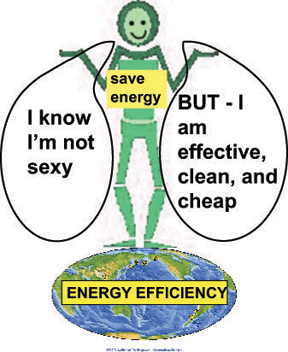 Fact is, there are trillions of dollars of highly profitable energy efficiency measures available that are currently not being pursued, according to McKinsey & Company. Energy efficiency is the cheapest form of new energy –
Nuclear power is also capital intensive and job poor. By contrast, energy efficiency is more labour-intensive – and efficiency creates jobs in every community.
Renaissance reconsidered, Corporate Knights, 13 February, 2014 Why build nuclear when we can meet growing demand less expensively through energy efficiency by Jim Harris, “……..The fall of nuclear power has been driven in part by the estimated cost of nuclear catastrophe. The Japanese Center for Economic Research, for example, has estimated that the cost of dealing with the Fukushima disaster alone will exceed $250 billion. Governments are also beginning to understand the magnitude of decommissioning costs. In the U.K., the cost of the Sellafield nuclear plant’s decommissioning has skyrocketed to $122 billion, all borne by taxpayers……
No insurance company will insure nuclear power without government guarantees, and no business will run nuclear plants without a government assuming the liability, construction cost overruns and decommissioning costs.
At the same time, nuclear costs are rising sharply while the price of renewable energy has dropped significantly, and continues to do so. In 2013, new installations of renewable energy in the United States are on pace for the first time to exceed new capacity of new fossil fuel plants (coal and gas fired) and nuclear combined.
Solar power, in particular, is enjoying cost reductions Continue reading
Sister Megan Rice ready for gaol – for her anti nuclear action
 I’ll do jail, says nun, 84, who broke into nuclear warhead site Devika Bhat Times,Washington, February 17 2014 Sister Megan Rice, 84, will begin her day in the usual manner tomorrow: breakfast at 4am followed by yoga or t’ai chi and an hour’s meditation. She will then be escorted to court by prison guards to find out whether she will spend the rest of her life behind bars.
“I’m ready to stay or ready to go. I see it as a win-win situation,” Ms Rice said from Knox County Jail, Tennessee…..(subscription only) http://www.thetimes.co.uk/tto/news/world/americas/article4007412.ece
Global warming brought extra hot summer to Australia
 Human influence heats up Australia Clare Pain ABC 12 Feb 14 Global warming caused by human greenhouse gas emissions were the likely cause of last year’s record-breaking temperatures in Australia, say researchers.
The Australian summer of 2012/13 was the hottest on record and the calendar year 2013 saw the highest average temperatures recorded in over 100 years of observations, University of Melbourne research fellow Dr Sophie Lewis, told the Australian Meteorological and Oceanographic Society‘s annual conference in Hobart today. Continue reading
Australia’s Minerals Council out to stop climate change action, and start nuclear power
 Use G20 for power push: miners ANNABEL HEPWORTH THE AUSTRALIAN FEBRUARY 17, 2014 MINING giants will urge the government to use the presidency of the G20 to secure a renewed commitment to end global “energy poverty”, recognise coal as a cheap and plentiful fuel, and call for a national debate on nuclear power.
The powerful Minerals Council of Australia will today call on the Abbott government to urgently seek to reverse a move by the World Bank to restrict funding for coal-fired power generators in poor nations to “rare circumstances”.
And in a move sure to inflame tensions with environmental groups, the miners will ramp up calls for the repeal of the carbon tax and the phasing out of the renewable energy target, saying Australia now has some of the highest electricity prices in the developedworld largely because of “ill-judged policy interventions”…….. Continue reading
Australia’s opportunity for new industries – renewable energy
Renewable energy great solution to void in industry, Pierre Mars SMH, 12 Feb 14 “…Australia has such a nascent industry, renewable energy. Further, once the capital costs are recovered, recurring costs are low: sun, wind, waves and hot rocks are free and abundant in Australia, providing low cost energy as a competitive advantage for future industry.
Unfortunately, the Abbott government’s policies on climate change will strangle this industry at birth so Australia may be importing renewable energy technologies instead of exporting them.: http://www.smh.com.au/comment/smh-letters/renewable-energy-great-solution-to-void-in-industry-20140212-32i8t.html#ixzz2tbjZJeo6
Australian Capital Territory leads the way on solar power
Liberal government’s ideology threatens renewable energy future, Canberra Times, Mark Diesendorf, 17 Feb “….The initiative of the ACT government and its people is a beacon in these dark times in Australia when the federal and most state governments are trying to squash renewable energy to serve the vested interests in the fossil fuel industries. Frankly, I don’t care whether the ACT’s target is aspirational or not.
The point is that the ACT is actually doing something of substance, unlike federal and state governments. Research at the University of NSW by PhD candidate Ben Elliston, guided by Associate Professor Iain MacGill and myself, shows that we could operate reliably the national electricity market entirely on renewable energy technologies that are commercially available now. The research is based on hour-by-hour computer simulations using real data on electricity demand, wind and sunshine over the region spanned by the market.
Furthermore, in peer-reviewed publications, we have shown that renewable electricity systems are affordable and likely to be less expensive than fossil-fuelled systems with hypothetical carbon capture and storage. We used the conservative cost projections for technologies and fuels by the Bureau and Resources and Energy Economics.
Australia does not need to buy its renewable energy from overseas, as Lawder seems to suggest. We have huge solar and wind resources. In the medium term we could have 100 per cent renewable electricity and in the longer term we could be exporting renewable energy to Asia, either by transmission line or modified LNG tankers.
The principal barriers to the transition to a sustainable energy system are no longer technological or economic. Instead they are the unhealthy relationships between the federal and state governments on one hand and the big greenhouse gas emitting industries on the other.
Mark Diesendorf is associate professor and deputy director of the Institute of Environmental Studies at the University of NSW. His new book, Sustainable Energy Solutions for Climate Change, is published by the UNSW Press. http://www.canberratimes.com.au/comment/liberal-governments-ideology-threatens-renewable-energy-future-20140216-32u2r.html#ixzz2tbi
1 This month
15 April – Zoom –Nuclear Power is Not the Solution
Apr 15, 2026 01:00 AM in Canberra, Melbourne, Sydney

Join the International Physicians for the Prevention of Nuclear War (IPPNW) on Tuesday, April 14th for a timely webinar exploring the risks associated with nuclear power and challenging the myth that it offers a simple, safe, carbon-free solution to the climate crisis

of the week – Australians for War Powers Reform (AWPR)
To see nuclear-related stories in greater depth and intensity
 Antinuclear