Abbott’s Review of Renewable Energy Target is an attack on Renewable Energy
RET review is a RET attack – Greens http://greensmps.org.au/content/media-releases/ret-review-ret-attack-greens 17 Feb 2014 | Christine Milne The Australian Greens say the Abbott government’s RET review is a thinly veiled attack on solar and wind energy in favour of coal energy.
“Reducing our clean energy quota will not make electricity cheaper, it will just make it dirtier,” Greens Leader Christine Milne said.
“All this hyperventilating we are seeing about energy prices is despite the fact that renewable energy has actually driven down wholesale prices in Australia.
“Not only that, renewable energy is reducing pollution and helping to mitigate the extreme droughts, fires and floods which are costing Australians dearly already.
“Australians already have a hands on understanding of clean energy with their rooftop solar but the Abbott government is trying to take us back to last century. 1.4 million households with solar panels are now competing directly with dirty coal generators and that is an excellent thing for people, the economy and the climate.
“The review is completely unnecessary and designed to justify slashing clean energy in favour of coal. It is a threat to current and future investments and will create huge uncertainty in the renewables industry.
“Climate denier Dick Warburton is one of the nation’s chief opponents to carbon pricing and effective global warming policy. I’m sure the global warming sceptics in the government think he is a marvellous choice to head up this anti-wind and anti-solar review.
“Everyone knows where this is going. The review is just a move to severely cut our clean energy quota to put coal profits first.”
Australia should join with other nations for an end to nuclear weapons
behind the scenes, Australia’s diplomats under Labor actively worked against international efforts to rid the world of nuclear weapons because they were worried that advocating disarmament may irritate our great and powerful friend, the United States.
Australia’s resistance to banning nuclear weapons sits at odds with most of the world..
Nuclear weapons: it’s high time for Australia to be bold and call for a ban David Donaldson, Guardian, 18 Feb 18 Julie Bishop’s assertion that somehow advocating a ban on the deadliest weapons ever created would distract from real disarmament is spurious and misleading
All countries are happy to condemn nuclear weapons in principle – even those who are building more of them. For many this involves spouting a couple of throwaway lines about the evils of nukes while sitting on their hands. Judging by the evidence, Australia appears to be embracing this approach. As a result, Australia remains committed to a broken UN disarmament structure, refusing to support promising new initiatives. Continue reading
USA urges for renewable energy, as Abbott plans to prevent it
 The announcement of the review came after United States Secretary of State John Kerry declared on Sunday that:
we have to invest in new technology that will help us bring renewable energy sources like solar, wind, and hydro power, not only to the communities where those resources are abundant but to every community and to every country on every continent..
Renewables inquiry leader vows ‘open mind’ on target’s future The Conversation Michelle Grattan Professorial Fellow at University of Canberra, 17 February 2014, ……..The last review of the Renewable Energy Target was completed in December 2012 by the federal government’s Climate Change Authority. It concluded that the government should retain the current Renewable Energy Target, and that scrapping it would save an average household only $15 a year.
The new review will be finished by the middle of this year and feed into the government’s energy white paper. Continue reading
Tony Abbott appoints climate sceptic to review of Renewable Energy Target
An earlier review of the renewables target by the Authority in 2012 found it should not be changed because it would hurt investor confidence in the sector. The Authority also recommended the next review of the target be pushed back to 2016
The renewable energy industry say billions of dollars in investment will be significantly hurt if the target is radically altered.
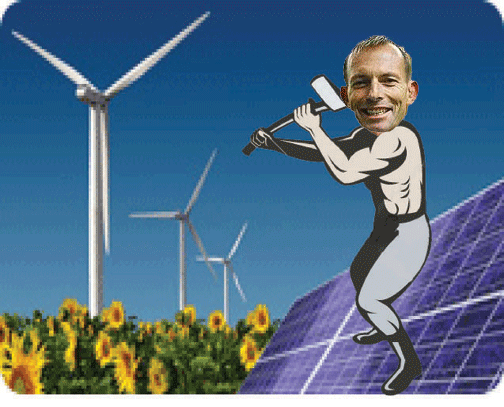 Climate sceptic Dick Warburton to head Tony Abbott review into renewable energy target SMH Tom Arup 18 Feb 14 Environment editor, The Age The Abbott government has launched a formal review of Australia’s 20 per cent renewable energy target, choosing senior business figure and climate change sceptic Dick Warburton to head it. Continue reading
Climate change hitting Adelaide earlier than predicted
 Hot weather in Adelaide already at levels not expected until 2030, says Climate Council report ,The Advertiser ELLEN WHINNETT HERALD SUN FEBRUARY 17, 2014
THE frequency of hot-weather days in Adelaide has already reached levels previously not expected until 2030, according to a report by the controversial Climate Council.
The council — the publicly funded version of the official national climate authority cut off by the Abbott Government — will release its latest environmental report on Tuesday. It says heatwaves will become more common and severe in Australia and that Adelaide, Melbourne and Canberra are already experiencing more extreme-heat events.
Adelaide has sweltered through a summer of record-breaking heat, enduring two severe heatwaves and more days above 40C than in any summer on record.
The council report says Adelaide’s heatwaves are an average 2.5C hotter than they were half a century ago, and peak heat days are 4.5C hotter…….http://www.adelaidenow.com.au/news/south-australia/hot-weather-in-adelaide-already-at-levels-not-expected-until-2030-says-climate-council-report/story-fni6uo1m-1226829833961
50-state plan to transform US to renewable energy
Stanford scientist to unveil http://www.eurekalert.org/pub_releases/2014-02/su-sst021314.php Stanford Professor Mark Jacobson and his colleagues recently developed detailed plans to transform the energy infrastructure of New York, California and Washington states from fossil fuels to 100 percent renewable resources by 2050. On Feb. 15, Jacobson presented a new roadmap to renewable energy for all 50 states at the annual meeting of the American Association for the Advancement of Science (AAAS) in Chicago. Continue reading
Time for an international agreement against radiological weapons
1 This month
15 April – Zoom –Nuclear Power is Not the Solution
Apr 15, 2026 01:00 AM in Canberra, Melbourne, Sydney

Join the International Physicians for the Prevention of Nuclear War (IPPNW) on Tuesday, April 14th for a timely webinar exploring the risks associated with nuclear power and challenging the myth that it offers a simple, safe, carbon-free solution to the climate crisis

of the week – Australians for War Powers Reform (AWPR)
To see nuclear-related stories in greater depth and intensity
 Antinuclear