Do 60% of South Australians really favour nuclear power?
Nuclear debate ‘a must’ for South Australia, says union boss news.com.au 21 Feb 14 THE State’s most powerful union boss has joined a Business SA campaign for South Australia to debate the issue of nuclear power. Shop, Distributive and Allied Employees’ Association state secretary and Labor Right action powerbroker Peter Malinauskas has gone against the views of the State Government to back the nuclear industry……..In contrast the Labor Party on Friday affirmed its opposition to a nuclear dump and power plant in SA, while the Liberal Party said there was “no support for any progression of this industry”.
But Greens MLC Mark Parnell said pro-nuclear advocates ignored economic evidence as well as environmental safety.
“There is adequate evidence that further involving SA in the nuclear cycle is a bad move economically, socially and environmentally,’’ he said. “Renewable energy is the future for SA, not nuclear.’’….
Business SA director of policy Rick Cairney said: “We are pleased to see that 60 per cent of South Australians are pro-nuclear which shows there is an appetite to value add our vast uranium reserves and strengthens the case for a public debate on the entire nuclear industry’’.
“Even if there is currently somewhat of a reluctance to develop a nuclear waste storage industry, at least the public is now to considering the possibilities.’’http://www.news.com.au/national/south-australia/nuclear-debate-a-must-for-south-australia-says-union-boss/story-fnii5yv4-1226834191612
NEW REACTOR TECHNOLOGIES WON’T MAGICALLY HALT CLIMATE CHANGE
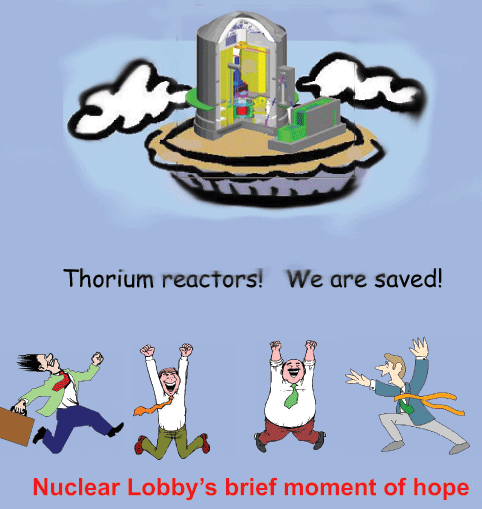 Will Thorium Save Us? David Suzuki February 20,
As knowledge about climate change increases, so does demand for clean energy. Technologies like solar, wind, hydro, geothermal, tidal and biofuels, along with eb energy-grid designs that will help us take advantage of renewables, are part of the equation, as is conservation.
What are “safer nuclear power systems”? And are they the answer?
Proposed technologies include smaller modular reactors, reactors that shut down automatically after an accident, and molten salt reactors. Some would use fuels and coolants deemed safer. (Industry proponents argue the low incidence of nuclear accidents means current technology is safe enough. But the costs and consequences of an accident, as well as problems such as containing highly radioactive wastes, provide strong arguments against building new reactors with current technology.)
One idea is to use thorium instead of uranium for reactor fuel. Thorium is more abundant than uranium. And unlike uranium, it’s not fissile; that is, it can’t be split to create a nuclear chain reaction, so it must be bred through nuclear reactors to produce fissile uranium.
Thorium-fuelled reactors produce less waste, and while some trace elements in spent uranium fuels remain radioactive for many thousands of years, levels in spent thorium fuels drop off much faster. China and Canada are working on a modified Canadian design that includes thorium, along with recycled uranium, fuels. With the right type of reactor, such as this design or the integral fast reactor, meltdown risks are reduced or eliminated.
Thorium can be employed in a variety of reactor types, some of which currently use uranium — including heavy water reactors like Canada’s CANDU. But some experts say new technologies, such as molten salt reactors (including liquid fluoride thorium reactors), are much safer and more efficient than today’s conventional reactors.
So why aren’t we using them?
Although they may be better than today’s reactors, LFTRs still produce radioactive and corrosive materials, they can be used to produce weapons and we don’t know enough about the impacts of using fluoride salts. Fluoride will contain a nuclear reaction, but it can be highly toxic — and it’s deadly as fluorine gas. And though the technology’s been around since the 1950s, it hasn’t been proven on a commercial scale. Countries including the U.S., China, France and Russia are pursuing it, but in 2010 the U.K.’s National Nuclear Laboratory reported that thorium claims are “overstated.”
It will also take a lot of time and money to get a large number of reactors on-stream — some say from 30 to 50 years. Given the urgent challenge of global warming, we don’t have that much time. Many argue that if renewables received the same level of government subsidies as the nuclear industry, we’d be ahead at lower costs. Thorium essentially just adds another fuel option to the nuclear mix and isn’t a significant departure from conventional nuclear. All nuclear power remains expensive, unwieldy and difficult to integrate with intermittent renewables — and carries risks for weapons proliferation.
If the choice is between keeping nuclear power facilities running, or shutting them down and replacing them with coal-fired power plants, the nuclear option is best for the climate. But, for now, investing in renewable energy and smart-grid technologies is a faster, more cost-effective and safer option than building new nuclear facilities, regardless of type……http://www.planetsmag.com/story.php?id=1496
Climate change sceptic Dick Warburton no friend of renewable energy
Climate change sceptic Dick Warburton’s new role adds to renewable energy uncertainty http://www.smh.com.au/national/climate-change-sceptic-dick-warburtons-new-role-adds-to-renewable-energy-uncertainty-20140221-337ep.html Peter Hannam ENVIRONMENT EDITOR, THE SYDNEY MORNING HERALD 22 Feb 14 A new government appointment has the clean energy industry fearing for the future of the green energy target, writes Peter Hannam. espite a role on a Gillard government panel to help cut the impact of the carbon tax on companies exposed to foreign competition, former Caltex chairman Dick Warburton is no fan of carbon controls.
Rather, Warburton has made public his doubts that rising carbon dioxide levels are linked to climate change, a view at odds with the vast majority of climate scientists.
As recently as July, the renewable energy target, or RET, had bipartisan backing. Coalition Senator Simon Birmingham told a clean-energy summit in Brisbane that an Abbott government would retain the current settings, which now require large-scale electricity generators to source 41,000 gigawatt-hours of power from renewable sources by 2020.
”At every possible point, they tried to assure the community that there was a bipartisan consensus around the RET, and therefore the growth of renewables,” Labor climate change spokesman Mark Butler says. ”What’s clear now is that it was just an utter falsehood.”
Uncertainty about ongoing support for the scheme, set up in 2001 by the Howard government, chilled an initial investment surge. A five-fold increase in the clean energy goal – to at least 20 per cent of electricity by 2020 – triggered another boom, particularly for wind farms in South Australia which now account for about a quarter of the state’s supply..
Growth prospects are dimming, however. Major fossil fuel-based suppliers, particularly Origin Energy and Energy Australia, have stepped up calls for a cut in the RET, arguing the energy sector is already over-supplied as demand wilts.
Alcoa’s decision this week to shut its aluminium smelter near Geelong lopped another 350 megawatts off demand. By comparison, the capacity of Australia’s largest wind farm, at Macarthur in Victoria, is 420 megawatts.
With the carbon tax likely to be axed when the new Senate sits in July, Prime Minster Tony Abbott appears to have made the RET his next focus, regularly stressing ”the upward pressure” it places on power prices.
The Warburton-led panel – merely an advisory body, the government emphasises – will examine the RET’s costs and benefits. A review of the RET in 2012 by the Climate Change Authority recommended few changes, other than to stop reviewing it every other year to avoid regular bouts of uncertainty.
The authority’s review – which Warburton says he has not read – will itself be revisited later this year in the unlikely event the authority, which was set up by the Gillard government, dodges Abbott’s axe.
NSW’s Independent Pricing and Regulatory Tribunal estimates the RET will cost $40 per household in the 2014 fiscal year. Other states put the tab lower, and falling.
The 2 per cent impost is dwarfed by the almost 50 per cent of a typical power bill going on poles and wires and about 25 per cent on electricity generation, while the carbon price is responsible for about 8 per cent, IPART data shows.
The benefits of renewables are less obvious.
Analysts say wholesale power prices are forced lower by near-free wind and hydro power, at least nullifying the 2 per cent cost.
Other benefits include lower carbon emissions – 20 million tonnes averted between 2001 and 2012 alone, more jobs in rural regions and security against rising fuel costs, such as soaring gas prices.
”The only people who unambiguously benefit from a reduction in the RET are the incumbent [fossil-fuel] generators,” said an industry analyst who requested anonymity.
NSW’s government is selling its Macquarie Generation power plants – which burn 11 million tonnes of coal a year – and would be keen that there be less competition.
”Every week, they’re worth less,” Pitt & Sherry principal consultant Hugh Saddler said
Abbott tries to reassure IMF about climate change action
PM seeks to assure IMF on climate action .Herald Sun, 21 Feb 14 PRIME Minister Tony Abbott has assured Christine Lagarde that Australia will meet its CO2 reduction targets, after the International Monetary Fund head renewed calls for greater action on climate change.
Ms Lagarde is in Sydney ahead of the G20 finance ministers meeting this weekend, and
used the opportunity to stress that one way or another, climate change must be dealt with. “I was really pleased to see that the government is maintaining its objective and clearly we will be interested in seeing what the proposals are,” she said…….
The coalition government is trying to scrap Labor’s carbon tax and replace it with a direct action plan on climate change, which is still being finalised.
The five per cent target is the unconditional goal agreed to by both parties, but environment groups and the independent Climate Change Authority have warned deeper cuts will be necessary in the future.
Ms Lagarde has previously championed Australia’s pioneering role in working to combat climate change and said on Thursday she “certainly hopes” that doesn’t change. http://www.heraldsun.com.au/news/breaking-news/pm-seeks-to-assure-imf-on-climate-action/story-fni0xqi4-1226833672221
Taxpayer anxiety over US govt loan to nuclear company
 McCumber: Whistling past the nuclear graveyard CtPost.com, Friday, February 21, 2014 WASHINGTON — One nice thing about announcing an “all-of-the-above” energy policy, as the Obama administration has done, is that it requires all of the careful consideration and discernment that a Labrador retriever shows toward food.
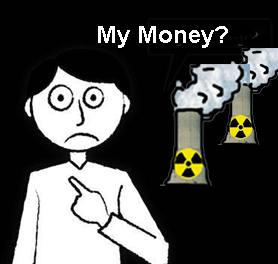 If you never met an energy source you didn’t love, you can make momentous, multibillion-dollar decisions without concern for inconvenient facts. So Energy Secretary Ernest Moniz showed us this week, when he blithely put the federal government on the hook for $6.5 billion in loan guarantees for a project to build the first two new commercial nuclear plant reactors in 30 years.
Underwriting construction of nuclear power plants means assuming a worrisome amount of risk for the taxpayers’ money — more than Wall Street was comfortable with, in this case — but that’s not new. The federal government has historically subsidized and underwritten nuclear projects. ……
Nothing nuclear in the news this week is designed to ease those concerns. The manager of nuclear safety at the troubled, massively contaminated nuclear-waste site at Hanford, Wash., was fired after blowing the whistle on safety problems. A radiation leak has shut the Waste Isolation Pilot Project, a New Mexico storage site for lower-level waste, for the last several days.
And the ongoing, slow-motion horror that is Fukushima produced another ugly headline — the leakage of more than 100 tons of highly contaminated water from one of the site’s more than 1,000 storage tanks.
It’s bad enough that the surge in renewables and the glut of cheap natural gas make nuclear construction look staggeringly expensive, particularly in an environment where several operators have recently opted to take nuke plants offline rather than repair them or even invest more in their continued operation. But the really reprehensible part of the federal loan guarantee is that it comes from the same administration that has halted any progress toward finding a permanent solution for the storage of spent nuclear fuel, for reasons just as cynically political as the approval itself……..
it doesn’t take a scientific review to understand that before we build new nuclear plants, we should have a place to put the waste they produce, which will be dangerous for the next 160,000 years. David McCumber is Hearst Newspapers‘ Washington Bureau Chief.david.mccumber@hearstdc.com.
Wind turbines more efficient than previously thought
Study Gives Wind Turbines a ‘Thumbs Up’ http://www.usnews.com/news/articles/2014/02/20/study-gives-wind-turbines-a-thumbs-up Researchers in the U.K. found wind turbines put out nearly twice the power in the long term than some critics have claimed. By Alan Neuhauser Feb. 20, 2014 A new study from the United Kingdom has found wind turbines generate more power in the long term than some critics have claimed. Some have argued turbines lose a third of their electrical output after just 10 years of operation, the paper said. Researchers from the Imperial College Business School, however, determined that turbines still churn out about three-quarters of their original capacity for 19 years – nearly twice as long.
“There have been concerns about the costs of maintaining aging wind farms and whether they are worth investing in,” professor Richard Green, a co-author of the study, said in a statement. “This study gives a ‘thumbs up’ to the technology and shows that renewable energy is an asset for the long term.”
The team used wind-speed data from NASA from the past 20 years and compared it with the actual recorded output from each wind farm. They then developed a formula to calculate how wear-and-tear affected the turbine’s performance, finding that the wind farms were putting out more power than had been previously thought. A key reason: the high-end engineering of the turbines.
“They’re designed to be as light and as strong as possible, and to be able to survive and withstand and use really powerful winds,” explains Dan Kammen, professor of energy at the University of California, Berkeley. “Anything that’s designed in that way, kind of optimizing lightness, strength and performance, it’s not surprising they’d really outperform what you’d expect, because that’s a really tough environment.”
Wind farms generate about 7.5 percent of the energy in the U.K. In the United States, wind power makes up slightly more than 4 percent of all generated energy, according to the Department of Energy.
“Our study provides some certainty,” said research fellow and co-author Iain Staffell, “helping investors to see that wind farms are an effective long-term investment.”
The findings were published in the journal Renewable Energy on Thursday.
1 This month

of the week – Australians for War Powers Reform (AWPR)
To see nuclear-related stories in greater depth and intensity
 Antinuclear