Australian uranium helping India to develop nuclear weapons?
 Australian Prime Minister Tony Abbott’s administration has signaled it could be open to easing some of Canberra’s past demands for assurances that Australian-origin uranium not be diverted to nuclear-arms efforts, according to the Times.
“We see it as a priority and want to move as quickly as possible,” Continue reading
Auxstralia’s peak medical research body gives wind farms a clean bill of health
 Link between wind farms and health problems rejected by research review SMH, February 24, 2014 Tom Arup Environment editor, The Age There is no reliable or consistent evidence that wind farms directly cause human health problems, a major draft review by Australia’s leading medical research body has found.
The hotly anticipated study by the National Health and Medical Research Council, has also called for further research into the issue after it identified only a handful of studies into the issue it deemed credible enough to be considered under the review.
Anti-wind farm campaigners claim turbines can cause a wide range of ailments including, headaches, insomnia, and dizziness, sometimes dubbing the symptoms as “wind farm syndrome.”
These have been widely rejected by the industry and many public health researchers.
Nuclear lobby is oblivious, but the Fukushima catastrophe continues
nuke promoters are oblivious to the dangers, so the rest of us need to keep in mind, Fukushima is an ongoing disaster still looking for a solution almost three years later, and the land in that area will never be the same.
 Fukushima: The Nuclear Disaster That Keeps On Giving http://www.tucsonweekly.com/TheRange/archives/2014/02/23/fukushima-the-nuclear-disaster-that-keeps-on-giving The tsunami and meltdown at Japan’s Fukushima Nuclear Power Plant happened way back in March, 2011, going on three years now. Old news, right? Meltdowns happen. BY DAVID SAFIER ON SUN, FEB 23, 2014
Actually, not such old news. Another 100 tons of radioactive water leaked last Wednesday, just one of an ongoing series of mini-disasters occurring regularly at the damaged nuclear plant which is currently being held together by duct tape, baling wire and chewing gum — or techniques similarly temporary and unreliable.
It’s not the first spill, there have been many, but this water is more contaminated than usual. Continue reading
Labor-Liberal skullduggery in coming South Australian election
To The Editor The Advertiser, 25 Feb 14
from Dennis Matthews
 Nominations for the March 15 state elections have now closed and the magnitude of the Labor-Liberal skullduggery are now clearer.
The recent changes to the Electoral Act have failed to do anything about voting problems in the Legislative Council. The voting paper will still be very large, comprising some 25 columns. If you want to vote below the line you will have to correctly number some 63 boxes.
There are 20 micro parties or groups of independents totaling some 40 candidates, many of whom will be involved in preference deals that have outcomes that even experienced political commentators will be unable to decipher. Most of these candidates will lose their $3000 deposit, netting the state government a handy $120,000.
Meanwhile in the House of Assembly, for which the voting paper was straightforward, democracy has been dealt a serious blow. Thanks to the exorbitant nomination deposit the number of micro parties and non-sitting independents has been decimated.
Abbott’e review panel is stacked against renewable energy !
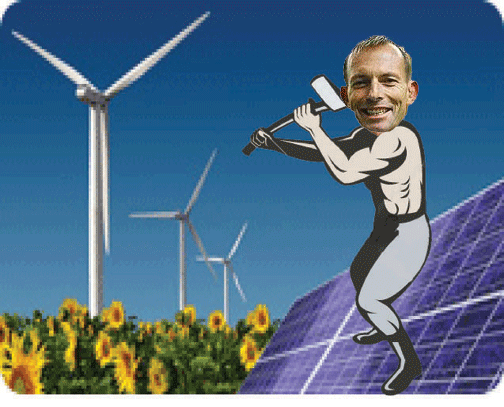 Renewable Energy Target Review Panel – Further Doubts http://www.energymatters.com.au/index.php?main_page=news_article&article_id=4191 25 Feb 14, The Federal Government promised an open and transparent RET review – but to some it’s appearing as a rigged game from the get-go.
The Sydney Morning Herald reports former Caltex chairman and climate change sceptic Dick Warburton, who is leading the panel, has declined to comment on whether he or his family hold any interests in fossil-fuel companies that might benefit from a reduction in the Renewable Energy Target.
It’s also been revealed that while Environment Minister Greg Hunt said all panel members had completed private interests declarations, “as is required to identify potential conflicts of interest,” Shirley In’t Veld, said she had not been asked to make such a disclosure.
Professor Ross Garnaut, economist and former advisor to the Labor Government, believes the Climate Change Authority should be carrying out the Review. According to RenewEconomy, Professor Garnaut believes the current panel is “comprised of people who have neither the independent status, nor the professional capacity of the executive in the CCA”.
Greens Leader Senator Christine Milne has labelled the Review a “hatchet job” and an “anti-renewable energy review”. Others have expressed similar sentiments.
The Small-scale Renewable Energy Scheme (SRES), a component of the RET, will have zero net cost impact on household power bills. Even so, the continuation of the program after the Review is anything but assured given the circumstances under which the Review is occurring; including recurring negative signals from Prime Minister Abbott.
The Review is already having somewhat of a dampening effect on Australia’s renewable energy industry, with some large scale projects being put on hold until the results are in and actions decided.
If the RET is abolished, up to 6,750 solar PV jobs could be lost and foregone nationally in under 5 years says the Australian Solar Council. If the RET remains unchanged, approximately 30,000 more jobs in the renewables sector will be created and another $18.7 billion in investment will occur.
South Australia gets wave energy unit to power 1,000 homes
 $7m wave energy unit heads to Port MacDonnell http://www.abc.net.au/news/2014-02-24/7m-wave-energy-unit-heads-to-port-macdonnell/5279420 24 Feb 2014, A 20 square metre wave energy unit will be towed from Adelaide to its position off South Australia’s south-east coast today.
The $7 million unit, developed by wave energy company Oceanlinx, will be tugged to Port MacDonnell. CEO Ali Baghaei says the unit will produce enough electricity to power 1,000 homes. He says the unit was meant to be connected to the grid last year but it was delayed.
“It’s been delayed because of weather and obviously it’s very important that we ensure that the unit commences its journey of four to five days during the best weather window period, as much as we can predict of course, hence why we have to assess the weather report and see what the tide master’s opinion is of the journey and so forth,” he said.He says it is a unique opportunity for South Australia.
“I believe that certainly this is the first of its kind, it’s the largest of its kind in the world, it’s one megawatt power and hopefully we will be able to demonstrate that successfully within coming months,” he said.
AUDIO: UN and World Bank fund renewable energy across the Pacific
 AUDIO: Renewable energy funding across the Pacifichttp://www.radioaustralia.net.au/international/radio/program/pacific-beat/renewable-energy-funding-across-the-pacific/1270348 25 February 2014, One million dollars of extra funding has been allocated to boost renewable energy projects across the Pacific.
The Pacific Renewable Energy Project is being promoted by the Secretariat of the Pacific Regional Environment Programme (SPREP) and, with additional support from the UNDP and World Bank, is providing practical assistance to Pacific Island nations to meet their renewable energy targets.
Presenter: Richard Ewart
Speaker: Sill’a Ualesi Kilepoa, Project Manager, Pacific Renewable Energy Project, SPREP
The fast growing success of wind energy in USA

 Will wind energy become a more dominant alternative energy source? http://www.pottsmerc.com/lifestyle/20140224/will-wind-energy-become-a-more-dominant-alternative-energy-source By E, The Environmental Magazine 02/24/14, Dear EarthTalk: What is the latest
  prognosis for wind energy to command a larger piece of the renewable energy pie? — Peter M., Akron, OH Hydroelectric sources of power dwarf other forms of renewable energy, but wind power has been a dominant second for years, and continues to show “hockey stick” growth moving forward. According to the Global Wind Energy Council, global cumulative installed wind capacity — the total amount of wind power available — has grown 50-fold in less than two decades, from just 6,100 megawatts (MW) in 1996 to 318,137 MW in 2013.
And the future looks brighter still. Continue reading
Abbott’s “Direct Action” policy – costly and ineffective
 Banks and big business warn Direct Action will lift costs and deter projects, Short-term incentives offered by the policy ‘will drive up’ the amount Coalition will pay to buy emissions reductions Guardian, Lenore Taylor, political editor. 25 Feb 14, Banks and big business are warning the government the short-term incentives offered by its Direct Action climate policy will deter many projects and drive up the amount the government will have to pay to buy emission reductions. Continue reading
The Hibakusha and the invisible, but real, effects of radiation
 Radiation Makes People Invisible http://nuclear-news.net/2014/02/24/radiation-makes-people-invisible-full-article-%E6%94%BE%E5%B0%84%E8%83%BD%E3%81%AF%E4%BA%BA%E3%80%85%E3%82%92%E8%A6%8B%E3%81%88%E3%81%AA%E3%81%84%E5%AD%98%E5%9C%A8%E3%81%AB%E3%81%99/ Robert Jacobs 24 Feb 14, Radiation makes people invisible. We know that exposure to radiation can be deleterious to one’s health; can cause sickness or even death when received in high doses. But it does more. People who have been exposed to radiation, or even those who suspect that they have been exposed to radiation that never experience radiation related illnesses may find that their lives are forever changed – that they have assumed a kind of second class citizenship. They may find that their relationship to their families, to their communities, to their hometowns, to their traditional diets and even traditional knowledge systems have become broken. They often spend the remainder of their lives wishing that they could go back, that things would become normal. They slowly realize that they have become expendable and that their government and even their society is no longer invested in their wellbeing.

As a historian of the social and cultural aspects of nuclear technologies I have spent years working in radiation-affected communities around the world. Many of these people have experienced exposure to radiation from nuclear weapon testing, from nuclear weapon production, from nuclear power plant accidents, from nuclear power production or storage, or, like the people in the community that I live, in Hiroshima, from being subjected to direct nuclear attack. For the last five years I have been working with Dr. Mick Broderick of Murdoch University in Perth, Australia on the Global Hibakusha Project. We have been working in radiation-affected communities all around the world. In our research we have found a powerful continuity to the experience of radiation exposure across a broad range of cultures, geographies, and populations. About half way between beginning this study and this present moment the nuclear disaster at Fukushima Daiichi happened here in Japan. Continue reading
146 nuclear-weapons-free nations represented in Mexico talks to eliminate nuclear weapons
 The World Turns Against Nuclear Weapons Peter G. Cohen The Smirking Chimp, February 21, 2014 A new kind of world meeting has just ended (2-13-14) in Nayarit, Mexico. It was unusual because 146 weapons-free nations, from all over the world, attended and discussed ways to eliminate the nuclear weapons now held by the Nuclear Nine, who ignored the meeting.
This worldwide movement is concerned with the recent information on the effects of any nuclear detonations that would be distributed around the world. The fireball from a typical U.S. weapon is so hot that it will ignite an area of from 30 to 40 square miles around the planned target. The heat from this giant firestorm will lift a huge amount of soot into the high atmosphere where it will drift around the world. Such a huge black cloud will blot out the sun and cause a nuclear winter by blocking the sunlight from reaching food crops.
Additional effects will include a wide dispersal of ionizing radiation that interferes with normal development in women and children, weakens the protection of the ozone layer, and destroys the phytoplankton of the sea, which supports most ocean life
The world is now realizing that the uncontrollable and long-lasting effects of nuclear weapons on civilians and all life, including domesticated animals amd plant ecosystems, make any use of these weapons an intolerable crime against humanity.
“The Mexico conference is the latest stop in a process that has changed the way nuclear weapons are discussed at the international level…..http://www.smirkingchimp.com/thread/peter-g-cohen/54358/the-world-turns-against-nuclear-weapons
1 This month

of the week – Australians for War Powers Reform (AWPR)
To see nuclear-related stories in greater depth and intensity
 Antinuclear