Australia NEEDS to see “Utopia”- and stop white-washing its Aboriginal history
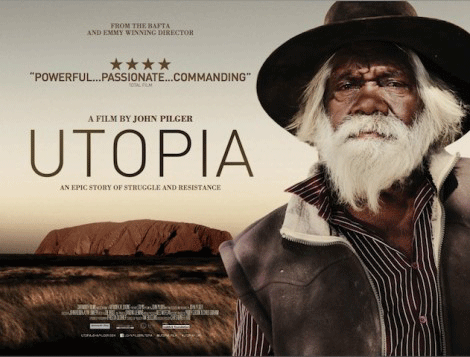 It’s nothing new that other countries are expressing shock and outrage over this film, whilst Australia tries to ignore its content. For further information, check out the mounting pile of political denials following reports from visiting UN officials.
It’s a crying shame, because Australia NEEDS to see this.
Utopia: An Aboriginal perspective, Black Feminist Blogspot, BY TRACKER, JANUARY 7, 2014 Award winning investigative journalist John Pilger’s new film Utopia will be a powerful weapon to raise awareness about Aboriginal Australia, according to Arrente writer Celeste Liddle*. On flicking through the UK reviews of John Pilger’s new documentary film “Utopia”, one thing quickly becomes apparent: Pilger has created a hard-hitting film that is of extraordinary importance.
Utopia, which was released in the UK in November, has consistently received rave reviews. CineVue refers to it as “as an examination of forgotten injustice it’s quite simply essential viewing”. Metro states that the film is “confrontational, eye-opening and saddening viewing”.
As someone who has been lucky enough to see the film, I cannot say I am at all surprised that four-star ratings have dominated, with the slightly lower ratings seemingly limited to criticism about the length of the film and Pilger’s interruptive and bombastic-at-times interview style.
It is frequently described as a “must see”, its content as bleak, confronting and disturbing and its core arguments as compelling and shameful.
In short, since its release, it has shaken viewers in the UK and awoken them to some unspoken truths in this country. That the film may not have the same reaction in Australia is not a surprise to me. The content, after all, covers the appalling situations and vast injustices facing many Indigenous Australians.
It’s been historically well-established that these things are not items of interest to the majority of people living in this country.
Whilst some independent cinemas have come on board to screen Utopia, it looks like additional screenings are going to have to be held in places such as universities and activist organisations, as well as on SBS TV.
In other words, what should be mandatory mainstream viewing about what’s happening in the proverbial “backyard”, particularly if people take the democratic process of voting seriously, is probably going to end up preaching to the converted.
It’s nothing new that other countries are expressing shock and outrage over this film, whilst Australia tries to ignore its content. For further information, check out the mounting pile of political denials following reports from visiting UN officials.
It’s a crying shame, because Australia NEEDS to see this. They need to sit down and absorb the realities of the “Aboriginal situation” and they need to start responding if they actually do believe in the “fair go for all” they’re so fond of espousing as a core value of this country.
They need to start acknowledging the history and addressing the current issues if they do actually believe this country is a place to be proud of.
In Utopia, Pilger takes the viewer on a journey through some of the most horrible human rights abuses affecting Indigenous Australia………
Pilger’s final argument; that a treaty with Indigenous Australia needs to happen is a very poignant note to end on. I particularly commend him for this.
In an endless and well-funded campaign for Constitutional Recognition, which to me is a form of “practical reconciliation”, the point that it’s not a true negotiation and redistribution for the proper benefit of black Australia needs to be made.
What will truly change if black Australia is merely written into a coloniser document, and why is it considered so important at this point in time for this to happen? Why was a treaty on the table in the 1980s yet is not being talked about now when we are told so frequently that many gains have been made?
Pilger doesn’t even mention Constitutional Recognition and I can only garner from this that he, like so many of us in the community, has reservations regarding this push and cannot see what the true benefit of it will be beyond yet another symbolic gesture.
Throughout the film, you see Pilger completely setting politicians and other officials on the back foot when questioned on how they have dealt with Aboriginal issues, and the few gains that have been made.
You see medical practitioners, journalists and researchers highlight the many miscarriages of justice and human rights abuses that have been inflicted particularly on the most vulnerable members of the community.
You see Pilger bring the evidence of all this to the table over and over again for the audience to ruminate upon.
Yet here’s the rub for me: as an Aboriginal woman in this country, very little of what he has presented to me is information I did not already know. Nor would it be information a fair chunk of black Australia wouldn’t know. It’s affected our families, it’s denied our heritage, it’s been right there in front of us our entire lives. We know it because it is a part of us.
This is why I have little sympathy when I see opinion pieces criticising John Pilger for releasing this film to the UK before Australia because they feel that this is an Australian story and it needs to be discussed here first.
The evidence has been there for Australians for a very long time, and Australians have chosen; through socially-embedded racism; through personal greed; through manufactured national pride, to ignore it over and over again.
If Utopia causes outrage in other parts of the world and casts a very stern global spotlight on Australia with regards to the situations facing Indigenous Australia, then perhaps this might actually lead to some more positive outcomes for a change.
We can only hope.
*Celeste Liddle is an Arrernte Australian woman living in Melbourne. She is the current National Indigenous Organiser for the National Tertiary Education Union (NTEU). Celeste blogs personally at Rantings of an Aboriginal Feminist and is particularly interested in education, politics and the arts. http://blackfeministranter.blogspot.com.au/2014/02/utopia-aboriginal-perspective.html
No comments yet.
1 This month

of the week – Australians for War Powers Reform (AWPR)
To see nuclear-related stories in greater depth and intensity
 Antinuclear
Leave a comment