NUCLEAR WEAPONS PROLIFERATION IN SOUTH AUSTRALIA 1945 – 1965
 Nuclear Information Centre, Conservation Council of South Australia INTRODUCTION The ways in which a country or state can contribute to the proliferation of nuclear weapons are many and varied. They include direct and indirect, overt and covert, subtle and not so subtle; the line between contributing and not contributing is fuzzy and elusive. What may be ignored at one time may later be seen to be highly significant.
We will concentrate on the obvious and widely acknowledged contributions.
A successful nuclear weapons program requires:
- A pool of knowledge
- A supply of highly trained specialists
- Research and development
- A source of fissionable material
- The facilities for converting the fissionable material into weapons grade
- Testing of guidance and delivery systems, firing mechanisms, various materials, and complete weapons.
We will limit this article to contributions made in the post-war period 1945 to 1965, which constitutes the first phase of South Australia’s contribution to nuclear weapons proliferation.
History will probably record that the second phase started with the discovery of uranium at Beverly east of Mt. Painter (1969), at Honeymoon about 75 km north-west of Broken Hill (1972), and at Olympic Dam on the Roxby Downs station (1975).
The Olympic Dam mine at Roxby Downs has been exporting to nuclear weapons states since it began production in 1988.
Contributions to nuclear weapons proliferation were made in the period 1945-1965 by:
- The Department of Defense facilities at Salisbury and Woomera.
- Nuclear weapons tests at Emu Plains and Maralinga
- Uranium exploration by the Mines Department.
- Uranium mining, principally at Radium Hill.
- Uranium processing at Port Pirie.
SALISBURY
The beginning of South Australia’s involvement in the proliferation of nuclear weapons was the discovery of Radium Hill in 1906. This was an inadvertent step in the direction of nuclear weapons; radium rather than uranium was the initial object of the mine.
The first deliberate step was the setting up at Salisbury, some 20 km north of Adelaide, of the Long Range Weapons Establishment (LRWE) which later became the Weapons Research Establishment (WRE) and then the Defense Science and Technology Organization (DSTO).
Following an agreement reached between the UK and Australian governments in 1946, the LRWE commenced operations on April 1 1947. The agreement resulted in the Joint (UK/Australian) Project, whose main purpose was to set up an experimental guided weapons testing range and associated facilities at Woomera. The LRWE became the scientific and engineering base for the Woomera rocket range (Dept. Defense 1978-79).
In 1949 three Australian funded defense research laboratories were added to the Salisbury complex in order to provide a broader background for the work on guided weapons and to cover other aspects of defense science. Eventually these three laboratories became known as the Chemistry and Physics Research Laboratory (CPRL) (Dept. Defense 1978-79).
In 1955 all the Salisbury Laboratories and the LRWE were amalgamated to form the WRE. CPRL became the Weapons Research and Development wing of the WRE and retained its wholly
Australian funded character. The other three wings of the WRE were funded by the Joint Project (Dept. Defense 1978-79).
The Salisbury complex participated in nuclear weapons proliferation through its involvement with:
- The Woomera rocket range.
- The analyses of ore from Radium Hill.
- The development and construction of the nuclear capable surface-to-air weapons Bloodhound, Thunderbird, Seaslug, Sea Dart, and Rapier.
- The development and construction of the nuclear capable air-to-ground weapon Blue Steel.
- Engineering, supply and administrative services for the nuclear weapons test site at Maralinga.
WOOMERA
The work at Salisbury went hand in hand with the tests at the Woomera rocket range.
Southall (1962) has shown that the intention of the British government was to use Woomera and the associated facilities at Salisbury for the development and testing of a rocket to carry a nuclear warhead over long distances.
The main nuclear related activities were those involved in the construction and testing of the Black Knight and Blue Streak rockets.
“Despite the urgency that surrounded its (the Black Knight) development it was only a means to an end. Black Knight was an experimental unit. From it would come the lessons and the facts necessary to produce a gigantic vehicle capable of delivering a nuclear warhead from the British Isles to any target chosen in Europe or European Russia or the Middle Eastern countries flanking the Mediterranean.” (Southall, p55).
“Blue Streak, in principle if not in fact, would be bringing back into the atmosphere, a tremendous distance from its launching place, a compact but highly detailed nuclear warhead.” (Southall, p.55).
The Woomera rocket range and the Salisbury complex were deliberate steps in the development of nuclear weapons delivery systems and as such made significant contributions to the proliferation of nuclear weapons.
The next stage in South Australia’s contribution to nuclear weapons proliferation was the tests at Emu Plains and Maralinga.
Whilst plans for these tests were under way there an urgent search was in South Australia for the raw material to make the explosive for these weapons.
URANIUM MINING
The explosive in nuclear weapons such as those tested at Emu Plains and Maralinga was either uranium highly enriched in the isotope U-235 or it was plutonium obtained from reactors fueled with uranium.
The Mines Department (later the Department of Mines, then the Department of Mines and Energy) was instrumental in fostering firstly radium then uranium exploration. Radium was discovered at Radium Hill in 1906 and at Mt. Painter in 1910. The search for uranium was also promoted by the British Government.
“In 1944, the urgent wartime need for supplies of fissionable material led to a vigorous appraisement of South Australia uranium resources at the request of the British Government. This task, involving geological, metallurgical and chemical engineering investigations, was jointly undertaken by the South Australian Department of Mines and the C.S.I.R.O.” (South Australian Mines Department, 1961).
“By 1951, combined field and laboratory investigations showed sufficient promise to warrant the erection of a metallurgical pilot plant on the radium Hill field to confirm in practice the metallurgical process developed in the laboratory. In 1952 a chemical extraction pilot plant was erected at Thebarton to perfect the extraction of uranium oxide concentrate from the Radium Hill metallurgical concentrates.
As a result of this post-war exploration, laboratory research, and pilot plant operation a contract was signed in 1952 by the Commonwealth Government, South Australian Government and the Combined Development Agency of the United Kingdom and United States Governments. This contract provided for the purchase of the uranium oxide concentrate output of Radium Hill by the C.D.A. oven a seven year period of full production.” (South Australian Mines Department, 1961).
The strategic nature of uranium resulted in new legislation. In 1945 amendments to the Mining Act provided for the control of mining, treatment and use of uranium and thorium ores and the vesting of these minerals in the Crown. In 1949 the Uranium Mining Act empowered the Minister of Mines to open and work mines for the recovery of uranium ore, its treatment and its sale.
RADIUM HILL
The first uranium deposits to be mined were at Radium Hill (discovered 1906) and Mount Painter (discovered 1910). The deposits at Radium Hill were discovered by A.J.Smith who worked them for two years. Both deposits were worked intermittently for the recovery of radium until the 1930’s.
Interest in Radium Hill and Mount Painter revived in 1944, when a search for uranium began in Australia at the request of the British and US Governments. The Radium Hill deposit was redeveloped as a uranium mine in 1954 following further exploration and pilot-plant studies.
Full scale production commenced at Radium Hill in November 1954. The mine produced 721 tons of uranium in the period 1954-62 at a capital cost of £ 5,000,000 (Uranium Advisory Council, 1982).
Concentrate was treated at Port Pirie and sold to the C.D.A., the joint UK/USA uranium purchasing agency.
WILD DOG HILL
Wild Dog Hill, which is six kilometers south west of Myponga, was discovered in October 1953. It was worked by the SA Government from 1954 to May 1955. There were two shafts 27ft and 38ft long, respectively, and a number of drives. It produced 340 tons of ore, assaying 8.08lb of uranium per ton, or a total of 2748lb of uranium. The ore was treated at Port Pirie.
As shown in the next section it is highly likely that much of the uranium from these mines went to the UK and ended up in weapons tested at Maralinga.
URANIUM PROCESSING AT PORT PIRIE
The contract signed in 1952 by the Commonwealth Government, the SA Government and the C.D.A. of the UK and USA Governments provided for the purchase of the uranium oxide concentrate output of Radium Hill by the C.D.A. over a seven year period of full production. (SA Department of Mines, 1961).
The concentrate from Radium Hill was stockpiled until the beginning of chemical extraction at Port Pirie in August 1955. The capital cost of the Port Pirie plant was £ 1,800,000. The contract with the C.D.A. expired on December 31 1961 and uranium ore treatment at Port Pirie ceased in February 1962. (SA Department of Mines, 1961).
The key to understanding what happened to the uranium from Port Pirie is the Combined Defense Trust (later Agency).
The Groves-Anderson memorandum of November 16 1945 contained the following:
“3. The three governments (USA, Canada, UK) will take measures so far as practical to secure control and possession, by purchase or otherwise, of all deposits of uranium or thorium situated in areas compromising the United States, its territories or possessions, the United Kingdom, and Canada. They will also use every endeavor with respect to the remaining territories of the British Commonwealth and other countries to acquire all available supplies of uranium and thorium. All supplies acquired under the provisions of this paragraph will all be placed at the disposition of the Combined Development Trust.
- The materials at the disposition of the Trust shall be allocated to the three Governments in such quantities as may be needed, in the common interest, for scientific research, military, and humanitarian purposes.” (Gowing and Arnold, p85).
Prior to 1955 the main demand for Australian uranium came from the USA with the UK demand being satisfied by supplies from the Belgian Congo, but by the time that Port Pirie uranium concentrate became available the UK was again actively seeking new supplies for its nuclear weapons program.
There was a clear intention, on the part of both the supplier and the buyer, that the uranium was to be for military purposes and it seems highly likely that the uranium oxide from Port Pirie went to the UK. This can be seen from Figure 1 and from the following quote:
“Uranium from Britain’s nuclear weapons programme came from four main sources: The Belgian Congo, the South African Rand goldfield and the Rum Jungle and Radium Hill mines in Australia.” (Durie and Edwards, p44).
At the time, uranium was being enriched in the UK at Capenhurst to reactor grade (1949-57) and to weapons grade (1957-63). The reactor grade uranium was for the reactors at Windscale (1950-57), which produced weapons grade plutonium, and for Calder Hall (1956- ) and Capelcross (1959- ), whose spent fuel was then reprocessed for weapons grade plutonium at Windscale. Fuel for the reactors was fabricated from enriched uranium at Springfields.
Some of the Port Pirie uranium may have been enriched to weapons grade at Capenhurst (1957- ) and some may have been used in reactors with the spent fuel being reprocessed for weapons grade plutonium at Windscale (1955- ). This plutonium was probably used in the Buffalo, Antler and Vixen series of tests at Maralinga from September 1956 to May 1961.
The following revealing extracts are from Durie and Edwards:
“Between 1950 and 1957 Britain’s first two piles were run at Windscale, together producing enough plutonium for 30 atomic bombs a year. Windscale’s first reprocessing plant was commissioned in 1952 and used, until it was closed in 1964, to extract plutonium from reactor spent fuel as part of the atomic bomb construction effort. ………The second reprocessing plant came into operation in 1964 and was also, according to BNFL, used for military purposes.” (p33).
“The first Windscale pile began operating in October 1950, the second in June 1951. The first plutonium was extracted by the Windscale reprocessing plant in February 1952, and sent to Aldermaston in August of that year for incorporation into Britain’s first atomic bomb. On 3 October 1952 the bomb was tested at Monte Bello, off the northern coast of Australia” (p18).
“According to the UKAEA’s (UK Atomic Energy Authority) first ever Annual report in 1956, the Springfields fuel fabrication plant near Preston was completed in 1948 ‘to meet an urgent military requirement’. It was built to fabricate uranium metal fuel for the two Windscale plutonium production piles, and for Calder Hall and
Capelcross as well as for the new generation of ‘civil’ Magnox reactors.” A conversion plant to supply the Capenhurst enrichment plant was operated at Springfields from 1952. (p39).
The role of BNFL’s (British Nuclear Fuel) uranium enrichment establishment at Capenhurst in Chesire has been as vital to weapons production as Windscale. The first plant built there in 1949 was a low enrichment ‘gaseous diffusion’ plant, to enrich the uranium discharged from the Windscale plutonium production piles so that it could be re-used as fuel in the piles. This was expanded by 1957 to enable it to enrich uranium to over 90 per cent for use either in atomic weapons or as a fuel for the navy’s nuclear powered submarines.” (p37).
Calder Hall which opened in October 1956 produced a quarter of the plutonium for Britain’s pre-1964 weapons program. (Durie and Edwards, p35).
The trigger, code-named Red Beard, for the UK’s first H-bomb had a fissile core made from plutonium produced from uranium in British nuclear reactors (Blakeway and Llyod-Roberts, p153). This H-bomb was detonated in 1957, two years after Port Pirie commenced exports of uranium concentrate. There is a high probability that the H-bomb trigger contained uranium of South Australian origin.
The next section describes the tests which were part of the British nuclear weapons program that occurred in SA during the period 1953-63. Not all of these tests involved nuclear material but they were all intended to assist in the design and construction of nuclear weapons and hence were significant contributors to the proliferation of nuclear weapons.
EMU PLAINS AND MARALINGA
The following is a brief description of the various test series. Further information may be obtained from the Report of the Royal Commission into British Nuclear Tests in Australia.
The purpose of the Totem trials at Emu Plains in October 1953 was to find out how much of the isotope Pu-240 could be tolerated in military grade plutonium. This arose because Britain’s nuclear power stations were not producing plutonium fast enough to meet the requirements of the Chiefs of Staff who wanted 200 A-bombs by 1957. The British scientists wanted to know whether the Magnox reactors, which were able to produce electricity as well as fissile material, could produce enough weapons grade plutonium. (Blakeway and Lloyd-Roberts, p78).
Both Totem bombs were mounted on towers for detonation. Totem 1 an Totem 2 had approximate yields of 10 and 6 kiloton, respectively.
The atomic weapons needed to be supplied with a large number of neutrons at the time that the fissile material was most compressed by high explosive. The source of neutrons, the neutron initiator, consisted of a radioactive substance brought into contact with beryllium by a chemical explosion.
The early Kitten trials from September 1953 to May 1961 were concerned with developing and testing neutron initiators. In the later trials, the neutron output was used to assess the performance of the high explosive assembly that compresses the fissile material in the core.
Five Kittens experiments were carried out at Emu Plains and a further 94 at the Naya area of Maralinga.
The Buffalo explosions in September and October 1956 were the first atomic bomb tests at the Maralinga range. The tests not only furthered bomb design and development but also they provided an opportunity for selected Australian, New Zealand, Canadian and British officers from the various services to observe at first hand the effects of a nuclear explosion on various targets including a Centurion tank, aircraft, military, electronic, and medical equipment, and defensive emplacements.
Buffalo 1 was detonated on a tower and had the explosive power (yield) of about 15 kiloton of TNT. Buffalo 2 was exploded at ground level; yield was about 1.5 kiloton. Buffalo 3 was dropped by the RAF and exploded at 500 ft above the Kite site; yield was about 3 kiloton. Buffalo 4 was mounted on a tower; yield was about 10 kiloton.
The Antler trials in September to October 1957 were designed to evaluate components used in thermonuclear weapons but did not involve thermonuclear explosions. High yield lightweight warheads for ballistic rockets and low yield lightweight weapons using plutonium-239 were tested, with particular emphasis being given to their triggering mechanisms.
Antler 1 and Antler 2 were tower mounted; yields were about 1 and 6 kiloton, respectively. Antler 3 was suspended from a balloon at an altitude of about 1000 ft; yield was about 25 kiloton. The Antler explosions were the last of the major trials on Australian soil.
Later experiments, code-named Vixen A, were carried out from June 1959 to April 1961 to investigate the dispersal of radioactive material. A further series, Vixen B, carried out from April 1961 to April 1963 to investigate the effect of accidents on nuclear weapons.
The Vixen A experiments were a study of the spread of radioactive and toxic materials that might result from an accident. Three kinds of experiments were carried out: Combustion in a petrol fire, combustion in an electric furnace, and dispersion by a high explosive. Thirty one Vixen A experiments were carried out.
The Vixen B trials studied the effects of accidental detonation of some of the high explosive in the weapon, such as might happen in a fire or a crash. The high explosive was exploded in a random manner so as to not properly compress the fissile core. The Vixen B experiments were said to be designed to measure how close such an accident came to producing a significant nuclear explosion. They involved the release of fission energy, although the yield was less than that from the high explosive.
Twelve Vixen B experiments were conducted in 1960, 1961 and 1963 plus a calibration round at the beginning of each annual series and used a total of 25.4 kg of plutonium.
The early minor trials, code-named Kittens, Tims and Rats, were tests of individual components or sub-assemblies of the nuclear weapons.
The Tims experiments from July 1954 to October 1960 were concerned with the measurement of the compression of a simulated core of an atomic weapon and the design of the high explosive component to achieve the maximum compression. Three hundred and twenty-one Tims experiments were carried out.
The Rats experiments from March 1959 to September 1960 were similar to the Tims experiments. One hundred and twenty five Rats experiments were carried out.
CONCLUSIONS
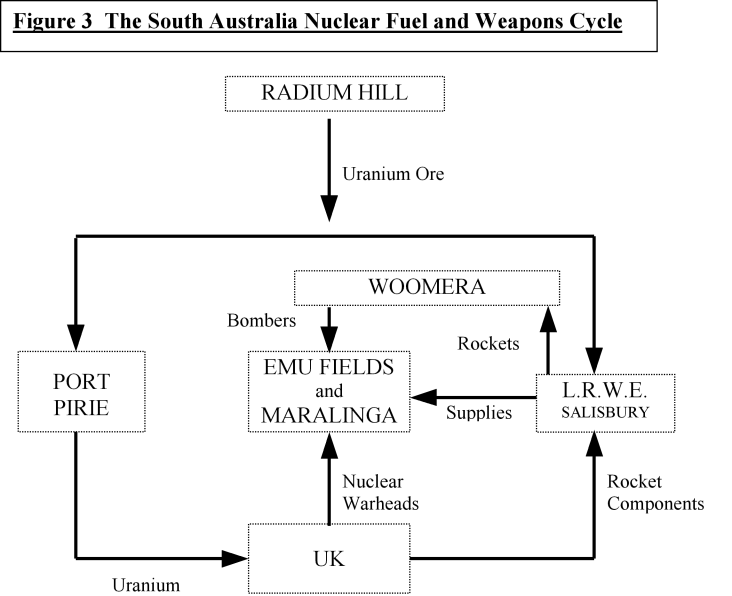
The above information is summarized in Figure 3.
No comments yet.
1 This month

of the week – Australians for War Powers Reform (AWPR)
To see nuclear-related stories in greater depth and intensity
 Antinuclear
Leave a comment