Wind and solar energy make economic and scientific sense
 Audio: Renewable energy finally makes economic sense, ABC Radio National 3 March 2014 Critics says renewable energy cannot supply a reliable base-load of electricity, a claim rejected by author Mark Diesendorf. In this opinion piece, he
 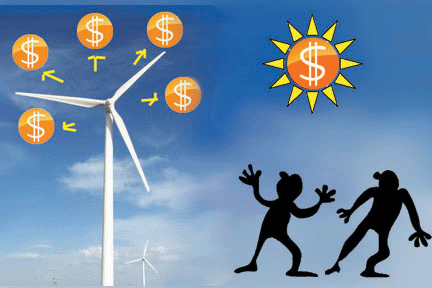 argues that wind, solar and other technologies are not only better for the environment, they make economic and scientific sense as well.You may have recently heard the following common claim repeated by aproponent of nuclear power: renewable energy cannot supply ‘base-load’ electric power. This misleading claim is based on the false assumption that the only way to supply base-load electricity demand is via coal and nuclear power stations.
Liberal leader in Tasmania will fight Abbott govt’s push to remove Renewable Energy Target
 As Rare as Tassie Tiger: Coalition leader advocates renewable energy REneweconomy By Giles Parkinson on 5 March 2014 Last weekend was an exciting one for the Australian renewable energy industry: a sighting as rare as the Tasmanian Tiger, an Australian conservative political leader willing to talk out in support of renewables. They were thought to be extinct.
Tasmania’s Liberal leader Will Hodgman, seeking to get elected in a state poll on March 15, told The Australian on the weekend that he would fight Tony Abbott’s attempts to dilute or remove the renewable energy target.
He planned a “strong” push to ensure RET changes did not stymie the state’s key wind and hydro energy sectors.
Naturally, his position was welcomed by the Clean Energy Council, which pointed out that renewables will be a useful hedge against surging gas prices, and the current review is causing uncertainty for investors that want to back major solar, wind, bioenergy, hydro and other projects.
“Mr Hodgman clearly recognises the benefits renewable energy has brought to Tasmania,” CEC CEO David Green said in a statement. “The Apple Isle sources the majority of its power from renewables such as hydro, wind and solar.”
That Hodgman’s position is at odds with his colleagues on the mainland could be explained by the fact that, unlike other states such as Victoria, NSW, Queensland, and Western Australia, Tasmania is not beholden to a powerful domestic fossil fuel industry. It is no accident that the areas with the most progressive renewables policy, Tasmania, South Australia and the ACT, are those where the fossil fuel industry is non existent or not powerful………. http://reneweconomy.com.au/2014/rare-tassie-tiger-coalition-leader-advocates-renewable-energy-28150
Devastating and longterm effects of Fukushima nuclear catastrophe
Fukushima Three Years On. Devastating Environmental and Health Impacts By Dr. Janette Sherman Global Research, March 04, 201 Counterpunch by Janette Sherman M.D and Joseph Mangano
The third anniversary of the Fukushima meltdown will occur on March 11th. The news is that Prime Minister Shinzo Abe and major Japanese corporations want to re-open the 50 other nuclear power plants that closed when Fukushima blew up, calling them a friendly economic source of cheap power.
Will this end up with business as usual? We were recently asked if we thought that Fukushima could ever be cleaned up. We have to say “no,” based upon what we know of the biology, chemistry and physics of nuclear power and isotopes and the history of nuclear development. Chernobyl melted down in 1986 and is still releasing radioisotopes.
Not all life systems were examined around Chernobyl, but of those that were – wild and domestic animals, birds, insects, plants, fungi, fish, trees, and humans, all were damaged, many permanently, thus what happens to animals and plants with short-term life spans is predictive of those with longer ones.
Worldwide, some 985,000 “excess” deaths resulted from the Chernobyl fallout in the first 19 years after the meltdown. In Belarus, north of Chernobyl, which received concentrated fallout; only 20% of children are deemed to be “healthy” although previously 80% were considered well. How can a country function without healthy and productive citizens? Notable in the U. S. is the Hanford Nuclear Site in Washington State, built some 70+ years ago by 60,000 laborers, and currently leaching radioisotopes into the Columbia River. DuPont was the original contractor, but since, multiple corporations, each paid mllions of dollars and have yet to contain the leaking radioactivity.
Every nuclear site is also a major industrial operation, contaminated not only with radioactive materials, but multiple toxic chemicals, such as solvents and heavy metals……..
Fukushima is still leaking large quantities of Cs-137 and Sr-90 into the Pacific Ocean, where all forms of marine life will absorb them – from algae to seaweed, to fish, to sea mammals and ultimately to humans who consume the contaminated sea life. Our recently released peer-reviewed paper confirms hypothyroidism in newborns in California, whose mothers were pregnant during the early releases from Fukushima. Thyroid abnormalities were detected early in Marshall Islanders and in Belarus residents of Gomel located near Chernobyl.
Radioactive iodine, known to interfere with thyroid function entered the U. S. from Fukushima in late March, shortly after the meltdowns, and was carried by dairy products resulting in damage to the unborn. It takes ten half-lives for an isotope to decay. Sr-90 and Cs-137 have half-lives of approximately 30 years, which means three centuries will occur before the initial releases are gone, and the releases have not stopped. There are some 26 nuclear reactors in the United States with the same design as those at Fukushima, and they pose a significant risk to people and the environment……..
The Indian Point Nuclear Power Reactors are located some 35 miles from mid-town Manhattan, with 18 million people living within 50 miles of the site.What would be the environmental, human and economic costs if the Indian Point reactors were to fail? The current estimated price tag to “clean up” the TEPCO mess at Fukushima is $500 billion (that’s billion, with a “B.”
For us who have trouble thinking of such numbers, it will take 96,451 years to spend $10.00 per minute. Unless we close the existing nuclear power plants and build no new ones, we are destined to repeat the on-going stories of Fukushima, Chernobyl, Three Mile Island in Pennsylvania, and the myriad other sites that have already caused untold environmental, health, social, and economic costs. So will it be sanity or business as usual? Perhaps it was Albert Einstein who defined insanity as doing the same thing over and over and expecting a different result.
We must choose a sane path away from nuclear energy. Business as usual is insane.
Janette D. Sherman, M. D. is the author of Life’s Delicate Balance: Causes and Prevention of Breast Cancer and Chemical Exposure and Disease, and is a specialist in internal medicine and toxicology. She edited the book Chernobyl: Consequences of the Catastrophe for People and Nature, written by A. V. Yablokov, V. B., Nesterenko and A. V. Nesterenko, published by the New York Academy of Sciences in 2009. Her primary interest is the prevention of illness through public education. She can be reached at: toxdoc.js@verizon.net and www.janettesherman.com
Joseph Mangano, MPH MBA, is the author of Mad Science (pub. 2012) as well and many articles on the effects of nuclear power. He is an epidemiologist, and Executive Director of the Radiation and Public Health Project and can be reached at: (www.radiation.org). http://www.globalresearch.ca/fukushima-three-years-on-devastating-environmental-and-health-impacts/5371907
1 This month

of the week – Australians for War Powers Reform (AWPR)
To see nuclear-related stories in greater depth and intensity
 Antinuclear