Call to Northern Territory’s Country Liberal Party to oppose radioactive waste dump plan
 CLP needs to stand up for the Territory over Canberra’s radioactive waste plan. 13 Mar 14, National and Territory environment groups have called on Chief Minister Adam Giles to send a clear message to Canberra to end plans for a radioactive waste dump in the NT.
The call comes on the second anniversary of former federal Labor Minister Martin Ferguson pushing ahead with controversial federal laws for a radioactive waste dump at Muckaty, north of Tennant Creek.
“Radioactive waste is long lived, hazardous and serious stuff but sadly the Muckaty plan is based more on broken promises and dodgy political expedience than credible science or proper process,” said Australian Conservation Foundation campaigner Dave Sweeney.
“The approach taken by successive federal governments has not been inclusive, scientific or robust and is not consistent with either international industry best practise or Australia’s obligations”.
The Muckaty plan is strongly contested by many Traditional Owners, environment, public health and trade union groups and is the focus of current Federal Court legal action due to go to trial in June 2014.
“For over two decades there has been a push by Canberra for a remote waste dump – first defeated by a strong community campaign in South Australia, and now their sites are firmly set on the NT. This has occurred without a scrap of evidence or success to support such a plan, and in the absence of community consent or a social license,” said ECNT campaigner Lauren Mellor.
“The Territory community and environment deserves better than Canberra playing short term politics with a long term problem.”
“It is time for the Chief Minister to send a clear message to Canberra.Territorians don’t want, and won’t cop, a cynical and dodgy dump plan. We want a genuine examination of how to responsibly manage Australia’s radioactive waste”.
For comment: Dave Sweeney, ACF, 0408 317 812 Lauren Mellor, ECNT, 0413 534 125
Aboriginal landowners firm: time to scrap draconian Radioactive Waste Law
 Renewed call for Muckaty dump plan to be scrapped as ‘draconian’ nuclear waste legislation hits two-year mark, Natalie Wasley, 13 Mar 14 Marking two years since passage of the National Radioactive Waste Management Act (NRWMA), Traditional Owners and supporters have renewed calls for the government to drop plans for locating the first national radioactive waste dump at Muckaty, 120km north of Tennant Creek in the NT.
Beyond Nuclear Initiative convenor Natalie Wasley said, “The National Radioactive Waste Management Act is draconian and gives the Minister absolute discretion in key aspects of radioactive waste management. It overrides any state or territory law that would ‘hinder’ the plan, and limits the application of environmental protection laws, Aboriginal heritage protection legislation, and appeal rights. It does not grant ‘procedural fairness’ in relation to the existing Muckaty nomination.”
“Radioactive waste management laws should require engagement with civil society stakeholders in line with international standards. Australia’s targeting of remote communities considered politicially expedient through application of draconian legislation like the NRWMA is an international embarrassment.”
Traditional Owner Penny Phillips said “We had very hurt feelings when the legislation passed the Senate two years ago. We had been saying no for a long time- my old aunty Bunny Nabarula cried her heart out. People are upset that the new government is pushing ahead, but we are not going to stop fighting. We want the government to put a full stop to the nomination.”
“If the Northern Land Council prepares another nomination on Muckaty then we will stand up to them again. Continue reading
AUDIO: Construction of nuclear submarines for Australia?
 AUDIO: Australian Defence Minister researches submarine construction in the UK http://www.abc.net.au/news/2014-03-12/australian-defence-minister-researches-submarine/5314574?section=business Wed 12 Mar 2014,Louise Yaxley Source: AM | Duration: 3min 7sec
The Defence Minister David Johnston is in Scotland inspecting the way Britain is building its nuclear powered submarines. His visit is part of official talks with his UK counterpart. Senator Johnston has high praise for the UK submarines as he struggles with the expense and complexity of choosing the best option for Australia.
Awkward for Abbott govt – nuclear power will need carbon tax!
This is interesting stuff for Tony Abbott’s conservative government. Many of his advisors favour nuclear
if Abbott was ever to entertain nuclear as a serious option – it could only do so by abandoning the idea of a cheap fuel source, accepting the need for loan guarantees, and for a carbon price.
 UK nuclear power plant builders want higher carbon tax http://reneweconomy.com.au/2014/uk-nuclear-power-plant-builders-want-higher-carbon-tax-28916 By Giles Parkinson on 12 March 2014
The Telegraph in the UK is reporting that EdF, the mostly French government owned nuclear giant that is proposing to build the $26 billion Hinkley Point C, is now pushing the UK government to increase its carbon tax so the financials for the first nuclear plant in the UK for nearly three decades adds up. Continue reading
Most of Japan’s nuclear reactors unlikely to ever start again
THREE YEARS AFTER: Majority of Japan’s nuclear reactors face bleak future THE ASAHI SHIMBUN 12 Mar 13 Due to stricter government safety regulations, 30 of Japan’s idled 48 nuclear reactors have no immediate prospects of restarting operations, at least in the near future, according to an Asahi Shimbun survey of utilities.Thirteen of those, mainly due to their age, are having particular difficulty in complying with the new standards, according to the survey, and are likely to be decommissioned……..
The new restrictions ban electric power companies from locating reactor facilities directly on top of active fault lines. The state also revised the Law on the Regulation of Nuclear Source Material, Nuclear Fuel Material and Reactors to limit, in principle, the operational life of reactors to 40 years.
“No matter how much money and time we spend, it would be impossible (for some reactors to clear certain hurdles),” said an official with an electric power company, referring to the two requirements.
The two restrictions are the main obstacles the utilities face in their efforts to restart idle reactors. The 13 likely to be decommissioned are the Tokai No. 2 plant in Ibaraki Prefecture; the three reactors at the Mihama plant in Fukui Prefecture; the two reactors each at the Oi, Takahama and Tsuruga plants, all in Fukui Prefecture; the No. 1 reactor at the Shimane plant; the No. 1 reactor at the Ikata plant in Ehime Prefecture; and the No. 1 reactor of the Genkai plant in Saga Prefecture.
Of these reactors, the Tsuruga plant’s No. 1 reactor and the Mihama plant’s No. 1 and No. 2 reactors have exceeded the 40-year limit.
The Shimane plant’s No. 1 reactor will mark its 40th anniversary of operation at the end of this month, while the Takahama plant’s No. 1 reactor will pass the four decade mark in November. Furthermore, an investigation by the Nuclear Regulation Authority has concluded that there is an active fault line beneath the Tsuruga plant’s No. 2 reactor building. A slip of an active fault directly under a reactor is highly likely to lead to its destruction.
The NRA is also studying the geological structure of the ground beneath the Shika nuclear plant in Ishikawa Prefecture, the Higashidori plant in Aomori Prefecture and the Mihama plant.
The new government standards also require nuclear plant operators to bolster fire prevention measures…….http://ajw.asahi.com/article/0311disaster/fukushima/AJ201403120057
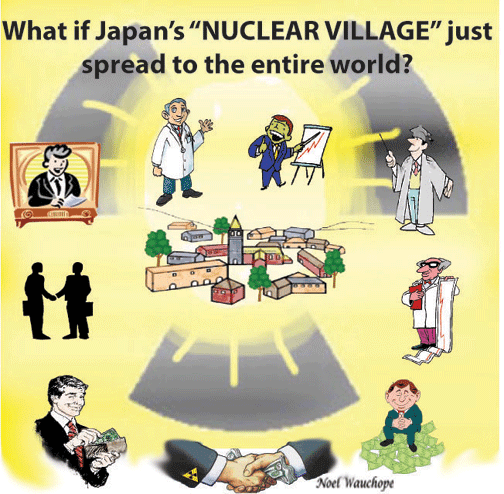
Japan’s ‘Nuclear Village’ still in control
Plutonium fever blossoms in Japan Cronyism, influence-buying and a stifling of dissenting voices have kept the Japanese nuclear industry going strong after the Fukushima disaster, critics say Center for Public Integrity By Douglas Birch R. Jeffrey SmithJake Adelstein 12 Mar TOKYO — When Taro Kono was growing up as the son of a major Japanese political party leader, he had what he calls a “fever for the atom.” Like many of his countrymen, he regarded nuclear power plants as his country’s ticket to postwar prosperity, a modern, economical way to meet huge energy needs on an island with few natural resources. pro-nuclear sentiment led Japan to build the world’s third largest fleet of nuclear reactors. Its officials spent more than two decades and $22 billion building a factory to create plutonium-based nuclear reactor fuel, the largest ever to be subject to international monitoring. The facility is slated for completion in October at Rokkasho on Japan’s northeast coast, kicking off a new phase in the country’s long-term plan to increase energy independence.
High Court rules: mining leases do not extinguish native title
Indigenous community hails High Court native title ruling http://www.sbs.com.au/news/article/2014/03/12/indigenous-community-hails-high-court-native-title-rulingThe High Court in Canberra has unanimously held that native title rights held by the Ngarla people in the Pilbara region of Western Australia are not extinguished by the grant of two mineral leases. SBS News, By Myles Morgan Source NITV News 12 Mar 14,
In a one page statement, The High Court of Canberra found the native title rights of the Ngarla people in Western Australia could exist alongside mining leases in the area.
“We’re very satisfied and very happy and jubilant on behalf of the Ngarla people who have obviously fought very hard to get this outcome,” said CEO of the Yamatji Marlpa Aboriginal Corporation, Simon Hawkins.
The dispute was concerned with land situated at the former iron-ore mine at Mount Goldsworthy, located over 1000 kilometres north of Perth in the state’s Pilbara region. The Ngarla people first went to court to claim native title over an area of 11,000 square kilometres in 1998.
Since then, it’s been a constant battle between the West Australian government, mining company BHP Billiton and the Ngarla people.
“Well this ends the matter so there’s nothing that they can do. So effectively, this is the law now and we were successful in challenging the state and others and now this is what everyone has to operate in,” said Mr Hawkins
Conflict of interest in mining regulation in Australia
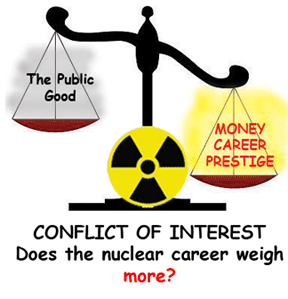 Dennis Matthews, 13 Mar 14, In Australia the mining industry and its so-called regulators have a history of not doing baseline studies before exploration and mining start. As a result we are usually unable to prove that pollution has increased.
Mining regulators are also the promoters of mining and therefore have a serious conflict of interest
EPA’s inadequate response to aquifer uranium contamination by CSG company Santos
Concerns raised over EPA response to aquifer uranium contamination by CSG company Santos ABC News The World Today By Tanya Nolan 12 Mar 14 Concerns have been raised over the failure of the New South Wales Environmental Protection Authority (EPA) to request follow-up tests from Santos after the contamination of an aquifer in the Pilliga forest.
The coal seam gas (CSG) company’s operations led to contamination of the aquifer in February, with the EPA fining Santos $1,500. Continue reading
Things just got even worse for Australian uranium miner Paladin
Uranium miner Paladin falls as Newmont sells 5.4% stake Mining.com,Cecilia Jamasmie | March 12, 2014 Shares in Paladin Energy Limited (ASX, TSX:PDN) fell over 5% in Australia after news broke one of the world’s largest gold producers Newmont Mining Corporation (NYSE:NEM) is selling its 5.4% stake in the uranium miner……At the time of acquisition the stake was valued at about $278 million, but Paladin’s share price was struck shortly after by the Fukushima nuclear disaster and has had a rocky time since then.http://www.mining.com/uranium-miner-paladin-falls-as-newmont-sells-5-4-stake-14330/
Uranium market to stay in the doldrums for the foreseeable future
 Hopes fade for Short Term Uranium Recovery 9 News 13 Mar 14,While the Japanese prime minister has recently reaffirmed the country’s commitment to nuclear energy after two years of market anticipation (and the third anniversary of the Fukushima disaster now passed), the reaffirmation has come across as more “motherhood” than suggesting any renewed urgency to speed up reactor restarts. The market’s mood may brighten when the first Japanese reactor does actually restart at some point this year, but until then there are no signs near term demand for uranium is about to pick up…….
Revolutionary system for solar energy in remote areas of Africa
 Renewable energy: Samsung introduces digital village concept GhanaWeb 12 Mar 13 Samsung Electronics is developing a concept that will make use of sunshine, which is an abundant natural resource in Africa, to change and improve the lives of inhabitants of rural communities in Africa.
The leading provider of digital solutions will use sunshine as a renewable source of energy in Africa to establish various facilities that can be operated through transportable solar-powered generators. Continue reading
1 This month

of the week – Australians for War Powers Reform (AWPR)
To see nuclear-related stories in greater depth and intensity
 Antinuclear