See NITV News story Minister for Indigenous Affairs snubs Aboriginal tradiational owners?
 Natalie Wasley, 20 march 14 Yesterday Dianne Stokes and Kylie Sambo from Muckaty were in Canberra for a
  series of meetings.They met Senator Rachel Siewert (Greens), NT Senator Nova Peris and Resources Minister Ian MacFarlane.
Despite a request to meet, Senator Nigel Scullion refused to meet the women, as well as turning down requests from delegations representing Maningrida, Central Land Council and the Northern Land Council Senator Scullion is one of only two NT Senators (Nova Peris being the other) and also Minister for Indigenous Affairs.
See NITV news story linked below-Intro on Muckaty i http://www.sbs.com.au/ondemand/video/199701571622/NITV-News-19-March-part-1
Doctors and Secondary College present Anzac Eve Peace Event: Melbourne
 ANZAC EVE PEACE EVENT Melbourne Thursday April 24th at 7pm After the war is over …
Kevin Foster academic, author: How the media shaped what we know about the war in Afghanistan.
Nouria Salehi biophysicist originally from Afghanistan: A civilian view of Afghanistan during and after war.
Peter Wigg psychiatrist: Why the Arms Trade Treaty matters.
Music: the Asylum Seeker Resource Centre, Brunswick Secondary College and the Home Brew Choir Poetry: performed by the students of Brunswick Secondary College
Followed by a light supper. Free entry: donations welcome. To book email: vicsec@mapw.org.au or call 9023 1958
Brunswick Secondary College Auditorium, Dawson Street, Brunswick (enter from Fallon Street)
Organised by the Medical Association for Prevention of War & Brunswick Secondary College
Australian Senate votes against repealing the carbon tax
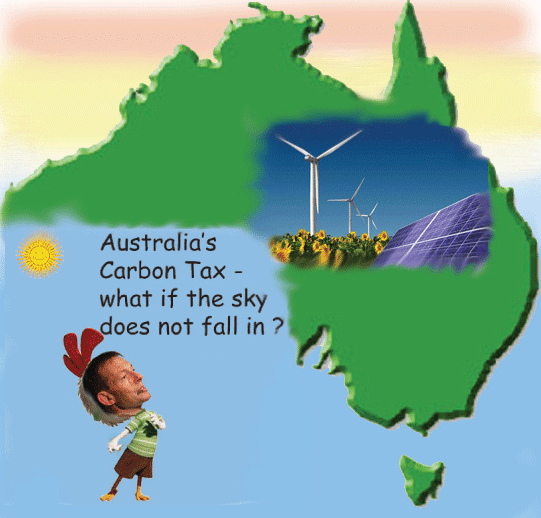 Senate votes to block carbon tax repeal legislation ABC News By political correspondent Emma Griffiths 20 March 14, The Senate has voted down legislation to axe the carbon tax – a core election promise of Prime Minister Tony Abbott.
After months of debate Labor and the Greens combined to vote against the repeal laws 33 votes to 29 today.Labor, which introduced the carbon pricing scheme in 2012, says the Coalition’s alternative policy to tackle climate change, called Direct Action, will be ineffective and too expensive.
“Without a credible alternative, Labor cannot support the abolition of the existing clean energy policies,” Opposition climate change spokesman Mark Butler said.Greens leader Christine Milne has issued a statement saying the current law, maintaining a price on carbon, must stand.”The Senate has rejected Tony Abbott’s do-nothing approach on global warming and voted to maintain the price on pollution,” she said.
The carbon pricing scheme was brought in by the Gillard Labor government, after extensive negotiations with the Greens, and currently charges polluters about $25 per tonne of carbon emissions……..
Earlier today, the Government had already reintroduced carbon tax-related legislation that could set the stage for a double dissolution election on the issue.The Coalition wants to axe the multi-billion-dollar Clean Energy Finance Corporation (CEFC) but the Senate rejected the legislation in December…….
The laws were brought back before Parliament this morning, and if voted down again would give the Government a trigger to call an election of both houses of Parliament……….http://www.abc.net.au/news/2014-03-20/senate-votes-to-block-carbon-tax-repeal-legislation/5334020
Australian Medical Association says wind farms do no cause adverse health effects
 AMA statement on wind power should reassure Australians says CEC http://www.renewableenergymagazine.com/article/ama-statement-on-wind-power-should-reassure-20140319 Robin WhitlockTuesday, 18 March 2014 The Australian Clean Energy Council (CEC) has welcomed a public statement by the Australian Medical Association dismissing claims of adverse health effects from wind turbinesThe CEC said that the AMA statement should provide additional peace of mind for communities living in the vicinity of existing or proposed wind power projects. CEC Policy Director Russell Marsh added that the AMA statement followed similar recommendations by health and acoustic bodies across Australia, to the effect that there is no evidence to link wind farms and adverse health effects.
“Other groups that have made positive statements on wind farm noise and health recently include the New South Wales and Victorian health departments, the South Australian Environmental Protection Agency and the Association of Australian Acoustical Consultants” said Mr Marsh. “The National Health and Medical Research Council, the national peak body for health research, also released a draft position statement several weeks ago that stated there was ‘no reliable or consistent evidence that proximity to wind farms or wind farm noise is directly associated with health effects’.”
Mr Marsh went on to report that no credible Australian health or acoustic organisations are opposing wind farms and that people should therefore feel reassured by that.
There has been a steady misinformation campaign in Australia over several years waged by those opposed to wind farms. This makes it even more important that developers of wind power projects should maintain good relations with the communities living in the vicinity of existing or proposed wind farms.
The CEC has now developed community engagement guidelines for wind farms in addition to a community expectations guide.
For additional information: Clean Energy Council (CEC) Community Engagement Guidelines
Japan starts a trend to a world awash with plutonium?
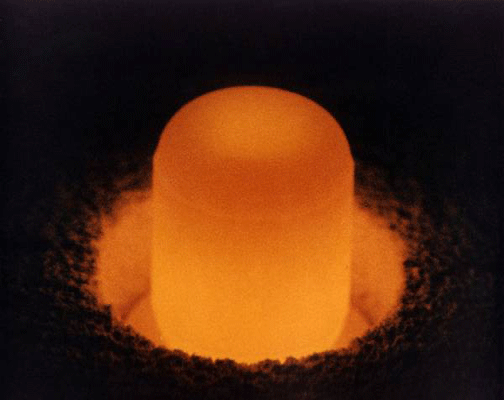 A World Awash in a Nuclear Explosive? TruthOut, 19 March 2014 12:24 By Douglas Birch and R. Jeffrey Smith, Center for Public Integrity | Report Washington — A generation after Three Mile Island and Chernobyl, the world is rediscovering the attractions of nuclear power to curb the warming pollution of carbon fuels. And so a new industry focused on plutonium-based nuclear fuel has begun to take shape in the far reaches of Asia, with ambitions to spread elsewhere — and some frightening implications, if Thomas Cochran is correct.
A Washington-based physicist and nuclear contrarian, Cochran helped kill a vast plutonium-based nuclear industrial complex back in the 1970s, and now he’s at it again — lecturing at symposia, standing up at official meetings, and confronting nuclear industry representatives with warnings about how commercializing plutonium will put the public at enormous risk.
Where the story ends isn’t clear. But the stakes are large.
 The impetus for Cochran’s urgent new campaign — supported by a growing cadre of arms control and proliferation experts — is a seemingly puzzling decision by Japan to ready a new $22 billion plutonium production plant for operation as early as October. Continue reading
China’s nuclear ambitions may be fading
Why China’s nuclear energy ambitions are falling flat http://qz.com/189731/why-chinas-nuclear-energy-ambitions-are-falling-flat/ By Lily Kuo @lilkuo March 19, 2014 At a time when other countries are scaling back their nuclear energy programs, China has been plowing ahead. Its largest nuclear energy companies are considering initial public offerings to raise over $2 billion, and Chinese researchers are racing to build the world’s first nuclear plant that runs on thorium. China’s nuclear reactors account for almost 40% of the world’s total. This year alone, the country plans to add 8.6 gigawatts of nuclear power capability—almost as much as the United Kingdom’s annual nuclear power capacity.
Thus, nuclear power’s contribution to China’s goal of reducing its reliance on coal—and, crucially, reducing the air pollution that is choking many of its major cities and contributing to global warming—is likely to be modest for decades to come.
Nuclear power has been underwhelming in China for many of the same reasons it has struggled elsewhere: it’s technically difficult, expensive, and resisted by parts of the public. Because nuclear power plants take so long to build, and China’s energy demands are imminent, other forms of renewable energy like wind and hydropower have taken precedence. (Nuclear reactors typically require at least six years to build, compared to around two years for geothermal power plants and just a few months for wind farms.)
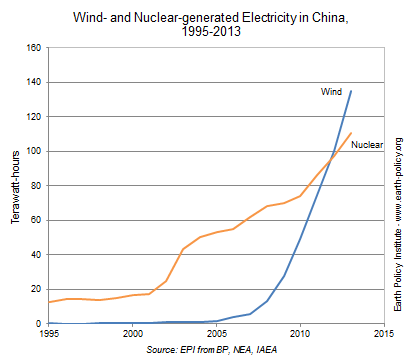
Engineering problems and delays are also a major culprit, and may prevent China from meeting its scaled-down nuclear power goals. As Grist points out, even if all Chinese nuclear capacity currently under construction were to become operational in the next six years, China would have reached only 45 gigawatts by 2020, well shy of its 58 gigawatts goal. Advanced plants that could bring higher efficiency, like a thorium reactor, will still require years of work to resolve engineering issues, researchers say.
Moreover, one of the benefits of nuclear power is that it can be installed close to where it is in demand—in contrast to wind and hydropower—lessening the distance that electricity has to travel along a power grid where some of the power is inevitably lost. But China is spending over 1 trillion yuan ($162.8 billion) to upgrade and expand its grid. As of last year, 84% of the country’s wind capacity was connected to the grid, from 72% in 2011, and the amount of wind-generated electricity wasted in transfer has fallen to 11% from 16% over the same period,according to Fitch Ratings.
Palmer United Party to the rescue of Australia’s Renewable Energy Target?
 Renewable Energy Target – Even Clive Palmer Gets It http://www.energymatters.com.au/index.php?main_page=news_article&article_id=4227 Australia’s renewable energy sector has perhaps found an unexpected ally in Clive Palmer and the Palmer United Party (PUP). After PUP’s WA candidate, Zhenya ‘Dio’ Wang, expressed support for the Renewable Energy Target to be left as is and labelled the controversial RET review a ”waste of taxpayers’ money”, Mr. Palmer backed Mr. Wang’s views and told Fairfax Media he was a supporter of renewable energy.
 Grassroots solar advocacy groups Solar Citizens applauded Mr. Wang’s public statement of support for the RET.
“Mr Wang’s media release of earlier today, which acknowledged the importance of the renewable energy target (RET) and the jobs it creates, is great news for all solar loving West Australians” said Lindsay Soutar, National Director of Solar Citizens.
“WA Senate candidates need to understand that West Australians want more renewable energy, and that’s why all parties should reveal their position on solar and the RET before Western Australians go to the polls.”
The Australian Solar Council also congratulated Palmer United Party (PUP) for pledging their support for the Renewable Energy Target to stay exactly as it is. “Politicians know Australians love solar because it cuts household power bills. They know that supporting the Renewable Energy Target at the Senate election will deliver them votes,” said Australian Solar Council Chief Executive John Grimes.
“Not supporting the Renewable Energy Target will cost them votes.”
The Council says it will be publishing a preliminary solar scorecard in The West Australian on March 22 to show where the various players stand on the issue of solar. It will also be engaging a substantial TV advertising campaign in the lead up to the WA Senate election.
“More than 12,000 Australians (1,200 West Australians) would lose their jobs if the Renewable Energy Target was axed”, said Mr Grimes.
Close to 150,000 households in Western Australia have installed solar panelsand many more have expressed and interest in doing so. Under the Renewable Energy Target, support is provided for the purchase of systems.
Glencore a company remarkable for worker deaths

Mining is work, not war, why 26 deaths? There is a remarkable, grim and thoroughly unacceptable statistic on page 16 of Glencore’s 2013 annual report. (subscribers only) Financial Review 19 Mar 14 http://www.afr.com/p/business/companies/mining_is_work_not_war_why_deaths_IfZFqnL7hltokyyJztjBUN
President Obama makes it easier for Americans to learn all about climate change

White House to introduce climate data website.
President Obama wants Americans to see how climate change will remake their own backyards and to make it as easy as opening a web-based app
http://www.dailyclimate.org/t/-4892843182917180297
Two important international stories
Radiation Damage at the Root of Chernobyl’s Ecosystems
Radiological damage to microbes near the site of the Chernobyl disaster has slowed the decomposition of fallen leaves and other plant matter in the area, according to a new study.
http://www.sciencedaily.com/releases/2014/03/140319124855.htm
1 This month
7 April – WEBINAR – Australia and the Doomsday Clock – Preventing nuclear war through NoFirstUse and other policies
Online | Tuesday April 7, 4:00-5:30pm, Australian Eastern Time / 8:00-9:30am Central Europe Time
– Access the registration link
15 April – Zoom –Nuclear Power is Not the Solution
Apr 15, 2026 01:00 AM in Canberra, Melbourne, Sydney

Join the International Physicians for the Prevention of Nuclear War (IPPNW) on Tuesday, April 14th for a timely webinar exploring the risks associated with nuclear power and challenging the myth that it offers a simple, safe, carbon-free solution to the climate crisis

21 April Webinar: No Nuclear Weapons in Australia
Start: 2026-04-21 18:00:00 UTC Canberra, Melbourne, Sydney (GMT+10:00)
End: 2026-04-21 19:30:00 UTC Canberra, Melbourne, Sydney (GMT+10:00)
Event Type: Virtual
A virtual link will be communicated before the event.
Host Contact Info: australia@icanw.org

of the week – Australians for War Powers Reform (AWPR)
To see nuclear-related stories in greater depth and intensity
 Antinuclear