Christina Macpherson 26 March 14, When are we going to wake up to the pro nuclear propaganda insidiously pervading our media and government?
THE AUSTRALIAN newspaper’s headline “Australia can take lead role to brighter safer nuclear future” (24/3/14) I was spared the details, as I do not pay up to read this nuclear/fossil fuel industry’s advertising brochure.
Bodies with vested, and not so vested interests are pushing away -especially with submissions for the Energy White Paper to come out in a few months.
The mainstream media would have us to believe that there’s a mad global rush for nuclear power, and that it’s not only our ethical duty to import the world’s radioactive trash, – but also – Oh My God – if we don’t import the world’s trash – why we might impede the global development of this wonderful nuclear industry!
Deloitte Access Economics analyst Chris Richardson says in today’s Financial Review “A focus on selling nuclear waste “storage” to global customers would remove one of the biggest barriers to nuclear power around the world.”
Bewdy, sez I – Let’s keep that barrier up.
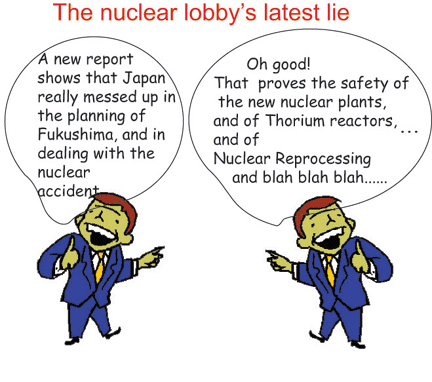
But more amusing to me is the constant propaganda for thorium nuclear reactors. Apart from ads “Thorium Replaces Uranium” – there are pro thorium tweeters saying “Thorium means the death of uranium”
Now how does that affect Australia’s much vaunted uranium industry? Oblivious to this Thorium push – we get headlines like this today from the Whyalla newspaper – ‘Uranium SA confident of future’
I have yet to see mainstream media in Australia cover things like:
USA’s radioactive trash crisis
UK’s nuclear costs crisis
And – well,it’s bad taste to mention this now – Japan’s Fukushima crisis
Children have been experiencing health effects already. As Paul said, it’s important not to jump to conclusions. But it’s hard to understand why, for example, that a teacher I personally know witnessed 50% of his class with noses bleeding at the same time. And this is a recurring thing that we hear, that children’s noses are bleeding a lot.
There have been respiration problems and immune system problems reported by some teachers and many families. This is coming from lots of different areas.
Fukushima Voice, Mar. 21, 2014: On March 4-7, 2014 […] international conference was held, 25 minutes outside of Frankfurt, on “Effects of Nuclear Disasters on Natural Environment and Human Health,” co-organized by the German chapter of the International Physicians for Prevention of Nuclear War (IPPNW) and the Protestant Church in Hesse and Nassau. Mako Oshidori, a Japanese comedienne and a freelance journalist, was part of the press conference on March 6, 2014. The Ustream video in Japanese can be found here […] Mako Oshidori was enrolled in the School of Life Sciences at Tottori University Faculty of Medicine for three years […] Mako Oshidori herself discovered a TEPCO memo telling officials to “cut Mako-chan(‘s question) short appropriately.”
Transcript of Oshidori’s presentation by Fukushima Voice, Transcription by Takashi Mizuno/Translation by @YuriHiranuma, Mar. 21, 2014: […] government agents began following me for surveillance. I heard about it from researchers who were my friends as well as some government officials. I will show you a photo I secretly took of the agent, so you know what sort of surveillance I mean. When I would talk to someone, a surveillance agent from the central government’s public police force would come very close, trying to eavesdrop on the conversation. […] I would like to talk a little about my interview of a nurse who used to work at Fukushima Daiichi nuclear power plant (NPP) after the accident. […] He was a nurse at Fukushima Daiichi NPP in 2012. He quit his job with TEPCO in 2013, and that’s when I interviewed him. As of now, there are multiple NPP workers who have died, but only the ones who died on the job are reported publicly. Some of them have died suddenly while off work, for instance, during the weekend or in their sleep, but none of their deaths are reported. Not only that, they are not included in the worker death count. For example, there are some workers who quit the job after a lot of radiation exposure, such as 50, 60 to 70 mSv, and end up dying a month later, but none of these deaths are either reported, or included in the death toll. This is the reality of the NPP workers.
Leaders issue $2bn challenge for Abbott PATRICIA KARVELAS THE AUSTRALIAN MARCH 25, 2014 INDIGENOUS Land Corporation chairwoman Dawn Casey has enlisted the support of the most powerful Aboriginal leaders to seek an emergency meeting with Tony Abbott to protect the $2 billion indigenous “land account”.
In an escalation of tensions between the government and ILC, the taxpayer-funded body has taken the unprecedented step of drafting its own bill that if passed into law would protect its funding from political tampering………
The land account and corporation were established after the High Court’s recognition of native title.
“More than 20 years on from the High Court’s Mabo decision and the passage of the Native Title Act, we want to remind Australians — particularly young people — that the land account was established as part of a national settlement that provided land-title certainty for all Australians,” Dr Casey said.
“The issues at stake are not just administrative arrangements, to be changed at the whim of a minister regardless of what political party.
Mining Lease Land Aboriginal Land Rights not DeleteBlog Cerdas Bumiputera 24 Mar 14,Aboriginal Society in Western Australia welcomes the decision of the Supreme Court of Australia , which states that the rights and mining activities could apply simultaneously. In other words , no mining lease land to remove the customary rights .
Bumiputera institution that represents citizens Ngarla in Western Australia said that the decision also affects the relationship between land rights and land leases for farms .
Chairman of the agency , Simon Hawkins , said that the State Government of Western Australia lost the appeal , and it is clear that the lease for mining activities and state-level approval will not abolish customary rights .
Astonishingly, the U.S. Department of Defense claims that no human cancer of any type has occurred as a result of exposure to either natural or depleted uranium. Additionally, numerous studies have been done claiming that there is no correlation – but how many of those studies were funded by the government?
VA Abandons Vets Suffering From Depleted Uranium Contamination Intellectual Conservative, BY RACHEL ALEXANDER, March 24, 2014“………After young and healthy Marine Matt Parker fought for his country in the Middle East, he mysteriously came down with tumors. Now, he finds himself without adequate help from the country he fought for….
Matt enlisted in the Marine Corps in 1994 at age 19. ……
His unit was tasked in part with arming Cobra helicopters in Kuwait with special 20mm rounds tipped in depleted uranium. No one instructed the Marines to wear gloves or protective clothing.
Labor’s victory in SA offers hope for a little energy sanityhttp://reneweconomy.com.au/2014/labors-victory-sa-offers-hope-little-energy-sanity-53302By Giles Parkinson on 24 March 2014 The surprise return of the Labor government in South Australia means that the book is not entirely closed on Australia’s mainland for renewable energy.Indeed, while the broad thrust of national renewable energy policy will be directed by the Abbott government, the return of the Jay Weatherill Labor government in Adelaide, the election of Mike Hodgman in Tasmania, and the ambition of the ACT Labor government means that there are some counters to the apparently ideologically-driven opposition to renewables in the Federal government.
As RenewEconomy has noted before, it is not by accident that the three states and territories most supportive of renewable energy in Australia are those with no, or relative weak, fossil fuel interests.
The ACT – which has no local coal or gas developments – has an ambitious 90 per cent renewable energy target by 2020. This will result in up to 550MW of wind, solar and other renewables being built over the next five years – whether the national renewable energy target stays in place.
The first 200MW of wind energy will be auctioned later this year, and another 50MW for a solar hub will follow next year. Like Victoria did a decade ago with its state-based target, the ACT is single-handedly underpinning the large-scale renewables target in Australia in the absence of a strong national policy – even if most of these developments will occur in NSW.
The main local fossil fuel interests – Alinta Energy’s two coal-fired generators at Port Augusta – are nearing the end of their life. One plant has been mothballed, the other works on a seasonal basis only. Local residents are pushing for a solar thermal and storage facility to be built, although nothing is likely to happen untilAlinta is sold by its private equity investors. Even the gas generators are taking a hit.
Tasmania may now be ruled by a conservative party for the first time in more than a decade, but new leader Will Hodgman has made it clear he will fight for the RETto be maintained as is. Tasmania sources around 90 per cent of its electricity from renewables, mostly hydro, but also with some new wind farms such as the Musselroe facility.
Its state owned electricity generator would suffer if the RET was removed or castrated, and the value of renewable energy certificates fell (they are already down nearly half in recent months since the appointment of Dick Warburton to head the RET Review). The state may still have ambitions of building new wind farms and a major link to the mainland, although it is not yet clear that Hodgman will pursue this.
Renewable energy insiders were pleased with the surprise result in South Australia. “It’s good news. Very good news,” said one.
The re-election of Labor means that the state is unlikely to follow in the footpath of Victoria in imposing draconian planning restrictions. However, any new developments, and there are several billion dollars of proposals – will depend both on the RET being maintained, and on new export capacity for those electrons being constructed.
The remaining states – WA, NSW, Queensland and Victoria – remain opposed to the RET. This is particularly the case for WA, NSW, and Queensland, which still have state-owned assets whose value and revenues are being eroded by renewable energy, and WA and Queensland have the added burden of having to heavily subsidise the delivery of electricity from their predominantly coal and gas-fired generators.
In Victoria, which has privatized its industry, the dynamics may be changing. The fire at Morwell near the Hazelwood brown coal generator has brought pollution issues to a critical level, and there are signs that the Napthine government may relax its opposition to the wind farms implemented by the previous premier Ted Baillieu. A state losing manufacturing industry can hardly afford to reject some $10 billion in potential renewable energy investment.
It is still a bleak outlook for the renewable energy industry across the country. But it hasn’t quite faded to black. And a positive result in the WA Senate re-run may offer more hope yet.
“The future of the Renewable Energy Target will be a key issue in the WA Senate election. From our questions to candidates, householders will know which candidates commit (to) help them reduce their power bills.”
Australian Solar Council Launches Save Solar TV Ad http://www.energymatters.com.au/index.php?main_page=news_article&article_id=4231The Australian Solar Council has launched its first ever TV and print advertising campaign as part of its efforts to save the nation’s Renewable Energy Target.
Timed to coincide with the lead-up to the election in Western Australia; the Save Solar campaign advertising underlines the importance of the Renewable Energy Target in relation to providing financial support for the installation of home solar power systems. Currently, the RET provides up to $3,450 subsidy on a 5kW solar power system. A solar panel system of this size is large enough to wipe out the power bills of an average Australian household.
If the RET is gutted, it would not only seriously impact on the affordability of systems; but also on solar jobs throughout Australia.
Elders declare Native Title deal “outrageous insult” Indigenous Times 24 March 14One of the most senior Elders of the Noongar peoples, Richard Wilkes has slammed the South West Aboriginal Land and Sea Council’s (SWALSC) role in the $1.3 billion Native Title negotiations with the Western Australian State Government.
Mr Wilkes said the SWALSC had degenerated from a representative body of the Noongar peoples to a “collaborative body with the government”.






 Antinuclear