Queensland’s Premier Newman breaks promise to keep ban on uranium mining
 No apology for dumping Uranium mining ban on 2nd anniversary of election of the Newman Government Mark Bailey Keep Queensland Nuclear Free 24 March 2014 http://www.mysunshinecoast.com.au/articles/article-display/no-apology-for-dumping-uranium-mining-ban-on-2nd-anniversary-of-election-of-the-newman-government,33604?utm_source=rss&utm_medium=rss&utm_campaign=MSC_Feed#.UzNVFahdV9U With the second anniversary of the Newman government this week, it is timely to note there has been no apology from Premier Newman for dumping his promise to Queenslanders before the last election to keep the ban on uranium mining in Queensland.
Premier Newman was explicit when he said;
“We have no plans and that’s as clear as I can be. The parliamentary team are very, very clear that we have no plans to develop any sort of uranium mines in Queensland.” ABC 16 Nov 2011
Yet, two years on there is less than 100 days left until dirty and dangerous uranium mines are made legal by the Newman government with approval power likely to be handed to them by the Abbott Federal Government.The safety record of uranium mining in Australia has been appalling with over 200 recorded safety incidents at Ranger mine, which is still shut down after a toxic spill last year of a million litres of radioactive slurry.
Not a single closed uranium mine in Australia has been successfully rehabilitated to this day with the last mine at Mary Kathleen a toxic mess to this day.
Queenslanders do not want the risk of radioactive contamination of their waterways, from truck accidents near their homes and schools and they certainly don’t want uranium being exported across the Great Barrier Reef.The Newman state government should suspend their dumping of the twenty-three year ban on uranium mining forthwith and conduct an independent enquiry into all implications of allowing uranium mining in our state so that communities, schools and existing industries can have their say in this far reaching decision.
The nuclear industry’s Thorium propaganda – a distant irrelevant dream
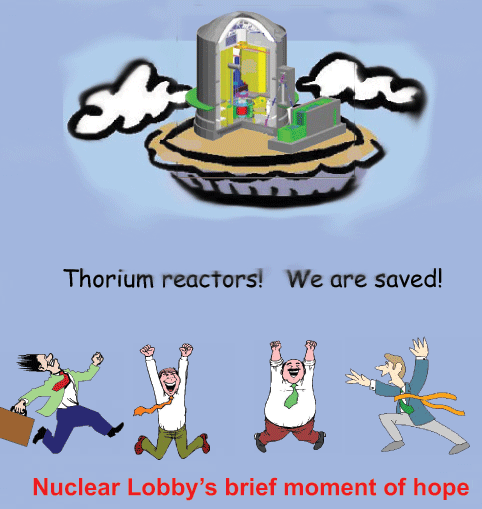 All in all, it rather looks like the nuclear industry, failing terribly to provide a reliable and affordable energy source, is trying to divert our attention from its scandals and incompetence to a distant, rosy dream. Not bad PR but not much else.
The mythologies of thorium and uranium http://funologist.org/2014/03/26/the-mythologies-of-thorium-and-uranium by Jan Beránek – March 24, 2014 Thorium and uranium represent the heaviest naturally occurring elements on Earth. Both were named after ancient gods: Uranus was the principal Greek god of the sky while Thor was the Norse (and broadly Germanic) god of a thunder.
There’s a modern mythology surrounding thorium and uranium too, such as the currently very popular suggestion that thorium can replace uranium and deliver much better (safer, cheaper, fuel abundant) nuclear energy.
Well, we’ve heard all these things from advocates of nuclear energy before, haven’t we? Weren’t we told in the 50’s, 60’s, 70’s, 80’s, 90’s and even until recently that all these miracles would actually be delivered by uranium fueled reactors? Yeah, something obviously went wrong because none of those dreams actually came true, despite half a century’s worth of effort and hundreds of billions in subsidies poured into the nuclear industry.
What are the chances that replacing the Greek god with a Germanic one will help? Would Thor take his powerful hammer and nail it all down? Not likely.
Thorium technology is in principal based on nuclear fission and therefore keeps fission’s inherent problems. While it partially addresses some of the downsides of current commercial reactors based on uranium (plutonium) fuel, such as limited reserves of uranium and unwanted production of plutonium and transuranic isotopes, it still has significant issues related to fuel mining and fabrication, reactor safety, production of dangerous waste, and the hazards of the proliferation of nuclear weapons.
Let’s look more closely at some of the hopeful claims around thorium.
Safer reactors? The risks inherent in nuclear reactors are due to the massive concentrations of radioactive materials and the huge amount of heat they produce (which is actually needed to generate electricity). No matter if the fuel is based on uranium or thorium, if it’s solid or liquid, this characteristic alone will inevitably continue to be the Achilles heel of any nuclear reactor.
As you can read in the Union of Concerned Scientists’ briefing on this issue, the truth is that the U.S. Department of Energy concluded in 2009 after a review that “the choice between uranium-based fuel and thorium-based fuel is seen basically as one of preference, with no fundamental difference in addressing the nuclear power issues [of waste management, proliferation risk, safety, security, economics, and sustainability].”
Less nuclear waste? It’s obvious that fission applied to different nuclear fuel results in a different composition of radioactive waste. But it’s still radioactive waste and whether the waste produced by thorium reactors is less problematic (because there’s no plutonium in it) remains a question. Spent thorium fuel still contains long-lived isotopes such as proactinium-231 (with a half-life 32,000 years which is even longer than plutonium Pu-239) which implies the need for long term management in timescales comparable to typical high level waste from uranium reactors. Not surprisingly, a chart published in Nuclear Engineering International magazine in November 2009 shows that the radiotoxicity of spent thorium fuel is actually higher than uranium spent fuel over the long term, ie after first 10,000 years:
No proliferation? Yes, thorium can’t itself be used to build nuclear weapons but it can’t be used directly as a nuclear fuel either. In fact, it has to be first converted into the fissile uranium isotope, U-233. That’s an isotope that is suitable for nuclear weapons. The US successfully detonated a nuclear bomb containing U-233 in 1955.
Even the UK Department of Energy and Climate Change commissioned a report which concluded in 2012 that the claims by thorium proponents who say that the radioactive chemical element makes it impossible to build a bomb from nuclear waste, leaves less hazardous waste than uranium reactors, and that it runs more efficiently, are “overstated”.
Thorium reactors exist only in blueprints and early experiments, which means there could be other issues not yet detected that would complicate their large scale implementation. In any case, this also means that it would take much longer than a decade before thorium reactors would potentially become available for a larger commercial deployment.
Recent studies, like the one published by the Norwegian thorium commission, while being supportive of the concept, also conclude that there are many uncertainties and problems related to it. It notes that Norwegian thorium reserves are of limited economic attractiveness compared to other sources; that accelerator-based reactors will be viable in the distant future at best; that thorium reactors would create nuclear waste problems; and that any of this will require massive international research.
Related to this is thorium’s unknown economic performance. Experts suggest that one of the key reasons why thorium reactors are not being developed is that they cannot compete economically with uranium fuel-based reactors, due to more complicated fuel fabrication and processing. And current pressurized water reactors are already uncompetitive. With investment costs of current reactor technology easily reaching 8,000 USD/kW of installed capacity, it is difficult to imagine that thorium reactors would be developed and built in foreseeable future.
All in all, it rather looks like the nuclear industry, failing terribly to provide a reliable and affordable energy source, is trying to divert our attention from its scandals and incompetence to a distant, rosy dream. Not bad PR but not much else.
While we are once again told to dream about a bright nuclear future, modern renewable energy technologies are already cheaper and upscaled well beyond nuclear: in 2013, while only 4,000 MW was globally installed in four single reactors, installations of wind and solar combined reached 80,000 MW. Those newly added capacities of wind and solar alone will generate, on an annual basis, as much electricity as twenty large reactors.
Let’s not get distracted. Let’s not waste even more time, money and brainpower on trying to make the impossible: a nuclear energy source that would actually really work. The future is renewable, and that’s where we need to go as quickly as possible.
Market prices for uranium – grim and getting grimmer
 Uranium Week: Another Broker Downgrades Price Forecasts Ninemsn-Mar 24, 2014 Only four transactions totalling 500,000lbs of U3O8 equivalent were conducted in the spot uranium market last week. Industry consultant TradeTech notes year to date volumes, at just 7.4mlbs, are down 32% on the same time last year. The ongoing lack of buyer urgency saw TradeTech’s spot price indicator fall another US15c to US$34.60/lb.
Critical to global demand-supply is the restart of Japanese reactors, progress in which has been slower than the broker expected.
So far 17 of Japan’s 44 idled reactors have applied to the regulator for restart,……
Brokers have long seen the first Japanese restarts as the impetus for the uranium market to overcome its malaise, but even with the first of these in sight a well supplied market has meant little price improvement.
As a result, Merrills has lowered its 2014 spot price forecast by 3.2% ….There were no transactions in the term market last week and TradeTech’s term price indicators remain unchanged at US$37.75/lb (mid) and US$50.00/lb (long)……..http://finance.ninemsn.com.au/article.aspx?id=8819579
Sickness amongst workers at Hanford radioactive waste site
 TV: 11 workers at U.S. nuclear site transported to medical facilities — Suffering nose bleeds, chest pains, coughing up blood — Multiple locations evacuated — Persistent symptoms “extremely unusual” — Workers: “The place is falling apart… serious problems out there” (VIDEO) http://enenews.com/tv-11-workers-at-u-s-nuclear-site-transported-to-medical-facilities-suffering-nose-bleeds-chest-pains-coughing-up-blood-multiple-locations-evacuated-persistant- KING 5 News Susannah Frame, Mar. 25, 2014: Hanford sources tell the KING 5 Investigators that at least 11 people have gotten sick in the last six days after breathing in toxic fumes while working near underground tanks holding hazardous nuclear waste. […] The first two workers to fall ill in the last week breathed in fumes that “tasted like copper” on Wednesday, March 19. […] both are still suffering effects of breathing in the vapors: headache, chest pain, difficulty breathing, nose bleeds and sore throats. One employee has coughed up blood. Sources who work in this area of Hanford tell KING […] this is “extremely unusual” to have symptoms persist this long. The next batch of employees to get sick breathed in fumes today, Tuesday, March 25. Four WRPS employees breathed in vapors at 9:00 am and were immediately transported to a medical facility […] the tank farm, identified as AY-AZ farm was evacuated […] Immediately afterward two employees from what’s known as the industrial hygiene department of WRPS [Washington River Protection Solutions], who monitor chemical exposures, were sent out to investigate and they too, had reactions to the fumes and were transported to the onsite medical facility. […] Sources tell KING 5 that three additional employees got sick from ingesting fumes later on Tuesday. TheseWRPS employees were working in a different portion of the tank farm […] about 8 to 10 miles from the AY-AZ farm. That location was also deemed a Vapor Control Zone and was evacuated. Sources say two were transported to the hospital by ambulance and one was transported to the HPMC.
Australia losing $1 Billion in Projects because of Review of Renewable Energy Target
$1 Billion in Projects Stalled by Renewable Energy Review Sourceable, 26 March 14, Uncertainty surrounding the Renewable Energy Target has left nearly $1 billion in wind and solar projects in limbo as developers await the outcome of the Coalition government’s review. – Spanish wind power firm Acciona has announced that it has placed three projects in Victoria with a collective value of $750 million on hold due to concerns over the fate of the Renewable Energy Target (RET), which is currently under review by the government. – ……
David Green, chief of the Clean Energy Council, said worries of sovereign risk in relation to government policy is on the rise amongst foreign investors, a factor which could seriously compromise the growth of Australia’s renewable energy sector given the prominent role of overseas players.
According to members of industry, the total value of projects which have been temporarily shelved as a result of the RET review could be as high as $1 billion in total.
-The RET review was announced in February, with the ostensible purpose of investigating the impact of clean energy on retail power prices.At the time that the review was launched, however, the ABC quoted a senior member of the Liberal Party as saying it would help provide the Coalition government with the “cover” they needed to “kill the RET,” with the appointment of climate change skeptic Dick Warburton to the head the study…….http://sourceable.net/1bn-in-projects-stalled-by-renewable-energy-review/
–
Nuclear waste facility in New Mexico radioactively contaminated beyond further use
 Radiation Expert: 5 types of plutonium were released from WIPP; Officials not informing public — Caldicott: “I predict that facility will never be able to be used again”; Inhaling a millionth of a gram of plutonium will induce lung cancer (AUDIO) http://enenews.com/radiation-expert-5-types-of-plutonium-were-released-from-wipp-officials-not-informing-public-caldicott-i-predict-that-facility-will-never-be-able-to-be-used-again-inhaling-a-millionth-of-a?utm_source=feedburner&utm_medium=email&utm_campaign=Feed%3A+EN
KUNM, Mar. 24, 2014: The director of an organization that evaluated the WIPP site for over 25 years said officials aren’t doing enough to inform New Mexicans. […] “I just can’t stress the importance of DOE being available to respond to detailed questions that people have,” [Dr. Bob Neill] said. “There’s no substitute for direct communication.” Immediately after the leak was discovered, the public should have been given a detailed explanation of what was released, said Dr. Neill, who received his degree in radiological medicine. Americium 241 and plutonium 239 were mentioned. “But there are four other radio-isotopes of plutonium, namely the 238, 240, the beta and 241,” he said. “They’re all bone-seekers. So you want to be able to report all the values—how each one may have contributed. It’s just essential.” […] “It’s so important to answer people’s questions—and not just people in Carlsbad, but throughout the state and elsewhere,” he said. As for the leak itself, he said all of the possible causes of the failure at WIPP must be considered, and a response system should be designed accordingly.
Interview with Dr. Helen Caldicott,, March 2014 ): One of the repositories for very, very dangerous radioactive waste plutonium, americium, etc. has just leaked radiation all around the area in Carlsbad, New Mexico. One microgram of plutonium, a millionth of a gram of plutonium, if inhaled will induce lung cancer. It’s extraordinarily radioactive. So they thought this would be safe storing radiation in salt mines, but something happened, one of the casks blew up or part of the ceiling fell on the casks, we do not know. But I predict that that facility will never be able to be used again, it will be so contaminated.
Tony Abbott’s ‘Direct Action’ ineffective as a curb on carbon emissions
 Direct Action subsidies: wrong way, Abbott, go back
Crikey, FRANK JOTZO AND PAUL BURKE | MAR 25, 2014 Nothing has happened since the election to challenge the view that the Coalition’s Direct Action plan for carbon reduction is vastly inferior to carbon pricing, write economists Frank Jotzoand Paul Burk at INSIDE STORY. Direct Action is often perceived as an exercise in keeping up appearances: a fig-leaf policy from a government that has expressed little enthusiasm for serious action on climate change. But with the possible neutering of the Renewable Energy Target, Direct Action subsidies are set to be the main pillar of Australia’s climate change mitigation effort as well as a new drain on our scarce fiscal resources.
The cornerstone of Direct Action is a system of subsidies for emissions-reducing projects, channelled through an Emissions Reduction Fund. In a nutshell, government will pay companies to implement specific projects that are thought to reduce emissions. It will “buy up the cost curve”, purchasing the lowest-cost emissions reductions first.
Not much more detail is available about the policy than was sketched before the election. The government’s December 2013 green paper leaves many of the most crucial questions open, including how baselines would be set, whether there would be a penalty for companies that exceed their baselines, and whether projects in all parts of the economy would compete directly or there would be separate pots of money for sectors such as agriculture, forestry and industrial energy efficiency.
The consultation process is under way and will no doubt reveal the competing interests of different groups. It is also no foregone conclusion that the Senate will vote in favour of the scheme.
When examined under a bright light — as we have done so inour submissions to the recent Senate inquiry on Direct Action — Direct Action doesn’t hold up at all well. Yes, it’s an attractive political phrase, the combination of two very positive-sounding words. Yes, the Coalition’s negative strategy surrounding carbon pricing has been politically successful. But as a piece of public policy for use in achieving either short- or long-term emissions reduction goals, Direct Action is fundamentally flawed.
From an economic point of view, the first weakness of Direct Action is that, unlike carbon pricing, it doesn’t offer the potential to pick all of the “lowest hanging” emissions reduction opportunities….. http://www.crikey.com.au/2014/03/25/direct-action-subsidies-wrong-way-abbott-go-back/
Fukushima radiation data withheld. True levels much higher
 Inside Source: Gov’t officials are withholding Fukushima radiation data — Levels much higher than expected — Releasing numbers would “have a huge impact” — Over 2,000 millisieverts per year where residents are being encouraged to return http://enenews.com/inside-source-govt-officials-are-withholding-fukushima-radiation-data-levels-much-higher-than-expected-releasing-numbers-would-have-a-huge-impact-over-2000-millisieverts-per-year-wher?utm_source=feedburner&utm_medium=email&utm_campaign=Feed%3A+ENENews+%28Energy+News%29
Mainichi,Mar. 25, 2014: A Cabinet Office team has delayed the release of radiation measurements from three Fukushima Prefecture municipalities, and plans to release them later with lower, recalculated results, the Mainichi learned on March 24. […] According to one source, the original measurements were higher than expected, prompting the Cabinet Office team […] to hold the results back over worries they would discourage residents from returning. The Mainichi has acquired documents drawn up in November last year detailing the radiation measurements and intended for release. The documents, however, were never made public. According to this and other sources, the measurements were taken in September last year in the city of Tamura’s Miyakoji district, the village of Kawauchi and the village of Iitate […] According to an inside source, the Cabinet Office team had noticed that measurements taken with older dosimeters distributed by Fukushima Prefecture municipalities to residents showed radiation measurements much lower than those recorded by aerial surveys. The Cabinet Office team had planned to release the latest measurements […] putting special emphasis on how low the figures were. The new results, however, were significantly higher than expected, with the largest gap coming in Kawauchi. There, the Cabinet Office team had predicted radiation doses of 1-2 millisieverts per day, but the data showed doses at between 2.6 and 6.6 millisieverts. Cabinet Office team members apparently said that the numbers would “have a huge impact” […] and release of the results was put off. At the request of the Cabinet Office team, the JAEA and NIRS then recalculated the results by ditching the assumption that people would be outside eight hours a day […] Under these new assumptions, a farmer was now expected to spend around six hours a day outdoors.
Atsuo Tamura, official on the Cabinet Office team: “We did not hold the results back because they were too high. We did so because it was necessary to look into whether the assumptions for residents’ lifestyle patterns matched reality.”
Shinzo Kimura, associate professor of radiation and hygiene at Dokkyo Medical University: “The assumption of eight hours a day outside, 16 hours inside is commonly used, and it is strange to change it. I can’t see it as anything but them fiddling with the numbers to make them come out as they wanted.”
It’s a MYTH that We Need Fossil Fuel Or Nuclear
 Replacing Fossil Fuel and Nuclear Power with Renewable Energy: Wind, Solar and Hydro Power http://www.globalresearch.ca/replacing-fossil-fuel-and-nuclear-
 power-with-renewable-energy-wind-solar-and-hydro-power/5375036?utm_source=rss&utm_medium=rss&utm_campaign=replacing-fossil-fuel-and-nuclear-power-with-renewable-energy-wind-solar-and-hydro-power
We Could Power All 50 States With Wind, Solar and Hydro By Washington’s Blog Global Research, March 24, 2014 It’s a MYTH that We Need Fossil Fuel Or Nuclear
The big oil, gas, coal and nuclear companies claim that we need those energy sources in order to power America.
Good news: it’s a myth.
Mark Diesendorf – Associate Professor and Deputy Director, Institute of Environmental Studies, UNSW at the University of New South Wales –notes:
The deniers and scoffers repeatedly utter the simplistic myth that renewable energy is intermittent and therefore cannot generate base-load (that is, 24-hour) power.
Detailed computer simulations, backed up with actual experience with wind power overseas, show that the scoffers are wrong. Several countries, including Australia with its huge renewable energy resources, could make the necessary transition to an electricity generation system comprising 100 per cent renewable energy over a few decades.
Feasibility has been established by computer simulations of electricity generation systems by several research groups around the world, including my own …
Diesendorf gave an update earlier this month:
Ben Elliston, Iain MacGill and I have performed thousands of computer simulations of 100% renewable electricity in the National Electricity Market(NEM), using actual hourly data on electricity demand, wind and solar power for 2010.
Our latest research, available here and reported here, finds that generating systems comprising a mix of different commercially available renewable energy technologies, located on geographically dispersed sites, do not need base load power stations to achieve the same reliability as fossil-fuelled systems.
The old myth was based on the incorrect assumption that base load demand can only be supplied by base load power stations; for example, coal in Australia and nuclear in France. However, the mix of renewable energy technologies in our computer model, which has no base load power stations, easily supplies base load demand.
Similarly, Dr. Mark Jacobson – the head of Stanford University’s Atmosphere and Energy Program, who has written numerous books and hundreds of scientific papers on climate and energy, and testified before Congress numerous times on those issues – has run a series of computer simulations based on actual historical energy usage data.
Jacobson found that the U.S. can meet all of its energy needs with a mix of wind, solar and hydropower.
The difference between a failed alternative energy pipe dream and a viable alternative energy strategy is in having the right mix … and that takes sophisticated computer simulations using historical data. Jacobson’s study started several years ago by matching California’s historical power demand with available wind, solar and other renewable energy sources:…….
Jacobson also shows that the wind-water-sun combination would actually reduce electrical consumption (because it is more efficient than fossil fuels or nuclear):
And he shows that the wind-water-solar combination is superior to nuclear, “clean” coal, natural gas and biofuels. As one example, Jacobson notes that it takes at least 11 years to permit and build a nuclear plant, whereas it takes less than half that time to fire up a wind or solar farm. Between the application for a nuclear plant and flipping the switch, power is provided by conventional energy sources … currently 55-65% coal. Nuclear also puts out much more pollution (including much more CO2) than windpower, and 1.5% of all the nuclear plants built have melted down. More information here, here and here.
A banker for one of the world’s biggest banks also notes that switching to alternative energyprovides certainty in energy pricing … and is usually a less expensive source of energy when long-term costs are factored in.
So why haven’t we switched? As David Letterman noted when interviewing Jacobson, the main hurdle to switching from fossil fuels and nuclear is simply that the big fossil fuel and nuclear companies would lose a lot of money, so they’re fighting tooth and nail to keep the status quo.
Read our recent interview with Dr. Jacobson on a related topic.
And note that decentralizing power supplies is arguably key to protecting against terrorism, fascism and destruction of our health, environment and economy.
Australia’s regressive politics – rejected in South Australia?
De nnis Matthews, 26 March 14, Is it possible that South Australians are smarter than the average voter? The results of the state election would seem to support this proposition.
Just when it seemed that there would be a change of government many voters decided that they would rather stay with the devil they know. Signals from Canberra that the former liberal party, which in recent decades has become the conservative party, was now becoming the regressive party did not go unnoticed.
It appears that regressive politics is being foisted on everyday life with the new political correctness being intolerance, rudeness, and downright bigotry. This may work in political circles but is it the way a civilized society should behave?
Should politicians take their lead from decent citizens or should we follow the example of those in the houses of parliament?
The answer to this question may well shape Australia’s future.
1 This month
15 April – Zoom –Nuclear Power is Not the Solution
Apr 15, 2026 01:00 AM in Canberra, Melbourne, Sydney

Join the International Physicians for the Prevention of Nuclear War (IPPNW) on Tuesday, April 14th for a timely webinar exploring the risks associated with nuclear power and challenging the myth that it offers a simple, safe, carbon-free solution to the climate crisis

21 April Webinar: No Nuclear Weapons in Australia
Start: 2026-04-21 18:00:00 UTC Canberra, Melbourne, Sydney (GMT+10:00)
End: 2026-04-21 19:30:00 UTC Canberra, Melbourne, Sydney (GMT+10:00)
Event Type: Virtual
A virtual link will be communicated before the event.
Host Contact Info: australia@icanw.org

of the week – Australians for War Powers Reform (AWPR)
To see nuclear-related stories in greater depth and intensity
 Antinuclear