Podcast: Radioactive Show : Anti-Nuclear Struggles of India
 Anti-Nuclear Struggles of India http://www.3cr.org.au/podcast 29 March 14
Part One of Two
Two special shows explore the anti-nuclear movement in India and its connections to the export of Australian uranium. In Part One we speak with Achin Vanaik of the Coalition for Nuclear Disarmament and Peace, Kumar Sundaram, a prolific organiser and Bhargavi Dilipkumar from People for Social Action. All recordings undertaken while on a learning trip to India, connecting the movements across aspirational nuclear-free borders.
The Thorium Nuclear Reactor Dream
Clamping down on tweets Mar 26th 2014, by Economist.com Thorium the wonder fuel of Tomorrowland by Oliver Morton HOW the Doppler effect helped locate the likely remains of MH370, why thorium will not be the fuel of tomorrow and how Turkey (tried to) shut Twitter down

35 years later – they are still lying about the Three Mile Island nuclear accident
Three Mile Island – 35 years on http://www.theecologist.org/News/news_analysis/2334940/three_mile_island_35_years_on.html Linda Pentz Gunter 28th March 2014 Thirty-five years ago today the USA had its worst ever civilian nuclear accident with a reactor meltdown at Three Mile Island. Linda Pentz Gunter reports on the lies and cover ups about the true scale of the radiation release and its impacts on human health. Today marks 35 years since the meltdown at Unit 2 of the Three Mile Island (TMI) nuclear power plant near Harrisburg, Pennsylvania. Despite the long passage of time, myths and misinformation about the disaster still abound. Many questions may remain permanently unanswered.
The consequences of the TMI disaster were made more serious because, early on, emergency planning officials were repeatedly misinformed about the disaster’s progression and kept in the dark about the need for public protective actions.
Ironically, despite today’s popular ‘too much information’ shorthand, TMI is a story of ‘too little information’. What the public believes about TMI is far removed from what really happened. Continue reading
Don’t invest in or work for BHP or Rio Tinto – Don Henry
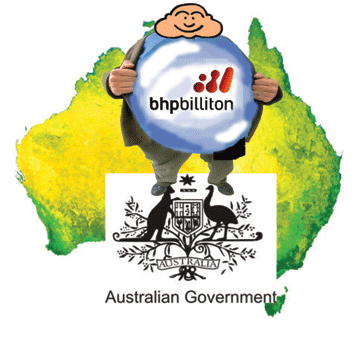 Australian Conservation Foundation outgoing head Don Henry calls on people to monitor big business, The Age, March 29, 2014 Tom Arup The outgoing head of the Australian Conservation Foundation, Don Henry, has urged people not to invest in or work for big businesses – including mining giants BHP and Rio Tinto – he says are pushing to bring down Australia’s climate change laws.
On Monday Mr Henry will step down as the foundation’s chief executive after almost 16 years. In an interview with Fairfax Media this week he accused a section of big business, and their lobby groups, of driving the Abbott government’s repeal of the national carbon price and other policies, saying ”Australians shouldn’t have a bar of it”.
Mr Henry specifically pointed to mining giants BHP and Rio Tinto. He said they were large members of industry bodies, such as the Minerals Council of Australia, that are pushing repeal of what he said was the most cost-effective way to cut emissions – carbon pricing.
”Let’s not be stupid here, they are very influential on our politics. Governments in Australia, both Coalition and Labor, listen closely to business,” he said. ‘Don’t watch the Prime Minister here, you should follow the BHPs, the Rio Tintos and other major actors. And you should start having a discussion with them. If you are shareholder in Rio or BHP do you really want to give licence to actions that are clearly against Australia’s well-being?”
He decried their position as ”short-termism”, focused only on boosting quarterly profit results. They are ignoring the erosion in their public standing and social licence caused by their position on climate, he says……http://www.theage.com.au/environment/australian-conservation-foundation-outgoing-head-don-henry-calls-on-people-to-monitor-big-business-20140328-35o7n.html
Play safe with WiFi technology – it might be harmful to health
Waves of uncertainty over wi-fi Stuff.co.nz 29 March 14“……..CUT BACK ON YOUR EXPOSURE
MOBILES AND DEVICES
Before buying a cellphone or internet-capable device, check out its SAR (specific absorption rate) rating – though in New Zealand you’ll likely have to go online for this information. The SAR measures how much the device’s emissions are absorbed by the body. Lower ratings indicate lower absorption.
Ensure your mobile has flight mode and use this as often as you can, including overnight, and when carrying it close to your body.
For long computing tasks, select a wired desktop or plugged-in laptop, rather than a wireless tablet.
Avoid holding a laptop or device on your lap or stomach – use a table instead, unless it’s in flight mode.
When you can, choose a text over a call. Keep phone calls to a minimum or use a hands-free kit.
Keep calls to a minimum where reception is bad – when a mobile is far from a cell tower, it has to boost its signal to connect.
Choose a wired mouse and keyboard.

CORDLESS PHONES
If possible, choose corded devices, or purchase one with speaker-phone capabilities.
Keep the main transmitting base of the cordless phone away from bedrooms and desks.
Keep calls short.
WI-FI
When installing a transmitting unit, ask for it to be put up high, such as on the wall or a shelf, away from bedrooms or where people sit.
Only turn the system on when you’re using it. Make sure the router is turned off overnight, especially.
Choose software on a laptop rather than cloud-computing technology such as Google Docs, if you’re using wi-fi. Typing in a Google Docs word processing means a wi-fi signal is sent with every single keystroke.http://www.stuff.co.nz/dominion-post/news/9882716/Waves-of-uncertainty-over-wi-fi
Intergovernmental Panel on Climate Change; how does it work?
 Explainer: how are IPCC reports written? , The Conversation, 29 March 14 David Karoly, Professor of Atmospheric Science at University of Melbourne This week in Yokohama, Japan, a group of scientists and representatives of more than 120 governments are meeting to approve the report Climate Change 2014: Impacts, Adaptation and Vulnerability. They will also agree on its Summary for Policymakers – an arduous process of negotiation and line-by-line approval. On Monday they will release it to the media and public.
This is the second part of the Assessment Report of the IPCC. It follows last September’s release of the first part, Climate Change 2013: The Physical Science Basis.
The IPCC was established in 1988 to undertake comprehensive assessments of the scientific basis of climate change and the impacts and future risks to different sectors and regions. It also assesses the options for adapting to these impacts, and opportunities to mitigate climate change.
The IPCC is the accepted global authority on climate change. A recent explainer on The Conversation has described the structure of the IPCC and how it works.
It has three “Working Groups”: one on Climate Change Science; one on Impacts, Adaptation and Vulnerability; and one that deals with Mitigation of Climate Change. They work together to prepare comprehensive Assessment Reports roughly once every six years. The IPCC Third Assessment Report was released in 2001 and the Fourth Assessment Report in 2007.
Now we are in the middle of the release of the various parts of the Fifth Assessment Report, one from each Working Group and finally the Synthesis Report, to be released later this year.
 How are the reports written?

The IPCC assessments are written by hundreds of leading scientists who volunteer their time. They undertake comprehensive assessments of the scientific literature across a very wide range of topics relevant to climate change. The reports are required to present policy-relevant information, but it must be presented in a policy-neutral manner, so there are no recommendations in any IPCC assessment.
Each part of the report goes through three stages of drafting and review by experts and governments. All review comments and the responses from the authors on how they addressed the comments are made public. This review process is more open and comprehensive than for any other scientific publication or assessment, including the peer-reviewed science publications on which the reports are based.
The final stage, the approval of the Summary for Policymakers, is often misunderstood. The government representatives go through the final draft line by line, seeking to ensure that the text is scientifically accurate, that any uncertainties are carefully explained, and that the language is as clear as possible. The authors of the chapters ensure their scientific accuracy and can veto any text that they consider to be inaccurate. Every line is approved by consensus by the representatives of all the governments present. It takes a long time.
A very helpful explainer on how to read an IPCC report was published on The Conversation last September.http://theconversation.com/explainer-how-are-ipcc-reports-written-24641
Don’t knock Earth Hour: it awakens people to Climate Change action
 Why on Earth are supposed environmentalists knocking Anna Rose and Earth Hour?
Earth Hour: a reminder to re-activate Australia’s drive for action on Climate Change
 Earth Hour matters in fight for Great Barrier Reef March 27, 2014 SMH, Anna Rose
On Saturday at 8.30pm, millions of Australians will join over a billion people in 154 countries to make a stand for our climate by turning off their lights for an hour.
It’s a small gesture. Given the scale of the crisis facing our climate, one hour of awareness certainly isn’t enough. But Earth Hour does prove that the citizens of the world can unite around the climate change cause – even if just for an hour.
This global movement has never been more needed, as we expect the Intergovernmental Panel on Climate Change to make very clear when they release their much-anticipated report into climate impacts on Monday.
Earth Hour was founded in Australia, and support has remained strong. Volunteers will hold over a thousand Earth Hour events on Saturday, including at the Prime Minister’s favourite beach in Manly, to highlight the urgent threat our Great Barrier Reef faces from rising temperatures…….
modelling shows it’s extremely unlikely that the amount of funding put aside by the federal government to cover the costs of paying polluters will be enough to reach Australia’s emission reduction target of 5 per cent by 2020. If we can’t even reach a 5 per cent target, how are we going to reach the higher targets that scientists say are needed to protect the reef?
For these reasons, the Clean Energy Finance Corporation – the government financing body tasked with speeding up the transition to renewables, has been very cautious about “direct action”. Earlier this year, they warned ”direct action” would only have a chance of working if it was combined with other policies around renewable energy – policies that the Prime Minister has already signalled might be wound back.
Earth Hour was founded in Australia on the principle that no one can do everything but everyone can do something. It would be ironic if the country that started the biggest global movement on climate change in history was the first country to wind back effective climate change policies…….http://www.smh.com.au/comment/earth-hour-matters-in-fight-for-great-barrier-reef-20140327-zqnow.html

Abbott would make it open slather for public racial bigotry
 Locked in a war of words to define free speech, SMH, March 29, 2014 Gay Alcorn “………-At the centre of debate is section 18C of the Racial Discrimination Act, which makes it unlawful to do an act publicly that is likely to ”offend, insult, humiliate or intimidate” on the basis of race or ethnic origin. You can do all those things but still be protected if your action was done reasonably and in good faith, and if it’s an artistic, academic or scientific work, or part of a debate in the public interest. It’s a civil, not a criminal, provision – there are no convictions for breaching the act, and remedies are often apologies or small payments.
Electromagnetic (non-ionising) radiation might not be safe and healthy
The uncertainty around the radiation’s effect should mean we treat the technologies using it with kid gloves rather than abandon, Monash University radiation researcher Mary Redmayne said.
The Melbourne-based scientist said there was not enough research for us to know what a safe level of exposure was…… She said young people have thinner skulls, and the brain’s protective defences – a protein that covers nerve cells called myelin – were only fully developed in middle age. This combination meant children’s brains were poorly insulated from outside interference, such as radiation.
Waves of uncertainty over wi-fi Stuff.co.nz 29 March 14, After thousands of studies, the most that experts worldwide can determine is the radiation used for wi-fi networks, digital devices, cordless phones and cell phones is a “possible” cause of cancer. With such uncertainty, OLIVIA WANNAN asks if we are using this technology with enough caution. Continue reading
30.000 Germans march in support of renewable energy, and against nuclear and fracking
 24 March 2014 by Sara Knight GERMANY: As the German government comes close to completing its draft for a new Renewable Energy Act, intended to be implemented as soon as August, demonstrations in support of wind and renewables continue. Around 30,000 people took to the streets in seven major German cities to show their support for renewable energies and opposition against coal, nuclear and gas fracking on 22 March, reported environment and nature protection organisation Bund on the same day……..http://www.windpowermonthly.com/article/1286689/german-wind-protests-continue
Climate Change – What is being discussed in Yokohama?
Explainer: how are IPCC reports written? , The Conversation, 29 March 14 David Karoly, Professor of Atmospheric Science at University of Melbourne #………This week, the IPCC has been meeting to approve the second part of its Fifth Assessment Report – the volume that covers “Impacts, Adaptation and Vulnerability”. This assesses the impacts of climate change and vulnerabilities to these impacts, as well as options for how we can adapt to minimize the impacts.
It considers a wider range of sectors than previous reports, as well as more regions of the globe. This means that this Impacts Assessment has twice as many chapters and is nearly twice as long as the previous IPCC Working Group 2 report in 2007.
The different sectors include water resources, terrestrial, coastal and ocean systems, food production, urban and rural areas, human health and human security, as well as approaches to adaptation and multi-sector risks and vulnerabilities. The regions include each of the continents, plus the poles, small islands, and the oceans.
The IPCC has worked hard to include a broader and more representative group as authors. Working Group 2’s writing team consists of 310 scientists from 73 countries, divided into Coordinating Lead Authors, Lead Authors and Review Editors. Most have not previously been involved in any of these roles in the past decade. Some 40% of the writing team come from developing countries and economies in transition.
When the report comes out on Monday, make sure to read its Summary for Policymakers (as well as The Conversation’s IPCC coverage).http://theconversation.com/explainer-how-are-ipcc-reports-written-24641
‘Lights Out for the Reef’ – TV Channel 10 – 4.30 p.m. Saturday 29 March
 http://earthhour.org.au/doco/ On Saturday 29th March you’ll have the opportunity to watch the world premier of the Earth Hour documentary Lights Out for the Reef. Two of Australia’s most famous YouTube sensations, Natalie Tran (community channel) and The Axis of Awesome, are sent on a mission by Dr Karl to travel to the Great Barrier Reef to find out how it can be saved from climate change, and how we can all help. Axis write a rock song about coral, while Nat falls in love with a baby turtle.

Lights Out for the Reef uses humour to carry a very important message: climate change happening right now and affecting one of Australia’s most loved natural icons: our Great Barrier Reef. Lights Out for the Reef was filmed on location at the Great Barrier Reef. It will be screened on Network TEN at 4.30pm and is available for Earth Hour event hosts once you register your event. Simply register here and we’ll make sure you get a copy to show your friends and family this Saturday.
1 This month
15 April – Zoom –Nuclear Power is Not the Solution
Apr 15, 2026 01:00 AM in Canberra, Melbourne, Sydney

Join the International Physicians for the Prevention of Nuclear War (IPPNW) on Tuesday, April 14th for a timely webinar exploring the risks associated with nuclear power and challenging the myth that it offers a simple, safe, carbon-free solution to the climate crisis

21 April Webinar: No Nuclear Weapons in Australia
Start: 2026-04-21 18:00:00 UTC Canberra, Melbourne, Sydney (GMT+10:00)
End: 2026-04-21 19:30:00 UTC Canberra, Melbourne, Sydney (GMT+10:00)
Event Type: Virtual
A virtual link will be communicated before the event.
Host Contact Info: australia@icanw.org

of the week – Australians for War Powers Reform (AWPR)
To see nuclear-related stories in greater depth and intensity
 Antinuclear