Australia is a “canary in a cage” when it comes to climate change
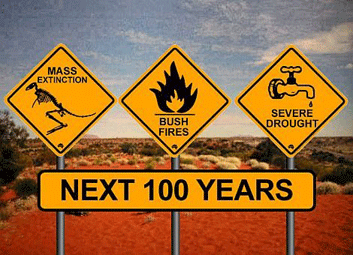 Climate change could be putting human health at risk: Australian IPCC report researchers ABC News, By Carl Smith 31 March 14, Climate change will increasingly harm people’s health and Australians will be particularly vulnerable, according to Canberra authors of the latest international climate change report.
The health section of the United Nation’s Intergovernmental Panel of Climate Commission (IPCC) report shows humans will be more at risk over coming years with areas of the world likely to become uninhabitable.
University of Canberra’s Professor Helen Berry is one of three Canberra researchers who have contributed to the health section of the report. She says human health has so far been neglected in public discussions on climate change, as debate has generally focused on the environment and the economic effects of reducing emissions.
“If climate change goes on unchecked we will see many deaths – we are seeing many deaths already – and you can imagine the human population could possibly go extinct if you take the effects of climate change to their extreme logical conclusion,” she said.
“We as a nation and we as a world really need to be focusing on health and well-being, because it’s the bottom line for human survival.”
Fellow contributor Professor Colin Butler, also from the University of Canberra, says climate change could be a major threat in the decades to come.
“We might be heading into a new dark age, not in the next five years but maybe in the next 100 years,” he said.
“We’ve got to put far more effort onto slowing down the pace of climate change, rather than deluding ourselves to the idea that we can adapt to it.
“I’m very concerned that within 100 years there will be devastation through multiple interacting pathways – more expensive foods, sea level rise, migration, ultimately war.”
Australia a climate change ‘canary in a cage’
Professor Helen Berry says Australia should be particularly concerned. “Australia’s already a hot country, warming is not good for us,” she said. “Warming brings about an increased risk of droughts, of bushfires, of floods and storms, and heatwaves. “All of these climatic conditions are common already in Australia and they will become more and more common and more and more erratic and wild and unpredictable. “When that happens, larger numbers of people are affected, injured, sometimes killed tragically in these disasters.”
Professor Berry warns Australia is a “canary in a cage” when it comes to climate change………http://www.abc.net.au/news/2014-03-31/climate-change-researchers-say-climate-puts-human-health-at-risk/5356306
IPCC latest report – conservative, but grim
As grim as the Working Group 2 report on impacts is, it explicitly has very little to say about the catastrophic impacts and vulnerability in the business as usual case where the Earth warms 4°C to 5°C [7°F-9°F] — and it has nothing to say about even higher warming, which the latest science suggests we are headed toward.
Conservative Climate Panel Warns World Faces ‘Breakdown Of Food Systems’ And More Violent Conflict THINK PROGRESS, BY JOE ROMM ON MARCH 30, 2014 THE U.N. INTERGOVERNMENTAL PANEL ON CLIMATE CHANGE (IPCC) HAS ISSUED ITS SECOND OF FOUR PLANNED REPORTS EXAMINING THE STATE OF CLIMATE SCIENCE. THIS ONE SUMMARIZES WHAT THE SCIENTIFIC LITERATURE SAYS ABOUT “IMPACTS, ADAPTATION, AND VULNERABILITY” (BIG PDF HERE). AS WITH EVERY RECENT IPCC REPORT, IT IS SUPER-CAUTIOUS TO A FAULT AND YET STILL INCREDIBLY ALARMING.
It warns that we are doing a bad job of dealing with the climate change we’ve experienced to date: “Impacts from recent climate-related extremes, such as heat waves, droughts, floods, cyclones, and wildfires, reveal significant vulnerability and exposure of some ecosystems and many human systems to current climate variability.”
It warns of the dreaded RFCs (“reasons for concern” — I’m not making this acronym up), such as “breakdown of food systems linked to warming, drought, flooding, and precipitation variability and extremes.” You might call them RFAs (“reasons for alarm” or “reasons for action”). Indeed, in recent years, “several periods of rapid food and cereal price increases following climate extremes in key producing regions indicate a sensitivity of current markets to climate extremes among other factors.” So warming-driven drought and extreme weather have already begun to reduce food security. Now imagine adding another 2 billion people to feed while we are experiencing five times as much warming this century as we did last century!
No surprise, then, that climate change will “prolong existing, and create new, poverty traps, the latter particularly in urban areas and emerging hotspots of hunger.” And it will “increase risks of violent conflicts in the form of civil war and inter-group violence” — though for some reason that doesn’t make the list of RFCs.
In short, “We’re all sitting ducks,” as IPCC author and Princeton Prof. Michael Oppenheimer put it to the AP. AN OVERLY CAUTIOUS REPORT
As grim as the Working Group 2 report on impacts is, it explicitly has very little to say about the catastrophic impacts and vulnerability in the business as usual case where the Earth warms 4°C to 5°C [7°F-9°F] — and it has nothing to say about even higher warming, which the latest science suggests we are headed toward.
The report states:
- “Relatively few studies have considered impacts on cropping systems for scenarios where global mean temperatures increase by 4°C [7°F] or more.
- “… few quantitative estimates [of global annual economic losses] have been completed for additional warming around 3°C [5.4°F] or above.”………
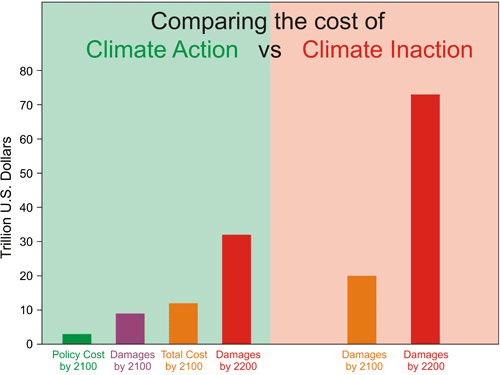
THE HIGH COST OF INACTION
The IPCC’s discussion of economic costs is equally muddled:
“… the incomplete estimates of global annual economic losses for additional temperature increases of ~2°C are between 0.2 and 2.0% of income. Losses are more likely than not to be greater, rather than smaller, than this range…. Losses accelerate with greater warming, but few quantitative estimates have been completed for additional warming around 3°C or above.”
It would have been nice if the IPCC had mentioned at this point that keeping additional temperature increases to ~2°C requires very aggressive efforts to slash carbon pollution starting now. As it is, the deniers, confusionists, and easily confused can (incorrectly) assert that this first sentence means global economic losses from climate change will be low. Again, that’s only if we act now.
As Climate Science Watch noted Saturday, “Other estimates suggest the high impacts on global GDP with warming of 4ºC (For example the Stern Review found impacts of 5-20% of global GDP).”
The costs of even higher warming, which, again, would be nothing more than business as usual, rise exponentially. Indeed, we’ve known for years that traditional climate cost-benefit analyses are “unusually misleading” — as Harvard economist Martin Weitzman warned colleagues, “we may be deluding ourselves and others.” Again, that’s because the IPCC is basically a best case analysis — while it largely ignores the business-as-usual case and completely ignores the worst case……http://thinkprogress.org/climate/2014/03/30/3420723/climate-breakdown-of-food-systems/
20 Australia-wide organisations call for W.A. government inquiry into Wiluna uranium project
 United call for uranium inquiry 31 March 14 Today twenty* different public health, union, Aboriginal and environment groups have called on the WA Environment Minister Albert Jacob and the WA EPA to hold a dedicated Public Inquiry into the states most advanced uranium proposal, Toro Energy’s Wiluna uranium project.
State Secretary of the AMWU Steve McCartney said “The nuclear industry is increasingly marginal and uneconomic. This industry is worth 0.02% of our national export revenue and holds just 0.015% of Australian jobs. The risks far outweigh any rewards. Uranium mining does not pass the asbestos test for us – it impacts on the workers extracting it, transporting it and the end users.”
Dr Peter Underwood, National Vice President Medical Association Prevention of War, said “We need to have a way to look at all the risks of a uranium project including a detailed look at the public health risks from this industry here and overseas. A public inquiry is the only way to address these issues. We know it was Australian uranium that fuelled Fukushima and that’s something we need to look at before we push forward with plans to mine uranium.”
Melanie Walker, Acting CEO of the Public Health Association of Australia commented “We have seen a number of accidents at uranium mine sites across Australia, most recently at Ranger uranium mine in the Northern Territory. There needs to be public and transparent process to look at the risks of this industry on workers and the public.”
Mia Pepper, Nuclear Free Campaigner with the Conservation Council of WA said “This small inexperienced company is now proposing a uranium precinct – including four mines across two lake systems and a proposal to store over 50 million tonnes of radioactive mine waste in a lake bed*.”
“This idea lacks credibility and the company lacks capacity, experience and financial backing,” concluded Dave Sweeney Nuclear Free Campaigner with the Australian Conservation Foundation.
Media Comment
- Dr Peter Underwood: (08) 9840 9626
National Vice President Medical Association for the Prevention of War
- Melanie Walker: 0438 430 963
Acting CEO, Public Health Association of Australia
- Mia Pepper: 0415 380 808
Nuclear Free Campaigner, Conservation Council WA
- Dave Sweeney: 0408 317 812
Nuclear Free Campaigner, Australian Conservation Foundation
* Australian Conservation Foundation, Public Health Association of Australia, Australian Manufactures Workers Union WA, Conservation Council of WA, Medical Association for the Prevention of War, Social Justice Board Uniting Church, Maritime Union Australia, UnionsWA, United Voice, Electrical Trade Union, The Wilderness Society, Greenpeace Sustainable Energy Now, Friends of the Earth Australia, Mineral Policy Institute, Anti-Nuclear Alliance WA, Australia Nuclear Free Alliance, WA Nuclear Free Alliance, Beyond Nuclear Initiative,
* Based on the assumption that mining 1 tonne of uranium oxide produces approximately 2,400 tonnes of low level radioactive waste. Total of 22,270 + tonnes of uranium at the four deposits = 53,448,000 + tonnes of tailings.
For solar power in Australia, the Western Australian Senate election is critically important
 Western Australia’s Election Crucial In National Solar Battle http://www.energymatters.com.au/index.php?main_page=news_article&article_id=4241 As the people of Western Australia prepare to return to the polls, the Australian Solar Council says the outcome will play a major role in the battle solar is facing nationally.
“There are increasing indications that the Federal Government is planning to remove or scale back support for rooftop and large scale solar through its review of the Renewable Energy Target (RET),” says Australian Solar Council CEO John Grimes. Mr. Grimes says with Labor and the Greens supporting the position of not changing the RET, if numbers can be secured in the Senate, any changes the Abbot Government seeks to make that would negatively impact the RET can be blocked.
The Australian Solar Council has secured letters of support regarding the Renewable Energy Target from Labor and The Greens. Palmer United Party issending mixed signals. The Council’s Save Solar campaign is currently focusing the majority of its efforts in Western Australia and recently launched its first ever TV and print advertising campaign.
The response from the community is such that it says several political parties have asked the Council stop all of the emails being sent by solar supporters as they are receiving hundreds each day.
“Our clear message – anti-solar policies will only happen at great political cost, because the people are with us,” says Mr. Grimes.
“This campaign says to governments across Australia that solar is the future and the industry will not tolerate ad-hoc policy changes that damage our businesses and most of all restrict access to solar for the 3.5 million people who want solar over the next 5 years.”
Shadow Minister for Environment, Climate Change and Water, Hon. Mark Butler MP will meet solar workers in Perth on Monday to discuss the importance of the Renewable Energy Target for the solar industry; which employs thousands of people in Western Australia.
Liberal policies make sense when you realise who funds them
 The rise and rise of mining company donations. Crikey BERNARD KEANE | FEB 21, 2012 Labor’s mining tax and the resources boom may have permanently and significantly changed the balance of political donations, with millions of dollars flowing from mining companies to the Coalition, Australian Electoral Commission data shows.
Mining companies began increasing their stake in the political process before the financial crisis, favouring the Coalition but also contributing to Labor. However, the mining tax saw an extraordinary increase in donations to the Coalition that has opened up a huge funding resource for the Liberals.
Mining company donations to state and federal Labor parties and the Coalition since 2004 show the extent to which Coalition benefited from the surge in mining company largesse after the Rudd government infuriated them with its RSPT proposal in May 2010.

But the largesse is predominantly from Western Australia. In Queensland, the ongoing support of Clive Palmer has been the primary mining contribution to the conservative cause, including a monster donation of $500,000 to the LNP by his Queensland Nickel. Other than Palmer, the federal Liberal Party took $100,000 from controversial miner New Hope — the target yesterday of a protest led by Alan Jones and Bob Katter — maintaining the Queensland representation in 2010-11.
Last year the Queensland government capped donations at $5000 to parties and $2000 to candidates, but the cap only applies to donations relating to campaign purposes; general purpose donations to parties are not capped).
Santos and Beach Petroleum each gave big donations to the SA Liberals in 2010-11 as well……….
Federally, Labor’s take from miners slumped to a bare $50,000 worth of small donations and fund-raising dinner contributions, from $200,000 before the 2007 election.
The sheer scale of mining company generosity illustrates why Tony Abbott remains committed to repealing the carbon pricing package  and the mining tax despite the difficulties he will face in securing Senate support. That should continue to lock in big mining company donations this year and next and establish the mining industry as a go-to source for big donations that Labor cannot access for years to come.
The donations are widespread across the WA industry, with 25 companies giving the party on average $95,000. The list doesn’t include Rio Tinto and BHP Billiton, who no longer donate or only provide small donations; given they can pick and choose prime ministers and dictate how much tax they pay, donations would appear to be of limited value for the big foreign miners………..http://www.crikey.com.au/2012/02/21/the-rise-and-rise-of-mining-company-donations/
Superannuation fund is deeming fossil fuels as an unethical investment
 Superannuation fund UniSuper plans to to add fossil fuels to list of unethical investments http://www.abc.net.au/news/2014-03-30/super-fund-adds-fossil-fuels-to-unethical-investments-list/5354066 By Nonee Walsh 30 Mar 2014, One of Australia’s top 10 superannuation funds is planning to add fossil fuels to its list of unethical investments.
UniSuper, Australia’s seventh largest fund that services higher education and research workers, told members who chose its socially responsible packages that investment in fossil fuels, gaming, alcohol and weapons would be withdrawn this year unless members objected.
Those sectors are currently included in the Dow Jones sustainability index.
UniSuper proposes initially withdrawing from exploration and production in the coal and gas sector.
However it says in the future it will look at withdrawing from investment in power suppliers and other fossil fuel companies.
UniSuper has $1.6 billion in its sustainable investments, which is a small proportion of its overall fund
Closure of nuclear plant that would “consume plutonium”, but only consumed $billions
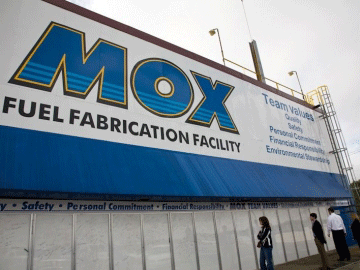 DOE shuts $4 billion ‘plutonium-eater’ reactor Ecologist, Douglas Birch 12th March 2014 A nuclear reactor designed to burn up surplus Cold War plutonium has been closed by the US Department of Energy. Initially it was meant to cost $1bn. So far it has cost $4bn. To complete and operate would cost $25-34bn.
After a year of study meant to examine the viability of the two-decade old program, the department’s leadership made clear in budget documents for fiscal year 2015 that the plant is no longer affordable within budget limits set by Congress.
The mad world of nuclear economics
Initially advertised as a $1 billion program, the plant has already consumed more than $4 billion and was projected to cost up to $10 billion to complete over the next five years. Its total costs – including operation over 15 years – were estimated at nearly $34 billion by a special study conducted for Energy Secretary Ernest Moniz.
The plant, which lay at the center of a diplomatic deal with Russia that was blessed by three U.S. presidents, was supposed to transform at least 34 tons of plutonium withdrawn from retired U.S. nuclear weapons into so-called Mixed Oxide (MOX) fuel to be burned in civilian nuclear power plants. Russia agreed to undertake a similar effort, but the cancellation of the U.S. plan may affect that decision.
The department’s review “has determined that the MOX fuel approach is significantly more expensive than planned and it is not viable within the FY 2015 funding levels”, the White House’s Energy Department budget proposal states……..http://www.theecologist.org/News/news_round_up/2317472/doe_shuts_4_billion_plutoniumeater_reactor.html
The world must act on Climate Change (and nuclear is NOT the answer)
The IPCC latest Climate Change report will be out today.
And I’m dreading it. I’m dreading what it means for our children and grandchildren , and even us!
I’m also dreading the attention that will be paid by the Australian and world’s aristocracy and plutocracy of middle aged white males – to the pressure from fossil fuel and nuclear lobbies – in response to this report.
Prepare to see science trashed by our lords and masters.

1 This month
15 April – Zoom –Nuclear Power is Not the Solution
Apr 15, 2026 01:00 AM in Canberra, Melbourne, Sydney

Join the International Physicians for the Prevention of Nuclear War (IPPNW) on Tuesday, April 14th for a timely webinar exploring the risks associated with nuclear power and challenging the myth that it offers a simple, safe, carbon-free solution to the climate crisis

21 April Webinar: No Nuclear Weapons in Australia
Start: 2026-04-21 18:00:00 UTC Canberra, Melbourne, Sydney (GMT+10:00)
End: 2026-04-21 19:30:00 UTC Canberra, Melbourne, Sydney (GMT+10:00)
Event Type: Virtual
A virtual link will be communicated before the event.
Host Contact Info: australia@icanw.org

of the week – Australians for War Powers Reform (AWPR)
To see nuclear-related stories in greater depth and intensity
 Antinuclear