What a lovely target! Nuclear waste ship now in the Tasman sea
 Nuclear waste ship in Tasman sea http://www.stuff.co.nz/national/9896660/Nuclear-waste-ship-in-Tasman-sea TIM DONOGHUE 2 April 14 The nuclear waste carrier Pacific Grebe is currently making its way through the northern mid-Tasman sea bound for Japan with canisters of high level reprocessed nuclear waste from Britain on board.
The 6,840 tonne British registered ship, owned by Warrington, UK based Pacific Nuclear Transport, sailed from Barrow-in-Furness, north of Liverpool, bound for Japan on 14 February 2014
The Japan Times reported in January, 2014 that 28 canisters of high-level radioactive waste, produced through the reprocessing of spent Japanese nuclear fuel in Britain, would be transported to the Aomori Prefecture on board Pacific Grebe.
The 28 canisters of vitrified radioactive waste included 14 for Kansai Electric Power Co and seven each for Chubu Electric Power Co. and Chugoku Electric Power Co.
The paper also reported in January that the shipment was the third involving vitrified radioactive waste to be brought to Japan from Britain.
Japan has received 104 canisters of such waste from Britain and plans to receive around 800 more. The 104 canisters have been stored at a facility in the village of Rokkasho, The Japan Times reported.
Wiluna Martu peoples condemn Toro Energy’s expanded uranium mining plan
 Wiluna Martu peoples against uranium mining, The Stringer, by Gerry Georgatos March 29th, 2014 Elders have condemned a move by Toro Energy to expand their yet unrealised Wiluna mine plan into a much larger uranium precinct spanning 100km and which will destroy ecologically sensitive lake systems. Local Wiluna Elder Glen Cooke said everything must be done to prevent this mine which is intended as Western Australia’s first uranium mine – the first of many.
“The lives of not only our people today are at stake but the future of our people into time immemorial. This uranium mining if it goes ahead will spell the end of us as custodians of the land. It will make toxic the land, preventing us from caring for the land, it will poison the rivers that we swim in, drink and fish from,” said Mr Cooke.
First Peoples anti-nuclear groups have coalesced to stand in the way of uranium mining in Western Australia
But the mine is destined to be operational next year.
WA’s Environmental Protection Authority (EPA) released details of the Toro Energy expansion plan. But Wongi anti-nuclear campaigner, Kylie Fitzwater said that Toro had a long way to go in gaining new approvals in expanding from their single-mine approved project. “The company needs to complete additional environmental management, mine closure, tailings management and transport plans for assessment before any mining can commence at the Wiluna site.”
“But we need to stop this mining proposal altogether which will only risk people and communities from toxic radiation,” said Ms Fitzwater.
“It is not just about the cumulative impacts of a regional uranium precinct covering 100km and two lake systems but about the lives lost, the communities destroyed, and the door opening in WA for a rush of nuclear mad investors.”
“Toro plans to double its water consumption and store radioactive mine waste from several mine sites in a Lake bed.”………..
The Central Desert Native Title Service released a statement on the uranium mining proposal. “The Wiluna Martu People’s previous experience with uranium exploration in the Wiluna region has left them with serious and genuine concerns about the health effects of radiation. It also raised questions about the Government’s capacity to properly regulate uranium exploration and mining on their Traditional Lands.”
“The issue of uranium mining is not something that Martu have invited. Rather under the current policy and State regulatory environment it is something they are forced to confront in order to ensure that their Traditional Lands and their people are sufficiently recognised and protected.”http://thestringer.com.au/wiluna-martu-peoples-against-uranium-mining/
Greens leader Christine Milne is scathing about Tony Abbott’s lack of climate policy
 Tony Abbott a fool on climate change says Greens leader Christine Milne WA Today, April 1, 2014 Judith Ireland “………We have a government with its head buried in the 19th without a plan for the nation in the 21st century.
With no plan for the future, Tony Abbott will fail as Prime Minister.
No one can lead at this moment without a plan to address global warming. It is a defining characteristic of leadership to identify the risks and threats to the nation and lead people to address them. The IPPC has made it clear. Time has run out, we are suffering already and are on track for 4 degrees of warming and we are not prepared. The Greens are the only party in the Australian Parliament who recognise the two possible futures, as the IPCC has said: “one of inaction and degradation of our environment, our economies, and our social fabric. The other, to seize the moment and the opportunities for managing climate change risks and making transformational changes that catalyses more adaptive and resilient societies where new technologies and ways of living open the door to a myriad of health, prosperity and job- generating benefits. The path of tomorrow is undoubtedly determined by our choices today. We must decide which path to follow.”
The Greens have chosen the future of transformational change – the government has not.
Nowhere is this lack of a plan for a climate change dominated future more obvious than in WA.
Yesterday’s report from the Intergovernmental Panel on Climate Change emphasised the enormity of the global task to avoid climate. In WA, the south west of the state is drying out, and Perth recently recorded its second hottest summer on record and sweltered through their hottest night on record ever, at 29.7 degrees, life will get harder with more heatwaves and extreme fire danger days resulting in loss of life and reduced productivity.
Tony Abbott is a fool to pretend climate change is not happening and even more foolish to try to prevent action that would help people, create jobs and create a future for WA, and the country, after the mining boom………
 This election offers WA the chance to vote for a future which takes the science of climate change into account, delivers billions of dollars and jobs in renewable energy, public transport, housing and education, saves money on power bills by supporting solar and gives hope and the promise of happiness to this and the next generation by standing up for people and the environment in the face of the biggest power grab for the greedy seen in generations.
If you’re feeling the “vibe” Vote Green! http://www.watoday.com.au/federal-politics/political-news/christine-milnes-speech-to-the-national-press-club-april-1-20140401-35vnj.html
Lined up against Renewable Energy – These Liberal and National Members of Parliament
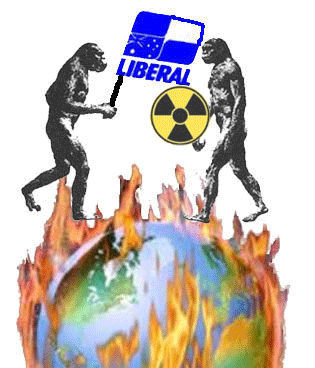 MPs unite against ACT’s renewable energy scheme, Braidwood Times, 1 April 14 Liberals and Nationals in NSW have joined forces to send a strong message to the ACT Government over its renewable energy policy: Leave our farms alone!
Windfarms have been controversial in the area surrounding the ACT and an110 tower ‘farm’ is in the wind for the area from Tarago, south across the Kings Highway down to Manar.
Marshall Islands deplore Australia’s backward moves regarding climate change
 Marshall Islands minister unsure of Australia’s stance on climate change http://www.abc.net.au/news/2014-04-01/an-marshall-islands-urges-urges-australia-to-take-22leadership/5360510 1 Apr 2014,
The foreign minister of Marshall Islands, Tony de Brum, says he’s extremely disappointed by Australia’s approach to climate change.Marshall Islands is hosting the UN-backed Cartagena Dialogue for Progressive Action on climate change, which includes the governments of 30 countries.
Mr de Brum has told the ABC that the Australian Government should be taking a leadership role. “We have always considered Australia to be a partner in this endeavour,” he said. “Recent changes in political tone when it comes to climate change have made us worry as to exactly where Australia stands on this issue.
“The previous government of Australia (was) instrumental in helping establish Cartagena Dialogue. This week, they’re sending a very junior official to represent Australia. I’m not sure how we should interpret that. “Frankly, it is quite confusing. At first they said they would participate without a flag; now they say they will participate with a flag.”
His comments came after the UN’s Intergovernmental Panel on Climate Change warned that soaring carbon emissions will amplify the risk of conflict, hunger, floods and mass migration this century.
The United Nations report said that, left unchecked, greenhouse gas emissions may cost trillions of dollars in damage to property and ecosystems, and in bills for shoring up climate defences.
“It is tradition that communities be built along shorelines, lagoon shoreline, but now even these areas are being inundated with salt water; areas where gardens and flowers used to grow are now sand and rubble,” Mr de Brum said.
“I’ve extended an invitation to Foreign Minister Julie Bishop and to the prime minister to visit the islands and see for themselves what we’re talking about, so they cannot be naysayers anymore.”
Mr de Brum says he hopes Australia will put climate change on the agenda when it hosts the G20 meeting in November. “They must set the tone for commitment, for progressive movement on climate change and not backpedal on commitments already made.
“We’ve heard from example that, in the upcoming G20 summit, Australia was going to leave climate change off the agenda, because it did not want it cluttered with climate change issues – this is appalling.” High tides flooded parts of Majuro in early March damaging homes and government facilities in the third inundation of the Marshall’s capital atoll in the past 12 months.
Legal bullying made a scientific journal remove its article about climate change
 The journal that gave in to climate deniers’ intimidation The Conversation, Elaine McKewon, Research Associate, Australian Centre for Independent Journalism at University of Technology, Sydney 1 April 14,
In February 2013, the journal Frontiers in Psychology published a peer-reviewed paper which found that people who reject climate science are more likely to believe in conspiracy theories. Predictably enough, those people didn’t like it.The paper, which I helped to peer-review, is called “Recursive fury: Conspiracist ideation in the blogosphere in response to research on conspiracist ideation”. In it, cognitive scientist Stephan Lewandowsky and his colleagues survey and analyse the outcry generated on climate skeptic blogs to their earlier work on climate denial.
The earlier study had also linked climate denial with conspiracist thinking. And so by reacting with yet more conspiracy theorising, the bloggers rather proved the researchers’ point.
Yet soon after Recursive Fury was published, threats of litigation started to roll in, and the journal took the paper down (it survives on the website of the University of Western Australia, where Lewandowsky carried out the study).
A lengthy investigation ensued, which eventually found the paper to be scientifically and ethically sound. Yet on March 21 this year, Frontiers retracted the paper because of the legal threats.
The episode offers some of the clearest evidence yet that threats of libel lawsuits have a chilling effect on scientific research………
the journal’s management and editors were clearly intimidated by climate deniers who threatened to sue. So Frontiers bowed to their demands, retracted the paper, damaged its own reputation, and ultimately gave a free kick to aggressive climate deniers.
I would have expected a scientific journal to have more backbone, certainly when it comes to the crucially important issue of academic freedom. http://theconversation.com/the-journal-that-gave-in-to-climate-deniers-intimidation-25085
Carbon tax brings cleaner air and prosperity to British Columbia
 How British Columbia Enacted the Most Effective Carbon Tax in North America, the Atlantic Cities, CHRIS MOONEY, 26 MARCH 14, Suppose that you live in Vancouver and you drive a car to work. Naturally, you have to get gas regularly. When you stop at the pump, you may see a notice like the one below, explaining that part of the price you’re paying
  is, in effect, due to the cost of carbon. That’s because in 2008, the government of British Columbia decided to impose a tax on greenhouse gas emissionsfrom fossil fuels, enacting what has been called “the most significant carbon tax in the Western Hemisphere by far.”
- A carbon tax is just what it sounds like: The BC government levies a fee, currently 30 Canadian dollars, for every metric ton of carbon dioxide equivalent emissions resulting from the burning of various fuels, including gasoline, diesel, natural gas, and, of course, coal. That amount is then included in the price you pay at the pump—for gasoline, it’s 6.67 cents per liter (about 25 cents per gallon)—or on your home heating bill, or wherever else the tax applies. (Canadian dollars are currently worth about 89 American cents).
-
If the goal was to reduce global warming pollution, then the BC carbon tax totally works. Since its passage, gasoline use in British Columbia has plummeted, declining seven times as much as might be expected from an equivalent rise in the market price of gas, according to arecent study by two researchers at the University of Ottawa. That’s apparently because the tax hasn’t just had an economic effect: It has also helped change the culture of energy use in BC. “I think it really increased the awareness about climate change and the need for carbon reduction, just because it was a daily, weekly thing that you saw,” says Merran Smith, the head of Clean Energy Canada. “It made climate action real to people.”
It also saved many of them a lot of money. Sure, the tax may cost you if you drive your car a great deal, or if you have high home gas heating costs. But it also gives you the opportunity to save a lot of money if you change your habits, for instance by driving less or buying a more fuel-efficient vehicle. That’s because the tax is designed to be “revenue neutral”—the money it raises goes right back to citizens in the form of tax breaks. Overall, the tax has brought in some $5 billion in revenue so far, and more than $3 billion has then been returned in the form of business tax cuts, along with over $1 billion in personal tax breaks, and nearly $1 billion inlow-income tax credits (to protect those for whom rising fuel costs could mean the greatest economic hardship). According to the BC Ministry of Finance, for individuals who earn up to $122,000, income tax rates in the province are now Canada’s lowest.
So what’s the downside? Well, there really isn’t one for most British Columbians, unless they drive their gas-guzzling cars a lot. (But then, the whole point of taxing carbon is to use market forces to discourage such behavior.) The far bigger downside is for Canadians in other provinces who lack such a sensible policy—and especially for Americans. In the United States, the idea of doing anything about global warming is currently anathema, even though addressing the problem in the way that British Columbia has done would help the environment and could also put money back in many people’s pockets. Such is the depth of our dysfunction; but by looking closely at British Columbia, at least we can see that it doesn’t have to be that way……….
- The tax has actually become quite popular. “Polls have shown anywhere from 55 to 65 percent support for the tax,” says Stewart Elgie, director of the University of Ottawa’s Institute of the Environment. “And it would be hard to find any tax that the majority of people say they like, but the majority of people say they like this tax.”
It certainly doesn’t hurt that the tax, well, worked. That’s clear on at least three fronts: Major reductions in fuel usage in BC, a corresponding decline in greenhouse gas emissions, and the lack of a negative impact on the BC economy……..
- The bottom line, then, is that BC’s experience provides an exclamation point at the end of the long list of reasons to like a carbon tax. Perhaps the leading one, in the end, is that it’s a far simpler policy option than a cap and trade scheme, and is, as Harvard economist and Bush administration Council of Economic Advisers chair N. Gregory Mankiw has put it, “more effective and less invasive” than the sort of regulatory approaches that the government tends to implement.
Indeed, economists tend to adore carbon taxes. When the IGM forum asked a group of 51 prominent economists whether a carbon tax would be “a less expensive way to reduce carbon dioxide emissions than would be a collection of policies such as ‘corporate average fuel economy’ requirements for automobiles,” assent was extremely high: 90 percent either agreed or strongly agreed. Yale economist Christopher Udry commented, “This is as clear as economics gets; provides incentives to find minimally costly ways to reduce emissions.”
“Totally basic economics!” added Stanford’s Robert Hall.
Since 2012, British Columbia has not raised the carbon tax further. Instead, the government agreed to freeze the rate as it is for five years. And no wonder: BC is now far ahead of most of its neighbors, and most of North America, in taking action to curtail global warming………
- In the meantime, BC can boast of the crown jewel of North American climate policy. “BC now has the lowest fuel use in Canada, the lowest tax rates in Canada, and a pretty healthy economy,” says the University of Ottawa’s Stewart Elgie. “It works.”http://www.theatlanticcities.com/jobs-and-economy/2014/03/how-british-columbia-enacted-most-effective-carbon-tax-north-america/8732/
Australian govt planning a hatchet job on renewable energy
 RET Review Threatens Massive South Australian Wind Farm http://www.energymatters.com.au/index.php?main_page=news_article&article_id=4246 2 April 14, South Australia’s largest wind farm project has been threatened by the Federal Government’s Renewable Energy Target review says the developer.
In February this year, the green light was given for the 197-turbine 600MW Ceres wind farmdevelopment. The facility is expected to generate $1.5 billion in economic benefits and provide enough power to supply 225,000 homes or equivalent to 14 per cent of South Australia’s electricity demand.
Developer Senvion Australia wants to start construction early next year and have the facility operational by the end of 2016, but says the RET review is creating difficulties in gaining investor confidence.
“The RET review has already seen investment stall right across Australia because of the continuing uncertainty,” said Senvion Australia managing directorChris Judd. “This is frustrating for our business, as we see enormous opportunity here.”
Last month, Spanish wind power firm Acciona placed three projects in Victoria with a collective value of $750 million on hold due to uncertainty over the future of the RET.
The battle to save the RET has been one of hearts and minds; an effort made more difficult by the stream of misinformation about the cost of the Renewable Energy Target.
For what it delivers, Australia’s Renewable Energy Target provides good valueand overall only represents 3.5% – 5% of an average power bill; an amount that will further decrease in the years ahead should the RET be left unaltered.
The RET has generated more than $18.5 billion in investment and created more than 30,000 jobs so far. If it is left unchanged, approximately 30,000 more jobs will be created and another ~$18.7 billion in investment will occur.
However, given the makeup of the RET review panel, there are fears of a “hatchet job” in progress and the RET will be substantially changed or abolished altogether.
Australia among the top 10 solar energy countries in 2013
 Australia A Global Top 10 Solar Performer In 2013 http://www.energymatters.com.au/index.php?main_page=news_article&article_id=4245 2 April 14, A new report from the International Energy Agency shows Australia among the top 10 countries for solar installations and total installed capacity in 2013.
According to the IEA PVP’s Snapshot of Global PV 1992-2013, at least 36.9 GW of PV systems were installed and connected to the grid in the world last year. With some installations not yet reported, the final number for the 2013 PV market could be above 38 GW.
Top 10 Countries for Installations (2013/MW)
China – 11.3
Japan – 6.9
USA – 4.8
Germany – 3.3
Italy – 1.5
India – 1.1
Romania – 1.1
Greece – 1
UK – 1
Australia – 0.9
Top 10 countries for total installed capacity (2013/MW)
Germany – 35.5
China – 18.3
Italy – 17.6
Japan – 13.6
USA 12
Spain – 5.6
France – 4.6
Australia – 3.3
Belgium – 3
UK – 2.9
Last year, Asia led the world in terms of solar deployment for the first time in a decade.
Annual PV contribution to electricity demand has passed the 1% mark in 15 countries, including Australia.
“PV technology today has become a major actor in the electricity sector in several countries. Globally, at least 160 TWh, or 160 billion kWh will be produced in 2014 by PV systems installed and commissioned until January 2014,” states the report (PDF).
“This represents about 0.85% of the electricity demand of the planet, though some countries have reached rapidly significant percentages.”
Stand-out performers in this regard are Germany, Italy and Greece; which have now enough PV capacity to produce 6.2%, 7.8% and 5.8% respectively of their annual electricity demand.
The IEA Photovoltaic Power Systems Programme (PVPS) has 29 member countries: Australia, Austria, Belgium, Canada, China, Denmark, EPIA, European Union, France, Germany, International Copper Alliance, Israel, Italy, Japan, Korea, Malaysia, Mexico, Netherlands, Norway, Portugal, SEIA, SEPA, Spain, Sweden, Switzerland, Thailand, Turkey, United Kingdom and the USA.
Aboriginal elder treated with disrespect by Toro Energy uranium company
Wiluna Martu peoples against uranium mining, The Stringer, by Gerry Georgatos March 29th, 2014 “……. “The Senior Lawmen acknowledge that there are divergent views about uranium mining within the wider Martu community and these divergent views have to be accommodated in this negotiation.”
Late last year and earlier this year Mr Cooke walked into Toro Energy AGMs and expressed his concerns at the prospective impacts on Martu Country were the uranium mines to proceed. He is also concerned that signatories to the mining proposal from within his people have been “misled”.
“The signatories have been persuaded to believe the uranium operation will have low environmental impacts.”
“These people are targeted and influenced by deals to sign over the rights of the land. These people Toro talked to are now driving around in Toyotas they didn’t have before. About eleven Toyotas just appeared,” said Mr Cooke.
“We must care for our land and children and not put our future at risk. These corporations only want to make money, they are full of broken promises.”
Ms Fitzwater accompanied Mr Cooke into the Toro Energy AGM. “When Elder Glen Cooke asked a question he was treated abruptly by Toro and with complete disrespect. He was not permitted to reiterate any questions. It is clear the company tolerates no opposition and has been unfair and biased during their submission period no matter what their convictions.”
“The EPA should seriously reconsider this approval basis and commit to protecting our ecosystem. Our State cannot afford this mistake, we will pay the consequences for an incomprehensible amount of time. This concerns all Australians,” said Ms Fitzwater.
Mr Cooke said he has a complete understanding of the effects of radiation. He was eight years old when the Maralinga atomic tests took place.
Former radiation worker, Bill Macham said that Governments must amend legislation from measures of understanding radiation effects in terms of “half lives and instead to baseline measures of what are biologically safe levels”. With anti-nuclear activists relocating to Alice Springs and the Arnhem to support communities and Elders against uranium expansion, the call for the closure of Jabiluka and for Muckaty to not be used as a radiation waste dump, it appears the next generation’s tensions will highlight the proliferation of uranium mining and the rapacious rise of nuclear reactors.
“For those who care about the earth and people, this is our duty, if those who don’t care about the earth and people win their war to make piles of money, then there will come the day that this earth and its people will pay very high, at what cost to the earth and to people, well we’ve seen Fukishima and Chernobyl,” said Mr Cooke. http://thestringer.com.au/wiluna-martu-peoples-against-uranium-mining/
Don’t worry, the Science Media Centres are on Abbott’s side
 Arclight 1 April 14 Australia and the UK covered up Fukushima using the Science Media centres with a small group of UK and Australian hand picked scientists..
The Science media centre (SMC) in the UK makes the BBC put on 1 of the 99 per cent who think there is a problem, with 1 climate denier from the remaimng 1 percent..
The UK government tells the SMC to manage the news..
The SMC is pro fracking and pro GMO too!
basically pro big buisness…
I think you were too kind with Cameron, Christina. The UK is managing climate change by saying it will be too far into the future to have any immediate effects. even after the weird weather and flooding we have been having in the UK over the winter. Also, they are commissioning some weather modification studies and has asked the SMC to deal with it.. So no articles on weather modification..
The SMC is funded and supported by petroleum, nuclear, pharma, BBC and the Department of Energy and Climate Change (DECC UK) etc etc
follow the money! The SMC did
Great comments! I hope the refrigeration is solar!!
1 This month

of the week – Australians for War Powers Reform (AWPR)
To see nuclear-related stories in greater depth and intensity
 Antinuclear