Western Australian election – so far – 7 % swing to the Greens
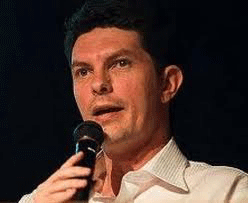
 WA Senate count shows swing to Greens, PUP, The Age, April 6, 2014 – Rebecca Le May Greens Senator Scott Ludlam appears to have retained his seat in the re-run West Australian Senate election, with early results showing a big swing to the party.
At 12.44pm local time, when 70.88 per cent of polling places had counted first preferences, there was a 5.91 per cent swing against the Liberals and a 5.33 per cent swing against Labor, while the Greens had put on 6.69 per cent.
At the same time, there was a 7.51 per cent swing towards the Palmer United Party (PUP).
Labor’s member for Perth, Alannah MacTiernan, said it appeared some of her party’s traditional voters had backed the Greens……….<>Greens Senator Rachel Siewert said it appeared from comments made to her at polling booths that the party had gained votes from both of the majors.
She said one woman told her: “I’ve been a Liberal voter but we need to keep a check on Tony Abbott.”
 “This is the strongest vote [for the Greens] I’ve seen,” Senator Siewert said……Both major parties had low-profile lead candidates, he said, but the Greens had promoted a lead candidate – Mr Ludlam – who made the others look dull.
And the party was creative in its campaign, said Former Labor workplace relations and tertiary education minister Chris Evans………”It looks like Scott’s home and hosed,” Labor Senator Sam Dastyari said……”It will be interesting to see where the Greens end up – how much over a quota they’ll get.”
Why the Western Australian Senate election is critical to this nation’s survival
 This website is dedicated to nuclear issues.
So – what am I doing, worrying about a side-issue like the Senate election tomorrow? And about climate change? After all, that’s not an immediate worry – it’s a gradual thing…..
Well – apologies to dedicated anti nuclear readers, but:
Climate Change IS an urgent matter.
The fossil funded Liberal Coalition government is out to use every delaying tactic, to see that no real action is taken, about global warming, and to, if they can, kill off the renewable energy industry, energy efficiency, and rail transport development.
Mavericks like Clive Palmer will join their onslaught. Other minor parties – who knows – but likely to be Liberal stooges.
Labor Party? It’s getting harder and harder to distinguish them from the Liberals.
WHAT’s LEFT? The chance that somebody in the Senate can put the brakes on Australia’s regressive government. That somebody is SCOTT LUDLAM , along with other Greens.
Tomorrow’s election may make all then difference – and how all the government and media stooges fear this! (which makes it all that amazing that THE AUSTRALIAN newspaper came out today barracking for climate change action and renewable energy! http://www.theaustralian.com.au/business/latest/wa-has-a-lot-to-lose/story-e6frg90f-1226873306480 )
NUCLEAR ISSUES – held over until tomorrow – but be assured – Australia’s pack of pro-nuke shills are on the move!)
Australian uranium miner Paladin hit by costs of water.
 Uranium Miners in Namibia Face Rise in Water Price, Paladin Says http://www.businessweek.com/news/2014-04-04/uranium-miners-in-namibia-face-rise-in-water-price-paladin-says By Felix Njini April 04, 2014 Uranium miners in Namibia, already coping with water shortages in the semi-arid Erongo region, face a steep rise in costs, Paladin Energy (PDN) Ltd. said.
“When we get it, sometimes we have problems with the quality of the water and the cost,” said Simon Solomons, managing director of Paladin’s Langer Heinrich mine. “At the moment there is no long-term solution to the water-supply situation.”
The mines operated by Paladin, Rio Tinto Plc and China General Nuclear Power Group rely on water from a 20 million-cubic-meter capacity desalination plant operated by Areva SA, a French reactor maker. Areva is in talks to sell a majority stake in the plant to state utility Namibia Water Corp. after shelving its Trekkopje project in 2012 as uranium prices slumped in the wake of the Fukushima disaster.
Namwater has “to look for finance to buy the plant,” Solomons said yesterday during a tour of the Subiaco, Western Australia-based company’s mine. “They will pass on those charges to the uranium mines.”
Calls to Namwater weren’t immediately answered.
The three mines, which require as much as 10 million cubic meters of water a year, were previously supplied by the Omaruru Delta aquifer, which has dwindling volumes as demand from the mines and surrounding towns of Swakopmund and Walvis Bay rises.
Langer Heinrich, which consumes 130,000 cubic meters of water a month, has had “no long-term and no firm discussion” with Namwater over supplies, Solomons said.
Namibia is the fourth-largest uranium producer after Kazakhstan, Canada and Australia.
To contact the reporter on this story: Felix Njini in Windhoek at fnjini@bloomberg.net
Westinghouse out of unviable Small Modular Nuclear Reactors, and into lucrative Nuclear Decommissioning
Westinghouse backs out of Small Modular Reactor market Enformable Nuclear News Lucas W Hixson http://enformable.com/2014/02/westinghouse-backs-small-modular-reactor-market/Danny Roderick, President and CEO of Westinghouse announced that the nuclear firm is backing off of research and development of their Small Modular Reactor design. The Westinghouse design is a scaled down version of the AP1000 reactor, designed to produce 225 MWe, which could power 45,000 residential houses.
In December, the firm was passed over for a second time by the United States Department of Energy’s SMR commercialization program. Roderick clarified the issue and noted that it was not the deployment of the technology that posed the biggest problem – it was that there were no customers. “The worst thing to do is get ahead of the market,” he added

According to Roderick, unless Westinghouse was capable of producing 30 to 50 small modular reactors, there was no way that the firm would return its investment in the development project. In the end, given the lack of market, and the similar lack of federal funding, Westinghouse was unable to justify the economics of small modular reactors at this point.
Westinghouse was working with St. Louis-based Ameren, which had indicated its desire to build a new reactor near the State’s only existing nuclear reactor – the Calloway nuclear power plant, if a federal investment could be secured.
Westinghouse will focus its attentions on its decommissioning business, which is a $1 billion dollar per year business for the firm – which is equivalent to Westinghouse’s new reactor construction business, and rededicate its staff to the AP1000 reactor design.

Analysts are monitoring how the companies who did receive funding from the Department of Energy perform as they evolve. Source: The Pittsburgh Post-Gazett
Large area of Japan contaminated by Fukushima radiation
Caldicott: All of Japan contaminated by Fukushima — “Realistic estimate is 60,000 km², occupied by 46 million people” — “Things are grim, it gets worse by the day” — Unheard of in history, 100s of tons of melted fuel may be in earth (VIDEO) http://tinyurl.com/ldeohpa
2014/03/08 【京都】未来を担う子どもたちの為に、今、私たち
Bay FM 99.9 – Byron Bay Australia, Feb. 26, 2014:
Dr. Helen Caldicott: Things are grim — it gets actually worse by the day. […] There have been 3 meltdowns, which is just unheard of in the history of nuclear age, Units 1, 2, and 3, so that means that molten cores of about 100 tons of uranium in 3 reactors have melted their way through 6 inches of steel in the reactor vessel through to the containment floors, possibly through feet of concrete and steel into the earth. >> Full broadcast hereDr. Helen Caldicott in Kyoto, Japan, Mar. 8, 2014:
Dr. Helen Caldicott: A more realistic estimate of contamination is 60,000 square kilometers, occupied by 46 million people including parts of Tokyo and surroundings. As you can see (map on right), the whole land mass is contaminated to a greater or lesser extent.Watch Dr. Caldicott’s Kyoto presentation here
European company sell off its uranium asset to Australian company (unprofitable?)
 European Uranium to sell Slovakia uranium projects to Forte Energy Proactive Investors, by Deborah Bacal 4 April 14 European Uranium Resources (CVE:EUU) said it has agreed to sell its Kuriskova and Novoveska Huta uranium projects in Slovakia to Australia’s Forte Energy NL (ASX:FTE) (LON:FTE) for approximately $8.5 million plus a production royalty. The deal represents the sale of the company’s only remaining mineral projects. It told investors in a statement Friday that it now plans to investigate mineral projects to option or acquire in “multiple commodities” in Europe, with the deal today giving the company the initial funding to implement its business strategy.
The binding heads of agreement with Forte, a dual-listed exploration and development company with a portfolio of uranium assets in the Republics of Mauritania and Guinea, is subject to regulatory and shareholder approvals of both companies…..
….French nuclear energy giant Areva currently holds a 4.5% stake in Forte. http://www.proactiveinvestors.com/companies/news/53229/european-uranium-to-sell-slovakia-uranium-projects-to-forte-energy-53229.html
Queensland government incapable of properly monitoring Mining industries
 Summary of Auditor-General’s report on mines Tony Moore SMH, 4 April 14 What was revealed in the Auditor General’s report on the monitoring of Queensland’s resource and waste industries by the Departments of Environment and Heritage Protection and Natural Resources and Mines.
Communications
“Poor data and inadequate systems continue to hinder EHP’s planning and risk assessments. As a result, EHP cannot target its monitoring and enforcement efforts to where they are most needed.”
This situation is exacerbated by the lack of coordination and sharing of relevant information across agencies, particularly between EHP and NRM……..http://www.smh.com.au/queensland/summary-of-auditorgenerals-report-on-mines-20140404-362w5.html
Three respected Aborigines resign from Country Liberal Party
Bush Aborigines are fed up AMOS AIKMAN THE AUSTRALIAN APRIL 04, 2014
TENSION between Aborigines who have remained poor while Darwin has been transformed from a disaster zone after Cyclone Tracy to a “Gateway to Asia” city now has finally burst through the seams, ripping apart the Northern Territory government.
The imminent departure from the ruling Country Liberal Party of three traditional, culturally respected indigenous members not only plunges the government into crisis but could create a watershed for indigenous representation in Australia. Aboriginal votes that enabled the CLP to win power failed to deliver a government in which a majority of Aboriginal members could influence policymaking, resources allocation and the public service to anywhere near their — or, it appears, their constituents’ — satisfaction……….
Since the start of self-government in 1978, the Territory has been a mendicant state administering large amounts of federal funds for the notional benefit of Aborigines. However, a parade of reports has revealed that much of the money is skimmed off before it reaches the ground and, despite the substantial spending, living standards and health outcomes have barely improved in 30 years.
Some indicators, particularly those for children, are going backwards.
Successive governments have tried to contain the competing interests of remote and urban voting constituencies. The division is a socioeconomic one that falls uncomfortably along racial lines. In effect, these two constituencies are hankering for the same government resources rather than, as might be the case elsewhere, partnering in the economy……
Chief Minister Adam Giles was installed in March last year with the help of so-called “bush members”, who hoped the change would bring stability………
Anderson, in particular, objected to Giles axing the indigenous advancement department she had been in charge of, and scrapping a committee established by Mills to bring feedback from the bush directly to the cabinet table.
Giles sacked her from his ministry in September, in a move some now view as counterproductive. Gradually it became clear that, by ousting Mills, Giles and his allies had sundered the CLP in much the same way Julia Gillard did Labor when she replaced Kevin Rudd……….
Giles has focused his attention, at times forcefully, on laying the groundwork for major private-sector investment. While this may be an admirable long-term goal, it has distracted from the small-scale change and consultative policymaking bush residents voted for.
The result has been a chorus of questions about whether Aboriginal people will be drivers or passengers in development of their own land — the sort of concerns that fostered the Aboriginal land rights movement. This has clearly been a problem for Kurrupuwu, Anderson and Lee.
“Our concerns for a long period of time has been that we haven’t delivered for the bush,” Anderson told the ABC recently………
The risk for the federal government is self-evident. While the nation debates controversial racial discrimination legislation, and edges towards a referendum on constitutional recognition of indigenous people, politicians exchange racial epithets and ugly allegations in the Territory……… http://www.theaustralian.com.au/news/features/bush-aborigines-are-fed-up/story-e6frg6z6-1226873925714#
Current energy economics is unsustainable, as renewables rapidly fall in price
 Arvizu: Why the current energy system is unsustainable REneweconomy By Giles Parkinson on 4 April 2014
The first point is on cost, as renewables become a cheaper option than coal or gas; the other is on environmental impacts, as the world finally absorbs the impact of dirty coal generation; and the third is the arrival of new disruptive (and mostly renewable) technologies, such as rooftop solar and storage. But the most stunning piece of evidence is this: the industry spends only 0.3 per cent of its phenomenal revenues (in the trillions of dollars) on R&D. And even that money is spent by new players looking to bring new technologies to the market.
In an interview with RenewEconomy on the sidelines of the 2XEP energy efficiency conference in Sydney this week, Arvizu says he knows of no other incumbent industry that has spent so little on securing its future and on innovation, and was relying so much on the models of the past.
“The energy sector has the highest level of conservatism and the lowest level of risk taking,” Arvizu says. Change, via disruptive technologies such as solar and storage and other renewables, along with smart devices, is now upon it. But it will be fighting hard to resist change.
“We need to change the business model. We need new infrastructure, and brick by brick we will dismantle the old system and make a new one,” he says……….
“The future is much more promising than a lot of people expect,” Arvizu says, adding that even he is surprised at the pace of technological change and cost reduction.
He dismisses the protests of people who say that renewables are too expensive – in particular those like Bjorn Lomborg who insist that more research should take place (ironic given the industry’s low R&D commitment so far). “That’s just kicking the can down the road,” Arvizu says.
“If we are just talking about incremental changes to the existing system, we will never fully utilise the potential.”
It is, he says, a scary prospect for the incumbent utilities, who have enjoyed decades – nearly a century – of uninterrupted growth and extraordinary market power. And they are protected by layers and layers or regulation.
“We created this monster,” Arvizu says. “You often hear the words, ‘let the market decide’, but this is such a disingenuous argument in such a highly regulated market.
“The classic supply and demand equations do not work …. because what we’ve allowed the incumbents to create a set of highly regulated markets where they have tremendous market share, and there has been an alliance between public policy markets and incumbents, where reliable power supply has been exchanged for a high return on investment.
“But now we have other options in the market place, and in order to break into that market, they need to mature and they need an ecosystem around them.”
The key to change, he says, will come in power for the consumers, and the key to that will come in storage.
“If we had storage that was cost effective – you would very quickly be able to encourage the utilities to get on to the program. Once you have got the opportunity to say, I don’t need your electrons any more, that is when consumers will have the (market) power.”………
he notes, it is important that the new model be integrated with the old, in other words, the best of distributed generation must be merged with the best bits of the old centralized model.
This will be difficult, considering the regulatory hurdles, but it is important. And in the same way he dismissed the idea of “energy independence” for a country (focusing more on energy security), he’s also not sure why individuals would want to do the same.
“I don’t think we need to go to 100 per cent renewables, although I think we can,” he says. “And I don’t know why you would want to pay to be autonomous (off grid). The extra cost that it entails … to be isolated as an act of bravado is absurd, it is an interconnected world.” http://reneweconomy.com.au/2014/arvizu-why-the-current-energy-system-is-unsustainable-76176
1 This month

of the week – Australians for War Powers Reform (AWPR)
To see nuclear-related stories in greater depth and intensity
 Antinuclear