How safe are the nuclear facilities of Australia’ uranium customers? Jim Green Reports
 Nuclear security and Australia’s uranium exports Jim Green, 8 April 2014, http://onlineopinion.com.au/view.asp?article=16197“………Australia’s uranium customers Nuclear security standards are demonstrably inadequate in a number of Australia’s uranium customer countries. Nuclear security risk factors in Russia include political instability, ineffective governance, pervasive corruption, and the presence of groups determined to obtain nuclear materials. A March 2014report by Harvard University’s Belfer Center for Science and International Affairs notes that Russia has the world’s largest nuclear stockpiles stored in the world’s largest number of buildings and bunkers, and that underfunding raises serious questions about whether effective nuclear security and accounting systems can be sustained.”
In a 2011 report, the US Director of National Intelligence discussed nuclear smuggling in Russia: “We assess that undetected smuggling of weapons-usable nuclear material has occurred, but we do not know the total amount of material that has been diverted or stolen since the dissolution of the Soviet Union. We judge it highly unlikely that Russian authorities have been able to recover all of the stolen material.”
Nuclear security lapses have repeatedly made headlines in the USA over the past two years. Example include:
- the Air Force removed 17 officers assigned to guard nuclear-armed missiles after finding safety violations, potential violations in protecting codes and attitude problems;
- Air Force officers with nuclear launch authority were twice caught napping with the blast door open;
- an inspection by the Department of Energy’s Inspector General found that Los Alamos National Laboratory failed to meet its goal of 99% accuracy in accounting for the lab’s inventory of weapons-grade nuclear materials, including plutonium;
- a report by LBJ School of Public Affairs at Texas University detailed inadequate protection of US commercial and research nuclear facilities;
- at least 82 missile launch officers from an Air Force base in Montana face disciplinary action forcheating on monthly proficiency tests or for being aware of cheating and failing to report it. Former missile-launch control officer Bruce Blair said cheating “has been extensive and pervasive at all the missile bases going back for decades”;
- missile launch officers in two different incidents were found to have violated security regulationsdesigned to prevent intruders from seizing their ICBM-firing keys;
- nineteen officers at Minot Air Force Base, North Dakota, were forced to surrender their launch authority because of performance and attitude problems;
- the Navy has opened an investigation into accusations of widespread cheating by sailors at an atomic-reactor training school in South Carolina;
- the congressionally mandated Advisory Panel on the Governance of the Nuclear Security Enterprise says that drastic reforms are crucial to address “systemic” management shortcomings at the National Nuclear Security Administration; and
- former military contractor Benjamin Bishop will plead guilty to providing nuclear-arms secrets and other classified information to his Chinese girlfriend.
Time magazine describes the most embarrassing lapse: “In the U.S. in 2012, an 82-year old nun and two other peace protestors broke into Y-12, a facility in Tennessee that contains the world’s largest repository of highly enriched uranium (HEU) in metal form and until the incident was colloquially known as “the Fort Knox of HEU” for its state-of-the-art security equipment. The nun bypassed multiple intrusion-detection systems because faulty cameras had not been replaced and guards at the central alarm station had grown weary of manually validating sensors that produced frequent false alarms. When the protestors started hammering on the side of a building that contains enough HEU for hundreds of weapons, the guards inside assumed the noise was coming from construction workers that they had not been told were coming. She and her fellow protestors were eventually challenged by a single guard.”
The United States’ credibility is also undermined by its failure to ratify the 2005 amendment to the Convention on the Physical Protection of Nuclear Materials and the International Convention on the Suppression of Acts of Nuclear Terrorism. Moreover US federal government budget requests and allocations for nuclear security have been reduced repeatedly since 2011, with programs such as the Global Threat Reduction Initiative, the International Material Protection and Cooperation program, Securing the Cities, and a program to replace HEU research reactor fuel with low-enriched uranium, suffering………
The March 2014 report by Harvard University’s Belfer Center for Science and International Affairs details significant nuclear security gaps in a number of countries that import uranium − or want to import uranium − from Australia. For example it states that India’s approach to nuclear security is “highly secretive”; the threats India’s nuclear security systems must confront “appear to be significant”; India faces challenges “both from domestic terrorist organizations and from attacks by terrorist organizations based in Pakistan”; India also confronts “significant insider corruption”; and the risk of theft or sabotage in India “may be uncomfortably high”……….
So what is Australia doing? So what is the Australian government doing about the vital problem of inadequate nuclear security standards in uranium customer countries? And what are the uranium mining companies operating in Australia doing about the problem? The short answer is: nothing. They adopt a head in the sand approach, just as they ignored the disgraceful nuclear safety standards in Japan that led to the Fukushima disaster.
There are simple steps that could be taken − for example uranium exports could be made contingent on customer countries ratifying the amendment to the Convention on the Physical Protection of Nuclear Materials, and the International Convention on the Suppression of Acts of Nuclear Terrorism. http://onlineopinion.com.au/view.asp?article=16197
India likely to decide that ‘first use’ of nuclear weapons is OK
 India’s BJP puts ‘no first use’ nuclear policy in doubt Yahoo 7 News, April 8, 2014, By Sanjeev Miglani and John Chalmers NEW DELHI (Reuters) –India’s opposition Bharatiya Janata Party (BJP), widely tipped to form the next government, pledged on Monday to revise the country’s nuclear doctrine, whose central principle is that New Delhi would not be first to use atomic weapons in a conflict.
Unveiling its election manifesto, the party gave no details,
but sources involved in drafting the document said the “no-first-use” policy introduced after India conducted a series of nuclear tests in 1998 would be reconsidered……..http://au.news.yahoo.com/world/a/22459963/indias-bjp-puts-no-first-use-nuclear-policy-in-doubt/
Nuclear industry in a state of paralysis in Japan
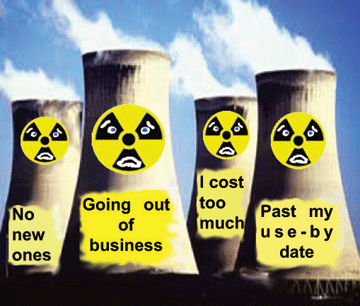 In the Wake of Fukushima: Japan’s Nuclear Energy Policy Impasse 60% of Japan’s 48 viable nuclear reactors,are not as yet being considered for application to the Nuclear Regulation Agency (NRA) for restart By Andrew Dewit Global Research, April 07, 2014 Asia-Pacific Journal Japan’s energy policy regime appears dangerously adrift in the context of accelerating climate change. The core problem is agency. On the one hand, Japanese PM Abe Shinzo and the nuclear village appear obsessed with nuclear power restarts and 20th century paradigms of the power economy. On the other hand, Japan’s anti-nuclear civil society lacks the political vehicle to force a combined nuclear pullout plus drastic reduction of greenhouse gas emissions. Some anti-nuclear forces do not yet understand the urgent need to reduce emissions, and are content to burn coal, despite of the patent threat of climate change. This is precisely what Japan has done in the wake of 3.11. The Abe cabinet is focused on getting restarts and a nuclear-based energy plan. Yet the scope for restarts is surprisingly limited and – incredible in this era of multiple crises and revolutions – the draft new energy plan lacks concrete numbers.1 The country needs better leadership on smart growth, in the context of what McKinsey specialists refer to as a “resource revolution”2 and MIT economists depict as “the second machine age.”3
Nuclear Is Probably No Longer Baseload
All of Japan’s 48 viable nuclear reactors are at present offline, and have been since September of 2013. The Abe cabinet is keen to restart as many of these as possible. But regulatory rules, public opinion and other factors constitute significant barriers to achieving even a third of Japan’s pre-Fukushima 30% reliance on nuclear power. That will mean nuclear will no longer be a “baseload” source of electricity, capable of supplying a reliable load to the grid at all times.
ndeed, an Asahi Shimbun survey of the utilities themselves indicates that fully 60% of Japan’s 48 viable nuclear reactors, meaning 30 reactors, are not as yet being considered for application to the Nuclear Regulation Agency (NRA) for restart. And of these 30 reactors, it appears that at least 13 are write-offs due to age, proximity to a seismic fault, and other factors that render them incapable of satisfying the new safety standards of the NRA.4 For that reason, at present there are only 17 reactors for which restart applications have been filed.
Of these, it appears – even to Japanese supporters of nuclear power – that perhaps only 8 will finally get approval and be restarted. Highly regarded energy specialist Tom O’Sullivan, of Mathyos Japan, concludes this on the basis of a survey of “various established Japanese policy institutes that are close to Japan’s industrial interests.” O’Sullivan notes that “[t]his level of restarts would only amount to 56 TWh of power output or 6% of Japan’s total power requirements and thus may not constitute a baseload power supply.”5
Reuters conducted its own analysis, using a broader set of questionnaires and interviews of over a dozen experts, along with input from the 10 firms that operate nuclear capacity. One suspects these operators painted as optimistic a picture of their restart prospects as possible. Even so, the result of this survey led Reuters’ expert journalists, Mari Saito, Aaron Sheldrick and Kentaro Hamada, to conclude that at best there will be 14 nuclear restarts at some point in time. They add that there is great uncertainty about the remaining 34 nuclear reactors. Their conclusion is that nuclear energy “will eventually make up less than 10 percent of Japan’s power supply.”6
Part of the reason nuclear appears not likely to recover its status as base-load power are the NRA’s new safety rules, in tandem with maintenance schedules and other factors that make a very shrunken fleet unreliable. But another large reason for this likely outcome is the stubbornness of the opposition to nuclear power. http://www.globalresearch.ca/in-the-wake-of-fukushima-japans-energy-policy-impasse/5376899?utm_source=rss&utm_medium=rss&utm_campaign=in-the-wake-of-fukushima-japans-energy-policy-impasse
Nuclear industry aims to keep its subsidies, while killing aid to renewable energy
 Utility Exelon Wants to Kill Wind and Solar Subsidies While Keeping Nukes Exelon is fighting renewables because they beat nuclear at new market needs. Xcel and NextEra back renewables. greentech grid, Herman K. Trabish April 1, 2014
Exelon, the biggest owner of U.S. nuclear power, has renewed its fight to kill wind’s production tax credit — and if Exelon gets its way, solar’s investment tax credit may be next.
Sources say renewal of wind’s $0.023 per kilowatt-hour production tax credit (PTC), which expired at the end of 2013, will fight its way into the revision of the upcoming Senate Finance Committee’s tax extenders package…….
 “This year, it’s the wind industry. Next year, it will be the solar industry,” said Joseph Dominguez, Exelon’s Sr. VP of Policy and Regulatory Affairs. “We’re just handling these subsidies piecemeal instead of looking at the problem more holistically.”……
Exelon says the reason for its opposition to wind’s PTC, for which its membership in the American Wind Energy Association (AWEA) was revoked, is because wind is driving out nuclear in the Midwest and other wind-rich markets……..http://www.greentechmedia.com/articles/read/Utility-Exelon-Trying-to-Kill-Wind-and-Solar-Subsidies-While-Keeping-Nukes
Climate denialists and opponents of renewable energy in power in Australia
 Australia’s renewable future in hands of policy fringe dwellers, http://reneweconomy.com.au/2014/australias-renewable-future-in-hands-of-policy-fringe-dwellers-71359 By Giles Parkinson on 7 April 2014 So, it’s come down to this. The defence of Australia’s renewable energy industry has been entrusted to the hands of a man who thinks carbon pollution is caused by nature, not people, and another who is openly hostile to wind farms.
The re-run of the Senate election in Western Australia this weekend provides some interesting fodder for the psephologists: Labor’s continued electoral implosion, the Scott Ludlum-inspired revival of the Greens, and the outstanding success of Clive Palmer’s expensive electioneering.
But for the key policies that will affect Australia’s renewable energy industry – and the decarbonisation of the Australian economy – the equation is essentially unchanged. The numbers in the new Senate, to site from July 1 means that the carbon price – despite whatever hoops that Palmer may try and get the Abbott conservative government to jump through – is effectively dead and buried.
Any changes to the renewable energy target – or even its ditching – will likely go unimpeded through parliament. At best, Labor and the Greens would need support for the RET from Nick Xenophon, not a fan of wind farms, and the DLP’s John Madigan, who has been celebrating what he is sure is the impending demise of the RET.
“The wind industry is panicking in Australia with the likely death of the Renewable Energy Target and this is another example of its peddling influence and money to manipulate the truth,” Senator Madigan told The Australian last week.
At worst, Labor and the Greens would need support from the Palmer United Party to support the renewables target. Good luck with that; Palmer, who now has three of his own Senators and a fourth from the Motoring Party tied up in an unspecified “alliance,” says renewable energy targets should not be compulsory.
“We don’t intend to legislate to make people do something they may not want to do,” Palmer told ABC’s Lateline program last week. This, as economist Ross Garnaut pointed out on the same program, would be about as effective as making taxes voluntary.
What’s not clear is the future of the $10 billion Clean Energy Finance Corporation, or likely budget cuts to the Australian Renewable Energy Agency, both of which would require legislative approval.
The CEFC was actually supported by Xenophon and Madigan in a repeal vote earlier this year because, while they are not supporters of wind energy, they see the upside of bringing in new renewable technologies. Xenophon, in particular is a fan of what he calls “baseload” renewables, meaning geothermal and ocean energy – even those these are years away from commercial deployment. The CEFC has been largely focused on energy efficiency, waste-to-energy, and some emerging solar technologies. ARENA is similarly focused on techologies that do not yet match wind energy on cost.
If Labor can somehow grab the sixth seat in the WA Senate, then Xenophon and Madigan could protect the CEFC, and allow it to continue beyond early July. If not, and the sixth seat falls to the Liberals, then the fate of the CEFC lies in the hands of Palmer.
Quite what he makes of the CEFC is anyone’s guess. The fact that it brings in private money at a ratio of nearly $3 for every $1 in loans may be appealing, so might its ability to develop a profit to the government, and abatement at a “net benefit.”
The abatement equation, however, may just fall on deaf ears. Palmer, it seems, appears to believe that any sort of abatement is a waste of time. Quoting material from what must be one of the more extreme climate denier websites, Palmer told Lateline last week:
“Now we know that 97 per cent of the world’s carbon comes from natural sources. Why don’t we have money to look at how we can reduce the overall carbon signature by reducing it from nature, not just from industry. It’s entirely wrong-focused.”
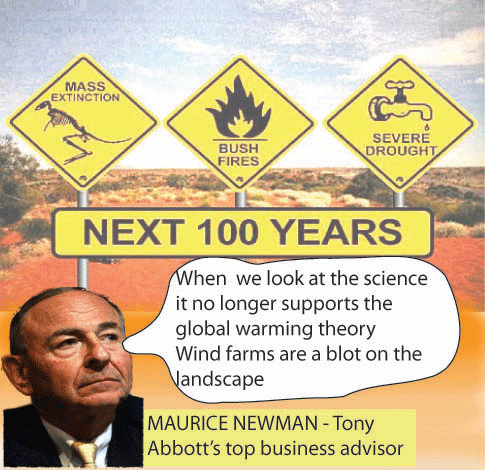 And there’s more. Check out the transcript, it gets feisty in part but it is as though Palmer is channeling the thoughts of Tony Abbott’s main business advisor, Maurice Newman, and those of Dick Warburton, the head of the RET review panel. The climate skeptic brigade is now in full control of climate and renewable energy policy in this country.
Of course, it did not need to have come to this. Climate change and renewable energy policies were supposed to be bipartisan, and for a brief moment in time they were, before the relentless and pig-headed push by the Rudd government to make climate change a wedge issue for the conservatives saw Malcolm Turnbull’s reign at the head of the Coalition ended abruptly, the Liberal Party swerve dramatically to the far right with his replacement by Abbott, and the Greens reject the then CPRS after Rudd refused to even talk to them.
The renewable energy target was also supposed to be bipartisan, and Labor had the opportunity to put this issue to rest if it had the conviction to accept the Climate Change Authority’s recommendation to provide certainty for the industry and push the next review out to 2016.
In the end, Labor backed off. It was the only one of the CCA’s key recommendations that Labor refused to implement. Not only did that decision make the rest of the CCA’s recommendations and endorsement of the RET irrelevant (because of lingering uncertainty about the future of the policy), it left the way open for the Abbott government to conduct its own review, and justify it as a legislative requirement.
And so it appointed a special panel comprising a climate change sceptic, a fossil fuel lobbyist and the former head of one of Australia’s most emissions intensive generation companies to consider the merits of wind and solar.
Now, the renewables industry has to rely, possibly beyond hope, on the support of politicians who think that human-caused climate change is a myth, and that renewables should not be mandated, probably cause health problems, are expensive and unreliable.
It should never have come to this. But it has.
UK’s subsidies for nuclear power ‘will kill renewables”
 ‘Bad value’ UK nuclear subsidy deal ‘will kill renewables’ http://www.independentaustralia.net/environment/environment-display/bad-value-uk-nuclear-subsidy-deal-will-kill-renewables,6361 Climate News Network 8 April 2014, The UK’s anti-competitive plan to subsidise nuclear power may be the final straw that breaks the renewable industry’s back, say critics. Paul Brown from the Climate News Network reports.
THE UNITED KINGDOM’S PLANS to build heavily subsidised nuclear power stations have come under withering attack from a coalition of politicians, academics, energy industry experts and environmental groups.
Evidence has poured into the European Commission, which is investigating whether the deal with the giant French nuclear company EDF breaks EU competition rules. The evidence from many objectors, whose submissions had to be made by yesterday (Monday, 7 April), claims that if the contract goes through it will wreck Europe’s chance of building up renewable energies to avert the worst impacts of climate change.
They say renewables will have to compete in an unfair market where one generator ‒ nuclear ‒ is guaranteed to be able to sell all its electricity at a stable price and with a built-in profit until 2058.
The UK Government has agreed a minimum price of £92.50 (AUD $137) a megawatt hour from a new nuclear power station at Hinkley Point in the west of England from 2023 — roughly double the existing price of electricity in Britain. The price will rise with inflation and runs for 35 years — a deal unprecedented in the energy sector, and not available to renewable energies like wind and solar. The guarantee will continue for all future nuclear stations too.
And the Government has gone even further — guaranteeing loans for construction, and providing insurance and compensation payments if policies change for any reason.
It claims that the deal will save £75 (AUD $111) a year on the average consumer’s bill if electricity prices rise by 2023, as it forecasts. But if they do not, then consumers will be paying far more for their electricity than they would otherwise.
EU test case
1 This month
7 April – WEBINAR – Australia and the Doomsday Clock – Preventing nuclear war through NoFirstUse and other policies
Online | Tuesday April 7, 4:00-5:30pm, Australian Eastern Time / 8:00-9:30am Central Europe Time
– Access the registration link
15 April – Zoom –Nuclear Power is Not the Solution
Apr 15, 2026 01:00 AM in Canberra, Melbourne, Sydney

Join the International Physicians for the Prevention of Nuclear War (IPPNW) on Tuesday, April 14th for a timely webinar exploring the risks associated with nuclear power and challenging the myth that it offers a simple, safe, carbon-free solution to the climate crisis

21 April Webinar: No Nuclear Weapons in Australia
Start: 2026-04-21 18:00:00 UTC Canberra, Melbourne, Sydney (GMT+10:00)
End: 2026-04-21 19:30:00 UTC Canberra, Melbourne, Sydney (GMT+10:00)
Event Type: Virtual
A virtual link will be communicated before the event.
Host Contact Info: australia@icanw.org

of the week – Australians for War Powers Reform (AWPR)
To see nuclear-related stories in greater depth and intensity
 Antinuclear