Plan for underground mine at Ranger is high risk and low return
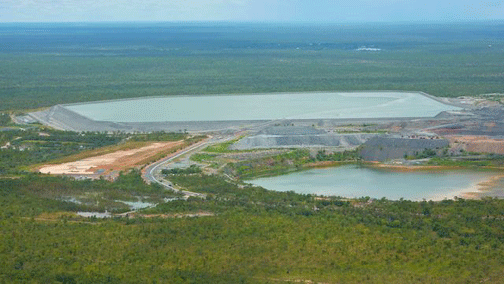 ERA told: Clean up Ranger uranium mine site and clear out rather than shifting underground, 9 April 14
http://www.abc.net.au/news/2014-04-09/era-urged-to-clean-up-ranger-uranium-mine-site-and-clear-out/5377698?section=ntPublic health experts have joined traditional owners and environmentalists in calling for Energy Resources of Australia (ERA) to focus on land rehabilitation rather than expansion of its Ranger uranium mine in the Northern Territory.
The company’s latest report shows that despite operations being suspended at the site since a toxic leak last year, plans to mine uranium underground continue.
ERA is holding its annual general meeting in Darwin today.
NT branch secretary of the Public Health Association of Australia, Dr Michael Fonda, says underground uranium mining poses serious health risks. One of the main things that is concerning us is that they [miners] are going to be exposed to dangerous levels of radon gas,” he said. Dr Fonda says ERA has a troubling safety record and it cannot be trusted to ensure safe work practices for the underground uranium mining.
“What is being planned for the R3 Deep’s expansion is for very large extraction fans to take much of that radon [gas] out of the mine,” he said.”I am concerned, and the Public Health Association is concerned, that will not be enough.”
Australian Conservation Foundation (ACF) national nuclear campaigner Dave Sweeney says ERA should focus on land rehabilitation in the final years of its mining lease. “Realise this is high risk and low return,” he said.
“Instead of accepting the inevitable and cleaning up and exiting, and having a staged and a costed and managed rehabilitation of the Ranger site, ERA is increasingly desperate and is chasing the illusion of dollars by going underground with the Ranger 3-Deep project.”Mr Sweeney says ERA and its parent company Rio Tinto should realise the planned underground mine is high risk and low return.
Indigenous traditional owners have expressed concerns that ERA will not have enough money to follow through on rehabilitation plans for the mine, which is near Jabiru and inside the boundaries of Kakadu National Park.
Australia-Japan joint military exercises (China won’t like that)

 Abe, Abbott agree on joint research on submarine technology, Kyodo News International April 7, 2014 Global Post Prime Minister Shinzo Abe and Australian Prime Minister Tony Abbott agreed Monday to conduct joint research on submarine-related technology as part of efforts to bolster bilateral security ties under Japan’s new policy on defense equipment.
The agreement reached during a summit between the leaders in Tokyo came nearly a week after Japan relaxed its arms export ban by adopting new principles and guidelines for the first time in nearly 50 years.
Abe and Abbott picked marine hydrodynamics used for submarines as the first area of bilateral cooperation. The Japanese and Australian defense and foreign ministers will meet in Tokyo in June and work out details. “We confirmed that we will expand practical cooperation to include joint exercises,” Abe told reporters after the summit. …….http://www.globalpost.com/dispatch/news/kyodo-news-international/140407/abe-abbott-agree-joint-research-submarine-technology
The end of an era for Energy Resources of Australia’s uranium mining in Kakadu
 The ERA of uranium mining is over http://www.onlineopinion.com.au/view.asp?article=16200, Dave Sweeney 9 April 14, In the early hours of Saturday December 7th 2013 the evacuation order was given in the processing area of Energy Resources of Australia’s troubled Ranger uranium mine in Kakadu.
Minutes later came the unforgiving sound of peeling metal followed by a surge of over one million litres of highly acidic uranium slurry from the buckled and broken number one leach tank. The toxic tide swept over the concrete bunds meant to contain any spills and moved uncontrolled through the night and the site.
Four months later and ERA remains under pressure, under performing and under scrutiny. Mineral processing remains suspended at Ranger pending the findings of a federal government review of the tank collapse and this week the ERA board and management will face sceptical shareholders and no doubt plenty of critical questions at the company’s annual meeting in Darwin. Continue reading
Radioactive cesium from Fukushima might have entered migratory birds
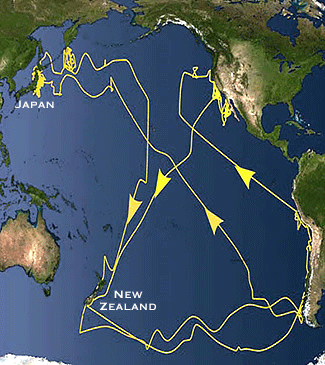 Birds Could Be Flying Japan Radiation Around Pacific Rim http://www.earthweek.com/2014/ew140404/ew140404b.htmlApril 4, 2014 MigMig Mi
Migratory seabirds that spend part of the year around New Zealand after flying in from Japan’s coastal waters are being checked for contamination from the Fukushima nuclear disaster.
A study by the University of Auckland is investigating whether radioactive cesium has entered the New Zealand ecosystem or food chain via the shearwaters, known in New Zealand as muttonbirds. Physicist David Krofcheck told NZ Newswire that the “detection of gamma rays would tell us whether the birds spend sufficient time near Fukushima to accumulate cesium-134 from nuclear fission.”
Vast amounts of contaminated water from the meltdown-plagued Fukushima Daiichi plant have poured into the Pacific since the disaster began in March 2011. Fish have since been measured with unsafe levels of nuclear contamination. Because the shearwaters feed on seafood, it is feared the long-haul birds could be carrying radioactive debris for many thousands of miles around the Pacific Rim.
Need to investigate new and extraordinary insect malformations in Fukushma
PHOTOS: Study finds deformities “significantly higher” in Fukushima insects — “To my knowledge, such deformations haven’t been reported” in species before — Lower body split in half, 2 tail-like appendages — 1,000% higher death rate in young than other Japan area — Urgent investigations called for, 8 April 14 http://enenews.com/photos-study-finds-deformities-significantly-higher-in-sample-of-fukushima-insects-to-my-knowledge-such-deformations-have-not-previously-been-reported-in-species-lower-body-split-in-ha?utm_source=feedburner&utm_medium=email&utm_campaign=Feed%3A+ENENews+%28Energy+News%29

World is taking notice of China’s renewable energy revolution
 China’s Renewable Energy Revolution Has Global Implications, Clean Technica John Mathews and Hao Tan, 8 April 14, China’s renewable energy revolution is powering ahead, with the year 2013 marking an important inflection point where the scales tipped more towards electric power generated from water, wind and solar than from fossil fuels and nuclear. This means that its energy security is being enhanced, while carbon emissions from the power sector can be expected to soon start to fall.
China’s energy revolution, which underpins its transformation into the world’s largest manufacturing system (the new “workshop of the world”), continues to astonish all observers, and terrify some. China is known widely as the world’s largest user and producer of coal, and the world’s largest emitter of carbon dioxide and other greenhouse gases. This is true. Less noticed has been the fact that China is also building the world’s largest renewable energy system – which by 2013 stood at just over 1 trillion kilowatt-hours – already nearly as large as the combined total of electrical energy produced by the power systems of France and Germany.1
The energy landscape continues to give the clearest indication of the trends in industrial dynamics and prospects for the future. China is powering ahead with renewables while at the same time it expands its reliance on fossil fuels; the US by contrast is further locking in its dependence on fossil fuels. The distinction is critical………
.We need to sketch in the background to China’s energy revolution, so that the enormity of its commitment to renewables may be appreciated. ……. While coal for thermal power continues to rise, the overall consumption of coal appears to be ‘capped’ at 3,500 million tonnes – a desperate measure taken no doubt in response to the blackening skies and poisoning of water and air
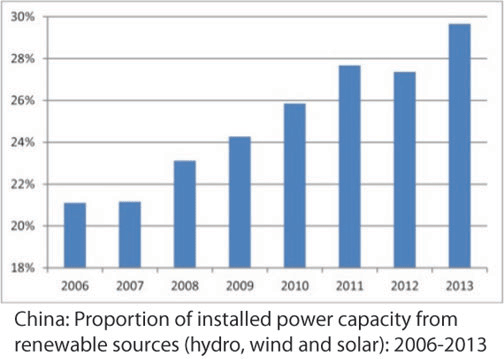
In just the space of eight years, China has become the world’s most important generator of wind power, with the world’s largest capacity and the largest addition of new power capacity in the year 2013. The increase in all three sources of renewables – hydro, wind and solar PV – is shown in Fig. 3, in terms of the proportion of power generated by renewables and its relentless rise (apart from a dip in 2012, following world recession in 2011).
The proportion reached by 2013, of close to 30% of electrical energy generated from renewable sources (hydro, wind and solar), is what gives China its international influence in renewables – and it demonstrates a relentless trend towards greater reliance on manufacturing systems for production of, e.g. wind turbines and solar cells, as opposed to the reliance elsewhere on alternative fossil fuels such as coal seam gas and shale oil…….
The sharp rise in renewables reflects particularly the new commitment to wind power – and it looks set to continue through industrial logistic dynamics. We will develop an argument below for the significance of this date……….
3. Investment trends
Expenditure in building new power generating infrastructure can reveal more than data on capacity and generating additions. The CEC has released investment data for 2013, which reveal the following trends. In terms of investment, China spent more on its grid in 2013 than on new power generation facilities………The significance of this is that China is spending on infrastructure to accommodate more renewable power facilities, as well as on the facilities themselves. Of the new generation facilities, investment in new energy sources accounted for more than 40% of the total investment in new power generation facilities…….
Thus our conclusion that in 2013, China’s leading edge of change in its electric power system is now more “green” than “black”. We have demonstrated above that this is unambiguously so in terms of capacity added and in terms of investment, while in terms of new generation of electrical energy thermal still marginally outranks renewables (180 billion kWh generated to 160 billion kWh)………
at the leading edge, for the year 2013 alone, China added 94 GW of new capacity, of which 55.3 GW came from renewables (59%), and just 36.5 GW (or 39%) came from thermal sources – a dramatic reversal of past trends;…….
our analysis that China’s carbon emissions are set to peak and then to fall – and fall faster than in the US or in Europe……..http://cleantechnica.com/2014/04/08/chinas-renewable-energy-revolution-global-implications/
Abbott government policies cloud the future for solar energy projects
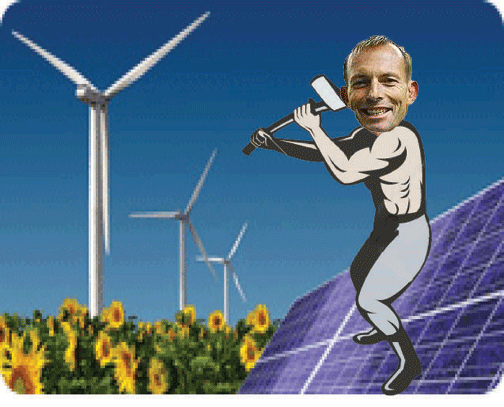 Policy cloud puts up to $110m in solar energy projects on hold SMH, April 8, 2014 Jared Lynch Business reporter Solar projects totaling tens of millions of dollars are at risk after the Abbott government launched a review into its renewable energy targets.
First Solar, the company building the southern hemisphere’s biggest solar plant, said it was reconsidering its future investment plans for Australia, citing increased policy uncertainty.
About $90 million to $110 million worth of projects have been put on hold, First Solar vice president for business development Jack Curtis said. ”We don’t have a great line of sight as to where the next round of projects is coming from, largely as a function of the uncertainty in the policy backdrop,” Mr Curtis said.
The government had planned to source 41,000 gigawatt hours from renewable sources by 2020, or 20 per cent of total supply in that year. But that is being questioned after the government appointed former Reserve Bank board member and global warming sceptic Dick Warburton to head the review.
Mr Curtis said many solar projects only needed short-term incentives. He believed the solar industry had a ”credible path” to become self sustainable, citing its ability to ”dramatically” reduce costs.
For example, in the past five years, the US solar industry had cut costs by 60-70 per cent, Mr Curtis said.
”We are not saying ‘support solar … and we’ll keep saying thanks’. What we are saying that there is a very credible path given the cost reduction demonstrated by the solar industry that it can get to a point where it is a sustainable industry.” First Solar is building two solar plants at Nyngan and Broken Hill in NSW with energy company AGL………
The projects that are on hold are mainly in the mining sector, helping companies with the off-grid operations, Mr Curtis said.
He said those projects had an economic multiplier effect of 1.5x, so for every $1 the government spent, $1.50 was injected into the broader economy. ”[The federal government] obviously has a tight fiscal outlook that they have to manage and we are sympathetic of that.
”But if their other industries that are on the up and up that can generate a 1.5 multiplier for every $1 the government invested, I’d like to hear about them because I think that’s a pretty good positive return on the allocation of government funds.” http://www.smh.com.au/business/carbon-economy/policy-cloud-puts-up-to-110m-in-solar-energy-projects-on-hold-20140408-36a7c.html
Nuclear industry PR covers up the truth on harm from Fukushima catastrophe
 When life becomes a shadow – after nuclear catastrophe, Ecologist Robert Jacobs 8th April 2014“…….It is disingenuous when nuclear industry apologists say things like “no one died at Fukushima” since they are well aware that for most of the people who will eventually get sick this process will take time.
We are currently in the latency period for these illnesses, a point not missed by nuclear industry PR people.
Losses of homes, community and identity
Areas that experience radioactive contamination often have to be abandoned by those who live there. The levels of radiation may be high enough that continued habitation can be dangerous to health.
In these cases people lose their homes – often traditional homes that may have been the primary residences for a family for multiple generations. In these cases one’s identity may be deeply connected to the home and the land around the home.
For communities that have to be abandoned the bonds that have been built up and that sustain the wellbeing of the community are disintegrated. Friends are separated, extended families are often separated, and schools are closed.
People who have lived in the same place all of their lives have to make a fresh start, sometimes in old age, sometimes as children, and lose the communal structures that have supported them – shopkeepers who know them, neighbors who can be relied on, the simple familiarity that we have by being known and knowing our way around.
Loss of land and continuity
What is lost when a person is no longer able to eat an apple from a tree planted by their parent or grandparent? With the loss of community many people lose their way of making a living. This is especially true in less industrialized places where many people have been farmers or fishers or herders for generations.
When someone who has only known farming is taken from the land they have tended, when someone who is a fisher can no longer fish in areas where they understand the natural rhythms and habits of the fish, it can be impossible to start over.
Often such people are forced to enter service positions or become dependent on state subsidies, which further erodes their sense of self and wellbeing. Usually, those removed from their land because of contamination are placed into temporary housing.
In almost all cases this housing is not temporary, but becomes permanent. Since it is initially intended to be temporary housing it is often very shoddy and cramped.
It can become impossible for multigenerational families that have been living together for decades to remain together. This can remove care for the elderly, childcare for young families and further erodes to continuity of family identity, knowledge and support. Ill health from processed or radioactive food
Removal from land also is accompanied by the loss of a traditional diet. Those without access to the lands and seas that have provided food for their families for generations often begin a journey of ill health fostered by a new diet composed of processed foods.
In some communities such as the small villages around the former Soviet nuclear test site in Kazakhstan the people simply continue to live in dangerously contaminated homes. The state responsible for their exposures no longer exists and no government feels the responsibility to evacuate them.
They live very traditional lives and most of their food is from their own gardens and from livestock raised on their contaminated land. Many of the long-lived radionuclides simply cycle through this ecosystem and those living here can be contaminated and recontaminated over many generations.
Loss of traditional knowledge
In some remote places survival is dependent on centuries old understandings of the land. In Australia the areas where the British conducted nuclear testing in the outback are very difficult places to live.
Traditional communities in these areas often have songs that hold and transmit essential knowledge about how to survive in such a harsh environment, such as – where to find water, when to hunt specific animals, when to move to various areas.
When the British relocated them to live in areas hundreds of kilometers from their traditional homes this knowledge became broken. It became impossible for the refugee population to survive living a traditional life in areas where they had no knowledge of the rhythms of the land and animals.
This removal from their traditional lands led quickly to dependence on governmental assistance and severed what had been millennia of self-reliance. This led to the further erosion of community, familial and personal wellbeing. http://www.theecologist.org/blogs_and_comments/Blogs/2351503/when_life_becomes_a_shadow_after_nuclear_catastrophe.html
Tony Abbott to share advanced military technology with Japan (Will China mind?)
Tony Abbott moves to strengthen defence ties with South Korea DAVID CROWE SEOUL THE AUSTRALIAN APRIL 08, 2014 TONY Abbott has moved to tighten defence ties with South Korea by laying out plans to conduct more joint exercises and share more military technology, helping to mend a bruising row two years ago over a cancelled weapons deal.
Blasting North Korea as an “outlaw state” that must give up its nuclear weapons, the Prime Minister used high-level talks in Seoul to assure his Korean counterpart about future defence collaboration.
The plans come one day after Mr Abbott formally launched negotiations with Japan to share advanced military technology and one day before he arrives in China, which has objected in the past to Australia’s defence declarations with Japan………
1 This month
7 April – WEBINAR – Australia and the Doomsday Clock – Preventing nuclear war through NoFirstUse and other policies
Online | Tuesday April 7, 4:00-5:30pm, Australian Eastern Time / 8:00-9:30am Central Europe Time
– Access the registration link
15 April – Zoom –Nuclear Power is Not the Solution
Apr 15, 2026 01:00 AM in Canberra, Melbourne, Sydney

Join the International Physicians for the Prevention of Nuclear War (IPPNW) on Tuesday, April 14th for a timely webinar exploring the risks associated with nuclear power and challenging the myth that it offers a simple, safe, carbon-free solution to the climate crisis

21 April Webinar: No Nuclear Weapons in Australia
Start: 2026-04-21 18:00:00 UTC Canberra, Melbourne, Sydney (GMT+10:00)
End: 2026-04-21 19:30:00 UTC Canberra, Melbourne, Sydney (GMT+10:00)
Event Type: Virtual
A virtual link will be communicated before the event.
Host Contact Info: australia@icanw.org

of the week – Australians for War Powers Reform (AWPR)
To see nuclear-related stories in greater depth and intensity
 Antinuclear