AS Indian election draws close, anti nuclear groups organise in the young Aam Aadmi Party
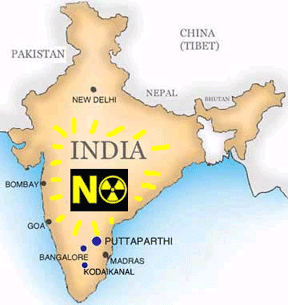 India’s Nuclear Energy Future at Risk in Elections, Financial Sense.com BY GLOBAL RISK INSIGHTS 04/09/2014, by Sean Durns, analyst at Global Risk Insights As Indian voters go to the polls this month, the choices they make in the voting booth will mark the future of nuclear energy in India. The young Aam Aadmi Party promotes an anti-nuclear platform that may significantly influence the country’s future energy composition.
On Monday, April 7, the world’s largest democratic elections began in what will likely be the world’s most populous country within the next ten years. Between April 7 and May 12, 815 million Indian voters cast their votes at 930,000 different polling stations. The electoral system in India is similar to the British parliamentary system. Voters are choosing 543 parliamentarians, who in turn will nominate a prime minister. If the results announced on May 16 indicate no actual majority, alliances will be formed and a coalition government will come to power.
The election will take place between three dominant political parties: the Bharatiya Janata Party (BJP), the incumbent Congress Party, which has been in power for much of India’s history, and the Aam Aadmi Party (AAP). The latter is a much younger party and a more regional political party in terms of strength. To the surprise of many observers, AAP saw some levels of success in last year’s state elections. It runs on a platform strongly emphasizing the need to combat the corruption endemic in Indian political life.
The AAP has also come out strongly against nuclear energy in India. Leader Arvind Kejriwal has publicly stated that the AAP is against the use of nuclear means to fulfil India’s energy needs. Kejriwal stated that “the destruction caused by nuclear power in case of an accident is enormous. This is why AAP is in-principle opposed to nuclear energy.” Other prominent members of the party, including Prashant Bhushan and Medha Patkar, call for a nuclear-free India.
The party has co-opted prominent members of the People’s Movement against Nuclear Energy (PMNE), encouraging them to run in certain districts. The movement garnered widespread attention during its three years of protests against the Kudankuluam nuclear power plant in the Tirunelveli district. Political opposition has already delayed new mines in Jharkhand, Meghalaya and Andhra Pradesh, areas essential in seeking to address fuel concerns……..
The growing opposition to nuclear energy in India is directly related to questions raised by the Fukushima disaster in Japan. Previously, Japan was considered a model for India in the adoption of atomic energy. Yet, Fukushima has raised concerns over India’s regulatory structures and infrastructure essential to supporting safe growth in the sector. The regulatory bodies are funded by the industry, and much of the oversight falls underneath the prime minister, leading to further oversight concerns.
Given the AAP’s concerns with regard to greater oversight and transparency, its support of improved infrastructure capabilities and its emphasis on grass root activism, opposing nuclear energy makes political sense for the party, particularly as it seeks to make inroads with key demographics.
The AAP seeks to contest more than 350 seats with over 268 candidates declared as of late March. One of the founders of the PMNE, SP Udayakumar, is among those seeking office. Udayakumar is running in Tamil Nadu along with seven other candidates from the AAP. The party has made significant progress on its plan to gain supporters in Iddinthakarai in Tamil Nadu, which is in the Tirunelvelli district and the very heart of the PMNE. The party stated previously that it had the goal of enrolling over 7,500 volunteers for poll work in the district………http://www.financialsense.com/contributors/global-risk-insights/india-s-nuclear-energy-future-risk-elections
No comments yet.
1 This month
7 April – WEBINAR – Australia and the Doomsday Clock – Preventing nuclear war through NoFirstUse and other policies
Online | Tuesday April 7, 4:00-5:30pm, Australian Eastern Time / 8:00-9:30am Central Europe Time
– Access the registration link
15 April – Zoom –Nuclear Power is Not the Solution
Apr 15, 2026 01:00 AM in Canberra, Melbourne, Sydney

Join the International Physicians for the Prevention of Nuclear War (IPPNW) on Tuesday, April 14th for a timely webinar exploring the risks associated with nuclear power and challenging the myth that it offers a simple, safe, carbon-free solution to the climate crisis

21 April Webinar: No Nuclear Weapons in Australia
Start: 2026-04-21 18:00:00 UTC Canberra, Melbourne, Sydney (GMT+10:00)
End: 2026-04-21 19:30:00 UTC Canberra, Melbourne, Sydney (GMT+10:00)
Event Type: Virtual
A virtual link will be communicated before the event.
Host Contact Info: australia@icanw.org

of the week – Australians for War Powers Reform (AWPR)
To see nuclear-related stories in greater depth and intensity
 Antinuclear
Leave a comment